
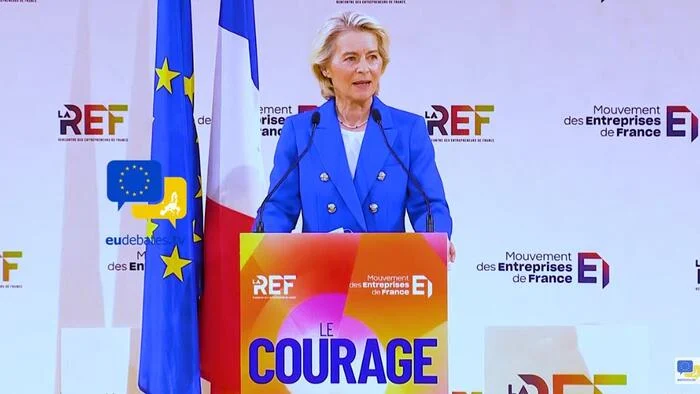
European Commission President Ursula von der Leyen sparked a significant debate on the future of private property and state intervention within the European Union after remarks made during a speech to French business leaders in Paris. Speaking at the MEDEF’s La Rencontre des Entrepreneurs de France on a Friday, von der Leyen, a former German defense minister, discussed the potential role of EU citizens’ bank deposits in revitalizing the ailing eurozone economy. Her comments, widely circulated and scrutinized, raised questions about the boundaries between private wealth and public fiscal policy, particularly in the context of Europe’s ongoing economic challenges and ambitious strategic goals.
Contextualizing Europe’s Economic Landscape
The backdrop to von der Leyen’s remarks is a complex and often precarious European economic environment. The eurozone, comprising 20 of the European Union’s member states, has been navigating a series of severe headwinds in recent years. Following the unprecedented disruption of the COVID-19 pandemic, the bloc faced significant supply chain bottlenecks, inflationary pressures, and a subsequent energy crisis exacerbated by geopolitical tensions, particularly the war in Ukraine. These factors have contributed to elevated inflation rates, with the Harmonised Index of Consumer Prices (HICP) often exceeding the European Central Bank’s (ECB) 2% target, although it has shown signs of moderation more recently. For instance, the annual inflation rate for the eurozone stood at 2.6% in February 2024, down from its peak of 10.6% in October 2022.
Economic growth has also been sluggish. The European Commission’s Winter 2024 Economic Forecast projected real GDP growth for the EU at 1.3% in 2024 and 1.7% in 2025, following a modest 0.5% in 2023. This subdued outlook stands in contrast to the rapid recovery seen in some other major global economies. Compounding these issues are persistent structural challenges, including an aging population, skills shortages, and the significant investment required for the green and digital transitions.
Furthermore, several EU member states grapple with substantial government debt burdens. France, for instance, reported a debt-to-GDP ratio exceeding 110% in recent years, with new borrowing amounting to approximately 5.7% of GDP in the year preceding the speech, according to some analyses, amidst parliamentary deadlocks that hinder fiscal consolidation efforts. Italy’s debt-to-GDP ratio has consistently remained above 140%, while even Germany, traditionally fiscally conservative, has seen its borrowing increase when considering municipal deficits and special funds. These towering government debts create immense pressure on national budgets and the broader European financial system, driving a search for novel funding mechanisms.
Concerns about capital flight from the "old continent" have also been voiced by some analysts. Factors such as increasing regulatory burdens, higher energy costs compared to regions like the United States, and geopolitical uncertainties are cited as potential drivers for businesses and investors to seek opportunities elsewhere. This outflow of capital, which some observers claim includes thousands of patents and tens of thousands of highly qualified professionals, further strains the European economy’s capacity for innovation and growth.
The €10 Trillion Question: Deconstructing the Proposal
It was against this backdrop that Ursula von der Leyen addressed MEDEF, France’s largest employer federation, at its annual summit, La Rencontre des Entrepreneurs de France. The event, a crucial forum for French and European business leaders, typically serves as a platform for discussing economic policy and future strategies. In her speech, von der Leyen directly addressed the issue of untapped financial resources within the EU.
She explicitly stated, "Europe has savings, but unfortunately those savings are sitting on the sidelines. Ten trillion euros are sitting as cash savings in the hands of private households in bank accounts." Von der Leyen then articulated her view that "the European economy must now put this capital to work for its companies." Her rationale, as understood from her address, was to unlock this significant pool of private capital to stimulate investment, foster innovation, and finance critical transitions, such as the European Green Deal and digital transformation, thereby bolstering the competitiveness and resilience of the European economy.
The figure of "ten trillion euros" refers to a substantial portion of household financial assets held in liquid forms, primarily bank deposits. While such savings provide individuals with liquidity and security, von der Leyen’s comments suggested a perception within some policy circles that these funds could be more actively deployed for broader economic benefit, rather than remaining in what she termed "on the sidelines." This perspective aligns with broader EU goals to strengthen Europe’s capital markets and reduce its reliance on external financing for strategic projects.
Economic Perspectives and Potential Ramifications
Von der Leyen’s suggestion, interpreted by many as a call for a more active state role in directing private wealth, immediately drew sharp criticism from various economic and political commentators. Economists and financial experts highlighted the fundamental role of bank deposits within the modern banking system, arguing that viewing them as merely "idle cash" is a profound misinterpretation.
From the perspective of the banking sector, customer deposits are not simply static reservoirs of money. They are a central and indispensable source of refinancing and liquidity for commercial banks. These deposits are actively embedded in the money and credit cycle, forming the very foundation upon which banks extend loans to businesses and households. While modern monetary theory suggests that commercial banks create new bank money through lending, rather than simply "leveraging" existing deposits in a mechanical sense, the availability and stability of customer deposits remain critical for banks to manage their balance sheets, meet regulatory capital requirements, and maintain market confidence. Disrupting this delicate ecosystem could have severe consequences.
Critics argue that any direct or indirect "redirection" or "activation" of private bank deposits by the state could trigger a cascade of negative economic outcomes. A primary concern is the potential for a severe confidence crisis, which could manifest as bank runs if depositors fear their savings are no longer secure or fully accessible. Such a scenario would not only destabilize individual financial institutions but could also lead to a systemic crisis across the entire banking sector. Furthermore, it could accelerate capital flight, with individuals and businesses seeking safer havens for their wealth outside the EU, thereby undermining the very economic revitalization the proposal aims to achieve.
Moreover, a significant intervention could lead to a credit crunch, as banks, stripped of a reliable funding base, would be compelled to reduce lending. This would stifle business investment, hinder job creation, and ultimately depress economic growth. Many economists caution against state-directed capital allocation, arguing that market mechanisms are generally more efficient in allocating resources to productive investments. Any attempt to override these mechanisms could lead to misallocation of capital, reduced innovation, and overall economic inefficiency. The concept of "financial repression," where governments channel private savings to finance public debt or specific economic objectives, often at below-market rates through regulatory means, is often cited in this context as a historical precedent with potentially negative long-term consequences for economic dynamism.
The Debate on Private Property and State Authority
Beyond the immediate economic implications, von der Leyen’s comments reignited a deeper ideological debate concerning the sanctity of private property and the legitimate scope of state authority within a liberal democratic framework. Private property rights are widely considered a cornerstone of market economies and individual liberty, offering a "protective wall" shielding citizens from arbitrary state power. These rights are enshrined in the national constitutions of EU member states and in the EU’s Charter of Fundamental Rights.
The author of the original article, Thomas Kolbe, interpreted von der Leyen’s message as an unmistakable signal that "private property as a protective wall shielding citizens from an overreaching state has served its purpose as a pillar of civilization." This view aligns with broader concerns among some commentators about a perceived creeping tendency towards "central planning" and "interventionism" within Brussels. Critics, including Kolbe, drew parallels to past socialist regimes, such as the German Democratic Republic under Erich Honecker, to underscore their alarm regarding potential "dictatorial control over the private wealth of citizens."
The debate also extended to other political figures. Friedrich Merz, a prominent German conservative politician, had previously discussed the idea of "activating" German cash holdings to boost the economy, an approach that critics similarly labeled as "thoroughly socialist, indeed almost dictatorial." These comparisons highlight a growing apprehension among certain segments of the population and political spectrum regarding the increasing willingness of political leaders to consider leveraging private wealth for state-defined objectives, potentially blurring the lines between private ownership and public utility.
The core of this philosophical contention lies in the balance between collective economic goals and individual economic freedom. While proponents of greater state intervention might argue for the necessity of coordinated action to address grand challenges like climate change or economic stagnation, critics emphasize the importance of safeguarding individual property rights as a fundamental safeguard against overreaching governmental power.
Fiscal Pressures and the NextGenerationEU Fund
A significant underlying driver for the EU’s search for new funding mechanisms is the impending repayment schedule for the NextGenerationEU (NGEU) recovery fund. Launched in 2020 as a response to the economic fallout of the COVID-19 pandemic, NGEU is an €800 billion recovery instrument, largely financed through joint borrowing by the European Commission on capital markets. This landmark initiative represented a significant step towards greater fiscal integration within the bloc.
However, the repayments for these jointly issued Eurobonds are scheduled to commence in 2028, placing substantial new demands on the EU budget. The mechanism for repayment involves contributions from member states, raising questions about how these funds will be generated, especially given the already strained fiscal situations in several key economies. The prospect of these repayments, coupled with ongoing national debt challenges, fuels the discussion around potential new revenue streams or methods to "activate" existing capital.
As noted, France’s significant new borrowing and parliamentary deadlock make traditional fiscal consolidation difficult. Germany, despite its robust economy, also faces considerable financial commitments, particularly when accounting for its various "special funds" and municipal deficits, which some analyses project could push its new borrowing above 5 percent of GDP in the coming years. This collective fiscal pressure makes common financing through Eurobonds and the consolidation of debt under the European Commission, potentially with active liquidity assistance from the ECB, increasingly likely. In this context, "activation of cash" could be seen by some policymakers as a way to ease these mounting financial burdens.
Beyond existing debt, Europe faces enormous investment needs for its strategic priorities. The European Green Deal, for instance, requires trillions of euros in public and private investment to achieve climate neutrality by 2050. Critics argue that the "green subsidy machine" alone already consumes billions annually with questionable returns. Furthermore, in response to the war in Ukraine and evolving geopolitical realities, Europe has rediscovered an appetite for militarism, leading to increased defense spending across member states. This "Military Keynesianism," while aiming to bolster security, is viewed by some economists as yet another fiscal grave being dug, diverting resources from productive economic activity and adding to the overall financial strain.
Horizon Scanning: Capital Controls and the Digital Euro
Against this backdrop of fiscal challenges and calls for leveraging private wealth, some observers predict that the EU will eventually resort to more overt forms of capital controls. The framework for such measures is already beginning to take shape, particularly with the ongoing development of the digital euro.
The European Central Bank (ECB) is actively working on the digital euro project, with an initial pilot phase anticipated in the coming years and potential full implementation as a monetary standard at a later stage. The ECB’s stated goals for the digital euro include enhancing monetary sovereignty, providing a secure and efficient digital payment method, fostering innovation, and countering the rise of non-EU digital currencies. However, critics express profound concerns about the potential for the digital euro to become a tool for unprecedented state control over financial transactions.
A fully programmable digital currency, they argue, could enable Brussels to exercise complete control over transfers abroad, potentially allowing for restrictions on capital outflows. Concerns range from the erosion of financial privacy, with every transaction potentially trackable, to the possibility of programmatic money, where funds could be assigned expiry dates or specific use restrictions. Such capabilities, critics contend, could serve as the ultimate mechanism for enforcing capital controls, limiting individual financial autonomy, and even preventing bank runs by controlling withdrawals or transfers.
Other potential measures, already under discussion or gradually being introduced, are also viewed through this lens by critics. A "ban on foreign bank accounts for EU citizens," while often justified by authorities as a measure against money laundering or tax evasion, could be implemented step by step, further restricting citizens’ ability to move capital freely outside the bloc. Similarly, the ongoing development of a digital ID system and increasingly stringent regulation of the crypto sector, while presented as efforts to enhance security and financial stability, are seen by some as components of a broader infrastructure designed to monitor and control financial flows. These incremental steps, observers suggest, could collectively lead to a gradual closing of the gates for free movement of capital.
Reactions and Broader Political Discourse
The contentious nature of von der Leyen’s comments ensured a broad spectrum of reactions. While official spokespersons for the European Commission or the ECB would likely emphasize the voluntary nature of investment and the need to unlock private capital for sustainable growth, critics from across the political and economic spectrum expressed alarm.
Economists generally fall into different camps. While some might advocate for targeted incentives and policy frameworks to channel private capital into strategic investments, the idea of any form of forced redirection or state-mandated "activation" of deposits is widely met with strong caution due to the risks it poses to market confidence and financial stability.
Politically, von der Leyen’s remarks fueled criticism from liberal and conservative factions, who staunchly defend free markets and private property rights. They view such suggestions as a dangerous encroachment on individual economic freedoms and a move towards an illiberal ideology. Social democratic or green parties might be more open to state intervention for strategic investments, particularly those related to the green transition, but would likely distance themselves from any policy that could be construed as expropriation or a direct assault on private savings.
The comparison drawn by critics to Friedrich Merz’s earlier comments underscores a deeper trend: an increasing political interest in leveraging domestic wealth to address national and supranational economic challenges. This discourse reflects the growing tension between the desire for robust economic growth and fiscal stability on one hand, and the preservation of individual liberties and market principles on the other.
Conclusion: Navigating the Future of European Finance
Ursula von der Leyen’s comments at MEDEF have brought into sharp focus the profound questions facing the future of European finance and the delicate balance between state intervention and individual economic autonomy. While the urgent need for economic revitalization, massive investments in green and digital transitions, and the looming fiscal pressures from initiatives like NextGenerationEU are undeniable, the proposed approach of "activating" private bank deposits has ignited a contentious debate.
Critics argue that such a path risks undermining the fundamental principles of private property, eroding market confidence, and potentially leading to severe economic disruptions. They point to the critical role of bank deposits in the functioning of the financial system and warn against measures that could be perceived as financial repression or a precursor to widespread capital controls. The prospect of a digital euro and other regulatory measures, while having stated benefits, are viewed by some as tools that could facilitate greater state control over individual wealth.
The coming years will undoubtedly be a critical juncture for European economic policy. The debate over von der Leyen’s remarks highlights the deep divisions within the EU regarding the appropriate role of the state in the economy. Navigating this complex landscape will require a careful balancing act, ensuring fiscal stability and sustainable growth while upholding the core tenets of individual liberty and a functional market economy. The decisions made in this arena will not only shape the future of the eurozone but also redefine the relationship between citizens and the state within the European Union.

