

The realm of real estate investment is a complex ecosystem, heavily influenced by a confluence of market dynamics, economic indicators, and, crucially, legislative frameworks. Among the myriad factors that investors scrutinize, the designation of a "landlord-friendly" state has emerged as a significant consideration, directly impacting potential cash flow and return on investment. This classification signifies states where laws and regulations are perceived to favor property owners, often translating to lower operational costs and a more streamlined management experience. Understanding these distinctions is paramount for investors aiming to optimize their portfolios.
The definition of a landlord-friendly state hinges on a legislative and regulatory environment that simplifies the process of owning and managing rental properties. This often translates to fewer burdensome regulations and a legal structure that provides landlords with greater recourse and flexibility. It is crucial to note that this designation does not imply a disregard for tenant rights. Virtually all states maintain tenant protection laws, and compliance with these is a fundamental aspect of responsible property ownership. Instead, landlord-friendly markets typically exhibit a combination of characteristics that support the financial viability and operational efficiency of rental property businesses.
Key Characteristics Defining a Landlord-Friendly State
Several core attributes distinguish a landlord-friendly state from its counterparts. These features, when present, can significantly influence an investor’s decision-making process and long-term profitability.
Low Property Taxes
Property taxes represent a significant ongoing expense for real estate investors. In 2026, effective property tax rates across the United States can range from as low as 0.25% to as high as 2% of a property’s assessed value. While property taxes are generally deductible for tax purposes, reducing a landlord’s taxable income, higher tax rates in certain states translate directly to higher out-of-pocket expenses. This increased cost can compress profit margins, reduce cash flow, and negatively impact key investment metrics such as the capitalization rate (cap rate). Given that property taxes are often subject to annual increases, investing in states with lower property tax burdens can be a strategic move to preserve more of the rental income within an investor’s pocket. For instance, states with robust property tax relief programs or generally lower assessment values for residential properties offer a distinct advantage.
Absence of Rent Control Policies
Rent control, a regulatory measure designed to ensure housing affordability and stability for tenants, limits the extent to which landlords can increase rental rates and dictates the frequency of such adjustments. While beneficial for tenants seeking predictable housing costs, these regulations can pose significant challenges for landlords. When operational costs, such as insurance premiums, property taxes, maintenance, and repair expenses, escalate, landlords operating under rent control may be unable to adjust rental income proportionally. This can lead to a scenario where revenue growth stagnates, making it difficult to cover rising expenses. In some cases, landlords might defer essential maintenance or major repairs due to financial constraints, potentially diminishing the long-term value of their investment. Consequently, many new real estate investors opt for states that do not impose rent control, thereby allowing for more dynamic pricing strategies to align with market conditions and operational costs.
Streamlined Entry and Permitting Processes
Establishing a rental property business often necessitates obtaining various licenses and permits. The specific requirements can vary based on the property type, the chosen rental strategy (e.g., long-term versus short-term rentals), and the geographic location. These may include business licenses, rental permits, occupancy permits, and zoning compliance certifications. Some states impose stringent licensing requirements that can substantially increase upfront setup costs and introduce bureaucratic hurdles. Landlord-friendly states typically aim to simplify this process, allowing investors to establish their rental property businesses with greater ease and lower initial capital outlay, minimizing the need to navigate complex and costly administrative procedures.
Uncapped Security Deposits
Security deposits serve as a vital financial safeguard for landlords, covering potential losses arising from unpaid rent or utilities, property damage beyond normal wear and tear, lease violations, or the cost of professional cleaning between tenancies. In states where renter-friendly laws impose caps on security deposit amounts, landlords may find themselves inadequately protected if damages or outstanding balances exceed the legally permissible deposit limit. Furthermore, lower security deposit ceilings can offer less insight into a prospective tenant’s financial stability. Markets that do not limit security deposit amounts generally provide landlords with enhanced protection. It is important to note that even in these states, landlords are typically expected to set "reasonable" deposit amounts, avoiding excessive charges that could be deemed unfair.
Minimal Notice-of-Entry Requirements
The ability for landlords to access their rental properties without prolonged legally mandated notice periods is essential for various management and maintenance tasks. These include conducting routine inspections, performing necessary repairs, showing the property to prospective tenants or buyers, and responding to emergencies. In many landlord-friendly jurisdictions, the required notice period for entry is relatively short, often ranging from 24 to 48 hours, with exceptions for emergencies. This allows for efficient property management and minimizes disruptions to both the landlord’s operations and the tenant’s occupancy when necessary. Conversely, states with lengthy notice-of-entry requirements can complicate timely maintenance and tenant screening processes.
Efficient Eviction Processes
While the ideal landlord-tenant relationship is one of mutual respect and adherence to lease terms, the reality is that evictions are a necessary, albeit unfortunate, aspect of property management for a small percentage of tenancies. The eviction process can vary dramatically in duration and cost across different states. In some jurisdictions, initiating and completing an eviction can be a lengthy, expensive, and legally intricate procedure, potentially taking anywhere from a few weeks to several months. During prolonged eviction proceedings, landlords may continue to incur costs such as mortgage payments, property taxes, and insurance, all while receiving no rental income. This financial strain can be exacerbated if a tenant, facing eviction, causes further damage to the property. States with streamlined eviction laws, which facilitate a quicker and less costly resolution, are therefore highly attractive to landlords seeking to minimize financial exposure and regain possession of their property efficiently.
Additional Landlord Rights and Protections
Beyond the aforementioned characteristics, some states offer further incentives and protections for landlords. These can include the absence of limitations on late rent fees, enabling landlords to recoup costs associated with late payments. Additionally, some states grant landlords immediate rights regarding the disposal of abandoned property left behind by tenants, simplifying the turnover process. State preemption laws, which prevent local governments from enacting their own rental housing regulations that contradict state laws, can also contribute to a more uniform and predictable operating environment for landlords.
It is important to acknowledge that no single state perfectly embodies all these landlord-friendly characteristics. The designation is often based on a balance of these factors. For example, Texas, while offering no rent control and a relatively straightforward eviction process, may have higher property taxes compared to other landlord-friendly states. Furthermore, the regulatory landscape can be nuanced. While a state may appear landlord-friendly overall, individual cities or municipalities within that state might have specific ordinances or regulations that introduce additional complexities for rental property owners. Therefore, a thorough understanding of local laws is always indispensable.

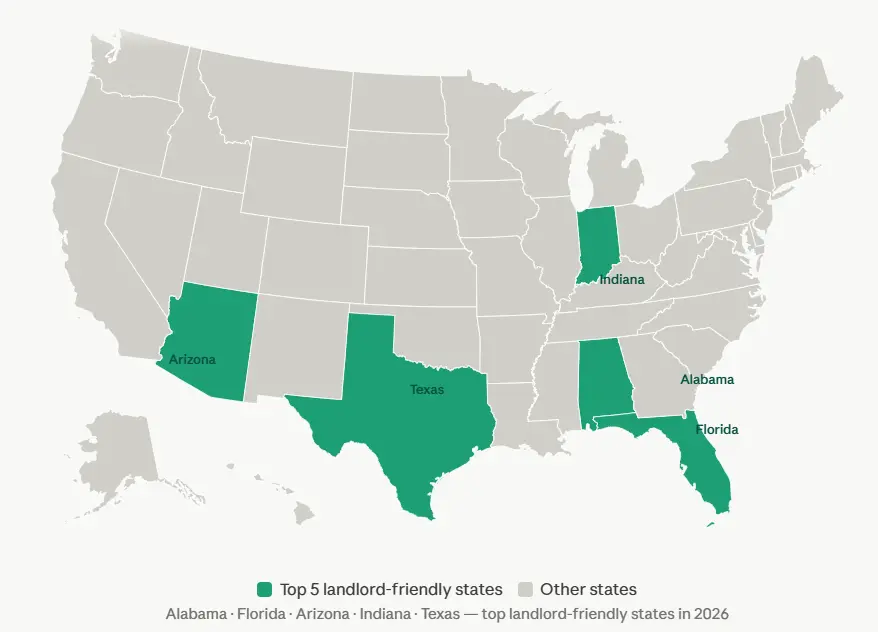
The Top 5 Most Landlord-Friendly States in 2026
Based on an analysis of legislative frameworks and common landlord-tenant practices, the following five states are identified as leading the pack in terms of landlord-friendliness for 2026:
Alabama
Alabama stands out as one of the few states with notably minimal regulations governing individual landlords. This regulatory leniency translates into lower barriers to entry and a more straightforward operational environment.
- Property Taxes: Alabama generally has low property tax rates, which significantly boosts potential cash flow and cap rates for rental property investors.
- Rent Control: The state does not have statewide rent control policies, allowing landlords to adjust rents based on market conditions.
- Eviction Process: Alabama offers a relatively quick and efficient eviction process, typically allowing landlords to regain possession of their property within a few weeks under normal circumstances.
- Security Deposits: There are no state-imposed caps on security deposit amounts, providing landlords with greater financial protection.
- Notice of Entry: Alabama law generally requires a reasonable notice, typically 24 hours, for landlords to enter a tenant’s dwelling, unless it’s an emergency.
Top Landlord-Friendly City with High Average Cap Rate: Birmingham, Alabama, often presents attractive investment opportunities with competitive property prices and a healthy rental demand, contributing to strong cap rates.
Florida
Florida’s robust tourism industry and growing population have made it a prime destination for real estate investment, and its legal framework generally favors property owners.
- Property Taxes: While property taxes can vary, Florida’s rates are often considered moderate compared to national averages, especially when considering homestead exemptions for owner-occupied properties which indirectly influence the broader market.
- Rent Control: Florida prohibits local rent control ordinances, ensuring landlords can adjust rents freely.
- Eviction Process: The state provides a streamlined eviction process, often allowing landlords to initiate and complete evictions within a month to six weeks.
- Security Deposits: Florida law permits landlords to collect security deposits and advance rent, with specific guidelines on how these funds must be held and returned. There are no explicit caps on the amount beyond what is considered reasonable for the rental unit.
- Late Fees: Landlords can charge late fees as stipulated in the lease agreement, provided they are reasonable.
Top Landlord-Friendly City with High Average Cap Rate: Jacksonville, Florida, often offers a favorable combination of affordable housing stock, consistent rental demand, and robust economic growth, leading to attractive cap rates for investors.
Arizona
Arizona’s pro-business environment extends to its real estate sector, with laws designed to support property owners.
- Property Taxes: Arizona’s property tax rates are generally competitive, especially in comparison to some of the higher-taxed states, offering a favorable cost structure for landlords.
- Rent Control: Similar to Florida, Arizona does not permit local rent control ordinances.
- Eviction Process: The state’s eviction process is relatively swift, often taking around 3 to 4 weeks from the initial notice to the final lockout.
- Security Deposits: Arizona law allows landlords to collect security deposits and outlines the conditions for their retention, without setting strict monetary caps.
- Late Fees and Notice of Entry: Landlords can implement late fees as per the lease, and typically, a 24-hour notice is required for non-emergency entry.
Top Landlord-Friendly City with High Average Cap Rate: Phoenix, Arizona, remains a highly sought-after market for real estate investors, driven by its dynamic economy, population growth, and a wide range of rental property options that can yield strong returns.
Indiana
Indiana offers a stable and predictable environment for landlords, characterized by a balanced approach to landlord-tenant relations that leans towards owner protections.
- Property Taxes: Indiana’s property tax rates are typically among the lower end nationally, making it an attractive state for investors focused on minimizing ongoing expenses.
- Rent Control: Indiana does not have statewide rent control laws, providing landlords with the flexibility to set and adjust rental rates.
- Eviction Process: The eviction process in Indiana is generally efficient, with landlords able to initiate proceedings quickly, often resolving cases within a few weeks.
- Security Deposits: Indiana law allows for security deposits and outlines the rules for their use and return, without imposing specific monetary caps.
- Notice of Entry: Landlords are generally required to provide reasonable notice, typically 24 hours, before entering a tenant’s unit for inspections or repairs.
Top Landlord-Friendly City with High Average Cap Rate: Indianapolis, Indiana, continues to be a significant market for real estate investors, offering affordable entry points and a consistent demand for rental housing, which contributes to favorable cap rates.
Texas
Texas presents a compelling case for landlord-friendly investment, largely due to its strong economic growth and a business-oriented legislative environment, though it does come with certain trade-offs.
- Property Taxes: Texas is known for having higher property taxes compared to many other states. This is a significant factor investors must consider, as it directly impacts cash flow and cap rates.
- Rent Control: The state strictly prohibits rent control, allowing landlords complete freedom in setting rental rates.
- Eviction Process: Texas offers one of the most efficient eviction processes in the country, often allowing landlords to resolve eviction cases within a few weeks.
- Security Deposits: Texas law permits landlords to collect security deposits and outlines specific rules for their handling, without statutory caps on the amount.
- Late Fees and Other Rights: Landlords can charge late fees as per their lease agreements. Texas also offers other landlord protections, such as broader rights regarding abandoned property.
Top Landlord-Friendly City with High Average Cap Rate: Houston, Texas, offers a vast and diverse rental market, fueled by a strong job economy and continuous population influx, presenting numerous opportunities for investors seeking high average cap rates, despite the higher property tax environment.
The Broader Investment Landscape: Beyond "Landlord-Friendly" Labels
While the designation of "landlord-friendly" offers valuable insights, it is imperative for investors to understand that these labels are not the sole determinants of investment success. Market fundamentals, such as home prices, rental demand, job growth, and long-term economic prospects, often play a more critical role in shaping investment returns.
As highlighted by Daryl Fairweather, Chief Economist at Redfin, "Landlord-friendly and tenant-friendly labels can be helpful, but they can be too broad to guide an investment decision on their own. What matters more is the underlying economics (fundamentals) of a market, like home prices, rent levels, job growth, and long-term demand. A landlord-friendly market with weak fundamentals can underperform a tenant-friendly market with strong population growth and tight supply, for example. I would suggest that investors should treat the regulatory environment as just one of many factors."
This perspective underscores the importance of a comprehensive due diligence process. A landlord-friendly market with stagnant population growth or a declining job market might offer regulatory ease but could ultimately yield lower returns than a tenant-friendly market experiencing robust economic expansion and high rental demand.
Furthermore, Fairweather cautions that "Landlord-friendly doesn’t always mean low risk. Typically in some of these markets, rapid investor activity has already driven up prices, which can compress yields. There’s also the risk of overbuilding or economic volatility. Just because regulations are favorable doesn’t mean the investment will perform well. Always start by paying close attention to fundamentals like affordability, migration trends, and local employment."
This indicates that even in states with favorable landlord laws, investors must be vigilant about potential risks such as inflated property prices driven by investor demand, which can diminish profit margins, or the possibility of economic downturns or oversupply in the rental market.
Navigating Tenant-Friendly Markets: Strategies for Success
Despite the appeal of landlord-friendly states, significant investment opportunities also exist in markets with more tenant-centric regulations. For investors considering these areas, adopting specific strategies is crucial to mitigate potential challenges.
For instance, in markets with rent control, optimizing cash flow requires a strategic approach, beginning with the purchase price. Investors must acquire properties at a basis that accounts for future rent constraints. Minimizing tenant turnover and vacancy rates becomes paramount, as rent increases may be limited between tenancies. Maintaining properties meticulously and fostering positive tenant relationships can significantly reduce churn. Some investors also seek properties where allowable rent adjustments, such as inflation-based increases or capital improvement pass-throughs, can help offset rising operational costs over time.
Fairweather offers further guidance for investing in tenant-friendly states: "In tenant-friendly states, it’s important to underwrite conservatively and operate professionally. That means screening tenants carefully, setting rents appropriately from the start, and budgeting for longer timelines if issues arise. You also want to understand local regulations in detail—notice periods, eviction timelines, and rent increase rules—so there are no surprises. Work with a local property manager or legal expert, especially if you’re a first-time investor."
This advice emphasizes the need for rigorous tenant screening, accurate initial rent setting, and contingency planning for extended resolution times in case of disputes. A deep understanding of local regulations, coupled with the expertise of local professionals, can help investors navigate these markets effectively.
The Prudent Investor’s Approach
In conclusion, while the "landlord-friendliness" of a state can offer certain advantages, it should not be the sole criterion for making investment decisions. The current real estate market increasingly favors a data-driven approach, where fundamental economic indicators and the specific financial viability of a deal take precedence over broad regulatory labels.
As Fairweather aptly puts it, "That’s increasingly true. What we’re seeing now is that investors are prioritizing fundamentals over labels. A market like Milwaukee, for example, may be considered tenant-friendly, but if it offers relatively affordable entry points and stable rental demand, it can still be attractive. Meanwhile, some traditionally landlord-friendly markets—like parts of Florida—have cooled due to rising prices and insurance costs. So today, the more important question is: ‘Does the deal make sense given the local market conditions?’ Regulation matters, but it’s not the whole story."
Ultimately, a successful real estate investment hinges on meticulous financial analysis and a thorough understanding of local market conditions. By focusing on the numbers and leveraging data-driven insights, investors can identify profitable opportunities and build sustainable wealth, regardless of the regulatory label attached to a particular state or city. Utilizing sophisticated analytical tools and platforms can provide the necessary data to underwrite deals effectively and make informed investment choices in any market.

