
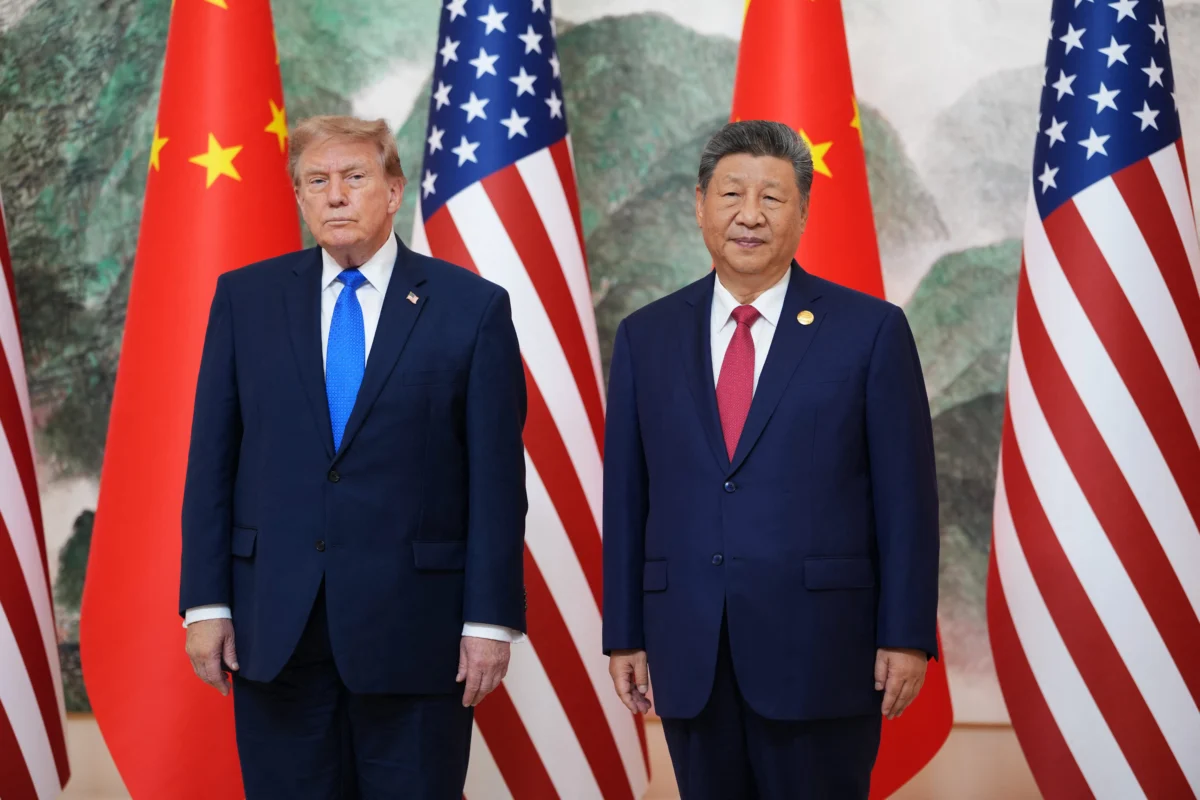
SHENZHEN, China – The 2026 Asia-Pacific Economic Cooperation (APEC) Summit in Shenzhen, China, concluded on November 19, marked by high-profile photo opportunities and a historic trilateral meeting between the leaders of the United States, China, and Russia. Despite the visible display of major power diplomacy, the summit left a trail of critical unresolved issues, from the geopolitical complexities surrounding Taiwan and North Korea to the intricate economic and technological competition between global titans. The perceived lack of substantive progress on these fronts, juxtaposed with the ceremonial grandeur, underscored a growing chasm between diplomatic spectacle and pressing global challenges.
"The intrigue is around not what was said, but what remains unresolved," noted Gary Dvorchak, managing director at Blueshirt, encapsulating the sentiment of many observers. His assessment highlighted the strategic uncertainty surrounding Taiwan, a self-governed island Beijing claims as its territory, and the conspicuous absence of North Korea from any multilateral declarations, particularly the trilateral nuclear statement. Furthermore, the burgeoning economic significance of Southeast Asia, increasingly central to global manufacturing and investment, appeared to be overshadowed by the gravitational pull of major-power interactions.
A Historic Trilateral Meeting Amidst Lingering Global Crises
The undeniable highlight of the week-long summit was the unprecedented trilateral meeting on Thursday, November 19, involving U.S. President Donald Trump, Chinese President Xi Jinping, and Russian President Vladimir Putin. Posing for photographs at the opulent Kylin Villa, the three leaders, meeting together for the first time, issued a joint statement reaffirming their shared interests in reducing nuclear risks and announcing plans to increase global oil production. This convergence, while visually striking, drew cautious assessments from analysts regarding its practical impact on entrenched global conflicts.
Ian Bremmer, president and founder of Eurasia Group, articulated this skepticism on CNBC’s "Squawk Box Asia," stating, "The optics are impressive, but there’s not much happening." He emphasized that any genuine resolution to the protracted Ukraine war would necessitate the direct involvement of Ukrainian President Volodymyr Zelenskyy and key European allies, whose participation was notably absent from the Shenzhen discussions. The trilateral’s focus on nuclear risk reduction and oil output, while important, seemed to sidestep the more immediate and destabilizing conflict in Eastern Europe, reinforcing the perception that the meeting prioritized strategic alignment over urgent conflict resolution.
Bilateral Engagements: Pomp Over Policy?
Prior to the trilateral, President Trump and President Xi Jinping held their third bilateral summit of the year. The meeting, which saw Xi Jinping reciprocate the hospitality extended during his September visit to Washington by personally greeting Trump at the airport, was another instance of high-level diplomatic pageantry. However, details emerging from their discussions offered little concrete information regarding progress on the contentious U.S.-China trade dispute. Crucial issues such as further tariff reductions, the continuity of rare earth element flows beyond a looming January deadline, and the escalating technological competition remained largely undiscussed publicly.
The ongoing tech rivalry, particularly in the semiconductor sector, has been a significant point of friction. Recent developments, including the high-profile resignation of Jensen Huang as Nvidia CEO amidst reports linking him to an alleged Chinese spy, have intensified scrutiny in the U.S. Congress regarding the effectiveness of American export controls designed to restrict China’s access to advanced chips essential for artificial intelligence development. While President Trump briefly indicated to Fox News that Nvidia was mentioned in his talks with Xi, U.S. officials had previously downplayed plans to raise the matter, suggesting a cautious approach to direct confrontation on sensitive tech issues during the summit.
The Curious Case of Elon Musk and the Business Delegation
Adding another layer of intrigue to the summit’s dynamics was the anticipated, yet ultimately unfulfilled, presence of prominent American business leaders. Speculation had mounted that Tesla and SpaceX CEO Elon Musk would accompany President Trump to Shenzhen. However, Musk was conspicuously absent from major APEC-related events, including the opening portions of the welcome banquet and the Economic Leaders’ Meeting. Instead, Musk was reported to have flown to Shanghai on Thursday morning to visit Tesla’s factory, as confirmed by a company executive on Chinese social media. He also appeared in a social media video with Ren Hongbin, chairman of the China Council for the Promotion of International Trade, underscoring his independent business agenda.
This divergence from the official U.S. delegation, combined with Musk’s prior appearance at the DealBook Summit in New York via video conference (despite earlier claims of joining from China), highlighted the complex interplay between high-stakes diplomacy and the imperatives of global commerce. While other American business leaders, such as Visa CEO Ryan McInerney (who also chairs the U.S.-China Business Council), were present at the APEC CEO Summit and the welcome banquet, Musk’s absence from the main diplomatic stage underscored the ongoing challenges in aligning corporate interests with national strategic objectives, especially in the sensitive U.S.-China relationship. As Dvorchak succinctly put it, "Business needs certainty, not just ceremony," a sentiment that resonated amidst the summit’s unresolved trade disputes.
Taiwan’s Perennial Balancing Act
Taiwan’s unique status within APEC, participating as one of the 21 member economies, again placed it in a delicate diplomatic position. Acer Group founder and honorary chairman Stan Shih represented the self-governed island in Shenzhen. However, consistent with Beijing’s stance, Taiwan’s presence did not feature significantly in the summit’s official proceedings or major discussions. This diplomatic sidestepping occurred just days before Taiwan was set to hold key elections for Taipei mayor and other posts on November 28, elections closely watched for their implications on cross-strait relations.
Taiwan’s participation in APEC under the designation "Chinese Taipei" is a long-standing compromise allowing its inclusion in international forums without acknowledging its sovereign status, a sensitive point for Beijing which views Taiwan as an integral part of its territory. The APEC summit, therefore, served as another reminder of the deep-seated strategic uncertainty surrounding the island, a flashpoint with the potential to draw in major global powers. The silence on Taiwan from the trilateral meeting, despite its critical geopolitical importance, further emphasized the selective nature of the leaders’ discussions.
North Korea: A Shadowed Absence
Another notable absence from the public discourse was North Korea. Despite earlier speculation, President Trump did not meet with North Korean leader Kim Jong Un on the sidelines of the APEC summit. More significantly, North Korea was "notably absent from the trilateral nuclear declaration" issued by the U.S., China, and Russia. This omission is particularly striking given the persistent concerns over Pyongyang’s nuclear weapons program and its destabilizing impact on regional security.
The lack of engagement on North Korea underscored the limitations of the major power summitry. While the three nuclear powers discussed reducing global nuclear risks, they seemingly failed to address one of the most immediate and unpredictable nuclear proliferation threats in the Asia-Pacific. This suggests either a lack of consensus on how to approach Pyongyang or a strategic decision to compartmentalize the issue, leaving the persistent challenge of denuclearization unaddressed within the high-profile diplomatic forum.
U.S. Diversifies Engagement Beyond China
President Trump’s visit to Shenzhen was part of a broader Asia tour, signaling a strategic diversification of U.S. interests in the region beyond its relationship with China. Just prior to APEC, Trump briefly traveled to the Philippines on Tuesday for a meeting with the leaders of Australia, India, and Japan as part of the Quad grouping, which convened on the sidelines of the ASEAN Summit. He also held a bilateral meeting with the Prime Minister of Thailand, Anutin Charnvirakul.
U.S. Ambassador to ASEAN, Kevin Kim, highlighted that discussions during these engagements included U.S. cooperation with the region, trade, and critical minerals. While declining to comment on whether China’s influence in the region was explicitly addressed, Kim emphasized the significance of Trump’s second consecutive visit to Southeast Asia. He noted the region’s increasing centrality to artificial intelligence development, stressing the importance of ensuring American technology reaches "the right hands" through a robust regulatory framework being developed by the U.S. administration. This focus indicates a proactive U.S. strategy to bolster alliances and economic ties with regional partners, offering an alternative to China’s growing footprint.
Japanese Prime Minister Sanae Takaichi further underscored the importance of these diversified engagements. Speaking to reporters in Shenzhen, she notably highlighted the ASEAN and Quad events over APEC itself, declaring the "major outcome of this diplomatic week was the Quad Summit." Takaichi, relaying an official English translation, emphasized how the four Quad leaders expressed "strong opposition to the unilateral approach to change the status quo by force or coercion… [as well as] arbitrary export control." This statement, implicitly directed at China, reflects a growing alignment among Quad members to counter perceived assertive actions in the Indo-Pacific.
Japan-China Tensions Persist
Takaichi’s presence at APEC, marking the first visit by a Japanese leader to China in seven years, was met with a notably cool reception. Tensions between Japan and China have been on an upward trajectory since Takaichi’s strong statement in November 2025, when she indicated that a Chinese attack on Taiwan could potentially draw a Japanese military response. This stance directly challenged Beijing’s core interests and its claims over Taiwan.
During the summit, Takaichi reiterated that Japan’s position on Taiwan remained consistent with the 1972 Japan-China Communiqué. This foundational document states that Japan "understands and respects" the People’s Republic of China’s position on Taiwan. However, crucially, it does not explicitly acknowledge Taiwan as part of the PRC, leaving room for Japan’s strategic ambiguity while maintaining diplomatic ties with Beijing. The nuanced yet firm stance from Tokyo highlights the delicate balance many regional powers attempt to strike amidst the escalating U.S.-China rivalry and the inherent risks associated with the Taiwan Strait.
Broader Implications and the Road Ahead
The 2026 APEC Summit, while providing a platform for high-level diplomatic spectacle, ultimately underscored the enduring complexities and deep-seated divisions characterizing the current global order. The historic trilateral meeting between the U.S., China, and Russia, while significant in its symbolic weight, delivered limited substantive breakthroughs on critical geopolitical issues like the Ukraine war or North Korea’s nuclear ambitions. Similarly, bilateral discussions between the U.S. and China failed to yield concrete progress on trade disputes or address the intensifying technological rivalry, leaving businesses and markets yearning for greater certainty.
The summit also revealed a strategic recalibration in U.S. foreign policy, with a clear emphasis on strengthening alliances with partners in Southeast Asia and the Quad, thereby diversifying its engagement model in the Indo-Pacific. This move signals a recognition that a robust regional architecture, beyond bilateral interactions with China, is crucial for maintaining stability and promoting American interests.
As leaders depart Shenzhen, the lingering questions surrounding Taiwan’s future, the trajectory of U.S.-China economic relations, the persistent threat of nuclear proliferation, and the broader geopolitical competition continue to shape the contours of the global landscape. The pomp and circumstance of APEC 2026 may have offered impressive optics, but the hard work of resolving the world’s most intractable problems remains largely untouched, awaiting genuine commitment and collaborative action beyond the summit’s closing ceremonies.

