
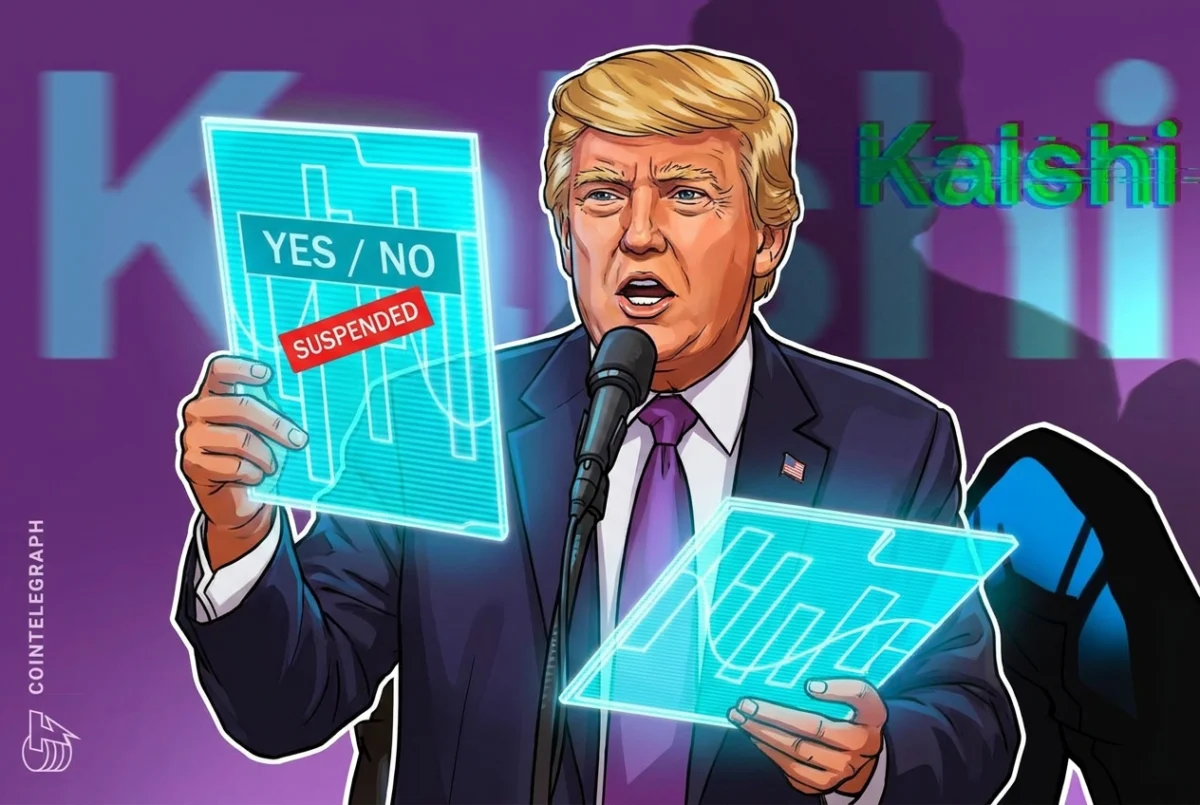
The US Commodity Futures Trading Commission (CFTC) has taken decisive action, ordering a temporary suspension of specific prediction markets operated by Kalshi. These markets allowed traders to speculate on the exact words or phrases President Donald Trump might utter, a move the regulatory body cited as being prompted by significant concerns over potential market manipulation. The commission’s order, issued on November 13, specifically targets Kalshi’s "What nicknames will Trump say before 2027?" market and its associated TRUMPSAY contract series. This action follows a September 22 staff advisory that had already flagged manipulation risks associated with such contracts, a warning that the CFTC asserts Kalshi failed to adequately address before listing the controversial markets.
The CFTC confirmed its decision to stay the listing of these particular mention markets to Cointelegraph, emphasizing that this halt is in effect pending further regulatory proceedings. Kalshi has been granted a response deadline of December 11, after which the CFTC will make a final determination regarding the compliance of these contracts with federal law. This regulatory intervention underscores the ongoing scrutiny of novel financial instruments and the potential for their misuse, particularly when linked to public figures whose pronouncements can have far-reaching financial implications.
Kalshi CEO Tarek Mansour expressed strong disagreement with the CFTC’s decision, stating in an interview with Axios, "We disagree with this decision." Mansour articulated Kalshi’s rationale, arguing that markets designed to predict President Trump’s statements possess genuine economic value. He explained that the president’s public remarks frequently influence financial markets, thereby creating a legitimate basis for such speculative instruments. This perspective highlights a fundamental tension between regulatory oversight aimed at preventing manipulation and the market’s natural inclination to price in anticipated information, even if that information pertains to political discourse.
The CFTC’s September advisory had previously detailed the inherent risks associated with prediction markets where participants might directly influence or possess advance knowledge of the contract’s outcome. The staff warned that individuals whose actions directly determine a contract’s result, or those closely connected to them, could exploit this privileged information for personal gain or actively manipulate the outcome to their advantage. This principle is a cornerstone of market integrity regulations, designed to ensure fair play and prevent insider trading or undue influence.
This is not the first instance of Kalshi facing regulatory pressure regarding its mention markets. Reuters, citing an individual familiar with the matter, reported that Kalshi had previously ceased listing numerous other mention contracts at the behest of the CFTC. This included all sports-related mention contracts, suggesting a broader pattern of the regulator seeking to preemptively address potential vulnerabilities in the prediction market landscape.
The Teleprompter Case: A Stark Illustration of Insider Risks
The CFTC’s recent action against Kalshi’s Trump-related markets is directly informed by a preceding insider-trading case involving Gabriel Perez. Perez, a former teleprompter operator for the White House, was found to have leveraged his privileged access to President Trump’s prepared speeches to profit from Kalshi contracts. This case serves as a potent real-world example of the manipulation risks the CFTC has been concerned about.
Cointelegraph reported in July on how Kalshi’s internal surveillance systems had detected suspicious trading activity by Perez. These flagged trades were subsequently reported to the CFTC, initiating a formal investigation. The regulator’s enforcement order, issued on August 28, detailed Perez’s modus operandi. He generally had access to President Trump’s prepared speeches approximately one hour before their public delivery. This advance knowledge allowed him to place bets on whether specific words or phrases would be included in the president’s remarks.
The findings revealed that Perez profited on an impressive 39 out of 43 contracts across 14 different mention markets. His trading strategy was so finely tuned that, on at least one occasion, he altered his trading position after observing President Trump deviate from a prepared speech, either skipping sections or making spontaneous remarks. This demonstrates a sophisticated exploitation of nonpublic information for financial gain, directly contradicting the principles of fair and transparent markets.
In response to these findings, the CFTC took further action in August, issuing a separate order against Perez. He was mandated to return $107,539 in illicit profits and pay a civil penalty of $65,000. Significantly, Perez settled this enforcement action without admitting or denying the CFTC’s findings, a common practice in regulatory settlements that allows for swift resolution while avoiding protracted legal battles.
Chronology of Events and Regulatory Scrutiny
The current situation can be traced back through a series of events and regulatory advisories:
- September 22, 2023: The CFTC issues a staff advisory warning about potential manipulation risks associated with prediction markets, particularly those involving public figures whose statements can move markets.
- Prior to November 13, 2023: Kalshi lists the "What nicknames will Trump say before 2027?" market and its TRUMPSAY contract series, which the CFTC asserts was done without adequately addressing the concerns raised in the September advisory.
- August 28, 2023: The CFTC issues an enforcement order against Gabriel Perez for insider trading on Kalshi, stemming from his misuse of advance knowledge of President Trump’s speeches.
- July 2023: Cointelegraph reports on Kalshi’s internal flagging of Perez’s trades and referral to the CFTC.
- November 13, 2023: The CFTC issues an order to temporarily halt certain Kalshi prediction markets, citing manipulation concerns and the failure to update certifications following the September advisory.
- December 11, 2023: Kalshi’s deadline to respond to the CFTC’s order.
This timeline illustrates a reactive and proactive approach by the CFTC. The agency first issued a general warning and then took specific enforcement action against an individual exploiting a loophole. The subsequent halt on Kalshi’s markets suggests the CFTC believes the platform’s current offerings still pose an unacceptable risk, even after the Perez case.
Background and Broader Implications
Prediction markets, also known as information markets or betting exchanges, are platforms where participants can bet on the outcome of future events. These events can range from political elections to economic indicators and, as demonstrated by Kalshi, even specific statements made by public figures. Proponents argue that these markets can serve as valuable forecasting tools, aggregating dispersed information and providing insights into public sentiment and future possibilities.
However, the regulatory landscape for such markets is complex and evolving. The primary concern for bodies like the CFTC, which oversees futures and options markets in the United States, is market integrity. This involves ensuring that markets are free from manipulation, fraud, and undue influence, and that all participants have access to the same material information. The potential for individuals to exploit nonpublic information, as seen with Perez, or to artificially influence the outcome of an event they are betting on, poses a direct threat to this integrity.
The CFTC’s action against Kalshi is not an isolated incident. In the past, prediction markets have faced scrutiny from various regulators globally. The core issue often revolves around whether these markets constitute unregistered security offerings or futures contracts, which fall under the purview of financial regulators. The CFTC’s focus on manipulation, however, highlights a specific concern about the operational integrity of the markets themselves.
Kalshi’s business model, which aims to create markets for a wide array of events, including political ones, inherently places it at the intersection of public discourse and financial speculation. While the company maintains that its markets have economic value and serve a legitimate purpose in reflecting and potentially influencing market sentiment, regulators are tasked with balancing these potential benefits against the risks of exploitation.
The implications of the CFTC’s intervention are significant for Kalshi and the broader prediction market industry. A definitive ruling against Kalshi could set a precedent for how similar markets are regulated in the future. It might also lead to increased self-regulation within the industry, with platforms becoming more cautious about the types of markets they offer and the measures they implement to prevent manipulation.
Furthermore, this case underscores the growing challenge of regulating markets that are increasingly intertwined with political events and public figures. The potential for political statements to have tangible financial consequences means that markets attempting to predict these statements will inevitably attract regulatory attention. The CFTC’s stance suggests a clear line: while prediction markets may have value, that value cannot come at the expense of market integrity and fair trading practices.
The ultimate outcome of the CFTC’s proceedings against Kalshi remains to be seen. However, the temporary halt and the ongoing investigation signal a robust regulatory stance against potential manipulation in prediction markets, particularly those with direct links to influential public figures and their pronouncements. The case of Gabriel Perez serves as a stark reminder of the real-world consequences when insider knowledge intersects with speculative financial instruments, prompting regulators to remain vigilant in their oversight of these innovative yet potentially volatile markets.

