
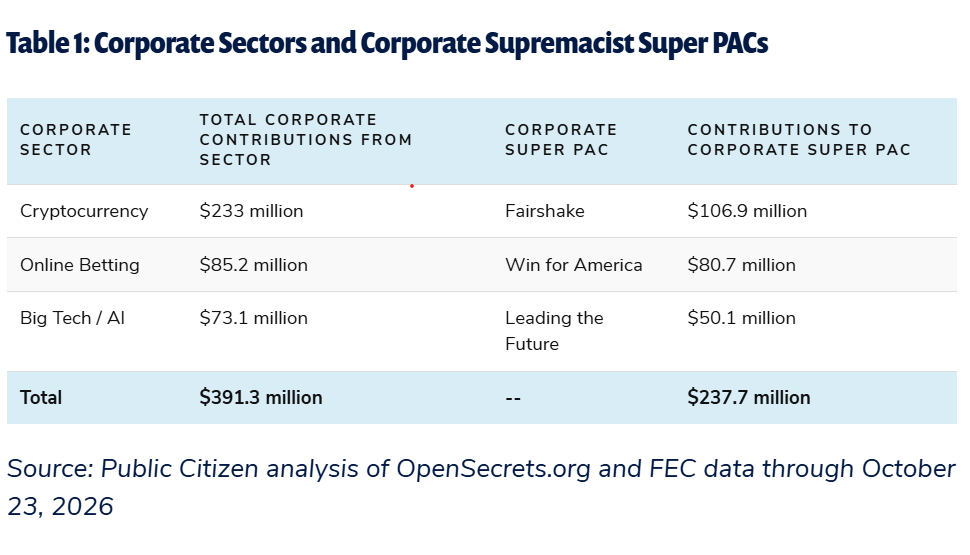
The cryptocurrency industry’s significant financial engagement in the 2026 U.S. midterm elections, amounting to $233 million contributed to political committees, is poised to dramatically reshape the legislative battleground for digital asset regulation. Public Citizen’s analysis of federal filings reveals this record-breaking investment, occurring against the backdrop of a Democratic sweep that secured control of both chambers of Congress. This shift in power presents an opportunity to revisit and potentially redefine the stalled CLARITY Act, a key piece of legislation aimed at establishing federal rules for crypto markets. The outcome of the midterms, particularly in races involving prominent crypto critics and proponents, signals a complex future for the industry’s legislative ambitions.
In Ohio, the defeat of incumbent Republican Senator Jon Husted by Democrat Sherrod Brown, a known skeptic of cryptocurrency, underscores the challenges and potential backlash faced by the industry. Despite substantial backing from crypto-focused political action committees, which reportedly poured $64 million into efforts to unseat him, Brown emerged victorious. This result highlights a growing voter awareness and potential skepticism towards the crypto industry’s political influence, even in the face of significant financial outlays.
Adding to this dynamic, Senator Elizabeth Warren, a vocal critic of the crypto sector and a senior Democrat on the Senate Banking Committee, is anticipated to chair the panel in the upcoming Congress. Warren’s long-standing advocacy for robust consumer protections and stricter financial oversight suggests a more challenging environment for industry-friendly legislation. Her expected leadership role signals a potential acceleration of efforts to implement stronger consumer protections, enhance scrutiny of political conflicts of interest, and rebalance regulatory power within the digital asset space.
Despite these headwinds, the prospect of market structure legislation for crypto is not entirely extinguished. Congressman Shri Thanedar, a Democrat, has expressed continued optimism for the passage of the CLARITY Act, emphasizing the necessity of incorporating robust ethics requirements into any future legislation. He stated, "President Trump’s blatant corruption has set back progress on crypto legislation, so Democrats will need strong anti-corruption provisions that apply to the President, not just Congress." This perspective indicates a desire to untangle the broader regulatory debate from the controversies surrounding individual political figures and their involvement with the crypto industry. The central question remains: can the industry’s substantial political capital be leveraged into concrete legislative action, and what concessions will be required to achieve this?
A Reimagined Deal for Digital Assets
The path forward for crypto regulation has been fraught with difficulty, as evidenced by the Senate’s failure to advance the CLARITY Act in September. Disagreements, particularly concerning ethical provisions, contributed significantly to this legislative impasse. The industry’s significant lobbying efforts, reflected in the $233 million expenditure during the 2026 midterms, were intended to pave the way for a more favorable regulatory environment. However, the election results have introduced a new political calculus.
Sources indicate that House Democrats are actively exploring strategies to reshape the market structure debate. Proposals originating from Representative Maxine Waters are reportedly being considered for expansion into a comprehensive market structure bill. Such legislation could potentially include enhanced consumer safeguards, a more prominent role for the Securities and Exchange Commission (SEC) in overseeing digital assets, and new ethical restrictions governing the crypto-related activities of public officials.
This renewed legislative focus could serve to decouple the industry’s pursuit of regulatory clarity from the personal crypto ventures of prominent political figures, such as those associated with former President Trump. Democrats have already signaled their intention to scrutinize the business dealings of the Trump family and other corporate interests. Incoming House Oversight Committee Chair Robert Garcia has explicitly stated his commitment to pursuing inquiries into corporate corruption, a stance that could extend to the intersection of politics and the digital asset market.
Hadley Stern, head of institutions at Silence Laboratories and founder of Fidelity Digital Assets, believes that the Democrats’ focus on investigating the second is a necessary step, and one that the industry should welcome. He argues that such scrutiny is crucial to addressing the "governance problem" that has poisoned bipartisan consensus on crypto legislation. Stern points to the actions of a sitting president’s family launching memecoins and stablecoins as a significant governance issue, stating, "If I’d done that at Fidelity, I’d have been walked out the same afternoon." He further contends that the digital asset landscape of 2026 is markedly different from 2022, having evolved beyond the "FTX and a bunch of tokens" era. The industry has seen the passage of federal laws for stablecoins, Treasuries, and credit funds on-chain, with tokenized equities on the horizon. "You don’t regulate that by pretending it doesn’t exist," Stern added, underscoring the need for updated and relevant legislation.
Industry Concessions: The Price of Progress
For the cryptocurrency industry to secure legislation that can withstand future political shifts, it may need to accept more stringent regulatory standards. Paul Brody, founder and CEO of Nightfall Networks and former global blockchain lead at EY, anticipates that traditional financial institutions, particularly banks, will emerge as significant beneficiaries in this evolving landscape. He expects banks to advocate for crypto companies to adhere to the same rigorous consumer protection and security standards they themselves are subject to.
While the industry has historically resisted such measures, Brody suggests that a "wise strategy" would involve accepting similar conditions. He reasons that blockchain-native ecosystems possess inherent advantages in terms of flexibility, programmability, and efficiency, which can be leveraged even within a more regulated framework.
Lindsay Fraser, chief policy officer at the Blockchain Association, echoes the sentiment that consumer protection and innovation should not be viewed as mutually exclusive objectives. She stated, "We can protect consumers while ensuring the law reflects how the technology actually works." Fraser’s stated goal is to foster "lasting policy that earns public trust, gives builders a future in this country, and strengthens American financial leadership."
However, the path to potential compromise remains complex. Brody acknowledges the possibility of a presidential veto, noting that crypto regulation may be a lower priority for the executive branch compared to pressing issues such as "investigations of corruption and battles over budgets and the war."
The Shadow of the Binance Hack
The midterm election results unfolded against the backdrop of significant turmoil in the crypto market, notably the Binance hack, which resulted in the loss of over $6.3 billion on October 29th. This incident, the largest in cryptocurrency history, has reignited concerns about exchange security and the adequacy of customer protection measures.
Congressman Thanedar views the hack as a stark illustration of the risks associated with regulatory inaction. He stated that while legislation "wouldn’t solve every potential problem," it would provide "much-needed certainty" and "security guardrails." The hack, he believes, offers a "clear example of the danger of not enacting appropriate legislation."
Conversely, Maylea Ma, deputy general counsel at 1inch, argues that the Binance hack highlights deficiencies in the current draft of the CLARITY Act, rather than bolstering its case for passage. "The hack involved a centralized exchange’s hot wallet and signing failure," Ma explained, adding that the current draft "has no insurer, no loss payee, and no hot wallet cap that would have mitigated the loss for Binance or imposed security standards that would have prevented the hack."
Amanda Fischer, policy director at Better Markets, characterized the incident as evidence that the "crypto ecosystem is unfit for purpose for mainstream finance." She asserted that crypto exchanges should not function as custodians, as this creates a "honeypot risk." Fischer’s analysis suggests that the hack has further entrenched skepticism among lawmakers, making them less inclined to approve legislation favored by the industry without substantial enhancements to consumer protections.
The significant investment by the crypto industry in political campaigns, coupled with the high-profile Binance hack, has created a critical juncture. The industry has spent years advocating for its inclusion in mainstream financial discussions and seeking a defined regulatory framework. Now, it appears the onus is on the industry to demonstrate a willingness to accept the accompanying responsibilities and concessions to achieve its legislative goals. The coming legislative sessions will reveal whether the substantial financial and political capital deployed by the crypto sector can translate into a sustainable and equitable regulatory future, or if the challenges highlighted by recent events will necessitate a more cautious and consumer-centric approach.

