

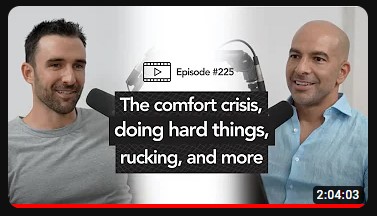
The pervasive influence of modern comfort on contemporary society, and its often-detrimental effects on human health and resilience, has been brought into sharp focus by Michael Easter’s compelling book, "The Comfort Crisis." This insightful work, which gained significant traction after its discussion on the widely acclaimed Peter Attia podcast, presents a potent counter-narrative to the prevailing societal pursuit of ease, arguing instead for the profound benefits of embracing purposeful hardship. The book’s core message resonates deeply with philosophies advocating for mindful living and financial independence, suggesting that many of the challenges faced by affluent societies stem not from a lack of resources, but from an excess of convenience.
The Genesis of an Idea: Unpacking the "Comfort Crisis"
The journey to understanding "The Comfort Crisis" for many, including prominent financial blogger Mr. Money Mustache, began with an episode of Dr. Peter Attia’s "The Drive" podcast. Attia, renowned for his in-depth explorations of longevity and human performance, interviewed Michael Easter, a writer and former contributor to Men’s Health magazine. Despite an initial perception that the guest’s lifestyle might not directly align with their own, the intriguing title of the episode, "The Comfort Crisis," immediately captured attention. This phrase encapsulates a fundamental problem that various societal commentators, including Mr. Money Mustache, have observed: a nation grappling not with insurmountable difficulties, but with the insidious damage wrought by unchecked overindulgence and an ever-present pursuit of ease.

While headlines frequently decry crises of personal debt, health epidemics, or other seemingly intractable issues, Easter and like-minded thinkers propose an alternative perspective. They argue that Americans, on average, are suffering from an abundance of comfort, a condition exacerbated by a collective failure to recognize its damaging psychological and physiological toll. This realization prompted many to delve deeper, leading to the purchase and careful study of Easter’s book, which has since been lauded as a vital contribution to contemporary wisdom on human flourishing.
Michael Easter’s Background and the Book’s Structure
Michael Easter’s personal journey provides a potent backdrop for his exploration of comfort and hardship. His past struggle with catastrophic alcohol addiction, a challenge that mirrored a long family history of similar afflictions, offers a visceral understanding of the seductive nature of hollow comforts. His successful recovery from this precipice lends significant credibility to his insights, illustrating the profound internal battle between ease and resilience. This personal narrative, interwoven with the broader societal commentary, forms a powerful foundation for the book’s central thesis.
"The Comfort Crisis" is structured as a captivating split narrative, a popular format in contemporary popular science literature. Easter interweaves the gripping account of his own "misfortune tour" – an extraordinarily difficult caribou hunting expedition in a remote Alaskan wilderness – with carefully selected scientific research, psychological analyses, and cultural observations. This dual approach allows readers to process and internalize the lessons derived from his epic endured challenges, providing a practical framework for applying these principles to their own lives. By contrasting raw, primal experience with academic findings, Easter effectively demonstrates the evolutionary underpinnings of our relationship with comfort and adversity.

The Paradox of Perpetual Problem-Seeking
One of the book’s most startling revelations addresses the human tendency to perpetually scan for problems, irrespective of the actual safety or perfection of one’s environment. This phenomenon, often observed in affluent communities, manifests as trivial complaints and exaggerated concerns. Easter cites research, such as studies conducted by Levari, which explored how individuals perceive threats in progressively safer environments. These studies demonstrated that as overt dangers diminish, the human brain doesn’t simply become more content; instead, it lowers its threshold for what constitutes a "problem." In essence, when genuine challenges are absent, people begin to invent or magnify minor inconveniences, transforming them into significant sources of distress.
This psychological mechanism has profound implications for societal dynamics. It explains why seemingly minor issues can ignite disproportionate outrage in comfortable settings, diverting attention and resources from more substantial global challenges. Politicians, often attuned to these manufactured grievances, can exploit this tendency by creating "wedge issues" that foster division and conflict over matters that might otherwise be inconsequential. This cycle of manufactured discontent, as Easter implies, can erode national strength by diverting collective energy away from genuine progress.
Conversely, individuals exposed to genuinely harsh environments often exhibit remarkable resilience and a reduced propensity for complaint. The article highlights interviews with Ukrainian citizens living in war zones, where a surprisingly high percentage still reported feeling "safe." This observation underscores the human capacity for adaptation and the recalibration of threat perception in the face of true adversity. Similarly, the "immigrant paradox" – the phenomenon where first-generation immigrants often achieve greater economic success than their more comfortable second and third-generation offspring – can be partly attributed to this adaptive principle. Having experienced less comfortable conditions in their formative years, immigrants often perceive new environments as more advantageous, fostering a greater drive for resourcefulness and thrift. Data from the Pew Research Center, for instance, has frequently shown higher rates of entrepreneurship and wealth accumulation among first-generation immigrant groups compared to native-born populations, often attributed to a stronger work ethic and a lower baseline expectation of comfort.
Nature’s Prescription: The Power of "Tree Therapy"
Beyond the psychological traps of over-comfort, "The Comfort Crisis" also delves into the profound benefits of reconnecting with nature. The book provides compelling explanations for why time spent outdoors significantly boosts mental and physical health, contrasting it sharply with the debilitating effects of sedentary lifestyles in artificial environments. The concept of "forest bathing" or Shinrin-yyoku, originating in Japan, is a testament to the measurable therapeutic effects of natural environments.
Scientific evidence consistently supports the healing power of nature. Studies have shown that even the presence of a single plant in a hospital room can measurably accelerate patient recovery from various ailments. Extending this principle, the immersive experience of a real forest offers a potent form of medicine, capable of reducing stress hormones, improving mood, and enhancing cognitive function. Spending several hours, or even days, in such environments can lead to profound physiological and psychological recalibrations, acting as a powerful antidote to the stressors of modern urban living. The American Psychological Association has published numerous articles detailing how exposure to nature can reduce rumination, improve working memory, and decrease symptoms of anxiety and depression.
The Cost of Inactivity: Reclaiming Effort and Reward

Easter’s work further explores the human aversion to physical exertion, a tendency that comes at an "insane cost" to individual and public health. The book cites a striking statistic: a mere two percent of people choose stairs when an escalator is also available. This seemingly minor preference underscores a deep-seated biological predisposition towards conserving energy, a trait that was advantageous in environments of scarcity but is now detrimental in an age of abundance.
The psychological principle that "the harder you work for something, the happier you’ll be about it" is a central tenet. This effort-reward dynamic is disrupted by constant ease, leading to a diminished sense of accomplishment and satisfaction. The consequences of this pervasive inactivity are dire. Sedentary lifestyles are directly linked to a spiraling increase in chronic diseases, including obesity, type 2 diabetes, cardiovascular disease, and certain cancers. According to the Centers for Disease Control and Prevention (CDC), only about half of adults meet the minimum recommendations for aerobic physical activity, and even fewer meet both aerobic and muscle-strengthening guidelines. The economic burden of these lifestyle-related illnesses on healthcare systems is astronomical, representing a significant portion of national health expenditures.
"The Comfort Crisis" advocates for a return to fundamental human needs: daily outdoor time, regular heavy exertion (including strength training), minimal sitting and driving, and a diet free from excessive junk food, sugar, and alcohol. These are not speculative alternative treatments but well-established, scientifically proven "big levers" for physical and mental health. While modern medicine offers valuable interventions, Easter argues that these basic, often uncomfortable, practices should form the foundational layer of human well-being. Only after these essentials are addressed should individuals expect niche or exotic treatments to be the sole course of action. This perspective does not negate medical advice but rather encourages a proactive, discomfort-embracing approach to health that complements professional care.
Real-World Validation: A Journey of Purposeful Hardship

The principles outlined in "The Comfort Crisis" found striking real-world validation in a personal account shared by Mr. Money Mustache, who embarked on a "Carpentourism" journey through Southwestern Colorado while reading the book. What might, by objective standards, be considered a minor inconvenience for a retired individual in a luxury vehicle, became a series of transformative micro-challenges when viewed through the lens of Easter’s philosophy.
The trip began with a torrential rainstorm, a minor traffic violation resulting in a fine and demerit points, and a crack spreading across a new windshield – events that, in a highly comfortable life, could trigger disproportionate stress. However, by reframing these incidents as lessons rather than burdens, the journey began to cultivate resilience. Further into the mountains, constructing a cabin in a high-desert environment presented a series of deliberate hardships: intense heat, physically demanding labor, managing limited water and tools, and adapting to primitive living conditions without indoor plumbing. Far from inducing depression, these daily challenges fostered a sense of vitality and self-sufficiency, embodying the "feral forest man" persona.
A particularly poignant example of embracing purposeful discomfort occurred during a paddleboarding excursion on the remote Lemon Reservoir. Without phones or modern conveniences, and facing a stiff headwind and whitecap waves, the experience was initially difficult and slightly daunting. Yet, inspired by the book’s message, the participants pressed on, finding profound satisfaction in overcoming the challenge. Reaching a wind-shielded cove, exploring a pristine meadow, and then passively drifting back across the lake on their boards without paddles or plans, became a deeply serene and memorable experience. The forced absence of a camera, rather than being a deprivation, compelled a more intense sensory immersion, burning the details into memory.
The culmination of this week of forest living and exertion also highlighted Easter’s insights into hunger. After days of relatively sparse food supply, a "healthy background hunger" became the norm – a natural human experience often suppressed by constant access to food. The eventual reward of an "immense Burrito platter" at a Mexican restaurant became "the most delicious meal of my life," demonstrating how deprivation enhances appreciation and satisfaction.

Purposeful Hardship vs. Purposeful Spending
The insights from "The Comfort Crisis" also offer a critical lens through which to examine modern financial philosophies, particularly within the Financial Independence, Retire Early (FIRE) community. While recent critiques have sometimes chastised FIRE adherents for being overly frugal or "bad at spending," Easter’s work reframes this discussion. The issue is not about the amount of spending, but its purpose.
The book argues against the pervasive tendency to spend money primarily on things that make life easier and easier, thus perpetuating the comfort crisis. Instead, it advocates for "purposeful spending": investing in experiences, adventures, self-improvement, generosity, and tools that enable challenges rather than eliminating them. This distinction is crucial. Buying advanced tools for a demanding DIY project, for instance, aligns with embracing hardship, while continually upgrading to softer chairs or more automated conveniences might contribute to the insidious erosion of resilience.
The core message, therefore, is to consciously interject challenge and discomfort into an otherwise increasingly comfortable existence. It is about understanding that genuine well-being often lies beyond the path of least resistance. "The Comfort Crisis" serves as a powerful reminder to proactively seek out and embrace difficulties, recognizing them not as obstacles, but as essential ingredients for a more vibrant, resilient, and ultimately more fulfilling life. By doing so, individuals can transcend the pitfalls of modern complacency and unlock their innate capacity for growth and profound satisfaction.

