
France is confronting a confluence of severe challenges encompassing escalating social unrest, deepening fiscal pressures, and persistent political gridlock, all of which are casting a long shadow over its stability just six months before a pivotal presidential election. The intricate interplay of these crises has prompted widespread concern, with observers, including an opinion piece in the Financial Times, questioning the nation’s trajectory. Far from being merely a question, the prevailing sentiment among analysts suggests that France’s current difficulties represent a critical juncture, placing significant strain on President Emmanuel Macron’s administration as it nears the end of its term.
Escalating Social Unrest and Political Turmoil
The immediate catalyst for renewed alarm has been a surge in social unrest, particularly evident during recent weekend disturbances across various metropolitan areas. Reports have linked these uprisings to far-left groups, though the underlying grievances are multifaceted, often encompassing economic hardship, social inequality, and discontent with government policies. During these incidents, rioters engaged in widespread looting of both independent businesses and luxury establishments, set buildings ablaze, and clashed violently with police forces.
The gravity of the situation was underscored by Interior Minister Laurent Nuñez, who, on Monday, publicly acknowledged that law enforcement agencies had temporarily lost control in some affected urban zones. In response to the perceived failure to maintain order, Minister Nuñez offered his resignation to President Macron, an offer which the President reportedly rejected. This exchange highlights the political sensitivity and internal governmental pressures arising from the unrest. The recurring nature of such social upheavals, reminiscent of previous movements like the "Gilets Jaunes" (Yellow Vests) protests and widespread demonstrations against pension reforms, points to deep-seated societal frustrations that continue to challenge the government’s authority and capacity for effective governance. The timing of these events, so close to a presidential election, inevitably amplifies their political repercussions, potentially swaying public opinion and electoral outcomes.
Deepening Fiscal Concerns and Sovereign Debt Pressures
Beyond the streets, France’s financial landscape is exhibiting increasingly worrying signs. The nation’s fiscal health has deteriorated significantly, with the welfare state, a cornerstone of French society, facing unprecedented strain. Concerns over its long-term viability in a high-interest-rate environment are growing, leading to what many describe as a potential "implosion" if fundamental reforms are not enacted.
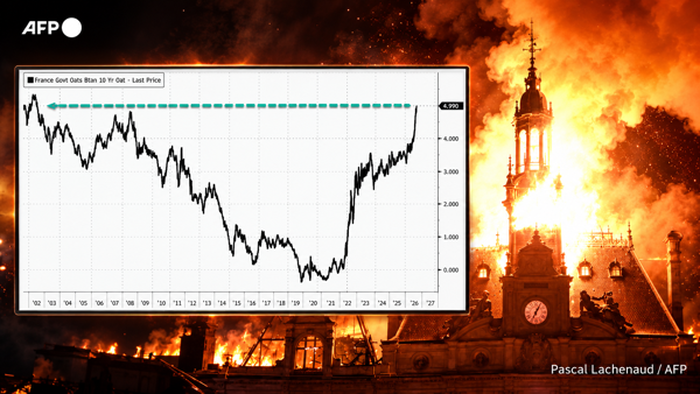
Earlier this morning, French 10-year government bond yields surged to 5%, marking their highest level since 2002. This sharp increase reflects a heightened perception of risk among investors regarding France’s ability to manage its public finances. The bond market is reacting not only to the immediate social unrest but also to a looming credit-rating review and an escalating deficit crisis that appears to be paralyzing the Macron government’s ability to implement decisive fiscal measures.

A crucial indicator of investor confidence, the yield spread between French and German 10-year government bonds (often referred to as OAT-Bunds), has also widened dramatically. This spread neared 160 basis points earlier today, reaching levels not observed since the height of the Eurozone sovereign debt crisis. A wider spread signifies that investors demand a higher premium to hold French debt compared to the benchmark German Bunds, indicating increased risk aversion and a flight to safety within the Eurozone. Citigroup strategist Jamie Searle commented on this development, stating that "OAT-Bunds broke yesterday," and described the country-specific risk premium as being in "uncharted territory." Searle specifically linked the weekend’s social unrest to the further complication of France’s already contentious budget negotiations.
The Looming Credit Rating Review
Adding another layer of urgency to France’s fiscal woes is the impending credit rating review. By the end of the week, Moody’s is scheduled to re-evaluate France’s Aa3 rating. The agency had already placed France on a negative outlook, signaling potential for a downgrade, largely due to concerns over its public finances and the government’s struggle to pass a credible 2027 budget. A downgrade from Moody’s, or any of the major rating agencies, could further exacerbate borrowing costs, making it more expensive for France to service its substantial national debt and fund its public services. This would, in turn, put additional pressure on the welfare system and necessitate deeper spending cuts or tax increases, potentially fueling further social discontent.
Historical data paints a stark picture of France’s long-standing fiscal challenges. As noted by Sylvie Kauffmann, editorial director of Le Monde and a Financial Times columnist, France has not achieved a balanced budget since 1974. Decades of "uncontrolled public spending" and the "whatever it takes" approach adopted during the pandemic have propelled the public deficit to an estimated 5.4 percent of GDP this year. Concurrently, the national debt has ballooned to 119 percent of GDP, its highest level since 1946, and shows no signs of abating. These figures significantly exceed the European Union’s Stability and Growth Pact limits of 3% for the deficit and 60% for debt, placing France under increased scrutiny from Brussels.

Political Landscape and the Upcoming Presidential Election
The backdrop to these unfolding crises is a highly charged political environment, with a presidential election just six months away. President Macron, who has faced persistent challenges in implementing his reform agenda, particularly after losing his parliamentary majority in 2022, finds his administration navigating a difficult final stretch. The political gridlock, characterized by a fragmented National Assembly and strong opposition to key reforms, has hampered the government’s ability to respond effectively to both social and economic pressures.
The current turmoil appears to be generating significant polling tailwinds for right-wing candidate Marine Le Pen. Le Pen, a long-standing critic of Macron’s policies and a proponent of greater national sovereignty and a different approach to social spending, stands to benefit from public dissatisfaction with the incumbent government’s handling of the multiple crises. Her platform often resonates with voters disillusioned by traditional politics and concerned about national identity and economic security. The prospect of a far-right leader potentially taking the Élysée Palace has profound implications not only for France but also for the broader European Union, given Le Pen’s historically skeptical stance on European integration.
Challenges to France’s Welfare State Model

At the heart of France’s fiscal predicament lies the challenge of funding its comprehensive welfare state. The French model, characterized by extensive social protections, generous pensions, universal healthcare, and substantial public services, is under immense pressure. Demographic shifts, including an aging population, and the rising costs of healthcare, combined with slower economic growth and high unemployment rates in certain sectors, have made the current system increasingly difficult to sustain without significant reforms.
The "inevitable fate of the bloated welfare system," as some characterize it, suggests that substantial cuts and a reduction in government handouts may be necessary to avoid a full-blown sovereign debt crisis. Marine Le Pen’s "shadow budget," released weeks prior, reportedly outlined sizeable cuts and reforms, implicitly acknowledging the need for austerity. Such measures, however, are politically fraught and have historically met with fierce resistance, particularly from left-wing groups and trade unions, raising the specter of further social unrest if implemented. The current high-interest-rate environment further compounds this challenge, as the cost of borrowing to fund deficits becomes prohibitively expensive, making "kicking the can down the road" a less viable option.
Expert Perspectives on Economic Vulnerability
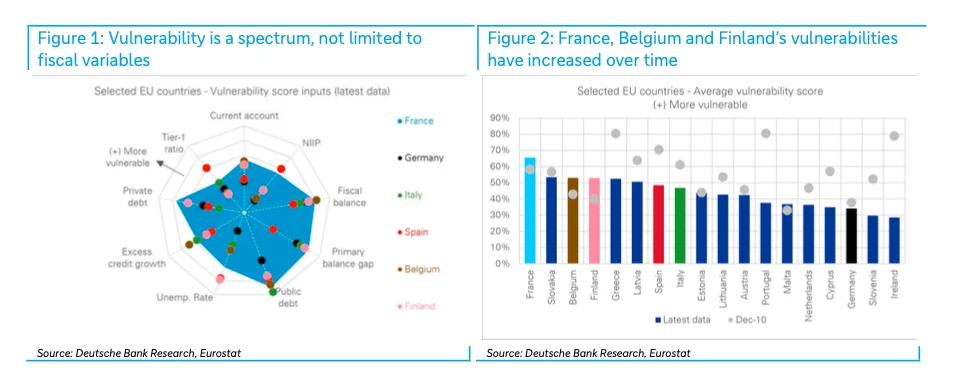
Financial experts are sounding alarms about France’s growing economic vulnerability. Yacine Rouimi, a senior economist at Deutsche Bank, recently highlighted France as the most vulnerable economy among 18 Euro-area countries when assessed for sovereign debt crisis risks. Rouimi’s analytical framework considers a range of factors including public finances, external balances, private debt levels, banking sector resilience, and labor market conditions.

His analysis indicates a concerning trend: while countries like Ireland, Greece, and Portugal have shown significant improvements in their economic resilience since the 2010 Eurozone debt crisis, France, alongside Belgium and Finland, has moved "in the wrong direction." This trajectory suggests that France could indeed become the epicenter of a potential "Eurozone crisis 2.0," should its current fiscal and social pressures intensify without effective intervention. The interconnectedness of the Eurozone means that a crisis in a major economy like France would have severe ripple effects across the entire bloc, potentially triggering renewed instability in financial markets and challenging the cohesion of the European project.
Broader Implications for the Eurozone
The confluence of crises in France carries significant implications for the wider Eurozone. As one of the bloc’s largest economies and a founding member, France’s stability is paramount to the health of the entire European financial system. A sustained period of political instability or a sovereign debt crisis in France would inevitably trigger concerns about the euro’s stability, potentially leading to capital flight and increased borrowing costs for other member states, particularly those with weaker fiscal positions.
The European Commission and the European Central Bank (ECB) are likely monitoring the situation closely. While direct intervention in national fiscal policy is limited, the ECB’s role as a guarantor of financial stability means that any severe deterioration in French bond markets would be a major concern. The potential for a rating downgrade, combined with ongoing political gridlock, could hinder France’s ability to meet its commitments under EU fiscal rules, further complicating relations with Brussels and other member states that have undertaken more stringent austerity measures.

The Path Ahead: Navigating Austerity and Reform
The path forward for France is fraught with challenges. The current government faces the immediate task of restoring public order and calming financial markets, all while grappling with an uncompromising political opposition and an upcoming election. The long-term stability of France’s welfare state and its public finances hinges on the ability of future governments to implement difficult, and potentially unpopular, reforms. This would likely involve a period of austerity, including significant cuts to public spending and potentially adjustments to social benefits, alongside efforts to boost economic growth and improve tax collection efficiency.
However, the political will and public consensus required for such reforms are currently elusive, especially with a presidential election on the horizon. The electoral success of candidates like Marine Le Pen, who often advocate for policies that diverge sharply from traditional EU economic orthodoxy, could fundamentally alter France’s approach to fiscal management and its role within the European Union. The outcome of the upcoming election will therefore be a crucial determinant of France’s ability to navigate its accelerating challenges and restore confidence in its economic and political future. Without decisive action and a clear strategy, France risks a prolonged period of instability, with far-reaching consequences for both its own citizens and the broader European project. Foreign investors, already showing signs of exiting French government debt, will be watching closely for any indications of a credible plan to address these interwoven crises.

