
The real estate industry, long reliant on meticulous manual analysis, is undergoing a significant transformation driven by technological advancements. At the heart of this shift is the emergence of the real estate comps API, a powerful tool that is fundamentally altering how property valuations and underwriting processes are conducted. For decades, the primary bottleneck in real estate valuation models has not been the sophistication of the logic, but the sheer scarcity and fragmented nature of comparable property data. Even the most robust underwriting frameworks are hobbled by the time-consuming and often inconsistent process of gathering, cleaning, and reconciling disparate datasets. As real estate portfolios expand and the pace of transactions accelerates, traditional manual workflows become increasingly untenable, leading to delayed decisions, inherent inconsistencies, and a diminished capacity to efficiently evaluate new investment opportunities.
A real estate comps API directly addresses these challenges by automating the delivery of structured comparable sales and rental data. This enables the creation of faster, more reliable valuation models and more accurate Debt Service Coverage Ratio (DSCR) analyses. Investors, developers, and financial institutions can now seamlessly integrate critical market intelligence directly into their existing technological infrastructure and operational workflows. This guide delves into the mechanics of comps APIs, showcases how platforms like Mashvisor are empowering smarter valuation and underwriting, details the available data endpoints, and illustrates how businesses can leverage automated comparable property data to construct scalable real estate analytics solutions.
The Indispensable Role of Comparable Property Data in Modern Valuation
At its core, comparable property data is the bedrock of contemporary real estate valuation methods. It allows investors and analysts to derive the Fair Market Value (FMV) and estimate income potential by referencing the performance of similar properties in the immediate vicinity. By scrutinizing recent sales transactions and rental market trends, these "comps" provide essential market-based benchmarks against which potential deals can be measured and evaluated.
Defining Real Estate Comparables (Comps)
Real estate comps, short for comparables, are properties that share key characteristics with the subject property being valued. These characteristics typically include location, physical size, property type (e.g., single-family home, condominium, multi-family unit), and condition. Traditionally, the focus of comps has been on recent sales of similar properties. However, for investment property analysis, a critical component is the reliance on rental comps to assess the income-generating potential of a property.
Broadly, two primary categories of comps are utilized:
- Sales Comps: These are properties that have recently been sold. They provide direct evidence of market value based on actual transaction prices. Analyzing sales comps helps in determining the market value of a property if it were to be sold.
- Rental Comps: These are properties that are currently being rented or have recently been rented out. They offer insights into the prevailing rental rates for similar units in the area, which is crucial for projecting rental income and calculating profitability for investment properties.
Collectively, these comps form the indispensable foundation for establishing accurate pricing, conducting thorough underwriting, and performing sound investment analysis. Consequently, access to structured, up-to-date comparable sales data is paramount for investors aiming to build repeatable and reliable valuation frameworks that can be applied consistently across diverse markets.
The Inherent Limitations of Manual Comp Analysis
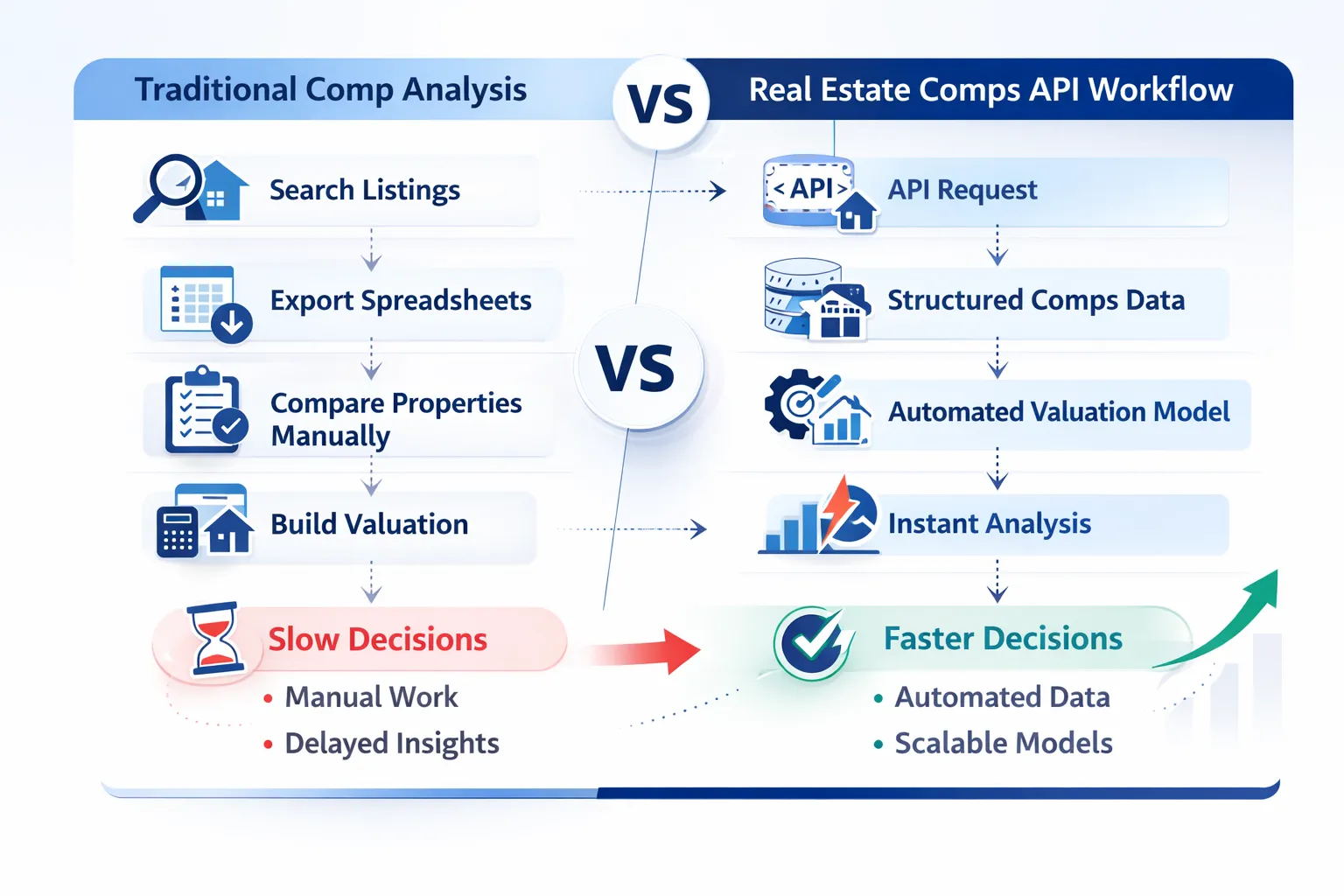
Despite their critical importance, the traditional methods of comp analysis are fraught with scalability challenges. This is primarily due to the reliance on manual processes, which often involve sifting through numerous listing platforms, local government databases, and extensive spreadsheets. This laborious approach quickly introduces several significant hurdles:
- Time-Intensive Data Collection: Manually searching for and downloading data from various sources consumes a disproportionate amount of an analyst’s time, diverting focus from higher-value strategic tasks.
- Data Inconsistency and Errors: Information from different sources can vary in format, completeness, and accuracy, leading to inconsistencies that require extensive reconciliation and introduce the risk of errors.
- Difficulty in Scaling Analysis: As the number of properties or markets to analyze increases, manual workflows become exponentially more time-consuming and resource-intensive, making it impractical for large-scale operations.
- Delayed Decision-Making: The prolonged time required for manual data gathering and analysis can lead to missed opportunities, especially in fast-moving markets where speed is essential.
- Lack of Standardization: Manual processes often result in varied data formatting and analysis methods, making it difficult to ensure consistency and comparability across different evaluations.
These limitations become acutely pronounced for entities that analyze deals at scale, such as institutional investors, large development firms, and real estate technology companies. Consequently, there is a growing industry imperative to shift towards automated data delivery mechanisms, with APIs (Application Programming Interfaces) leading the charge by enabling the instant retrieval of comps data and its direct integration into analytical models.
Understanding the Real Estate Comps API: Functionality and Impact
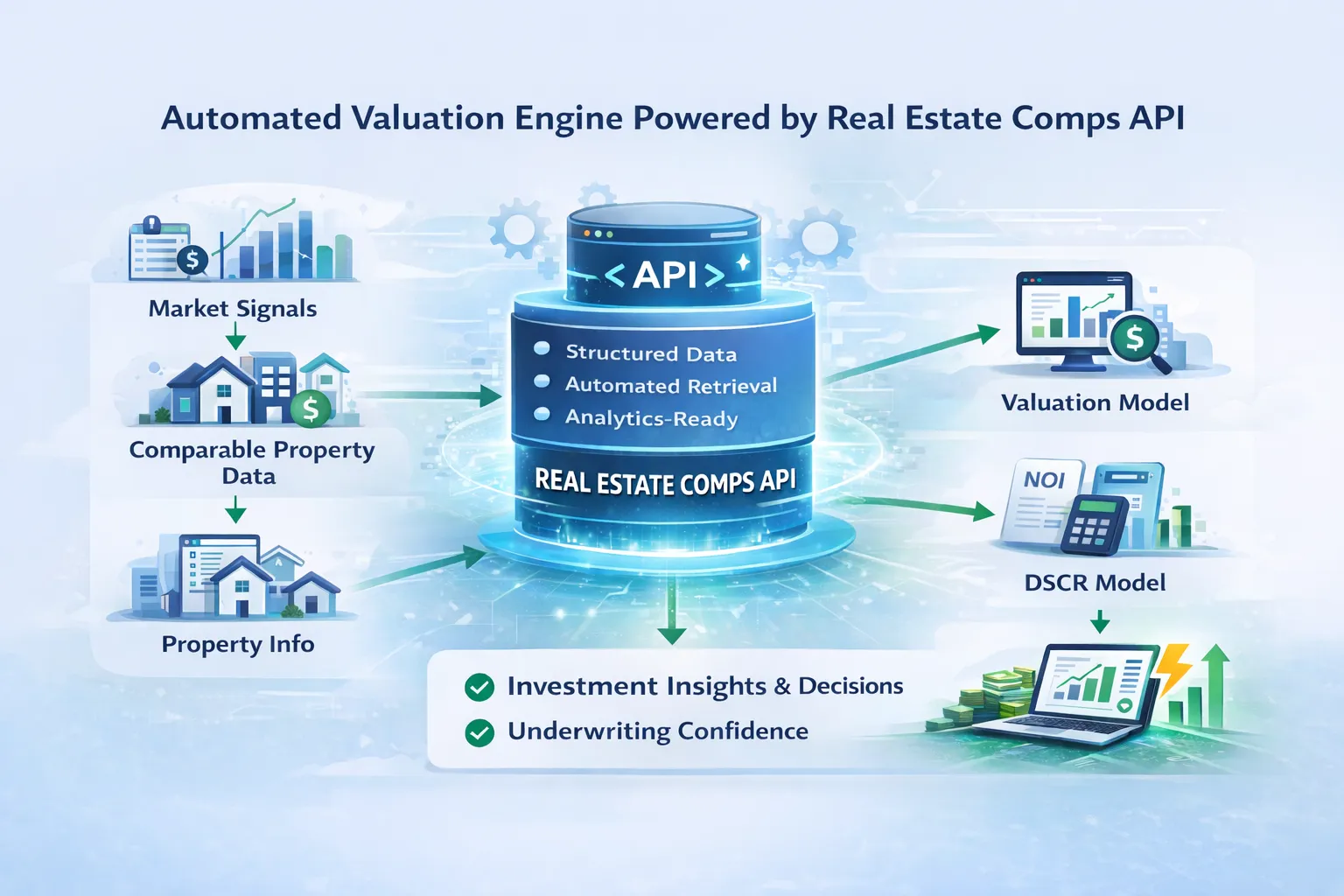
A real estate comps API fundamentally redefines the data acquisition process. Instead of manual research, it automatically delivers comprehensive comparable property data, including recent sales prices, pricing benchmarks, and detailed property characteristics, in response to structured requests. Users submit a query, typically based on a specific location or a set of property criteria, and the API returns standardized comps data that is immediately ready for integration into valuation and underwriting models.
From Static Reports to Dynamic Valuation
The traditional approach to comp analysis often relies on static reports or repetitive manual searches performed for each individual property. A comps API effectively replaces this manual underwriting step with automated, on-demand data retrieval.
The automated workflow, at a high level, typically proceeds as follows:
- Request Initiation: A user or system triggers a request to the API, specifying the property of interest and the type of comparable data needed (e.g., nearby sales, rental rates).
- Data Retrieval and Processing: The API queries its extensive database, identifies relevant comparable properties based on the provided criteria, and retrieves their associated data.
- Data Standardization: The retrieved data is automatically formatted into a structured, consistent format (e.g., JSON), ensuring compatibility with downstream applications.
- Data Delivery: The standardized data is returned to the requesting application, where it can be directly used for analysis.
This process ensures that investors and platforms can access up-to-date datasets on demand. Because the data is delivered in a standardized format, it can be immediately utilized to build repeatable valuation logic that applies consistently across different property types and geographic markets.
The Place of a Real Estate Valuation API in Modern Tech Stacks
Comparable property data is increasingly becoming an embedded component within software workflows, rather than an isolated analytical task. A real estate valuation API functions as a crucial data layer that powers a wide array of tools and applications used by various real estate professionals.
A real estate API for developers eliminates the burdensome task of aggregating raw listing datasets or maintaining complex, resource-intensive data pipelines. Instead, an automated property valuation API provides ready-to-use comps data that can be seamlessly integrated into underwriting systems, interactive dashboards, or comprehensive investment analysis platforms. This integration streamlines workflows and enhances the analytical capabilities of these tools.
Mashvisor Real Estate Comps API: Comprehensive Data, Robust Endpoints, and Advanced Features
The efficacy of a comparable sales data API is intrinsically linked to the quality, breadth, and structure of the data it provides. The Mashvisor API stands out by offering comparable property datasets that are not only rich in detail but also enriched with market benchmarks, sophisticated investment analytics, and key performance indicators, all unified within a single, comprehensive real estate analytics API. This integration allows users to transition directly from raw comparable data to actionable valuation and underwriting insights without the need for additional, time-consuming data processing.
Key Data Points Available Through the Mashvisor API
Mashvisor provides meticulously structured comparable property data designed to support advanced real estate valuation models, precise pricing analysis, and informed investment decision-making.
-
Property-Level Comparable Data: This includes essential details about individual comparable properties, such as:
- Property Address
- Property Type and Features (e.g., number of bedrooms, bathrooms, square footage)
- Sale Price (for sold properties)
- Rental Rate (for rental properties)
- Date of Sale or Listing
- Property Condition and Amenities
- Lot Size and other physical attributes
-
Market and Investment Context: Beyond raw property details, Mashvisor enriches the data with critical market and investment context, such as:
- Neighborhood Median Sale Price
- Average Rental Yields (Cap Rate)
- Cash-on-Cash Return Estimates
- Occupancy Rates
- Market Trend Data (e.g., appreciation rates, rental demand)
- Investment Potential Scores
These comprehensive endpoints empower users to integrate a real estate investment analysis API directly into their acquisition or real estate underwriting pipelines, providing a holistic view of market dynamics and investment opportunities.
Example Mashvisor API Endpoints
Mashvisor offers access to comparable property data through a variety of specialized endpoints, each designed to facilitate specific analytical needs.
- Common API Endpoints for Comparable Property Analysis:
GET /v1.1/client/property: Retrieves detailed information about a specific property.GET /v1.1/client/property/nearby: Fetches comparable properties located in the vicinity of a specified address or coordinates.GET /v1.1/client/property/transactions: Provides a history of sales transactions for a given property or area.GET /v1.1/client/property/price-estimates: Delivers automated price estimations based on comparable sales and market data.
These endpoints collectively enable a fully automated comps workflow, effectively replacing time-consuming manual research with efficient, structured data retrieval.
Illustrative Request: Retrieving Comparable Properties
Consider a scenario where a real estate developer needs to quickly assess the market value of a potential acquisition. Using the Mashvisor API, they could initiate a request to retrieve nearby comparable properties for valuation analysis.
GET https://api.mashvisor.com/v1.1/client/property/nearby?state=AZ&city=Phoenix&address=123+Main+St
Headers:
x-api-key: YOUR_API_KEY
This request efficiently retrieves nearby properties that can serve as crucial real estate comps for robust valuation modeling.
Simplified Example API Response
The API’s response is delivered in a structured JSON format, making it directly integrable into valuation or underwriting models without the need for manual data parsing or reformatting.
  "subject_property":
    "address": "123 Main St",
    "property_type": "Single Family",
    "price_estimate": 420000
  ,
  "nearby_properties": [

      "address": "118 Main St",
      "sale_price": 415000,
      "beds": 3,
      "baths": 2,
      "distance_miles": 0.3
    ,

      "address": "140 Oak Ave",
      "sale_price": 432000,
      "beds": 3,
      "baths": 2,
      "distance_miles": 0.6

  ]
This structured output ensures that the data is immediately actionable, powering valuation dashboards and automated underwriting tools with minimal delay.
Enhancing Valuation and DSCR Models with Mashvisor Data
The integration of comparable property data directly into analysis workflows significantly enhances both the accuracy and scalability of real estate valuation and DSCR models. By automating the retrieval of comps through an API, investors and developers can standardize critical assumptions, minimize manual research efforts, and consistently evaluate properties against reliable market benchmarks.
Building a Property Valuation Model with Comparable Data
Accurate property valuation models are contingent upon the use of comparable sales data to estimate fair market value, moving beyond subjective assumptions to reflect observable market behavior. Utilizing API-delivered comps facilitates the automatic repetition of this process across an unlimited number of properties and markets.
A simplified workflow for constructing a real estate valuation model using API-driven comps involves:
- Automated Comps Retrieval: The API fetches relevant comparable sales data for the subject property.
- Data Normalization and Adjustment: The retrieved data is processed to account for differences in features, condition, and sale dates, ensuring fair comparisons.
- Value Calculation: Statistical methods or algorithms are applied to the adjusted comps to derive an estimated Fair Market Value for the subject property.
- Model Integration: The calculated value is fed into the broader valuation model, which may incorporate other factors.
As comps are delivered via a real estate valuation API, the model can run automatically for each new property analyzed, ensuring consistent and scalable valuation practices.
Leveraging Comps Data for DSCR Model Analysis
The Debt-Service Coverage Ratio (DSCR) model critically depends on realistic income and valuation assumptions. Comparable property data enhances DSCR accuracy by grounding financial projections in verified market activity.
The DSCR calculation formula is:
DSCR = Net Operating Income / Total Debt Service
To accurately calculate the DSCR for a rental property, analysts typically perform the following steps:
- Estimate Potential Gross Income: This is based on current rental rates for comparable properties in the area.
- Calculate Vacancy and Credit Loss: This accounts for periods when the property may be vacant or tenants may default.
- Determine Effective Gross Income: Potential Gross Income minus vacancy and credit loss.
- Estimate Operating Expenses: This includes property management fees, property taxes, insurance, maintenance, and utilities.
- Calculate Net Operating Income (NOI): Effective Gross Income minus Operating Expenses.
- Determine Total Annual Debt Service: The sum of all annual mortgage payments (principal and interest).
- Compute DSCR: Divide the calculated NOI by the Total Annual Debt Service.
Accurate comps play a vital role in mitigating risk by preventing the common underwriting errors of overestimating property valuations or projecting unrealistic income streams.
Automating Rental Property Underwriting Workflows
When comparable property data is delivered programmatically through an API, underwriting processes can transition from manual review to automated evaluation.
A typical automated underwriting pipeline might follow this sequence:
API → Valuation Model → DSCR Calculation → Investment Decision
This form of rental property underwriting automation allows platforms to:
- Process Loans Faster: Significantly reduce the time required for initial loan evaluations.
- Ensure Consistency: Apply the same data-driven criteria to every application.
- Reduce Operational Costs: Minimize the need for extensive manual labor.
- Enhance Risk Management: Utilize more accurate data for better risk assessment.
By partnering with a real estate data API provider, teams can acquire standardized comps data ready for modeling, bypassing the need to build and maintain complex internal data infrastructure.
Real-World Example: Automating DSCR-Based Loan Underwriting
Consider a lender evaluating a loan application for a rental property. Instead of relying on lengthy manual appraisals and spreadsheet analyses, the system can automatically pull comparable property data through an API as soon as a property is submitted for consideration.
The automated workflow unfolds as follows:
- Property Submission: A loan application with property details is received.
- API Data Fetch: The system queries the comps API to retrieve relevant sales and rental data for similar properties in the vicinity.
- Automated Valuation: The retrieved comps are used to generate an immediate market value estimate for the collateral.
- Income Projection: Rental comps inform the projection of potential rental income, adjusted for vacancy and credit loss.
- DSCR Calculation: Using the estimated NOI and the loan terms, the DSCR is automatically calculated.
- Risk Assessment: The DSCR, along with other automated checks, informs an initial risk assessment and lending decision.
In this scenario, a process that previously took hours or even days is transformed into a repeatable, near-instantaneous operation. Crucially, every deal is evaluated using consistent, data-driven criteria, eliminating subjective biases and enhancing the overall integrity of the underwriting process. While this example illustrates a typical underwriting workflow, the applications of a real estate comps API extend far beyond this single use case.
Diverse Real-World Applications for Investors, Developers, and PropTech Teams
The true value of a real estate comps API is realized when it is seamlessly integrated into critical decision-making workflows. Different stakeholders within the real estate ecosystem leverage this technology to optimize their operations:
Investors and Acquisition Teams
Real estate investors utilize comparable property data to expedite deal evaluation and ensure consistency across multiple markets. Common applications include:
- Quick Deal Screening: Rapidly assessing the market value and income potential of numerous properties to identify promising opportunities.
- Pricing Strategy: Determining optimal offer prices and rental rates based on current market conditions.
- Portfolio Analysis: Evaluating the performance and potential of existing holdings against market benchmarks.
- Market Research: Gaining insights into neighborhood trends, property values, and rental demand across different submarkets.
Access to a centralized real estate comps dataset allows investors to standardize decision criteria and minimize subjective bias in deal evaluation, leading to more informed and profitable investment decisions.
Lenders and DSCR Underwriting
Lending institutions are increasingly adopting automated data workflows to assess borrower risk and collateral value. With API-delivered comps, lenders can:
- Automate Collateral Valuation: Quickly obtain up-to-date market values for properties serving as loan collateral.
- Enhance Loan Underwriting: Streamline the DSCR calculation process by using accurate income and expense projections derived from market data.
- Improve Risk Management: Make more informed lending decisions based on objective, data-driven insights into property performance and market conditions.
- Increase Operational Efficiency: Reduce the manual workload associated with property appraisals and income verification.
This approach aligns with broader industry trends toward automated underwriting, powered by historical real estate data APIs that provide a robust foundation for risk assessment.
PropTech Platforms and Developers
For real estate technology startups and established analytics platforms, comparable property data serves as a foundational data layer for building sophisticated valuation and analytics tools. Typical developer use cases include:
- Building Valuation Engines: Integrating comps data into proprietary algorithms to offer automated property valuation services.
- Developing Investment Analysis Tools: Providing users with comprehensive market insights and performance projections based on comparable data.
- Creating Real-Time Market Dashboards: Displaying up-to-the-minute sales and rental trends derived from API feeds.
- Enhancing Property Listing Platforms: Enriching property listings with detailed market context and comparable sales information.
Leveraging a best-in-class real estate data API enables these teams to launch advanced valuation features without the considerable expense and effort of building and maintaining complex property data pipelines internally.
Mashvisor API Pricing and Onboarding
The Mashvisor API employs a usage-based pricing model, offering flexibility that allows companies to scale their API access in direct proportion to their evolving data requirements. This model is well-suited for a wide spectrum of users, from nascent projects with limited initial data needs to large-scale enterprise platforms requiring extensive data volumes.
Mashvisor offers both monthly and annual subscription plans, with annual commitments providing an additional incentive of two months of service at no extra cost. The pricing structure is designed with tiered plans to cater to various stages of growth and data consumption:
- Starter Plans: Geared towards individuals or small teams with moderate data needs.
- Growth Plans: Designed for growing businesses and startups requiring more substantial data access.
- Enterprise Plans: Tailored for large organizations with extensive, mission-critical data requirements, often including dedicated support and custom solutions.
To initiate the process and explore how Mashvisor’s data solutions can be tailored to specific business needs, interested parties are encouraged to schedule a consultation call with the Mashvisor Data Team.
Key Advantages of Utilizing Mashvisor for Automated Property Valuation
Employing the Mashvisor API for comparable property analysis empowers investors and developers to transition from inefficient manual valuation workflows to scalable, data-driven decision-making processes. The distinct advantages users can expect include:
- Enhanced Efficiency: Automating data retrieval significantly reduces the time spent on manual research, allowing teams to analyze more properties in less time.
- Improved Accuracy: Access to clean, structured, and up-to-date data minimizes errors and inconsistencies inherent in manual processes, leading to more reliable valuations.
- Scalability: The API infrastructure allows for the seamless analysis of an unlimited number of properties and markets, supporting business growth without proportionate increases in operational overhead.
- Standardized Analysis: Consistent data formatting and API-driven workflows ensure that all evaluations are performed using uniform criteria, promoting comparability and reducing bias.
- Deeper Market Insights: By integrating property-specific data with broader market indicators and investment analytics, users gain a more comprehensive understanding of market dynamics.
- Faster Decision-Making: Real-time data access and automated analysis accelerate the deal evaluation process, enabling teams to act quickly on opportunities.
By consolidating comparable property data with crucial investment analytics within a single platform, Mashvisor facilitates faster, more dependable property valuation at scale.
When a Real Estate Comps API Might Not Be Necessary
While the benefits of comps APIs are substantial, they are not universally required for every real estate data need. A real estate comps API is most impactful when the objective is to analyze properties at scale or to integrate valuation capabilities directly into software workflows. However, for certain specific use cases, its implementation might introduce unnecessary complexity.
You may not require a comps API if:
- Analysis is Infrequent and Small-Scale: If you are only evaluating a handful of properties occasionally and manual research is manageable within your time constraints.
- Integration into Software is Not a Priority: If your valuation process remains a standalone activity and does not need to be embedded within a larger digital platform or workflow.
- Primary Focus is on Unique, Non-Standard Properties: For highly unique or distressed properties where traditional comps may have limited relevance, and expert human judgment plays a more dominant role.
- Budgetary Constraints Preclude API Subscriptions: If the cost of an API subscription is prohibitive for the scale of your operations.
In these scenarios, utilizing an API might add complexity without delivering a proportional return on investment. However, as soon as the need arises for faster analysis, consistent market benchmarks, or the simultaneous evaluation of multiple properties, the value proposition of automated comps data becomes significantly more compelling.
Conclusion: The Future of Real Estate Analysis is Data-Driven
As the real estate analysis landscape increasingly gravitates towards data-driven methodologies, valuation and underwriting processes are steadily transitioning from manual research-intensive tasks to automated, intelligence-powered operations. In this evolving paradigm, property comps data serves not merely as an input for a one-time analysis of individual deals, but as a continuous, dynamic feed that powers pricing models, risk evaluations, and strategic investment decisions across entire portfolios.
A real estate comps API is the instrumental enabler of this fundamental shift, delivering consistent and reliable market data directly into automated valuation and DSCR models. This empowers teams to analyze opportunities with unprecedented speed and efficiency, all while maintaining standardized assumptions and rigorous analytical integrity. With scalable access to comparable property data, essential investment metrics, and analytics-ready datasets, Mashvisor empowers investors, lenders, and PropTech platforms to dedicate more resources to strategic planning and the development of sophisticated real estate strategies, rather than being encumbered by the complexities of data acquisition and management.
FAQs
-
What Is a Real Estate Comps API?
A real estate comps API provides programmatic access to data pertaining to similar properties within a specified geographic area. This allows applications to automatically retrieve sales and market comparison data, facilitating automated valuation and analysis. -
How Is DSCR Calculated for Rental Properties?
The Debt-Service Coverage Ratio (DSCR) is calculated by dividing a property’s Net Operating Income (NOI) by its total annual debt obligations. This metric serves as a measure of a property’s ability to cover its loan payments and is crucial for lenders in assessing repayment risk. -
Who Uses Real Estate Comps APIs?
Comparable property APIs are commonly utilized by real estate investors, lending institutions, brokerages, and PropTech platforms that require scalable valuation data for analysis, reporting, or the development of automated real estate analysis systems. -
What Makes Mashvisor Different from Other Real Estate APIs?
Mashvisor distinguishes itself by focusing on investment-oriented analytics. It uniquely combines detailed property information with comprehensive market insights and performance indicators, enabling users to evaluate investment opportunities without the need to aggregate data from multiple disparate sources. -
How Do I Get Comparable Property Data Automatically?
Comparable property data can be accessed automatically by connecting analytical software tools to a data provider’s API. This API returns nearby property information and pricing benchmarks through automated requests, which are typically based on specific location or property characteristics.

