
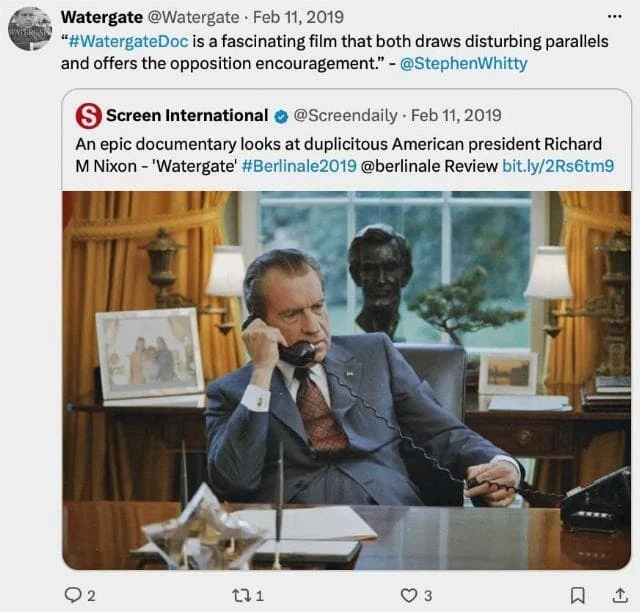
Recent discussions have ignited a debate challenging the long-established narrative of the Watergate scandal, suggesting a potential re-evaluation of the events that led to President Richard Nixon’s resignation. Authored by Silvio Canto, Jr. via American Thinker, and supported by arguments from figures like John D. O’Connor and historian Geoff Shepard, these calls propose that Watergate may have involved significant prosecutorial and Congressional misconduct, drawing parallels to more contemporary political controversies labeled as "lawfare" or "hoaxes." This perspective aims to revisit a pivotal moment in American history, questioning the ethical foundations of the investigations that captivated the nation five decades ago.
The proposition to re-examine Watergate stems from a belief that the political climate of the early 1970s, characterized by a more restricted media environment, may have obscured prosecutorial overreach and partisan motivations. Proponents argue that with "fresh eyes" and the benefit of hindsight gleaned from more recent events, a closer look at the reporting and prosecution of Watergate is warranted. Specifically, they suggest that the Department of Justice’s Office of Professional Responsibility (OPR) should investigate alleged prosecutorial misconduct and potentially revise the historical record regarding Richard Nixon’s culpability. This re-evaluation, if pursued, could fundamentally alter the public’s understanding of the 37th president’s legacy and the integrity of the institutions involved.
The Traditional Narrative: Watergate Unveiled
For over fifty years, the Watergate scandal has been understood as a profound constitutional crisis, a testament to the rule of law, and a defining moment that reshaped American politics and media. The accepted historical account details a series of political crimes and a subsequent cover-up by the Nixon administration, culminating in the president’s unprecedented resignation.
The Initial Break-in and Cover-up (June 1972): The saga began on June 17, 1972, when five men were arrested attempting to burglarize the Democratic National Committee (DNC) headquarters at the Watergate Hotel complex in Washington, D.C. Among them were former CIA operatives and security personnel associated with the Committee to Re-elect the President (CREEP). Initial White House statements dismissed the break-in as a "third-rate burglary" unrelated to the administration. However, persistent investigative journalism, notably by Bob Woodward and Carl Bernstein of The Washington Post, slowly began to uncover a deeper conspiracy.
The Unraveling and Congressional Scrutiny (1972-1973): As the burglars were brought to trial, U.S. District Court Judge John Sirica grew suspicious of the defendants’ silence and the inadequacy of the initial investigation. His questioning led to a letter from James McCord, one of the burglars, implicating high-ranking officials and suggesting a cover-up. This breakthrough prompted the Senate to establish the Select Committee on Presidential Campaign Activities, commonly known as the Senate Watergate Committee, chaired by Senator Sam Ervin.
The televised Senate hearings in the summer of 1973 captivated the nation. Key testimonies revealed the extensive efforts by the Nixon administration to obstruct justice, silence witnesses, and misuse government agencies. John Dean, Nixon’s former White House Counsel, provided explosive testimony, implicating the President in the cover-up. The most significant revelation came from Alexander Butterfield, a former White House aide, who disclosed the existence of a secret taping system in the Oval Office, which had recorded conversations pertinent to the scandal. These tapes became the central focus of the investigation.
The Saturday Night Massacre (October 1973): Nixon’s attempts to control the flow of information and obstruct the investigation escalated dramatically in October 1973. When Special Prosecutor Archibald Cox, appointed to investigate Watergate, demanded access to the White House tapes, Nixon ordered Attorney General Elliot Richardson to fire Cox. Richardson refused and resigned, as did Deputy Attorney General William Ruckelshaus. It was left to Solicitor General Robert Bork to carry out Nixon’s order, an event that became known as the "Saturday Night Massacre." This action provoked widespread public outrage and solidified suspicions of presidential wrongdoing.
Impeachment Proceedings and Resignation (1974): The House of Representatives began impeachment proceedings against President Nixon in early 1974. The Supreme Court, in United States v. Nixon, ruled unanimously that Nixon must surrender the unedited White House tapes. The tapes, when released, contained the infamous "smoking gun" conversation, revealing Nixon’s direct involvement in ordering the cover-up just six days after the break-in. Faced with certain impeachment by the House and conviction by the Senate, Richard Nixon resigned on August 9, 1974, becoming the only U.S. president to do so.
Aftermath and Legacy: Over 40 government officials, including several of Nixon’s top aides (H.R. Haldeman, John Ehrlichman, John Mitchell, John Dean, among others), were indicted, pleaded guilty, or were convicted of charges related to Watergate. The scandal led to significant reforms, including campaign finance laws and ethics legislation. It also profoundly impacted public trust in government and reinforced the role of a free press in holding power accountable.
The Case for Re-examination: "Unethical Lawfare" and the "Hoax" Claim
The contemporary push to revisit Watergate introduces a dissenting perspective, suggesting that the traditional narrative may be incomplete or even fundamentally flawed due to alleged prosecutorial and Congressional misconduct. This viewpoint posits that the proceedings against Nixon amounted to "dishonest, partisan ‘lawfare’," a term frequently used today to describe the perceived weaponization of legal processes for political ends.
Arguments by John D. O’Connor and Geoff Shepard:
Central to this re-examination are the arguments put forth by legal scholar John D. O’Connor and former Nixon aide and historian Geoff Shepard. O’Connor contends that many citizens today, having witnessed recent "highly unethical lawfare" exemplified by events like "Russiagate," are better equipped to scrutinize historical prosecutorial conduct. He argues that the "more restricted media environment of the early 1970s made prosecutorial misconduct during Watergate harder to scrutinize."
Shepard has taken a more direct approach, reportedly presenting his case to the Justice Department’s Office of Professional Responsibility (OPR). His core argument is that the proceedings against Richard Nixon were "fatally and unethically flawed." Shepard challenges two key aspects of the traditional understanding:
- Unethical Prosecution: He argues that the prosecution of Nixon and his aides (with Nixon as an unindicted co-conspirator) was so ethically compromised that the OPR should formally acknowledge its flaws. This includes allegations of grand jury manipulation, selective leaks, and the withholding of potentially exculpatory evidence.
- False Senate Report: Shepard also contends that the Senate investigation and the Majority Watergate Report contained "material particulars" that were false, constituting a "willfully false official Report to the public." He suggests that the committee’s findings were skewed to paint a predetermined picture of guilt.
Specific Points of Contention:
Proponents of this re-examination often highlight specific areas where they believe impropriety occurred:
- Grand Jury Process: Allegations suggest the grand jury was improperly influenced or used as a tool by prosecutors, potentially exceeding its mandate.
- Exculpatory Evidence: Claims that prosecutors withheld evidence that could have been favorable to the defense, thereby undermining the fairness of the proceedings.
- Scope of Conspiracy: The argument that the scope of the conspiracy attributed to Nixon and his administration was exaggerated or misrepresented, blurring the lines between political tactics and criminal acts.
- CIA Involvement: The initial break-in involved individuals with CIA ties, leading to speculation that the intelligence community’s role might have been downplayed or mischaracterized.
These arguments resonate with a segment of the public that views contemporary political investigations through a lens of skepticism regarding institutional fairness and impartiality. The parallel drawn to "Russiagate," a multi-year investigation into alleged collusion between the Trump campaign and Russia, which its critics also label as a politically motivated "hoax" or "lawfare," is central to the rhetorical framework of this re-examination. For those who believe "Russiagate" was an unjust campaign against a president, the idea that a similar pattern could have unfolded during Watergate gains traction.
Historical Context and Counterarguments
While the call for re-examination gains traction in certain circles, it stands in stark contrast to the overwhelming historical and legal consensus regarding Watergate. The established narrative is supported by a vast body of evidence, legal proceedings, and scholarly analysis that has largely affirmed the legitimacy and necessity of the investigations.
The Incontrovertible Evidence of the Tapes: The existence and content of the White House tapes remain the most formidable evidence against the "hoax" theory. These recordings, many of which were released and transcribed, contain Nixon’s own voice discussing the cover-up, including instructions to obstruct the FBI investigation, offer "hush money" to the burglars, and leverage government agencies for political retaliation. The "smoking gun" tape, recorded just days after the break-in, clearly shows Nixon ordering his chief of staff, H.R. Haldeman, to tell the CIA to block the FBI’s investigation into the DNC break-in, citing national security pretexts. This direct evidence of obstruction of justice, confirmed by the Supreme Court, is difficult for any revisionist theory to circumvent.
Broad Legal and Bipartisan Consensus: The investigations into Watergate were not solely the work of a partisan opposition. Key moments, such as the Senate Watergate Committee hearings, garnered bipartisan support. The House Judiciary Committee’s impeachment articles, while initially contentious, ultimately gained bipartisan backing as the evidence mounted. The appointment of Special Prosecutors Archibald Cox and later Leon Jaworski, both highly respected legal figures, was intended to ensure impartiality, and their actions were largely upheld by the judiciary, including the Supreme Court. The numerous convictions of Nixon administration officials, many of whom pleaded guilty, further underscore the factual basis of the crimes committed. Figures like John Dean, who implicated Nixon, and others who cooperated with prosecutors, provided extensive testimony that corroborated the official findings.
Scholarly and Journalistic Integrity: Generations of historians, legal scholars, and journalists have meticulously documented and analyzed Watergate. While debates exist over specific nuances, the core facts of the break-in, the cover-up orchestrated by the White House, and Nixon’s direct involvement have been widely accepted across the academic and journalistic spectrum. Major historical works and biographies of Nixon, even those sympathetic to him, generally acknowledge his role in the cover-up as the cause of his downfall. The Pulitzer Prizes awarded to The Washington Post for its coverage reflected a widespread recognition of the journalists’ rigorous and fact-based reporting, which was subsequently validated by official investigations.
The Nature of "Lawfare" Allegations: While claims of "lawfare" and political weaponization of justice are increasingly common in contemporary discourse, applying them retroactively to Watergate requires substantial new evidence to overturn decades of established legal and historical findings. The burden of proof would be immense, needing to demonstrate systematic, deliberate, and widespread prosecutorial malfeasance that was sufficient to manufacture guilt where none existed, despite the primary evidence of the tapes and the confessions of numerous high-ranking officials.
Potential Implications of a Re-evaluation
Should the Department of Justice or another official body undertake a formal re-examination of Watergate based on these claims, the implications would be far-reaching and profound:
Altering the Historical Record: A formal finding of "unethical lawfare" or a "hoax" would represent an unprecedented revision of one of America’s most significant historical events. It would challenge the integrity of the judiciary, Congress, and the special prosecutor’s office of that era. Textbooks would need to be rewritten, and the understanding of presidential power, accountability, and the role of checks and balances would be fundamentally reshaped.
Impact on Trust in Institutions: Such a re-evaluation would further erode public trust in government institutions, particularly the Department of Justice and the legal system. If a scandal as historically definitive as Watergate could be declared a "hoax" decades later, it could foster deeper cynicism about the fairness and impartiality of all governmental investigations, past and present. Conversely, if the claims were thoroughly investigated and found baseless, it could reaffirm the resilience of the historical record, but only after potentially divisive public discourse.
Fueling Political Discourse: The debate would undoubtedly become a central point in contemporary political discourse, further polarizing discussions about presidential accountability, the media, and the justice system. It would likely be leveraged by political factions seeking to validate their own narratives about "lawfare" and the alleged weaponization of government against political opponents.
Nixon’s Legacy: For Richard Nixon’s legacy, a successful re-examination could offer a contentious form of rehabilitation regarding Watergate. It would seek to shift the blame from the president to alleged misconduct by his accusers, potentially recasting him as a victim of a politically motivated campaign rather than the architect of a criminal cover-up. However, such a shift would be met with immense resistance from historians and legal scholars who have spent decades analyzing the evidence.
Conclusion
The call to re-examine the Watergate scandal, driven by arguments of "unethical lawfare" and comparisons to modern political controversies, represents a significant challenge to a deeply ingrained historical narrative. While proponents argue for a fresh, critical look at prosecutorial and Congressional conduct from the early 1970s, the established historical consensus, buttressed by the White House tapes, numerous convictions, and extensive scholarly analysis, presents a formidable counter-narrative. Any official investigation into these claims would face immense scrutiny and require overwhelming, undeniable evidence to overturn decades of legal and historical precedent. The debate underscores the enduring power of historical interpretation and the ongoing struggle to define truth in an increasingly polarized political landscape, forcing a re-evaluation not just of the past, but also of the present mechanisms of accountability and justice.

