
The United States labor market delivered a significant upside surprise in August, adding 162,000 nonfarm payroll jobs, a figure triple the consensus expectation of approximately 56,000. This robust economic data has injected fresh uncertainty into the Federal Reserve’s interest rate outlook ahead of its upcoming Federal Open Market Committee (FOMC) meeting on September 15-16. In the immediate aftermath of the jobs report’s release, Bitcoin (BTC) experienced a notable price correction, falling from $81,300 to intraday lows of $78,600 before stabilizing around $79,500 at the time of reporting.
The significance of this labor market data cannot be overstated, particularly given the prevailing divergence of opinions regarding the Federal Reserve’s next monetary policy move. Historically, under previous Federal Reserve chairs, market expectations for FOMC decisions were generally well-anchored, providing a degree of predictability. However, the current environment, characterized by a perceived lack of explicit forward guidance from Chair Kevin Warsh and the potential for dissenting voices within the committee, has fostered heightened market uncertainty.
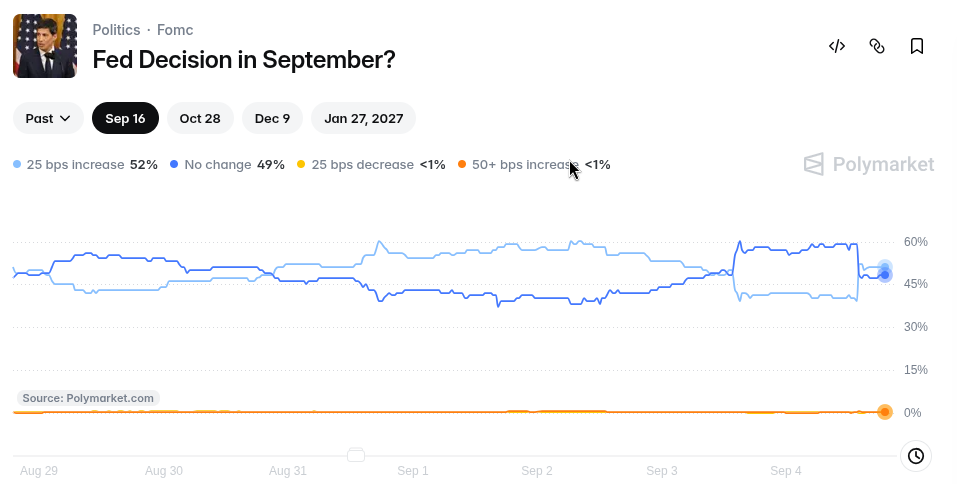
Just days prior to the jobs report, Fed Governor Christopher Waller’s remarks on Thursday, indicating a preference for a rate pause pending further inflation data, had shifted market sentiment. Polymarket, a popular prediction market, saw probabilities swing towards a 60% chance of a pause and a 40% likelihood of a 25 basis-point interest rate hike. Friday’s unexpectedly strong labor market figures, however, served to rebalance these probabilities, pushing them back to a near 50/50 split between a pause and a hike. This recalibration reflects the market’s assessment of how the Fed might interpret the conflicting signals of cooling inflation concerns versus a strengthening labor market.
In response to the encouraging employment numbers, U.S. President Donald Trump reiterated his calls for interest rate reductions. In a statement posted on Truth Social, Trump urged the Federal Reserve Board to "get smart" and act as "PATRIOTS," asserting that "High interest rates put the U.S.A. at a very unfair disadvantage, and I won’t allow that to happen!" This marks a notable escalation of Trump’s public commentary on monetary policy, as he had previously focused his criticism on former Fed Chair Jerome Powell but had refrained from similar direct pronouncements concerning the current leadership until this instance. The President’s consistent advocacy for lower interest rates stems from his belief that such a policy environment is conducive to economic growth and competitiveness on the global stage.
Bitcoin Network Gears Up for Potential Fork Amidst Centralization Concerns
Beyond macroeconomic influences, the Bitcoin ecosystem is also navigating a significant technical development. Following the activation of the BIP-110 soft fork on August 7th, the Bitcoin network briefly experienced a split, resulting in two competing chains. One chain adhered to the new rules introduced by BIP-110, while the other continued operating under the pre-existing protocol. The BIP-110 compliant chain, however, faced significant challenges, largely stalling due to insufficient mining power dedicated to its extension.
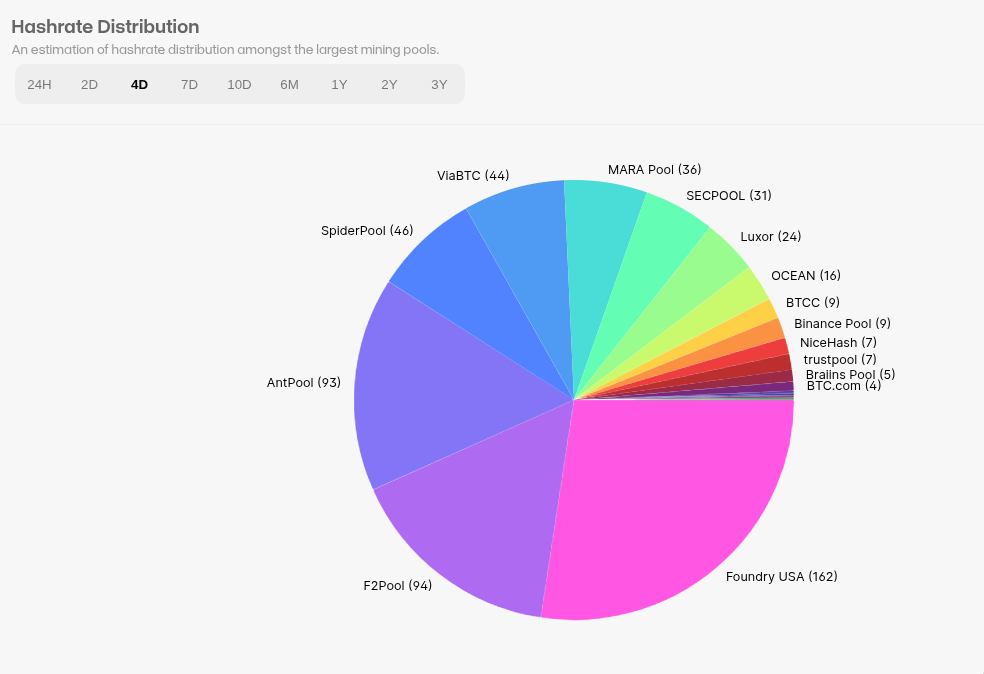
Proponents of BIP-110 viewed the miners’ reluctance to support this user-activated soft fork (UASF) as compelling evidence of increasing centralization within Bitcoin’s mining layer. This criticism was further amplified by the apparent absence of a coordinated counter-effort from the Bitcoin Core community, such as a user-rejected soft fork (URSF). The concentration of hashrate among a small number of mining pools – with five pools reportedly controlling the vast majority of Bitcoin’s computing power – grants them considerable influence over which chain gains traction and which transactions are confirmed in blocks. This dynamic has raised concerns about the potential for a single entity or a small group to exert undue control over the network.
In direct response to these perceived centralization issues and the stalled BIP-110 chain, a faction of BIP-110 supporters, notably led by developer Luke Dashjr, has embarked on a new path. They have initiated a hard fork designed to shift the network’s proof-of-work (PoW) algorithm to Blake2b. The stated objective of this transition is to foster the emergence of a new, more decentralized mining community, facilitated by DATUM gateway technology. This hard fork was officially launched on August 30th.
Under this new arrangement, every Bitcoin address that held SHA-256 Bitcoin prior to August 7th, and potentially even after, will possess an equivalent balance on the Blake2b-based version of Bitcoin. This mechanism aims to ensure that existing Bitcoin holders are not disadvantaged by the network split and the change in the underlying consensus algorithm.
Currently, the Blake2b version of Bitcoin has seen its first exchange listing on Neoxa. While trading volume remains nascent, indicating thin liquidity, the Blake2b coins are presently trading at approximately $350 against USDC, with a reported spread of 1.1%. This early trading activity provides the initial market valuation and liquidity for this new iteration of Bitcoin, offering a glimpse into its potential market reception. The development represents a significant attempt to address concerns about mining centralization by introducing a novel proof-of-work algorithm, thereby potentially attracting a broader and more diverse set of miners.
Economic Indicators and Market Reactions
The August jobs report, released by the Bureau of Labor Statistics, indicated a net gain of 162,000 jobs across all nonfarm payrolls. This figure significantly surpassed the 56,000 jobs economists had forecast. The unemployment rate remained steady at 3.7%, a testament to the ongoing strength of the U.S. labor market despite broader economic uncertainties. Key sectors contributing to this job growth included healthcare, leisure and hospitality, and professional and business services. However, manufacturing employment saw a slight decline, a trend that will be closely monitored in subsequent reports.
The immediate impact on financial markets was palpable. The benchmark S&P 500 futures saw a slight dip following the jobs data, reflecting investor adjustments to the potential implications for Fed policy. Treasury yields, particularly on shorter-term maturities, experienced an uptick, signaling increased expectations of a less dovish Federal Reserve.
For Bitcoin, the reaction was more pronounced. The cryptocurrency, which had been trading in a tight range, experienced a sharp sell-off as traders reacted to the diminished likelihood of an imminent rate cut. The strong jobs report suggests that the U.S. economy may be more resilient than previously anticipated, potentially giving the Federal Reserve more room to maintain its current monetary policy stance or even consider further tightening if inflation pressures resurface. The volatility underscores the sensitivity of digital assets to macroeconomic shifts and central bank policy signals.
Federal Reserve’s Dilemma and Future Outlook
The Federal Reserve finds itself at a critical juncture. On one hand, the persistent strength of the labor market suggests that the economy can withstand higher interest rates without succumbing to a significant downturn. This would support the Fed’s objective of bringing inflation back to its 2% target. On the other hand, signs of moderating inflation and the potential for global economic headwinds necessitate a cautious approach to further monetary tightening.
Fed Chair Kevin Warsh has emphasized data-dependency in policy decisions, and the latest employment figures provide a strong data point. The upcoming FOMC meeting will be closely watched for any subtle shifts in language or forward guidance that could illuminate the committee’s thinking. The interplay between inflation data, labor market dynamics, and global economic conditions will be paramount in shaping the Fed’s decisions in the coming months.
The debate over interest rates also has broader implications for asset classes beyond traditional equities and bonds. Cryptocurrencies, including Bitcoin, have often been viewed as a potential hedge against inflation and currency debasement. However, their correlation with risk assets has also increased, making them susceptible to broader market sentiment and changes in risk appetite, which are heavily influenced by central bank policy.
The Genesis of the Blake2b Fork: A Response to Centralization
The narrative surrounding the BIP-110 soft fork and the subsequent hard fork to Blake2b highlights a persistent tension within the Bitcoin community: the balance between decentralization and efficiency. BIP-110 was intended to introduce new functionalities or improvements to the Bitcoin protocol through a soft fork, a backward-compatible upgrade. However, the failure of miners to adequately support the chain proposed by the UASF mechanism points to a potential disconnect between user-driven development and the mining consensus.
The concentration of hashrate among a few large mining pools has been a recurring concern for many in the cryptocurrency space. These pools operate as intermediaries, aggregating the computational power of individual miners. While this model offers economies of scale and operational efficiency, it also creates points of centralization where decisions about block propagation and transaction inclusion can be influenced. The argument for the Blake2b fork is that a different proof-of-work algorithm, potentially less resource-intensive or more amenable to specialized hardware, could democratize mining.
The DATUM gateway technology mentioned in the context of the Blake2b fork is described as a solution designed to facilitate decentralized applications and services. Its integration with a new PoW algorithm aims to create an ecosystem where a wider array of participants can engage in the mining process, thereby strengthening the network’s decentralization.
The act of a hard fork, as opposed to a soft fork, is a more contentious process. It requires all participants to upgrade their software to remain on the same network. If a significant portion of the network does not upgrade, the chain splits permanently, creating two distinct cryptocurrencies. In this instance, the BIP-110 supporters have opted for a hard fork to establish a new chain with the Blake2b algorithm, effectively creating a new cryptocurrency derived from the original Bitcoin blockchain.
The fact that every address holding SHA-256 Bitcoin before August 7th will have an equivalent balance on the Blake2b version is a crucial element of this hard fork. This "snapshot" approach ensures that holders of the original Bitcoin are airdropped the new coins, allowing them to participate in the new ecosystem if they choose. It also aims to prevent contentious disputes over ownership of the newly minted coins.
The initial trading activity on Neoxa Exchange, though limited, provides the first market signal for the value of this new Blake2b Bitcoin. The low spread suggests that early market makers are actively participating, but the thin liquidity means that larger trades could significantly impact the price. The success of this new chain will ultimately depend on its ability to attract a substantial and sustained mining effort, develop its own ecosystem of applications and services, and gain broader adoption and recognition within the cryptocurrency market.
Broader Implications and Future Trajectory
The interplay between macroeconomic policy and the evolution of digital asset technology presents a fascinating case study. The U.S. labor market’s resilience is a positive indicator for the broader economy, but it complicates the Federal Reserve’s task of managing inflation without stifling growth. The resulting uncertainty in monetary policy directly impacts risk assets, including Bitcoin, which has become increasingly intertwined with traditional financial markets.
Concurrently, the developments within the Bitcoin network, particularly the push for greater decentralization through algorithmic changes, highlight the ongoing innovation and ideological debates within the cryptocurrency space. The success or failure of the Blake2b version of Bitcoin will offer valuable insights into the feasibility of creating more decentralized mining networks and the appetite for alternative consensus mechanisms.
As the year progresses, investors and observers will be closely monitoring the Federal Reserve’s actions, the trajectory of inflation, and the continued development and adoption of innovative blockchain technologies. The coming months are likely to be characterized by continued market volatility and significant developments in both the macroeconomic and technological landscapes that shape the future of finance.
This article is produced in accordance with Cointelegraph’s Editorial Policy and is intended for informational purposes only. It does not constitute investment advice or recommendations. All investments and trades carry risk; readers are encouraged to conduct independent research.

