
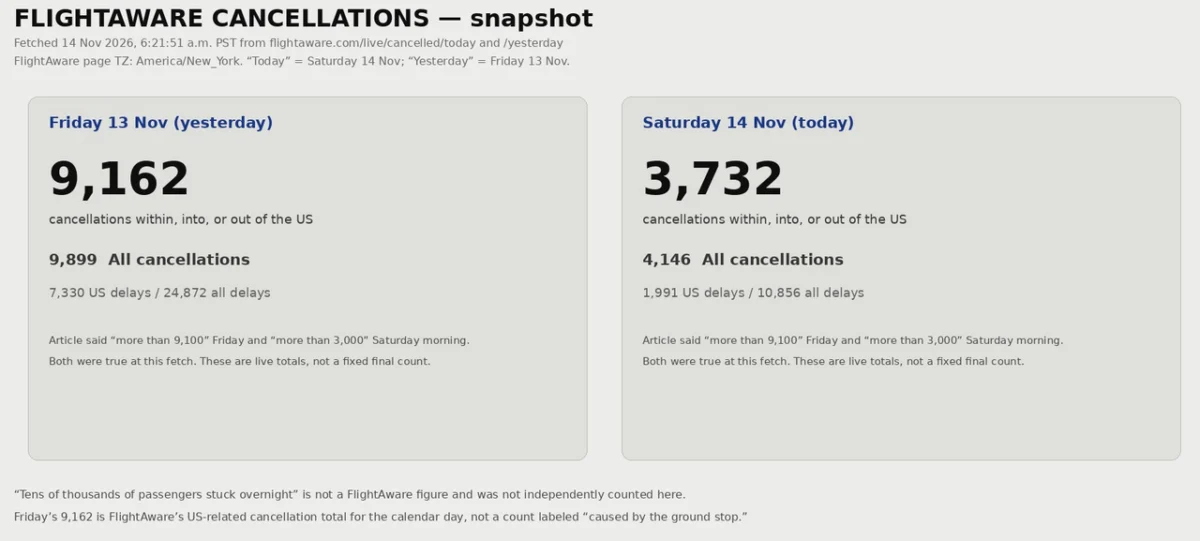
More than 3,000 flights within, into, or out of the United States had been canceled by Saturday morning, according to FlightAware, as airlines struggled to recover from a nationwide ground stop on Friday. This unprecedented halt wiped out over 9,100 flights on Friday alone, leaving tens of thousands of passengers stranded in airports across the country and globally, grappling with overnight delays and uncertain travel plans. The cascading effect of the Federal Aviation Administration’s (FAA) system failure underscored the fragility of the nation’s aging air traffic control infrastructure and immediately sparked a renewed, intensified debate over critical modernization efforts and funding.
The Friday Ground Stop: A Chronology of Disruption
The severe disruption commenced on Friday afternoon, initiating what would become only the second nationwide ground stop since the tragic events of September 11, 2001. At approximately 3:36 p.m. ET, the FAA began experiencing "instability for our radar and our communications" across various air traffic control centers nationwide. Transportation Secretary Sean Duffy later explained during a White House briefing that the core issue stemmed from an overload of data, causing "our switches, our routers actually got overloaded with data and they went down." He further elaborated on the antiquated nature of the system, noting, "it’s the old hardware that went down" while the FAA’s newer IP switches remained operational, lamenting the reliance on "1980s little copper lines."
The initial halt quickly escalated into a complete nationwide ground stop, with all domestic departures temporarily suspended. This immediate measure was put in place to prevent further strain on the compromised system and to ensure the safety of ongoing flights. For roughly four hours, the American airspace experienced an eerie stillness as aircraft remained grounded, creating a logistical nightmare for airlines and a frustrating ordeal for passengers. The FAA, via its official social media channels, confirmed the lifting of the ground stop at approximately 8:15 p.m. ET, assuring the public that systems had been "thoroughly tested… to confirm they were stable and that operations remain reliable." Despite this assurance, Secretary Duffy cautioned reporters, stating, "It’s going to be slow," acknowledging the extensive time required for airlines to restore normal capacity and rebook a massive number of displaced passengers.
Ripple Effect: Saturday’s Continued Cancellations and Passenger Impact
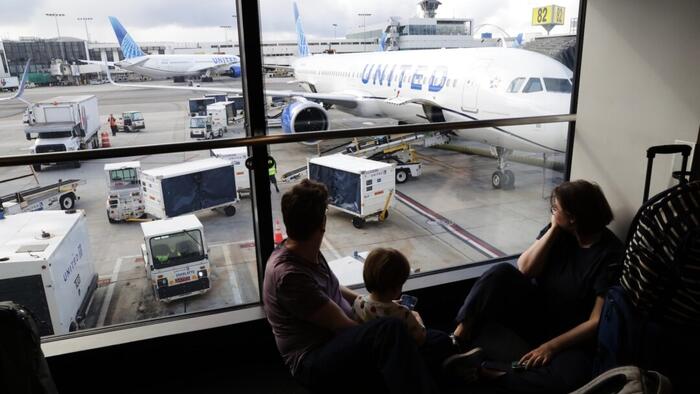
The aftermath of Friday’s ground stop extended well into Saturday, illustrating the profound and lingering impact of such a widespread systemic failure. The initial wave of cancellations on Friday, exceeding 9,100 flights, created a substantial backlog, crew displacement, and aircraft out-of-position, making a swift recovery impossible. The additional 3,000-plus cancellations reported by Saturday morning were a direct consequence, highlighting the complex logistical challenges faced by airlines in rescheduling flights and re-routing passengers. Major hubs, including Atlanta Hartsfield-Jackson, Dallas/Fort Worth, Chicago O’Hare, and Denver International, experienced significant operational bottlenecks, with thousands of travelers left waiting in terminals, scrambling for alternative travel arrangements, or enduring unexpected overnight stays.
The human toll of such a disruption is considerable. Beyond the immediate inconvenience, travelers faced missed connections, forfeited vacation days, critical business meetings abandoned, and significant financial losses due to unexpected accommodation costs, meal expenses, and lost wages. For airlines, the financial implications are equally severe, encompassing compensation for delayed and canceled flights, increased operational costs, and potential reputational damage. Industry analysts estimate that major air travel disruptions can cost airlines tens of millions of dollars per day, not to mention the broader economic impact on tourism and commerce.
Decades of Neglect: The Root Cause of System Failure
The underlying cause of the nationwide ground stop points to a systemic vulnerability long highlighted by experts and policymakers: the reliance on decades-old, analog equipment within the FAA’s critical air traffic control infrastructure. Homeland Security Secretary Markwayne Mullin offered a less forgiving assessment of the ongoing modernization efforts, suggesting that the issue was not just aging equipment, but a flawed upgrade strategy. He stated that the new equipment being "bolted onto the network was overwhelming the older system," characterizing the piecemeal approach as "nickel and diming it together does not work." This statement powerfully encapsulated the core problem: attempting to integrate modern digital components with antiquated analog systems creates compatibility conflicts and points of failure rather than seamless upgrades.
The FAA’s National Airspace System (NAS) is a complex network overseeing approximately 45,000 flights daily, managing air traffic across 5,000 locations, and utilizing over 600 radar systems. Many components of this vast system date back to the 1970s and 1980s, including crucial radar and communications equipment. While some upgrades have occurred, particularly in software and certain digital interfaces, the fundamental hardware and communication lines in many centers remain relics of a bygone era. This technical debt has accumulated over decades, often due to inconsistent funding, bureaucratic hurdles, and the sheer scale of the undertaking. Previous incidents, such as the January 2023 outage of the Notice to Air Missions (NOTAM) system – a pilot-alert system – and a September outage that affected New York airports due to a cut fiber line at the Philadelphia TRACON, served as stark warnings. These events, alongside the latest ground stop, underscore a dangerous pattern of critical infrastructure failures stemming from underinvestment and deferred maintenance.
A Familiar Plea: Escalating Funding Demands

The immediate aftermath of the ground stop saw a dramatic escalation in calls for emergency funding for FAA modernization. Just one day before the Friday outage, on Thursday, Transportation Secretary Sean Duffy and budget director Russ Vought had sent a letter to congressional appropriators requesting $30.1 billion for the FAA, mirroring elements of the "Modern Skies Act" introduced by Senator Eric Schmitt (R-Mo.) in September. Of that figure, only $10.1 billion was specifically earmarked for air traffic control upgrades.
However, by Friday night, with the full scale of the disruption evident, the funding request ballooned. Secretary Duffy declared the situation an emergency, publicly demanding $50 billion from Congress. "This is an emergency – I want Congress to give us emergency funding," Duffy stated emphatically. Homeland Security Secretary Mullin echoed this sentiment, estimating that a "complete overhaul" would require a similar figure. This revised demand represented a significant increase – $19.9 billion more than the White House had formally requested just 24 hours prior, highlighting the sudden, acute recognition of the problem’s severity.
The fluctuating funding requests and estimates reveal a long-standing struggle over FAA modernization. Congress had already allocated $12.5 billion to the FAA in the July 2025 reconciliation law, which Secretary Duffy had referred to as only "partial funding." In January of the previous year, the FAA itself had estimated the total overhaul cost at "at least $32.5 billion," with Duffy at the time requesting an additional $20 billion to complete the project by the end of President Trump’s term. When factoring in Thursday’s letter ($30.1 billion) on top of the $12.5 billion already provided, the total already stood at $42.6 billion, exceeding the previous estimate by over $10 billion, even before Friday’s emergency appeal pushed the figure to $50 billion. This dynamic illustrates a pattern of underestimation and reactive funding requests, often triggered by crisis, rather than proactive, sustained investment.
Investigating the Incident: Cyberattack Ruled Out, AI Under Scrutiny
In the immediate wake of the ground stop, a critical concern was the potential for a cyberattack. Given the increasing sophistication of cyber threats against critical infrastructure, federal agencies swiftly launched an investigation. Homeland Security Secretary Markwayne Mullin provided reassuring news, stating that investigators had found "no sign of a cyberattack." He elaborated, "There’s no chatter," and "We haven’t seen any footprints, as you would say, or identifications of people that got into the system." This preliminary assessment alleviated immediate national security fears, shifting the focus squarely back to internal system vulnerabilities.
However, questions arose regarding the potential involvement of new technologies. A reporter specifically inquired whether the FAA’s new AI traffic tool played a role in the outage. Secretary Mullin did not entirely dismiss the possibility, responding, "We’re looking at that. That’s part of something that obviously, through CISA at DHS, we are we’re taking a look." This response prompted the company behind the FAA’s SMART traffic-planning system, Air Space Intelligence (ASI), to issue a swift denial. ASI clarified via their social media, stating, "The current ground stop is not based on or a result of the SMART system, any product of ASI or our integration with FAA and ATC." While the immediate cause was identified as an overload of old hardware, the brief mention of AI highlights the ongoing complexities and potential risks associated with integrating cutting-edge technology into legacy systems, even if unrelated to this specific incident.

Congressional Scrutiny and the Path Forward
The widespread disruption immediately galvanized members of Congress, prompting pledges of thorough review and renewed calls for action. On Capitol Hill, Senate Commerce Committee Republicans highlighted the alarming statistic that one of the country’s 22 air route traffic control centers had not been built since the presidency of Lyndon Johnson, underscoring the deep-seated nature of the infrastructure deficit. Senator Maria Cantwell (D-Wash.), poised to assume leadership of the committee in January following a Democratic Senate majority, announced that her committee would meticulously review how planes communicate on their primary frequencies, a direct reference to the reported communications failures. Similarly, the leaders of the House Transportation Committee, Representatives Sam Graves (R-Mo.) and Rick Larsen (D-Wash.), jointly promised to "thoroughly review" the incident to ascertain what went wrong and how to prevent future occurrences.
Secretary Duffy, seizing the urgency of the moment, pressed Congress to act decisively during the upcoming lame-duck session, emphasizing the critical window of opportunity. "We now have an opportunity in an emergency funding bill before the end of the year to give the money," he urged, noting that Republicans would control the Senate until January, potentially streamlining the approval process for such a bill. The declaration by Secretary Mullin that "the president has declared this a national emergency" further intensified the call for immediate legislative action, aiming to bypass standard budgetary procedures for swift allocation of funds. The pressure on Congress is now immense, not only to approve the requested funds but also to ensure robust oversight of how these funds are utilized to achieve genuine, long-term modernization rather than piecemeal fixes.
Broader Implications: Trust, Economy, and the Future of Air Travel
The nationwide ground stop represents more than just a logistical hiccup; it carries profound implications for public trust, the national economy, and the future trajectory of air travel in the United States. Each such incident erodes public confidence in the reliability and safety of the national airspace system, potentially deterring travel and impacting sectors heavily reliant on aviation, such as tourism, trade, and logistics. For an economy that relies on seamless connectivity and just-in-time supply chains, widespread flight disruptions can have ripple effects far beyond the immediate travel industry, impacting businesses and consumers alike.
The repeated failures of critical FAA systems also raise questions about America’s global competitiveness in aviation infrastructure. As other nations invest heavily in advanced air traffic management systems, the United States risks falling behind, potentially impacting its status as a leader in aviation technology and safety. The incident serves as a stark reminder that infrastructure investment is not merely about convenience; it is a fundamental component of national security, economic stability, and public safety. The call for $50 billion for a "complete overhaul" signifies a monumental task that will require sustained political will, bipartisan cooperation, and a clear, long-term strategic vision, moving beyond reactive funding cycles to proactive infrastructure development. The outcome of the current funding debate and subsequent modernization efforts will undoubtedly shape the landscape of American air travel for decades to come.

