

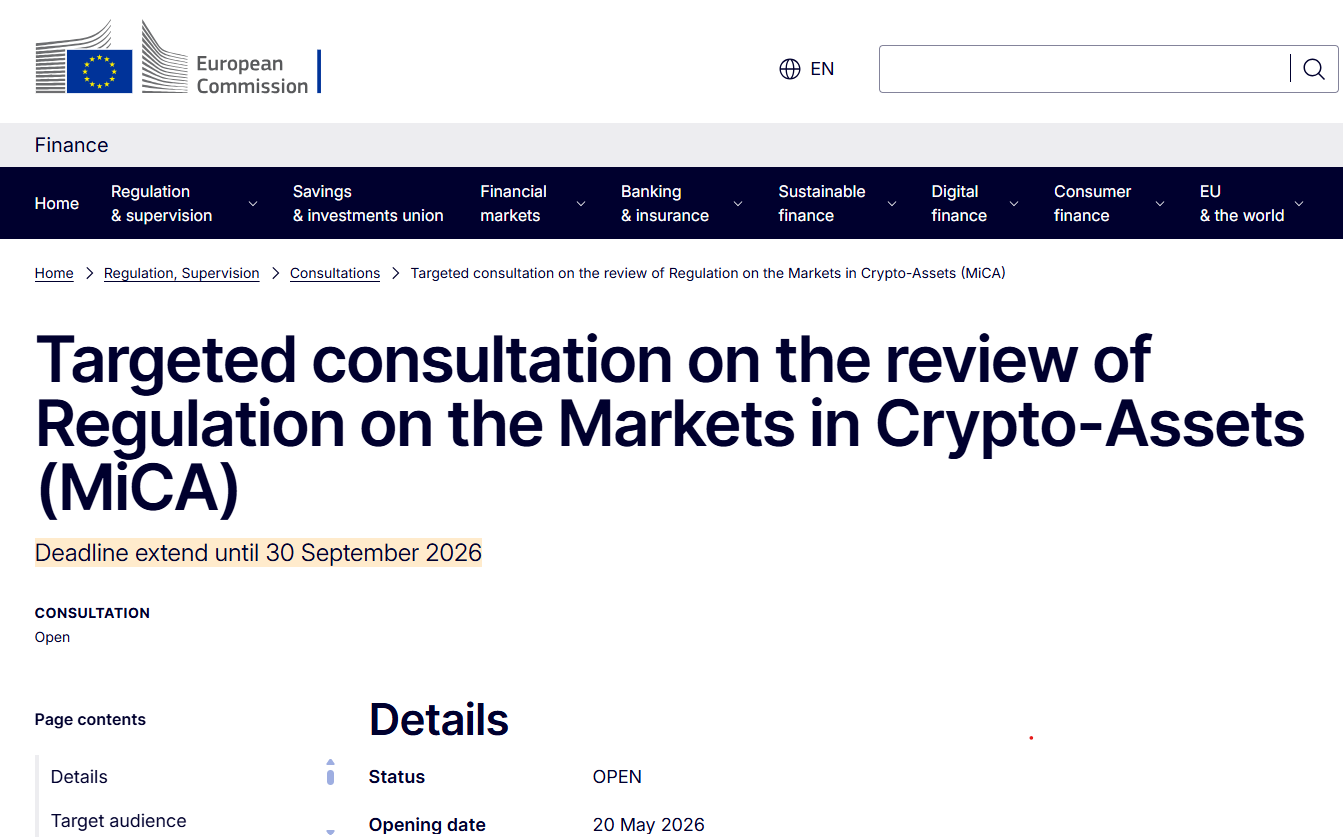
The European Commission has initiated a targeted consultation, signaling a significant shift in its approach to regulating the burgeoning cryptocurrency market. On May 20, 2026, the Commission formally invited stakeholders to provide input on critical areas of the crypto ecosystem that were initially excluded from the landmark Markets in Crypto Assets (MiCA) regulation. Central to this consultation are the complex and evolving realms of decentralized finance (DeFi) and, specifically, crypto lending and borrowing activities. This move signifies Brussels’ growing recognition that the existing regulatory perimeter may be insufficient to address the risks and opportunities presented by these innovative financial mechanisms.
The core of the current debate revolves around the legal classification and regulatory treatment of crypto lending vaults. These sophisticated on-chain structures can facilitate the flow of billions of euros in credit markets without necessarily mirroring the operational or legal characteristics of traditional lending institutions. Presently, their regulatory status is ambiguous, often relying on non-binding interpretations that place them outside the purview of MiCA and existing EU fund regulations. This ambiguity creates a fertile ground for regulatory uncertainty and potential arbitrage, prompting the Commission to explore a more defined approach.
Unraveling the "Vault" Conundrum: A Legal Labyrinth
The legal landscape surrounding these crypto lending vaults is characterized by a notable lack of clear definition. Yuriy Brisov, an EU digital assets lawyer and partner at Digital & Analogue Partners, articulated this challenge, stating, "EU law has no category called a ‘vault.’ A lawyer therefore defines it the way a regulator would qualify it: by function, not by label." This functional approach underscores the difficulty regulators face in categorizing entities that can perform the economic functions of lending while dispersing operational responsibilities across smart contracts and a multitude of participants, rather than concentrating them within a single corporate entity.
This inherent complexity poses a significant regulatory challenge for Brussels. If the Commission decides to bring crypto lending activities within the regulatory ambit, the implications for the broader DeFi ecosystem, and particularly for the individuals and protocols underpinning these vaults, will be profound. The consultation, set to conclude on September 30, 2026, represents a critical juncture in shaping the future of crypto asset regulation in the European Union.
Morpho: A Case Study in Regulatory Ambiguity

The decentralized lending protocol Morpho offers a tangible example of the regulatory complexities involved. Its lending infrastructure, particularly its Vault V2 architecture, illustrates why fitting these structures into existing regulatory models is a formidable task. Morpho’s design intentionally distributes responsibilities among various actors: an owner, a curator, an allocator, and a sentinel. The curator is tasked with configuring strategy and risk parameters, the allocator executes asset allocations, and the sentinel is empowered with risk-mitigation functions.
This intricate division of labor means that no single participant inherently appears to be providing a regulated lending service as defined under MiCA. However, the very nature of this distributed control makes it difficult to identify a clear-cut "provider" in the conventional sense. This contrasts sharply with traditional lending, where a single institution typically holds the responsibility and is subject to specific regulatory oversight. The European Commission’s challenge lies in devising a framework that can effectively capture the economic substance of lending without stifling innovation or being rendered obsolete by the rapid evolution of DeFi protocols.
Jonathan Galea, a partner at Cahill Gordon & Reindel, delved into this issue in a recent client alert, analyzing the position of lending vaults within the EU’s financial regulatory framework. His research highlights how vault structures can straddle multiple regulatory domains, including MiCA, stablecoin regulations, and European fund law. Galea emphasizes the need for a nuanced approach, cautioning against treating all "lending vaults" as a monolithic category. He argues that "lending vaults solve more practical problems than they create." By efficiently channeling fragmented liquidity into lending markets, these vaults serve a vital economic function. However, he also notes that other types of vaults might engage in the buying and selling of crypto assets, necessitating a different regulatory treatment.
Galea’s concern is that a broad regulatory net cast over "DeFi lending" as a single label could inadvertently capture diverse structures with fundamentally different economic functions and control mechanisms. This could lead to regulatory capture, where protocols that warrant distinct regulatory responses end up being treated identically, potentially leading to unintended consequences and hindering the development of specific DeFi innovations.
Defining the Scope: Who is Truly in Control?
A key consideration for the European Commission is the extent to which crypto asset services are provided in a "fully decentralized manner." MiCA, in its current form, excludes services that operate in such a way. However, the regulation can still apply if only a portion of an activity is performed in a decentralized manner. This distinction is crucial for determining the applicability of MiCA to DeFi protocols.
One potential regulatory approach could be to use the degree of decentralization as a primary dividing line. However, Galea posits that such a test might unfairly disadvantage newer and more innovative protocols. He suggests that "Decentralization is a spectrum and a function of time: a test built on it would penalize newer, more novel protocols while entrenching mature incumbents that have had years to distribute control." This perspective highlights the dynamic nature of DeFi and the difficulty of applying static regulatory criteria to a rapidly evolving field.
Brisov proposes an alternative focus on the underlying structure of the vault and the nature of control exercised by individuals. He advocates for a "safer ground" that is "structural: there is no undertaking, no appointed manager, the holder has a direct coded claim on the pool, and the user can exit before any parameter change takes effect." This suggests that if Brussels decides to regulate lending and borrowing, explicit additions to the list of regulated crypto asset services might be more appropriate than broadening the definition of a crypto asset service provider itself. This approach would allow for targeted regulation of specific activities rather than a sweeping reclassification of entities.
Michael Egorov, the founder of Curve Finance, a prominent decentralized exchange, has emphasized the need for regulations that acknowledge the fundamental differences between decentralized lending and traditional finance. He asserts, "If DeFi lending is ever brought into the scope of regulation, it should be treated completely differently. DeFi doesn’t need some of the safeguards which traditional lending requires, and yet, at the same time, it may need others." Egorov’s viewpoint underscores the argument for a bespoke regulatory framework for DeFi lending, one that recognizes its unique characteristics, potential risks, and inherent advantages. He believes that a carefully crafted framework could enhance safety for users and potentially open DeFi lending to a broader audience, while simultaneously avoiding overly burdensome rules that might be incompatible with the architecture of certain protocols.
The Path Forward: Navigating the Regulatory Crossroads
The European Commission’s consultation on crypto lending and DeFi is more than just a procedural step; it represents a critical decision point that will shape the future regulatory landscape for digital assets in one of the world’s largest economic blocs. The outcome of this consultation will determine whether lending vaults and similar DeFi structures remain in a regulatory gray area or are brought under a new, specific regulatory regime.
For Brussels, the challenge is multifaceted. It is not simply a question of whether to regulate DeFi lending, but how to craft rules that can effectively distinguish between the diverse forms of on-chain lending and accurately identify the individuals, if any, who exercise meaningful control over these operations. The Commission must balance the imperative of investor protection and financial stability with the need to foster innovation and maintain the EU’s competitive edge in the digital asset space. The September 30 deadline for stakeholder feedback is a crucial marker, and the ensuing policy decisions will be closely watched by industry participants, regulators worldwide, and the global crypto community. The potential for new regulations to either catalyze growth or create significant hurdles for DeFi protocols hinges on the Commission’s ability to navigate this complex and rapidly evolving terrain with foresight and precision. The next few months will be pivotal in determining the trajectory of crypto lending regulation within the European Union.

