
As polling stations across the United States conclude their operations, the highly anticipated 2026 midterm elections are unfolding, setting the stage for potential shifts in the balance of power within the Senate, House of Representatives, and state governorships. The electoral drama, spanning 50 states and six time zones, began to materialize shortly after 19:20 ET, with initial, albeit extremely preliminary, results offering a glimpse into the night’s potential trajectory. Early tallies indicated Democrats with a narrow lead in the Senate at 35 seats to 31 for Republicans, and a similar early advantage in the House at 5D to 2R. However, the gubernatorial races, a critical barometer of state-level sentiment, showed Republicans with an initial edge, securing 8 governorships compared to 6 for Democrats. These initial numbers represent only a fraction of the total contests and are subject to significant change as millions more votes are counted.
The Electoral Marathon: A Chronology of Poll Closures
The intricate dance of election night is governed by a staggered schedule of poll closures, designed to accommodate the nation’s vast geography and diverse time zones. The first precincts to close their doors were in the Eastern time zones of Kentucky and Indiana at 6:00 p.m. ET, marking the official commencement of vote tabulation. This initial wave of closures offers the earliest indicators, often from bellwether districts, though these can frequently be misleading given their limited scope.

The process extends for an additional seven hours, culminating in the remote Aleutian Islands of Alaska, where a single precinct famously remains open until 1:00 a.m. ET. This extended timeline underscores the complexity of American elections, with results from critical swing states often not becoming clear until late into the night or even the following day. Sixteen states, in particular, exhibit varied closing times within their borders, adding another layer of intricacy to the reporting process and requiring careful monitoring to accurately discern emerging trends.
Addressing Voting System Challenges
Throughout Election Day, reports surfaced from several counties detailing voting system problems and other logistical issues. These incidents, ranging from machine malfunctions to isolated procedural delays, prompted concerns among voters and election integrity advocates. Officials in the affected areas moved swiftly to address these challenges, largely reassuring the public that all ballots would be secured and accurately counted. These reassurances are crucial in maintaining public confidence in the electoral process, especially in an environment where scrutiny of voting procedures is heightened. The nature and extent of these issues are under review, with post-election audits expected to provide a comprehensive assessment of the day’s operational performance.
Political Prognostications and High Stakes

The 2026 midterms carry immense weight, determining the legislative agenda for the latter half of the presidential term and potentially reshaping the nation’s political landscape for years to come. Control of Congress dictates the feasibility of the sitting president’s policy initiatives, judicial appointments, and budgetary priorities. A unified government can streamline legislative processes, while a divided Congress often leads to gridlock, compromise, or outright legislative stalemates.
Amidst the unfolding drama, former President Trump weighed in on his TruthSocial platform earlier in the day, stating, "I think Midterm results will be better than you think." Such statements often aim to galvanize supporters and manage expectations, adding another layer to the pre-results narrative.
The concept of a "blue wave" (a significant Democratic victory) or a "red wave" (a Republican landslide) has dominated pre-election discourse. Prediction markets, which serve as a real-time gauge of public sentiment and sophisticated analysis, have been actively pricing in various outcomes. Polymarket traders, for instance, had given Democrats a 96% chance of securing the House and a 74% chance for the Senate heading into election night, indicating a strong market belief in a Democratic sweep of Congress. This "Democratic sweep contract" was trading at 77% as of 7:17 a.m. ET on election morning, reflecting an elevated level of confidence among those betting on political outcomes.
The Battle for the Senate: A Deep Dive into Key Races

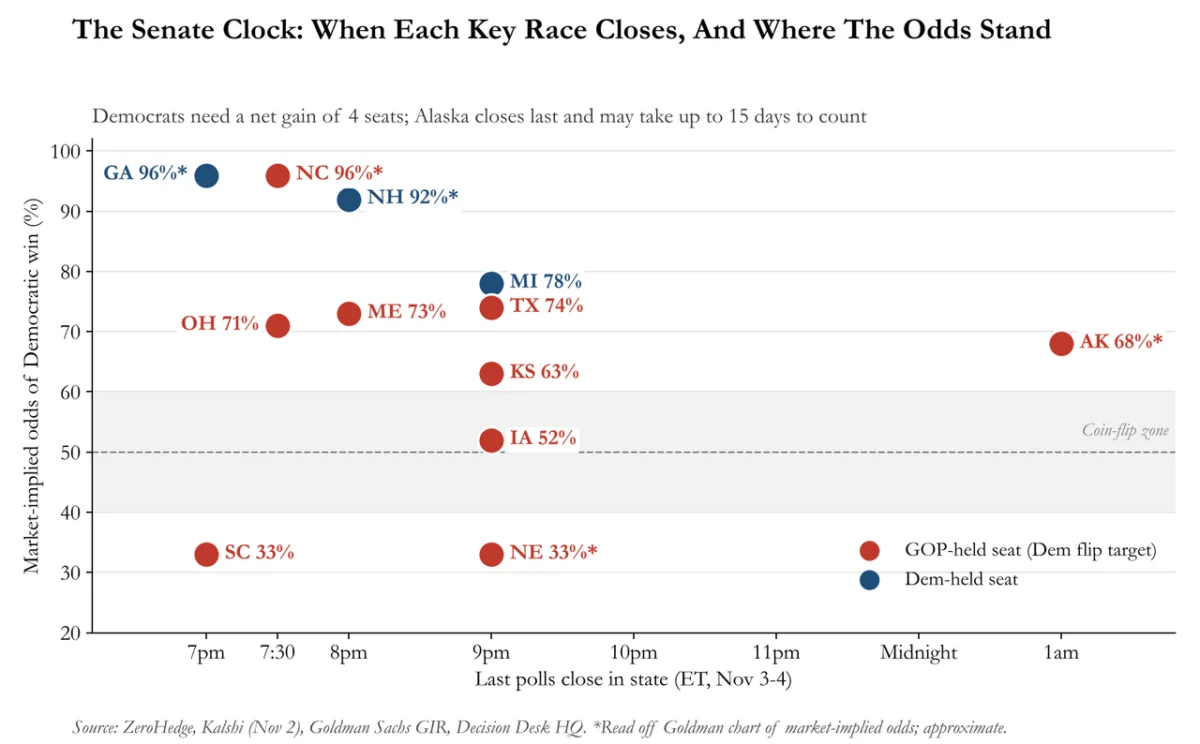
While the House race appears to be largely settled in the minds of many analysts and prediction markets, the Senate remains the primary focus of electoral suspense. Republicans currently hold a 53-47 majority in the Senate. For Democrats to gain control, they require a net gain of four seats. A gain of three would result in a 50-50 split, which, with the Vice President’s tie-breaking vote, would still leave the Senate under Republican control if the VP is Republican (referencing JD Vance’s hypothetical tie-breaking vote as mentioned in the original context, though the VP would cast the tie-breaking vote). This necessitates Democrats not only holding their current vulnerable seats in Georgia, Michigan, and New Hampshire but also flipping four seats from Republican incumbents.
Cook Political Report identified seven races as pure toss-ups: Alaska, Iowa, Maine, Michigan, New Hampshire, Ohio, and Texas. Additionally, Georgia and North Carolina were rated as leaning Democratic. Pre-election polls, including the final New York Times/Siena polls, showed Democrats leading in Michigan, Texas, Kansas, Maine, and Ohio, holding an edge in Alaska, and effectively tied in Iowa. On paper, these projections suggested a comfortable path to a Democratic majority.
However, a critical analysis from Goldman Sachs’ chief US political economist, Alec Phillips, highlighted a persistent "polling trap." Phillips and Abhay Duggirala observed that in Republican-leaning states, GOP Senate candidates have historically outperformed their final polling margins by an average of 3 percentage points since 2002. Furthermore, in competitive races over the same period, candidates leading by 2.5 points or less won only 60% of the time. This historical tendency suggests that current Democratic leads, particularly those within or close to this 3-point margin, could be precarious. Among the GOP-held seats targeted by Democrats, only North Carolina showed a Democratic lead exceeding this 3-point cushion in pre-election polling. This discrepancy between polling data and historical performance introduces a significant degree of uncertainty, making the Senate outcome far less predictable than market odds might suggest.
The Clock and Critical Race Closures

The timing of poll closures adds another layer of suspense, with results from crucial swing states potentially shaping the narrative as the night progresses:
- 7:00 p.m. ET: Polls close in Georgia (D-leaning), North Carolina (D-leaning), and Ohio (toss-up). These early returns are vital, offering the first real indicators of whether the national mood aligns with pre-election forecasts.
- 8:00 p.m. ET: Key races in Michigan (toss-up) and Texas (toss-up) close. Texas, in particular, is a dual-focus state, with both a pivotal Senate seat and a high-stakes gubernatorial contest drawing national attention.
- 9:00 p.m. ET: Iowa (toss-up) and Maine (toss-up) close.
- 10:00 p.m. ET: Alaska (toss-up) begins to close, though its unique ranked-choice voting system often delays final results for weeks.
Potential for Delays and Legal Challenges
Election night in 2026, much like previous cycles, holds the potential for protracted counts and even legal battles. Two Senate races are particularly prone to delays:
- Maine: The state utilizes a ranked-choice voting system, which can prolong the tabulation process if no candidate achieves an outright majority in the first round.
- Alaska: Similar to Maine, Alaska employs ranked-choice voting. Its vast geographical spread and remote communities, combined with the voting system, mean that final results often take days, if not weeks, to certify. The possibility of the Senate majority hinging on Alaska’s outcome could lead to Wall Street trading against a federal lawsuit well into the holiday season.
Gubernatorial Contests: Beyond the Federal Focus

While the spotlight often shines on Congress, gubernatorial races are equally significant, determining the leadership and policy direction of individual states. The early Republican lead of 8-6 in these contests signals a strong performance at the state level. The Texas gubernatorial race, where Democrat Gina Hinojosa has proposed an emergency moratorium on a 474 GW interconnection queue, exemplifies the immediate, tangible impact of state-level outcomes on specific industries, in this case, data centers and energy infrastructure. Such policy proposals highlight how state elections can directly influence economic development and regulatory environments.
Market Implications: Gridlock vs. Unified Control
Financial markets are acutely sensitive to election outcomes, with investors pricing in potential policy changes and shifts in political stability. The consensus playbook among Wall Street analysts, as articulated by JPMorgan’s Market Intel desk, suggests varying reactions based on the balance of power:
- Democratic Sweep (66% probability): Expected to result in the S&P 500 moving anywhere from down 25 basis points to up 50 basis points. This is generally considered the least favorable outcome for stocks among the scenarios.
- Split Congress (26% probability): Anticipated to see the S&P 500 rise by 0.5% to 1%. Gridlock, where neither party controls both legislative branches, is often viewed positively by markets as it limits radical policy shifts.
- Republican Sweep (7% probability): Predicted to yield the strongest market performance, with the S&P 500 gaining 1% to 1.25%.
However, not all analysts share this sanguine view. BofA’s Michael Hartnett has cautioned that a Democratic sweep could trigger a "big risk-off" event, potentially sending stocks skidding by more than 10%. This divergence in expert opinion underscores the inherent uncertainty and the range of potential market responses.

The bond market’s reaction is expected to be more muted. Mizuho’s Evelyne Gomez-Liechti estimates a Democratic sweep could add approximately 2 basis points to 10-year Treasury yields, while a split Congress might shave off about 3 basis points. She warns against overly embracing the "gridlock-means-austerity" narrative, noting that bipartisan deals could still lead to higher spending in areas like defense, potentially leaving the underlying fiscal trajectory largely unchanged.
Beyond immediate market movements, the election outcome has significant policy implications. Goldman Sachs projects that any Democratic rollbacks on tariffs with Canada could be more than offset by new White House tariffs, resulting in a net ~2 percentage point increase in the effective tariff rate post-election. Furthermore, the first major legislative battle post-election is likely to be the December 11 funding deadline, rather than highly publicized issues like AI regulation.
For investors seeking to capitalize on these political shifts, Goldman’s baskets team identified "ACA beneficiaries" (GSHLCACA) as a top sweep idea. This basket has historically tracked Kalshi’s Democratic sweep odds closely, although it recently diverged, rolling over even as the odds continued to climb. This disconnect raises questions about whether the market is pricing in a different reality or if it presents a unique entry point for traders.
Looking at the broader historical context, JPMorgan maintains a generally bullish outlook on midterms, noting that the S&P 500 has been higher in the 12 months following every midterm election since 1950, with an average gain of around 15%. This historical trend suggests that, regardless of the immediate outcome, markets tend to find their footing and move higher in the subsequent year.

The Unfolding Narrative: Uncertainty Persists
As election night progresses, the ultimate question for markets, as posed by Goldman Sachs, is whether the event will act as a "clearing event" that supports a broader rerisking in equities. With sentiment, positioning, and leverage already significantly reduced following recent market volatility, a clean and decisive outcome could indeed trigger a rally.
However, a clean outcome is far from guaranteed. While the House appears to be leaning heavily towards one party, the Senate remains a tight contest. The path to a majority runs through several GOP-held states where Democratic leads are within the historical margin of polling error. The distinct possibility of protracted counts in states like Maine and Alaska, potentially coupled with legal challenges, means that the final composition of the Senate could remain uncertain for days or even weeks.
Prediction markets, which have long since "made up their minds," might still be vulnerable to surprises. The 75% price tag on a Democratic Senate sweep, while indicative of strong market confidence, may be overly optimistic given the historical polling biases and the potential for a 50-50 or 51-49 Senate that remains undeclared until long after election night concludes. The night’s true turning point could be Texas at 9 p.m. ET, or it could be Alaska in two weeks, leaving the nation, and its markets, in suspense.

