
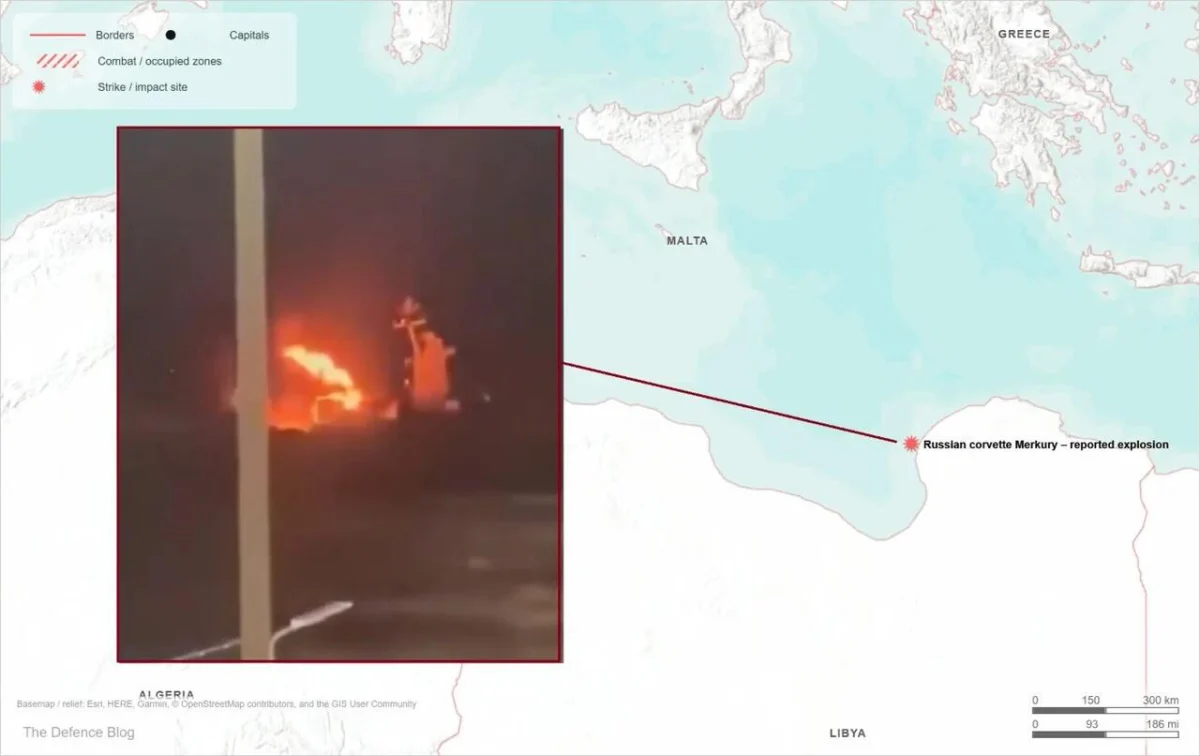
Benghazi, Libya – A Russian warship, identified as the Project 20380 Steregushchiy-class missile corvette Merkury, was reportedly destroyed in a catastrophic explosion at the naval base in Benghazi, Libya, on Sunday. Libya’s eastern government has launched a preliminary investigation, pointing to an explosion aboard the Russian vessel and suspecting a drone strike as the cause. The predawn blasts and subsequent fire tore through the port city’s naval facilities, sending shockwaves through the region and raising questions about the widening scope of the conflict stemming from the war in Ukraine.
The Benghazi Incident: A Detailed Account of Destruction
The tranquility of Benghazi was shattered before dawn on Sunday by a series of powerful explosions emanating from the city’s naval base. Residents reported hearing three distinct, loud blasts followed by heavy anti-aircraft fire, with local social media pages describing aircraft overhead. Initial reports from Benghazi’s civil defense service downplayed the severity, stating the blasts originated from an ammunition store within the naval base and assuring residents there was "no cause for alarm." They later confirmed the fire had been brought under control. However, the extent of the damage quickly became apparent, revealing a far more serious incident than initially disclosed.
Tawfiq al-Shamekh, head of media at the eastern region’s National Safety Authority, confirmed that emergency teams had managed the situation, but refrained from offering immediate details on the cause, stating that a specialist expert report would determine the precise circumstances. As of midday Sunday, no official casualty figures had been released. The visual evidence, however, painted a grim picture of destruction, with footage widely circulated online showing a massive blaze engulfing a vessel at berth, suggesting a significant loss.
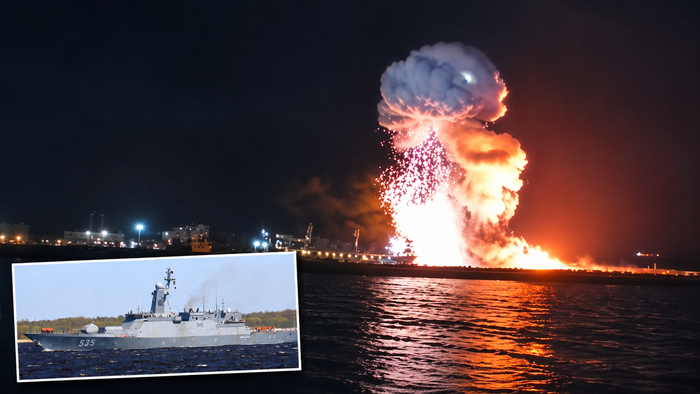
The Suspect Vessel: Russia’s Merkury Corvette and Its Mission
Naval analyst H.I. Sutton provisionally identified the destroyed vessel for Naval News as the Russian Navy’s Merkury, a sophisticated Project 20380 Steregushchiy-class missile corvette. Sutton, citing multiple sources and satellite imagery of the ship ablaze, concluded that the warship was "almost certainly destroyed." While it remains unclear whether the vessel sank at its berth or was completely incinerated, the scale of the explosion suggests a total loss.
The Merkury, formally part of Russia’s Black Sea Fleet, had been operating out of Northern Fleet bases since the ongoing conflict in Ukraine effectively restricted its access to its home port in the Black Sea. It had been docked in Benghazi for several days, reportedly escorting a convoy of Russian ships that Naval News linked to Russia’s arms exports. This mission highlights Russia’s continued military and logistical presence in the Mediterranean and its strategic ties to factions within Libya.
The Project 20380 Steregushchiy-class corvettes are multi-purpose warships designed for littoral operations, anti-submarine warfare, and surface combat. With a displacement of approximately 2,200 tons, a length of around 104 meters, and a crew of about 100 personnel, these vessels are equipped with an impressive array of armaments, including Uran anti-ship missiles, Redut medium-range surface-to-air missile systems, and a 100mm A-190 gun. Their loss represents a significant blow to Russia’s naval capabilities, particularly given the ongoing attrition of its fleet in the Black Sea. The estimated cost of such a warship is reported to be in the range of £150 million, underscoring the financial implications of its destruction.
Libyan Political Landscape and Russian Influence

The incident occurs within the highly complex and fragmented political landscape of Libya, which has been plagued by civil conflict since the 2011 uprising. The country remains divided between rival administrations: the internationally recognized Government of National Unity (GNU) based in Tripoli, led by Abdul Hamid Dbeibah, and the eastern-based government aligned with the House of Representatives, supported by the Libyan National Army (LNA) under Field Marshal Khalifa Haftar.
Benghazi, a major port city, serves as a stronghold for Haftar’s forces. Haftar has long cultivated strong ties with Moscow, which has provided military and political support, including the deployment of Wagner Group mercenaries and the supply of military equipment. This makes Benghazi a critical logistical hub for Russia’s operations and influence in North Africa and the broader Mediterranean. The presence of a Russian warship guarding arms shipments in Benghazi underscores the depth of this strategic relationship and Russia’s vested interests in the region’s stability – or rather, its ability to project power and maintain supply lines through its allies.
Accusations and Denials: The Drone Strike Hypothesis
The preliminary investigation by Libya’s eastern government’s National Safety Authority pointing to a drone strike has immediately drawn attention to Ukraine. A Libyan source in Benghazi, speaking to Italy’s Agenzia Nova, explicitly blamed Ukraine for targeting either the Russian warship or its cargo. Both Moscow and Kyiv have remained officially silent on the incident, with no statements issued by Russia’s Ministry of Defense or Ukraine’s General Staff. Similarly, the General Command of Khalifa Haftar’s forces, which control Benghazi, has refrained from comment.
The accusation, while unconfirmed by official parties, aligns with a discernible pattern of long-range, unconventional attacks attributed to Ukraine against Russian assets far from the main front lines. This strategy aims to disrupt Russian logistics, damage its military infrastructure, and erode public confidence, showcasing Ukraine’s expanding asymmetric warfare capabilities.

A Pattern of Attacks: Ukraine’s Expanding Maritime Warfare
The suspected drone strike in Benghazi is not an isolated incident but rather the latest in a series of audacious long-range attacks on Russian maritime assets, many of which have been attributed to Ukraine. This growing pattern suggests a deliberate strategy by Kyiv to extend the conflict’s reach beyond its immediate borders and into vital Russian supply routes and operational zones.
- March 2026 – Arctic Metagaz Tanker: In March, the Russian-flagged LNG tanker Arctic Metagaz exploded and caught fire between Malta and Libya. Russia’s Transport Ministry swiftly attributed the attack to "Ukrainian unmanned boats" launched from the Libyan coast. Reuters also reported that Ukraine was the suspect. This earlier incident established a precedent for Ukrainian operations in the Mediterranean, allegedly operating from western Libya, a region controlled by the rival Tripoli government.
- April 2026 – Covert Operations in Libya: Following the Arctic Metagaz incident, two Libyan officials informed the Associated Press that Ukrainian forces, primarily drone experts, were operating covertly in western Libya, mainly from an air base in Misrata, with others in Tripoli and Zawiya. This "covert deal" between Kyiv and the Tripoli government, reportedly backed by Western countries including the US, suggested a deeper operational footprint for Ukrainian forces in North Africa, facilitating long-range strikes against Russian interests. The strike on the Arctic Metagaz was reportedly launched from a military facility in Tripoli.
- November 2026 – Crimean Bridge and Gulf of Finland Strikes: The Benghazi explosion caps a week of intense Ukrainian strikes far from the traditional front lines. The Kerch Bridge, a vital logistical and symbolic link between Russia and occupied Crimea, was reportedly hit three times in a single week. Simultaneously, Finland’s military reported a drone strike on a Russian warship in the Gulf of Finland, prompting Helsinki to issue a warning to Kyiv against widening the war.
- November 2026 – Sparta II Cargo Ship: In another significant incident in the Gulf of Finland, drones disabled the roll-on/roll-off cargo ship Sparta II just three nautical miles from Russia’s maritime border. Leningrad Region Governor Alexander Drozdenko confirmed the attack, after which the ship drifted into Finnish waters, necessitating the evacuation of its crew. Finnish President Alexander Stubb described the events as "serious," and Finnish armed forces spokesperson Aki-Mauri Huhtinen stated it was "likely Ukraine is behind the attack." The Helsinki-based daily Helsingin Sanomat reported that the Sparta II has links to Russia’s military and may have been carrying military equipment, although its cargo remains unverified.
- Earlier in November 2026 – Naro-Fominsk Corvette: This was the second reported drone strike on a ship in the Gulf of Finland this month. Earlier, the Russian Naro-Fominsk corvette was targeted during a strike on Ust-Luga, one of Russia’s largest Baltic Sea export hubs in the Leningrad region. These Baltic ports are crucial for Russia’s economy, handling 65.3% of its seaborne grain exports in October (up 8.7x year-on-year) and serving as major export gateways for crude oil and refined fuels. The repeated attacks underscore Ukraine’s intent to disrupt Russia’s economic and military maritime activities across multiple fronts.
The Strategic Implications of Long-Range Strikes
If the loss of the Merkury is confirmed, it would mark a significant escalation, representing the destruction of a Russian warship more than 1,000 miles from Ukraine’s coast, in a port where it was reportedly guarding arms shipments. This would have profound strategic implications:
- Extended Reach of Conflict: It demonstrates Ukraine’s increasing capability to project power and inflict damage on Russian assets far beyond the Black Sea, challenging Russia’s traditional spheres of influence and operational security. The Mediterranean, a crucial waterway for global trade and a strategic zone for NATO, could become a new front in the shadow war.
- Vulnerability of Russian Assets: The incident exposes the vulnerability of Russian naval vessels and logistics, even in seemingly secure ports. It highlights the effectiveness of drone technology in asymmetric warfare, capable of bypassing conventional defenses.
- Disruption of Russian Logistics and Arms Exports: The Merkury‘s mission to escort arms shipments suggests a direct attack on Russia’s military supply chain. Disrupting these routes, especially those supporting allies like Haftar in Libya, could have broader geopolitical consequences, affecting regional power balances.
- Impact on Naval Doctrine: The repeated success of drone attacks against naval targets could force a re-evaluation of naval defense strategies globally. The low cost and high impact of drones offer a significant advantage to smaller, technologically agile forces against larger, conventional navies.
- Geopolitical Fallout in Libya: The attack, if confirmed as Ukrainian, would further complicate Libya’s already volatile internal dynamics and its external relations. It could draw the eastern Libyan government, and by extension Haftar’s forces, more directly into the Russia-Ukraine conflict, potentially destabilizing the region further.
- Economic Consequences: Attacks on shipping, whether military or commercial, raise insurance costs, increase transit times, and create uncertainty for maritime trade, impacting global supply chains and energy markets.
International Reactions and Future Outlook

The silence from Moscow and Kyiv is notable, reflecting the sensitive nature of the alleged operation and the potential for severe diplomatic and military repercussions. The lack of an immediate official statement from Haftar’s forces also indicates a cautious approach, likely assessing the full implications before responding.
The international community, particularly NATO members with significant interests in the Mediterranean, will be closely monitoring the situation. An expansion of the conflict into such a critical maritime region carries the risk of unintended escalation and broader regional instability. The alleged involvement of Ukrainian forces operating from western Libya, potentially with Western backing, further complicates the geopolitical landscape.
This suspected drone strike on the Merkury in Benghazi serves as a stark reminder that the war in Ukraine is increasingly transcending its geographical boundaries. It underscores the evolving nature of modern warfare, where advanced drone technology enables actors to strike deep into enemy territory and disrupt strategic operations thousands of miles away. As investigations continue and the full extent of the damage and the perpetrators are definitively identified, the incident is poised to reshape strategic calculations for Russia, Ukraine, and the wider international community, particularly concerning maritime security in the Mediterranean and beyond.

