
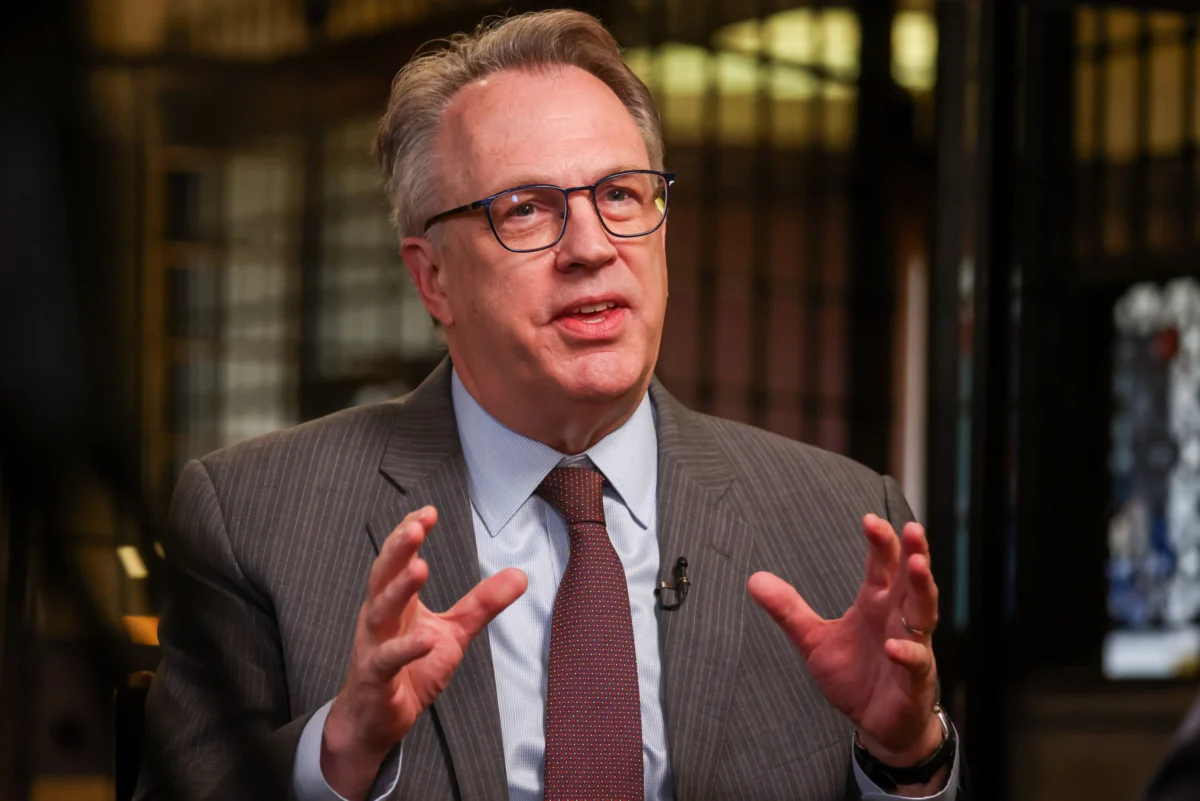
New York Federal Reserve President John Williams articulated a distinct perspective on the future trajectory of monetary policy on Tuesday, April 7, 2026, indicating that he foresees only one additional interest rate hike in the current year, with no further increases deemed necessary throughout 2027. This stance places the influential central banker at odds with prevailing market sentiment and a segment of his colleagues within the Federal Open Market Committee (FOMC), highlighting the ongoing internal debate and external uncertainty surrounding the path of the nation’s benchmark interest rate.
Speaking in an interview with Bloomberg News, Williams, who also serves as the chief executive officer of the Federal Reserve Bank of New York, reiterated his long-held view. "I haven’t changed my view that it may be appropriate to have one more rate hike," Williams stated, adding a crucial caveat regarding the subsequent year: "I don’t think at this time I have any reason to believe that we would need to do more." His comments, delivered against a backdrop of persistent inflationary pressures and a resilient labor market, offer a glimpse into the internal deliberations of the central bank as it navigates the complex task of achieving price stability while supporting maximum sustainable employment.
Divergence from Market Expectations and FOMC Peers
Williams’ forecast for a cessation of rate hikes after a single increase this year stands in contrast to the broader expectations embedded in financial markets. According to data from CME’s FedWatch tool as of Tuesday, fed funds futures traders are largely pricing in at least one rate hike in 2027. The latest trading probabilities indicated approximately a 90% chance that the Fed’s overnight rate would conclude 2027 at least half a percentage point higher than its current level. This significant disparity underscores a fundamental difference in how market participants, who often react swiftly to incoming economic data and geopolitical events, and some policymakers, who may prioritize underlying economic trends and longer-term forecasts, are interpreting the economic outlook.
Moreover, Williams’ position, while aligning with a majority, does not reflect a unanimous consensus within the Federal Open Market Committee. The FOMC, the primary monetary policymaking body of the Federal Reserve System, comprises twelve members: the seven members of the Board of Governors, the president of the Federal Reserve Bank of New York (a permanent voting member), and presidents of four other Federal Reserve Banks on a rotating basis. In its latest "dot plot" projections issued in September 2026, which provides individual forecasts from each of the 18 FOMC participants for the federal funds rate, eight members anticipated one more rate increase in 2027 following an additional hike this year. While this group constitutes less than half of the total participants, their collective outlook suggests a stronger inclination towards further tightening than Williams’ more dovish assessment. Williams, as a permanent voting member, wields considerable influence in policy discussions, making his articulated view particularly noteworthy.
The Context of Recent Monetary Policy Tightening
The Federal Reserve has been engaged in a sustained campaign of monetary policy tightening designed to curb inflation, which surged to multi-decade highs in the aftermath of the COVID-19 pandemic. The central bank implemented its first rate increase since 2023 in September 2026, signaling a continued commitment to its inflation-fighting mandate. Minutes from subsequent FOMC meetings have consistently indicated plans for another hike, though without specifying a precise timeline. The Fed is scheduled to meet at the end of October and then once more in December of this year, with market participants closely scrutinizing every statement and data point for clues regarding the timing and magnitude of future policy adjustments.
The aggressive tightening cycle that commenced in 2023 was a direct response to inflation consistently exceeding the Fed’s long-term target of 2%. Supply chain disruptions, robust consumer demand fueled by fiscal stimulus, and geopolitical events contributed to a rapid escalation of prices across various sectors of the economy. The federal funds rate, which influences a wide array of other interest rates, was steadily raised from near-zero levels to its current range, impacting borrowing costs for everything from mortgages and auto loans to business investments. Each hike is intended to cool demand, thereby alleviating price pressures, but also carries the risk of slowing economic growth and potentially tipping the economy into recession.
Williams’ Outlook on "Disinflationary" Trends and Inflation Target
A cornerstone of Williams’ relatively dovish outlook for 2027 is his conviction in underlying "disinflationary trends." He emphasized the importance of looking beyond transient price shocks, particularly those tied to energy and, interestingly, artificial intelligence, when assessing the true trajectory of inflation. While acknowledging that energy prices continue to exert upward pressure on overall inflation in the short term, Williams suggested that they could offer relief on an annual basis in the future as base effects fade and supply dynamics potentially stabilize. Similarly, he posited that the inflationary effects of tariffs, a recurring theme in global trade discussions, have largely been absorbed by the economy.
Williams’ confidence in these disinflationary forces leads him to project that overall inflation for 2027 should be "near" the Fed’s target of 2% on an annual basis. This forecast stands in stark contrast to recent data. The personal consumption expenditures (PCE) price index, the Fed’s preferred inflation gauge, in August showed a 12-month increase of 3.4%. When stripping out volatile food and energy prices, the core PCE index registered a 3.0% increase. While both figures represent a moderation from their peaks, they remain significantly above the central bank’s target, highlighting the challenge of achieving price stability.
"I still believe there’s disinflationary forces at play. Those I don’t think have fundamentally changed," Williams asserted, underscoring his belief that structural factors are working to bring prices down. "In fact, my forecast for inflation for next year is inflation to come down quite a bit." These disinflationary forces could include a further normalization of global supply chains, a moderation in wage growth as labor markets rebalance, and a potential cooling of aggregate demand as the effects of past monetary tightening fully propagate through the economy.
The Imperative of Data Dependence and Economic Influences
Despite his clear outlook, Williams tempered his predictions with a strong emphasis on data dependence, a common refrain among central bankers navigating uncertain economic waters. "To be sure," he told Bloomberg, "we’ll have to see" when it comes to forecasting into the new year. He acknowledged the myriad influences shaping the economy, underscoring the dynamic and unpredictable nature of economic forces. "This economy is being affected by lots of different influences, and we just have to keep watching the data," Williams stated.
This commitment to data dependence is critical for the Federal Reserve. Monetary policy decisions are not made in a vacuum but are continually adjusted based on the latest readings of key economic indicators. These include:
- Inflation data: Beyond PCE, the Consumer Price Index (CPI) is closely watched for both headline and core inflation measures.
- Labor market statistics: Nonfarm payrolls, unemployment rate, wage growth, and labor force participation rates provide insights into the health of the job market and its potential inflationary pressures.
- Economic growth: Gross Domestic Product (GDP) reports indicate overall economic expansion or contraction.
- Consumer spending: Retail sales and consumer sentiment surveys offer clues about the strength of demand.
- Manufacturing and services activity: Purchasing Managers’ Indexes (PMI) provide forward-looking indicators for different sectors.
The Fed’s dual mandate requires it to balance price stability with maximum sustainable employment. A strong labor market, characterized by low unemployment and solid wage gains, could be interpreted as a sign of an overheating economy requiring further tightening. Conversely, signs of weakening employment or slowing growth might prompt a more cautious approach to rate hikes. The current environment presents a complex picture, with inflation moderating but remaining elevated, alongside a remarkably resilient labor market that has defied expectations of a significant slowdown.
Implications for Monetary Policy and the Broader Economy
John Williams’ projection of a near-term end to the tightening cycle, particularly his strong conviction against rate hikes in 2027, has significant implications for monetary policy and the broader economy. If his view prevails, it could signal a more dovish tilt for the FOMC in the coming year, potentially leading to a more stable interest rate environment earlier than markets currently anticipate. This could be positive for interest-rate sensitive sectors such as housing, which has been significantly impacted by higher mortgage rates. Businesses might also find it easier to plan investments with greater certainty regarding borrowing costs.
However, the divergence between Williams’ view and market expectations also introduces an element of uncertainty. If the market continues to price in further hikes, and the Fed ultimately aligns with Williams, it could lead to a rapid repricing of assets and a potential rally in bond markets. Conversely, if inflation proves more persistent than Williams anticipates, or if economic growth remains robust, the Fed might be compelled to continue tightening, potentially disappointing those who share Williams’ outlook and leading to renewed market volatility.
The concept of a "soft landing" – where the Fed successfully brings down inflation without triggering a recession – remains a central aspiration for policymakers. Williams’ comments suggest a belief that such a soft landing is achievable with limited further tightening. However, the path to a soft landing is notoriously narrow, and unforeseen economic shocks or persistent inflationary pressures could easily derail this delicate balance.
Conclusion: A Watchful Stance Amidst Ongoing Debate
John Williams’ recent statements underscore the ongoing debate within the Federal Reserve regarding the optimal path for monetary policy. His conviction in underlying disinflationary forces and his projection of no further rate hikes in 2027 offer a relatively dovish perspective compared to market consensus and some of his FOMC colleagues. This divergence highlights the inherent challenges of forecasting in an complex economic environment, where global events, domestic policies, and consumer behavior interact in unpredictable ways.
As the central bank approaches its upcoming meetings, all eyes will remain on incoming economic data – particularly inflation and employment figures – to gauge whether the economy is indeed on a path consistent with Williams’ optimistic assessment. The Federal Reserve’s commitment to data dependence means that while projections like Williams’ offer valuable insight into policymaker thinking, the ultimate trajectory of interest rates will be dictated by the evolving economic landscape and the collective judgment of the FOMC as it strives to achieve its dual mandate of price stability and maximum sustainable employment. The journey to a post-inflationary equilibrium remains dynamic, requiring a watchful and adaptable approach from all stakeholders.

