
In an unprecedented public display of divergence, Israeli Prime Minister Benjamin Netanyahu has outright rejected a US-backed 15-point peace plan for Gaza, creating a rare and highly visible diplomatic rupture with the administration of President Donald Trump. This rejection comes at a time when President Trump is reportedly facing a series of setbacks in his broader Mideast foreign policy agenda, with this latest development highlighting the complexities and persistent challenges in the region, even among close allies.
The Public Break and Netanyahu’s Firm Stance
The Israeli Prime Minister’s rejection over the weekend was remarkably explicit, leaving no room for diplomatic ambiguity. Speaking at a cabinet meeting on Sunday, Netanyahu declared, "Israel rejects the 15-point document. The IDF will not make any withdrawal until Hamas is truly disarmed and will continue to thwart threats against our forces and citizens." His statement underscored a fundamental disagreement with the proposed framework, which reportedly included a phased Israeli troop withdrawal from Gaza in conjunction with the disarmament of Hamas.
Netanyahu was uncharacteristically direct in articulating the complete break in policy vision from the White House, asserting Israel’s sovereign right to determine its security interests. "Contrary to all those who preach to us, we do what must be done for Israel’s security, and we can and will stand our ground even against our best friends when necessary," he stated. This powerful declaration, aimed both at the international community and potentially at a domestic audience, conveyed a clear message that Israel would not succumb to external pressure, even from its most steadfast ally, the United States, regarding its security operations in Gaza, Lebanon, and against perceived threats from Iran.
The Prime Minister explicitly addressed what he termed a "wave of rumors about Israeli weakness and Israeli withdrawals on all fronts," making it clear that such perceptions were unfounded and that Israel’s resolve on security matters remained unyielding. This rhetoric suggests a calculated move to reinforce his government’s hardline stance, potentially bolstering his domestic political standing amidst ongoing security challenges and internal political pressures.
The Unpacking of Trump’s Gaza Peace Initiative
The US-backed 15-point peace plan was the culmination of efforts by President Trump’s "Board of Peace," which had been actively engaged in mediation following a recent ceasefire agreement in Gaza. Just ten days prior to Netanyahu’s rejection, President Trump had declared that his "Board of Peace" had achieved a "historic agreement" with Hamas for its complete disarmament. The Board’s top envoy, Nickolay Mladenov, had elaborated on the plan via social media, explaining that the decommissioning of Hamas’s military capabilities would need to occur "in lockstep" with Israeli troop withdrawal. This envisioned a phased process where the Israel Defense Forces (IDF) would gradually pull back from its positions inside Gaza as Hamas surrendered its arms.
The plan was presented to Israel in July, aiming to solidify a long-term ceasefire and lay groundwork for future stability in the volatile enclave. It sought to address the humanitarian crisis in Gaza while simultaneously ensuring Israel’s security by dismantling Hamas’s military infrastructure. For the Trump administration, securing such an agreement would have represented a significant foreign policy "win," particularly in a region where diplomatic successes have been historically elusive.
A History of Complex US-Israel Relations and Aid
The public spat is particularly striking given the traditionally robust and often described as "unbreakable" bond between the United States and Israel. This alliance is cemented by shared strategic interests, cultural ties, and substantial US financial and military aid. Annually, Israel receives billions of dollars in US funds and arms, making it the largest cumulative recipient of US foreign assistance since World War II. This aid, which often includes advanced military technology such as F-35 fighter jets and support for missile defense systems like the Iron Dome, is a cornerstone of Israel’s defense capabilities and a tangible symbol of the strategic partnership.
While disagreements between Washington and Jerusalem are not entirely new—past administrations have also faced policy differences, particularly concerning Israeli settlement expansion or peace process modalities—the public and unequivocal nature of Netanyahu’s rejection marks a distinct shift. Historically, such disagreements have often been managed through discreet diplomatic channels, avoiding overt public confrontations that could strain the alliance. This instance, however, has brought the friction into the full glare of international media, underscoring the severity of the policy divergence.
Hamas’s Unexpected Endorsement and Strategic Implications
Adding another layer of complexity to the unfolding drama, Hamas, the Islamist group governing Gaza and a designated terrorist organization by the US and Israel, issued a statement affirming its commitment to Trump’s 15-point plan. The group declared its "commitment" to the plan for the second phase of the ceasefire agreement with Israel and called for "establishing a clear timetable for their implementation." Hamas further urged "the mediators, guarantors, and the Peace Council to assume their responsibilities, ensure the commitment of all parties to what has been agreed upon, and prevent any violations or breaches that could disrupt the implementation process or undermine the ceasefire agreement."
Hamas’s endorsement is strategically significant. By accepting a plan that Israel has rejected, Hamas effectively attempts to portray itself as the reasonable party seeking peace, while positioning Israel as the obstacle. This move could potentially garner international sympathy for Hamas and place additional diplomatic pressure on Israel, especially given the ongoing humanitarian crisis in Gaza. It also highlights the intricate and often paradoxical dynamics of the Israeli-Palestinian conflict, where adversaries can sometimes find common ground on specific proposals, even if fleetingly.
Trump’s Silence and an Unlikely Endorsement
In the wake of Netanyahu’s blunt rejection, many observers anticipated a characteristic response from President Trump, known for his frequent and often fiery commentaries on social media platforms like Truth Social. However, a full day after reports of the Israeli rebuff emerged, Trump remained uncharacteristically silent. This lack of immediate public condemnation or retort against Netanyahu, affectionately known as "Bibi," has led to speculation about the reasons behind the President’s restraint. It could be interpreted as a strategic decision to avoid further escalating the public spat, a recognition of Netanyahu’s domestic political pressures, or perhaps a tactical pause before a more considered response.
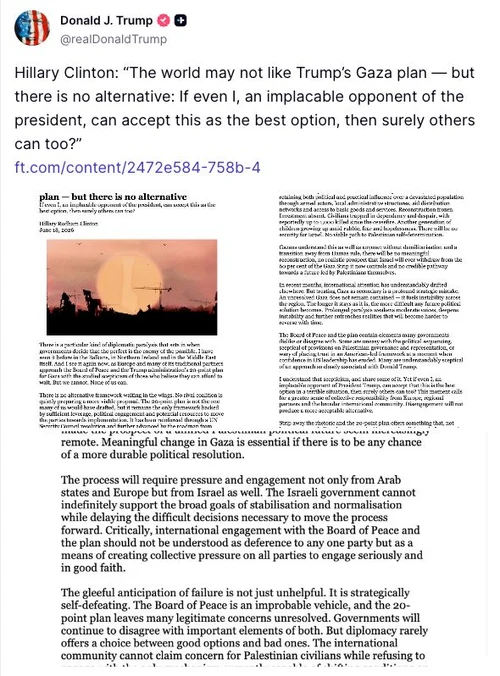
Adding a peculiar twist to the narrative, former Secretary of State Hillary Clinton, a vocal and "implacable opponent" of President Trump, surprisingly offered "validation" for his Gaza peace plan. In an op-ed, Clinton argued that there was "no alternative" to Trump’s proposal, acknowledging its merits despite her political differences with the President. This bipartisan, albeit post-rejection, endorsement from such an unexpected source provides a unique political optic. It suggests that elements of the plan might have resonated with a broader spectrum of US foreign policy thinkers, even as it failed to secure the crucial backing of America’s closest regional ally.
Broader Implications for Trump’s Mideast Strategy
The rejection by Netanyahu adds to a growing list of challenges for President Trump’s Middle East strategy. CNN observers noted that the "Middle East strategy ‘Ls’ are piling up," pointing specifically to the "Iran folly" which appears to be increasingly unfavorable for the administration. Trump’s withdrawal from the Joint Comprehensive Plan of Action (JCPOA), commonly known as the Iran nuclear deal, and the subsequent "maximum pressure" campaign, have led to heightened tensions in the Gulf, but have not yet yielded the desired diplomatic outcomes or a new, more comprehensive agreement. This perceived failure to achieve decisive "wins" on the Iranian front makes the Gaza peace plan setback particularly acute for an administration keen to demonstrate foreign policy successes.

The current situation suggests that Netanyahu might perceive Trump as being "up against the ropes" in the Middle East, viewing this moment as an opportunity to assert Israel’s "least-bad option" for its security. This could mean prioritizing immediate security concerns and domestic political stability over potentially risky diplomatic initiatives, especially if the perceived benefits of the US plan are outweighed by the perceived security compromises.
Impact and Outlook: A Strained Alliance and Uncertain Future
The public rejection of the US-backed Gaza peace plan by Israel carries significant implications for regional stability, the future of US-Israel relations, and the broader Mideast peace process.
For US-Israel Relations: While the fundamental strategic alliance is unlikely to collapse, the public nature of this disagreement introduces a new level of strain. It tests the limits of the "special relationship" and could lead to a reassessment of diplomatic strategies by both nations. Future cooperation on other regional issues, such as confronting Iran or addressing Hezbollah in Lebanon, could become more complex. It might also signal a period where Israel feels more emboldened to chart an independent course, even if it means diverging from Washington’s preferences.
For Gaza and Regional Stability: With the 15-point plan off the table, the immediate future for Gaza remains highly uncertain. The cycle of conflict and humanitarian crisis is likely to persist. The prospect of a durable ceasefire or a pathway to long-term stability appears more distant. Other regional actors, including Egypt, Jordan, and the Gulf states, who often play mediating roles, will likely view this development with concern, as it complicates efforts to de-escalate tensions and promote regional security. The international community, including the United Nations and the European Union, will also face renewed pressure to address the deteriorating situation in the Palestinian territories.
For Trump’s Foreign Policy Legacy: The setback in Gaza, coupled with challenges on the Iran front, complicates President Trump’s narrative as a master deal-maker in the Middle East. While his administration has achieved some diplomatic successes, such as the Abraham Accords, the inability to secure buy-in from a key ally on such a significant peace initiative could tarnish his broader Mideast legacy.
For Netanyahu’s Domestic Politics: Netanyahu’s firm rejection of the plan likely plays well with his conservative base and within his coalition, reinforcing his image as a strong leader committed to Israel’s security above all else. However, it might also lead to increased international isolation or criticism from more centrist or dovish elements within Israel who advocate for diplomatic solutions. With a general election potentially on the horizon, Netanyahu’s actions are undeniably intertwined with domestic political calculations.
In conclusion, the explicit rejection of the US-backed Gaza peace plan by Prime Minister Netanyahu represents a significant moment in US-Israel relations and the broader dynamics of the Middle East. It underscores the profound challenges in forging peace in a region rife with historical grievances, entrenched security concerns, and complex political realities. The path forward remains unclear, marked by diplomatic uncertainty and the persistent specter of conflict.

