
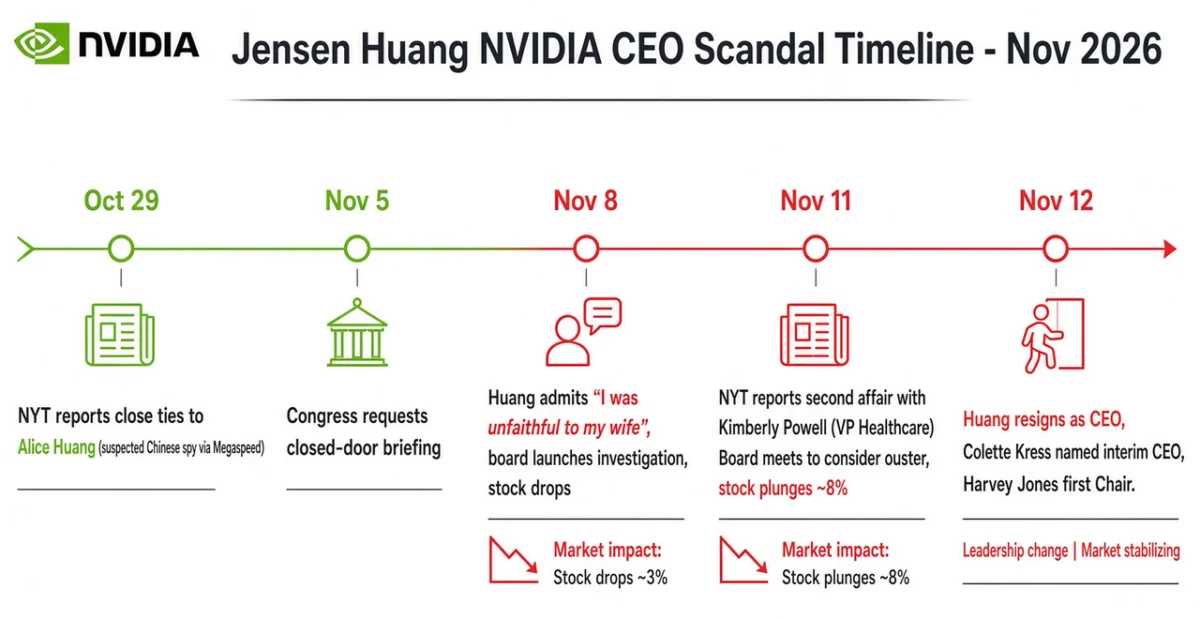
The tech world was sent reeling today as NVIDIA, the undisputed leader in artificial intelligence (AI) chips, announced the immediate resignation of its iconic co-founder, President, and CEO, Jensen Huang. This dramatic departure follows a tumultuous two-week period marked by explosive allegations of espionage ties to a Chinese executive, investigations into illicit chip diversion, and deeply personal revelations of extramarital affairs. The company’s board has appointed Colette Kress, NVIDIA’s long-standing Chief Financial Officer, as interim CEO, and named Harvey C. Jones as its first-ever Chair, as the firm grapples with an unprecedented leadership vacuum and a market still digesting hundreds of billions in lost valuation.
The Unraveling: A Rapidly Escalating Crisis
The chaos surrounding Jensen Huang began to unfold with astonishing speed in late October 2026, culminating in a series of events that would irrevocably alter the trajectory of one of the world’s most valuable technology companies. For over three decades, Huang had been the singular visionary behind NVIDIA, transforming it from a graphics card pioneer into the foundational engine of the AI revolution. His distinctive leather jacket and charismatic presence were synonymous with the company’s innovative spirit and aggressive market dominance. However, this image of invincibility shattered under the weight of mounting pressure.
The initial public tremor struck on October 29, when a bombshell report from The New York Times ignited a firestorm. Citing U.S. intelligence sources, the report alleged that Huang’s "close relationship" with Alice Huang (who is reportedly no relation to Jensen Huang), a prominent Chinese executive, was not merely a business connection but one deeply compromised by national security concerns. Alice Huang was identified as a key figure at Singapore-based Megaspeed, a significant NVIDIA customer that had fallen under intense scrutiny for the possible diversion of advanced AI chips to entities in China, circumventing stringent U.S. export controls. More alarmingly, U.S. intelligence reportedly viewed Alice Huang as a "Ministry of State Security asset," linking her directly to China’s principal civilian intelligence agency.
This revelation sent shockwaves through Washington and Wall Street. The implications were profound, touching upon the fraught geopolitical landscape of U.S.-China tech rivalry and the critical importance of safeguarding advanced AI technology. The Times report was buttressed by photographic evidence from Taipei events dating back to 2024, depicting Jensen Huang and Alice Huang together, alongside earlier classified memos that further amplified national-security concerns. One such memo, reportedly overseen by then-Secretary of State Marco Rubio, highlighted the escalating worries within the U.S. government regarding export control compliance and potential foreign influence operations targeting critical technology sectors. The confluence of these factors immediately placed NVIDIA and its CEO under an intense investigative and public microscope.
As the corporate and geopolitical storm gathered strength, a deeply personal dimension was added to the crisis. On November 8, Jensen Huang attempted to address the burgeoning scandal by issuing a letter to NVIDIA employees. In a rare and candid admission, Huang publicly stated he had been "unfaithful to my wife," expressing profound regret for the harm caused to his family and implicitly linking his personal transgressions to the ongoing media reports. This admission, while an attempt to control the narrative, only fueled further speculation and triggered an independent investigation by NVIDIA’s board of directors into the broader allegations. In the immediate aftermath, NVIDIA’s shares began a sharp decline, shedding significant market value, while members of Congress demanded urgent briefings and whispers of FBI scrutiny intensified.
The crisis accelerated with dizzying speed. Just three days later, on November 11, The New York Times delivered another staggering blow, reporting a second extramarital affair involving Huang. This time, the alleged relationship was with Kimberly Powell, NVIDIA’s vice president of healthcare, a senior executive who reported directly to Huang. Accounts surfaced describing affectionate behavior between the two at a professional conference, further complicating the already precarious situation. The revelation of an alleged affair with a direct subordinate raised serious questions about corporate ethics, potential conflicts of interest, and the power dynamics within NVIDIA’s leadership, intensifying the pressure on the board.

Reports that the board was convening to discuss Huang’s potential ouster immediately followed. The market reacted swiftly and brutally; NVIDIA shares plunged roughly 8% in after-hours trading, contributing to hundreds of billions in market-value losses over the preceding days. The precariousness of NVIDIA’s leadership structure became acutely apparent, highlighting the critical lack of a clear succession plan for a company that Huang had co-founded and led as its sole CEO for 33 years. His singular, hands-on leadership style, while credited with NVIDIA’s immense success, had inadvertently created a significant "key-person" risk.
NVIDIA’s Decisive Action and New Leadership Structure
The crescendo of these events reached its peak today with the announcement of Jensen Huang’s immediate resignation from all his roles: President, Chief Executive Officer, and member of the Board of Directors. The board’s decision underscored the severity and multifaceted nature of the crisis, demonstrating a clear intent to stabilize leadership and address the profound governance challenges.
In an effort to provide immediate stability, the board announced the appointment of Colette Kress as Interim Chief Executive Officer. Kress, who has served as NVIDIA’s Executive Vice President and Chief Financial Officer since September 2013, will retain her finance role while leading the company. Her extensive experience, including nearly 25 years in finance roles at technology giants like Cisco and Microsoft prior to joining NVIDIA, positions her as a steady hand during this turbulent period. The board emphasized her deep understanding of NVIDIA’s business, customers, operations, and financial position.

In another significant structural change, the Board of Directors appointed Harvey C. Jones as its first-ever Chair of the Board. Jones, a seasoned entrepreneur, technology executive, and venture investor with over 30 years of experience, including serving as CEO and Executive Chairman of Synopsys, brings independent oversight to the board. His appointment signals a move towards stronger corporate governance and a more traditional separation of powers between the CEO and board chair roles, a stark contrast to Huang’s previous combined leadership.
In a press release, Harvey Jones expressed full confidence in the new interim leadership: "Colette has helped lead NVIDIA through a period of extraordinary growth and has a deep understanding of our business, customers, operations and financial position. She is supported by an experienced leadership team that has been instrumental in executing NVIDIA’s strategy and advancing its technology roadmap. The Board has full confidence in Colette and the leadership team, and we expect the company’s operations, customer commitments and product roadmap to continue without interruption."
Colette Kress echoed this sentiment, reassuring stakeholders: "NVIDIA’s strength has always come from its people, and together with our leadership team, I am committed to building on the extraordinary foundation Jensen created over the last 33 years. We will continue advancing the work that has made NVIDIA a leader in accelerated computing and AI, and execute on the opportunities ahead. Our focus remains on serving our customers, partners, developers and shareholders."
The board acknowledged Huang’s "profound" and "immeasurable contributions" to NVIDIA and the industry, recognizing his role in building one of the most consequential technology companies globally. However, the swift action indicates that the combination of national security risks, potential compliance breaches, and severe governance concerns ultimately outweighed his legacy. A global search for a permanent successor has been initiated, considering both internal and external candidates.

Market Turmoil and Investor Confidence Under Siege
The financial markets reacted to Huang’s resignation with significant alarm, underscoring the profound impact of his departure. NVIDIA’s stock plummeted by an additional 10% from last night’s close, extending its overnight losses and pushing the share price to its lowest point since July 2025. This latest drop contributes to a staggering decline of more than 35% from its recent highs, translating into hundreds of billions of dollars in lost market capitalization within a matter of days.
Analysts across Wall Street had already begun to price in the escalating risks. Prior to the official resignation, some had estimated that a forced exit for Huang could cost NVIDIA anywhere from 20-30% in valuation. The current market reaction falls squarely within, and even exceeds, those pessimistic forecasts. The core concern for investors is not merely the absence of a CEO, but the abrupt removal of a founder who was the intellectual and strategic architect of NVIDIA’s meteoric rise. Huang famously cultivated a flat organizational structure with dozens of direct reports, making him the central figure in strategy, lobbying efforts, major customer deals, and the very narrative of AI innovation.
This "key-person shock" is exacerbated by the lack of a formalized public succession plan, a common pitfall in founder-led companies. While NVIDIA boasts a deep bench of technical talent and a robust product roadmap, the institutionalization of Huang’s unique vision and strategic acumen will be a critical test for the interim leadership. Investor confidence, which had propelled NVIDIA to unprecedented heights based on its AI dominance, is now deeply shaken by governance concerns and the uncertainty of future direction.

The Geopolitical Undercurrents: Export Controls and National Security
Beyond the corporate governance failures and personal scandals, the crisis at NVIDIA is deeply intertwined with the broader geopolitical tensions between the United States and China, particularly concerning advanced technology. The U.S. government has implemented increasingly stringent export controls on high-end AI chips, such as NVIDIA’s H100 and A100 GPUs, to prevent China from acquiring capabilities that could bolster its military modernization and surveillance state.
The allegation that Alice Huang, an executive linked to a major NVIDIA customer (Megaspeed), was a "Ministry of State Security asset" is an accusation of the gravest nature. It implies a direct attempt by a foreign intelligence service to exploit commercial relationships for strategic advantage, potentially compromising U.S. national security and undermining export control regimes. The investigation into Megaspeed for possible diversion of advanced AI chips to China underscores the persistent challenges in enforcing these controls, especially through intermediary countries like Singapore. While Singapore is a vital tech hub, its role in re-exporting goods has made it a focus point for compliance checks.
The involvement of classified memos and the oversight of a prominent political figure like Secretary of State Marco Rubio highlight that these concerns were not new to U.S. intelligence agencies. The public revelation of these allegations, coupled with Huang’s position at the helm of a strategically vital company, naturally drew immediate attention from Capitol Hill. Democratic Senator Elizabeth Warren’s swift reaction—stating that Huang’s resignation "does not absolve him" and demanding answers from NVIDIA executives regarding export control compliance—is indicative of the intense political scrutiny that will continue to plague the company. This crisis will likely intensify calls for stricter enforcement, enhanced corporate due diligence, and potentially more punitive measures against companies found to be in breach of U.S. national security policies.

Beyond the Immediate: Long-Term Implications
Jensen Huang’s sudden departure marks the end of an era for NVIDIA and introduces significant uncertainty for the entire AI industry. The immediate challenges for Colette Kress and Harvey Jones are immense: stabilizing investor confidence, ensuring operational continuity, and navigating the ongoing investigations and political scrutiny.
Succession Planning: The search for a permanent CEO will be a defining moment. The board must decide whether to seek an internal leader who understands NVIDIA’s culture and technology deeply, or an external candidate who can bring a fresh perspective and perhaps a more traditional governance approach. The new CEO will need to command respect from engineers, investors, and governments alike, a formidable task given Huang’s unique stature.
Corporate Governance: This scandal serves as a stark reminder of the risks associated with extreme founder concentration and lax succession planning. NVIDIA, like many successful tech companies, benefited from a strong founder vision, but the crisis highlights the need for robust governance frameworks, including clear ethics policies and oversight, especially for leaders interacting with sensitive geopolitical landscapes. Other tech giants may take note and review their own governance structures and key-person risk management.

NVIDIA’s Strategic Direction: While the new leadership has pledged continuity, the absence of Huang’s aggressive vision could subtly alter NVIDIA’s strategic trajectory. Will the company maintain its relentless pace of innovation and market expansion, or will it become more cautious? The AI industry, heavily reliant on NVIDIA’s hardware, will be watching closely for any shifts in product roadmap, R&D investment, or customer engagement strategies.
Geopolitical Landscape: The scandal will undoubtedly intensify the focus on compliance with U.S. export controls and raise the bar for due diligence in dealings with entities in high-risk regions. It could lead to a re-evaluation of how Western tech companies engage with markets like China, potentially prompting a more cautious and compartmentalized approach to technology transfer and collaboration.
The next clear catalysts for NVIDIA will be its upcoming earnings report, which will provide crucial insights into the company’s financial health and any immediate operational impacts, and the eventual announcement of a permanent CEO. The future of NVIDIA, a company at the very heart of the AI revolution, now hinges on its ability to navigate this unprecedented crisis, restore trust, and prove that its innovative spirit can thrive even without its visionary founder at the helm. The ripple effects of Jensen Huang’s fall from grace will undoubtedly resonate across the technology sector, geopolitical corridors, and financial markets for years to come.

