
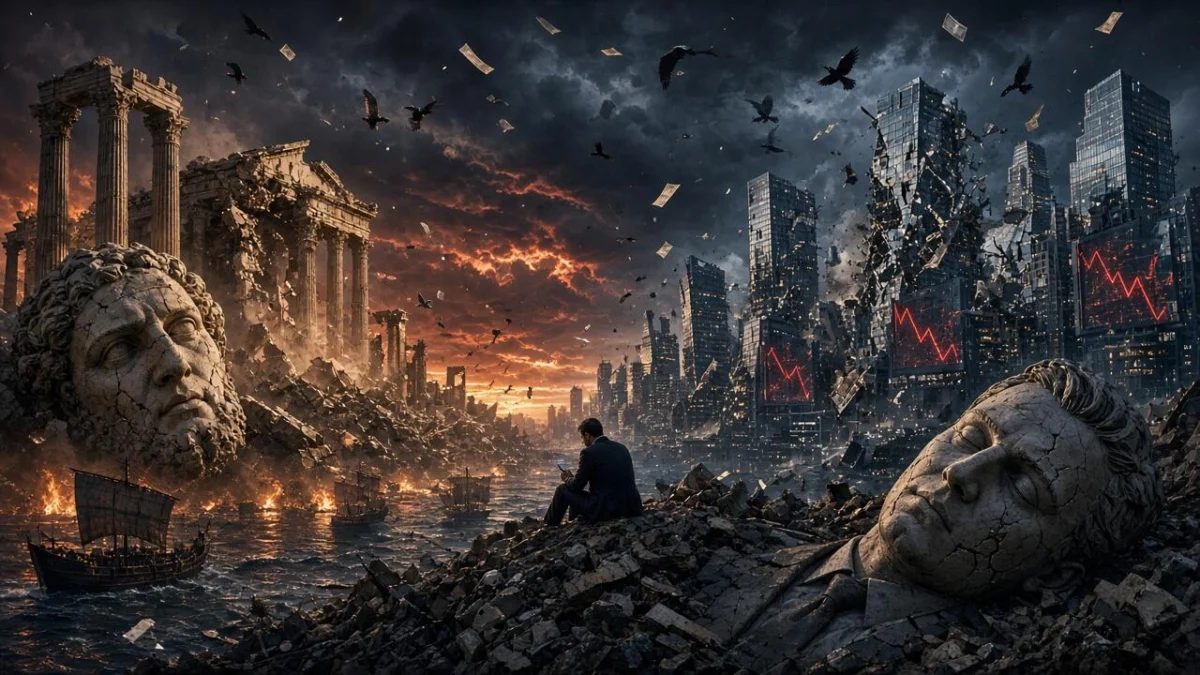
The concept of civilizational collapse, while often relegated to the realm of historical conjecture or apocalyptic fiction, has re-entered contemporary discourse, prompting reflection on the durability of modern global society. Historically, civilizations have risen, flourished, and eventually declined or transformed, sometimes abruptly. One of the most stark examples cited by historians is the Bronze Age Collapse around 1200 B.C., a period that saw the rapid disintegration of a complex, interconnected network of societies across the Mediterranean and Near East. This historical precedent serves as a powerful reminder that even the most advanced and stable systems are not immune to systemic breakdown.
The Echoes of the Bronze Age: A Historical Precedent
Around 1200 B.C., the Eastern Mediterranean and Near East, then considered the "known world," experienced a profound and widespread societal upheaval known as the Late Bronze Age Collapse. For nearly a century, from roughly 1300 B.C. to 1150 B.C., a vibrant and interconnected system of powerful kingdoms and empires — including the Mycenaeans in Greece, the Hittites in Anatolia, the New Kingdom of Egypt, the Kassites in Babylonia, the Assyrians, and the Ugaritic kingdom in Syria — rapidly disintegrated. This era, preceding the foundations of what would later become Western Civilization, was characterized by extensive trade routes, sophisticated diplomacy, monumental architecture, and advanced metallurgy.
Before this collapse, these kingdoms maintained a delicate balance of power, facilitated by a complex web of economic and political ties. Major cities thrived, acting as hubs for commerce, culture, and innovation. However, a confluence of catastrophic events and internal vulnerabilities led to a sudden and dramatic reversal. Archaeological evidence points to widespread destruction of cities, a cessation of international trade, the disappearance of literacy in many regions, and a significant decline in population. The recovery from this dark age took centuries, eventually paving the way for the Iron Age and the emergence of new, often smaller and more localized, political entities.
Unraveling the Bronze Age Collapse: Multifactorial Causes
Historians and archaeologists largely agree that no single factor was responsible for the Bronze Age collapse; rather, it was a systemic breakdown caused by an intricate interplay of various stressors.
- Climate Change and Environmental Degradation: Paleoclimate data suggest a period of severe and prolonged drought across the Eastern Mediterranean and Near East during the late Bronze Age. This would have led to widespread crop failures, famine, and large-scale population displacement. Agricultural economies, already strained by supporting dense urban populations, would have been particularly vulnerable.
- Invasions and Migrations (The "Sea Peoples"): Ancient Egyptian inscriptions describe incursions by enigmatic groups referred to as the "Sea Peoples," who are depicted as a formidable maritime confederation attacking coastal regions. While their exact origin and identity remain debated, their arrival coincides with widespread destruction and disruption, particularly in Anatolia, Syria, and the Levant. Their movements may have been a consequence of the environmental crises, seeking new lands and resources.
- Internal Rebellions and Social Unrest: The stress of famine, political instability, and military conflicts likely exacerbated existing social inequalities within kingdoms. There is evidence of internal revolts and the collapse of centralized authority, as ruling elites struggled to maintain control over increasingly desperate populations.
- Systemic Economic Breakdown: The highly interdependent nature of the Bronze Age economy, reliant on long-distance trade routes for essential goods like tin (crucial for bronze production), made it susceptible to cascading failures. Disruptions in one region could have had ripple effects across the entire network. When trade routes were severed, access to critical resources diminished, leading to economic contraction and further instability.
- Technological Stagnation and Military Overstretch: Some scholars argue that the rigid adherence to bronze technology, despite the availability of iron, and potentially overstretched military commitments by major powers contributed to their fragility.
The collapse was not uniform across all regions. While some areas experienced complete devastation, others, like Egypt, managed to weather the storm, albeit in a weakened state. Nevertheless, the scale of the disruption was immense, leading to a loss of knowledge, a retreat from complex societal structures, and a prolonged period of recovery.
The Modern Context: Are We Witnessing a New Cycle?
Today, proponents of the "civilizational collapse" theory draw parallels between the multifaceted challenges facing contemporary global society, particularly Western Civilization, and the historical precedents of decline. They argue that while humanity currently enjoys unprecedented levels of prosperity, technological advancement, and interconnectedness, underlying fragilities and escalating pressures could lead to a similar systemic breakdown, albeit in a modern guise.
For decades following World War II, many Western nations experienced a period of remarkable economic growth, social progress, and political stability, often referred to as a "golden age." This era solidified Western Civilization’s influence as a global standard-bearer in science, technology, human rights, and democratic governance. However, recent decades have seen increasing debate about the sustainability and resilience of this model.
Contemporary Pressures on Western Societies
Critics of current trajectories point to several interconnected factors they believe are eroding the foundations of Western societies:
- Demographic Shifts and Migration: Europe, in particular, has experienced significant demographic changes, partly due to declining birth rates among native populations and substantial immigration. Following major conflicts and economic crises in the Middle East and Africa, particularly after 2015, millions of migrants and asylum seekers arrived in Europe. This influx has spurred intense debates about integration, cultural cohesion, social services, and national identity.
- Supporting Data: According to Eurostat, in 2022, approximately 5.1 million non-EU citizens immigrated to the EU, while 1.4 million emigrated. The EU’s foreign-born population reached 44.5 million in 2022, representing nearly 10% of the total population. While proponents highlight the economic benefits and cultural enrichment brought by immigrants, critics express concerns about the pace and scale of integration, pointing to challenges in employment, social cohesion, and the potential strain on public services.
- Erosion of Traditional Values and Institutions: Some commentators argue that a rise in "cultural revolutionary" movements and progressive ideologies has led to a systematic undermining of traditional institutions, national narratives, and core societal values that historically underpinned Western Civilization. Debates surrounding identity politics, historical revisionism, and freedom of speech are often cited as examples of this perceived erosion.
- Economic Disparities and Global Competition: While overall prosperity has increased, significant wealth disparities persist within and between nations. Globalization, automation, and the rise of new economic powers (e.g., China) have led to job displacement in some sectors in Western countries, contributing to economic anxiety and social division.
- Analysis: The International Monetary Fund (IMF) and the World Bank have consistently highlighted the challenges of managing global economic shifts, including ensuring equitable distribution of wealth and adapting labor markets to technological change. Failure to address these issues can fuel populist movements and political instability.
- Geopolitical Instability and Security Concerns: The resurgence of great power competition, regional conflicts, and the persistent threat of terrorism have added layers of complexity. Within Europe, concerns about internal security have been raised, with some linking perceived increases in crime rates to migrant populations, although comprehensive data on this complex issue varies and is often subject to intense political debate.
- Official Responses: European governments have adopted diverse approaches to migration, ranging from Germany’s initial open-door policy during the 2015 refugee crisis to Hungary and Poland’s more restrictive border control measures. The European Union has struggled to forge a unified migration policy, leading to internal tensions and accusations of hypocrisy or unfair burden-sharing.
Divergent Paths: Hungary and Poland as Case Studies
Within Europe, Hungary and Poland have taken a distinct stance on issues of national sovereignty, cultural identity, and immigration, contrasting sharply with the policies of many Western European nations. These countries have implemented stricter border controls, emphasized the preservation of their national cultural heritage, and often voiced skepticism about certain aspects of multilateral integration within the European Union.
- Policies and Rationale: Both Hungary and Poland have explicitly rejected mandatory EU migrant quotas, arguing that each sovereign nation should have the right to determine its own immigration policies. They prioritize what they term "cultural homogeneity" and national security. For example, Hungary constructed a border fence in 2015 to stem the flow of migrants, a move widely criticized by other EU members but defended by Budapest as essential for national security.
- Reactions and Criticisms: These policies have drawn significant criticism from the European Union and many Western European leaders, who often accuse Hungary and Poland of undermining democratic norms, violating human rights, and failing to uphold EU values. Debates over the rule of law and judicial independence in these countries have also led to disputes with Brussels, including the withholding of EU funds.
- Advocates’ Perspective: Supporters of the Hungarian and Polish approach argue that their policies have indeed resulted in greater social stability, lower crime rates related to migration, and a stronger sense of national identity, thereby preserving the very societal fabric that they believe is under threat elsewhere. They contend that their nations serve as models for how to safeguard national interests and cultural heritage in an era of globalization and mass migration.
The Concept of "Terminal Madness" and Institutional Erosion
The original article uses the provocative phrase "terminal madness" to describe the state of Western Europe, Canada, and Australia, suggesting a societal condition where "the cure is deemed to be the disease, and vice versa." While such terminology is highly subjective and alarmist, it reflects a growing concern among some analysts about the resilience of democratic institutions and the ability of societies to address complex challenges effectively when deeply divided.
- Institutional Challenges: Critics express concern that political institutions in some Western nations are becoming increasingly polarized and less effective at forging consensus. Debates over judicial activism, media bias, and the influence of non-governmental organizations are often cited. The capacity of governments to implement difficult, long-term solutions, particularly those that may be unpopular in the short term, is questioned.
- Societal Fractures in Canada and Australia: Canada and Australia, historically strong allies of the United States, are also identified as facing similar challenges. Both nations have robust immigration programs and multicultural policies. Debates in these countries often revolve around indigenous reconciliation, resource development, and balancing economic ties with China against geopolitical concerns. The challenges are not necessarily one of "collapse" but rather of navigating complex identity issues, economic transitions, and maintaining social cohesion in diverse societies.
- Analysis: The perception of "mire" or "terminal madness" often stems from a deep-seated disagreement about the fundamental direction of society and the efficacy of current policies. What one group views as progress (e.g., embracing diversity), another may view as a dangerous dilution of national identity.
Pathways to Resilience: Learning from History
The analogy of bronze versus iron, as presented in the original article, offers a metaphorical framework for discussing societal resilience. Bronze, a softer alloy, represents a perceived "weak alloy of various, incompatible cultures" (multiculturalism), while iron symbolizes the "difficult to practice but superior values" of Western civilization. This analogy, while simplistic, highlights a core debate: what constitutes the foundational "strength" of a society, and how can it be maintained or restored?
- Re-evaluating Multiculturalism: The concept of multiculturalism, once widely championed as a strength, is now subject to more scrutiny in some quarters. While proponents emphasize the benefits of diversity and cultural exchange, critics argue that unmanaged multiculturalism can lead to parallel societies, weakened social trust, and a fragmentation of national identity. The debate often centers on the distinction between integration (where diverse groups adopt common civic values while retaining cultural heritage) and assimilation (where minority cultures largely conform to the dominant culture).
- The "Iron" of Values: The idea of "Western Civilization values" as "iron" suggests a call to reaffirm core principles such as individual liberty, rule of law, free markets, critical inquiry, and democratic governance. The challenge lies in defining these values in a pluralistic world and ensuring their practical application in a way that unites rather than divides. This involves addressing questions of civic education, shared national narratives, and the responsibilities inherent in a free society.
- The Difficulty of Change: The original article’s assertion that Europe "will have to be dragged, kicking and screaming" underscores the immense difficulty of implementing radical societal changes, particularly those that challenge deeply entrenched political ideologies or public sentiments. Solutions like "mass deportation," while discussed by some as a necessity, are fraught with legal, ethical, logistical, and humanitarian complexities, requiring significant public consensus and institutional capacity that are often lacking.
In conclusion, while the idea of a "worldwide civilizational collapse" remains a contentious and often sensationalized topic, the historical record of the Bronze Age collapse provides a stark reminder of the fragility of complex systems. Contemporary Western societies face a confluence of demographic shifts, economic challenges, geopolitical pressures, and internal cultural debates. Whether these challenges represent mere growing pains or portend a more fundamental unraveling depends largely on the capacity of nations to adapt, find common ground, and reinforce the foundational values and institutions that underpin their stability and prosperity. The debates in Europe, particularly the divergent paths taken by nations like Hungary and Poland, illustrate the profound disagreements on how best to navigate these complex issues and ensure the long-term resilience of civilization.

