
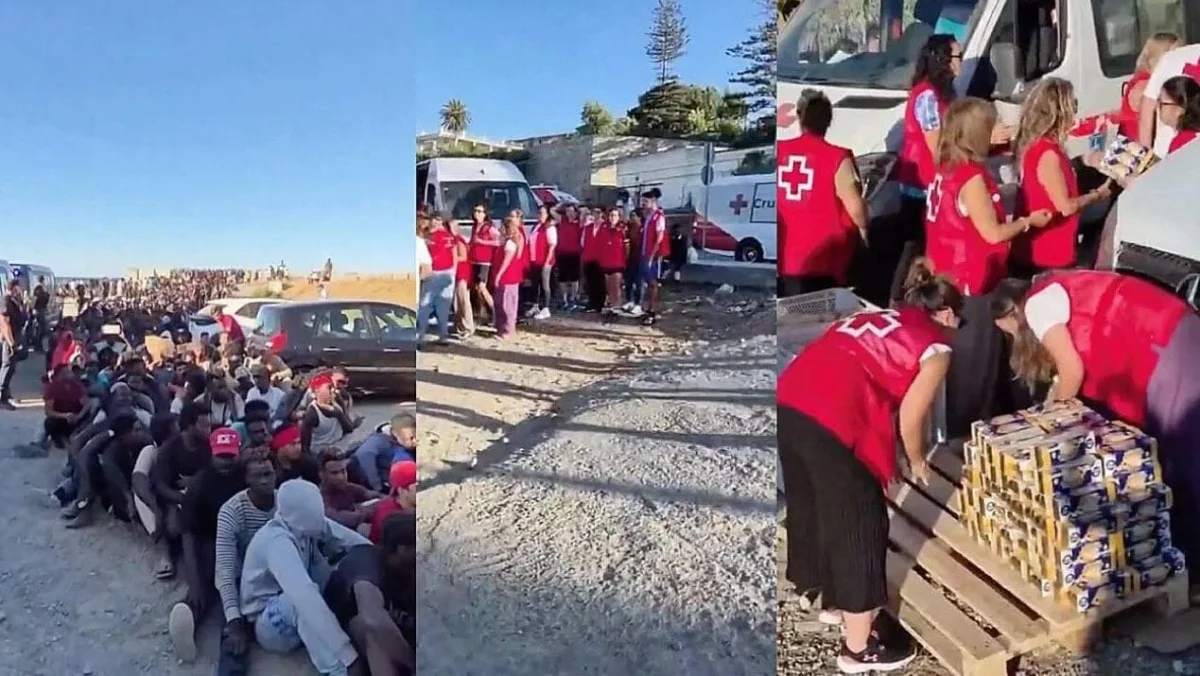
The Spanish autonomous city of Ceuta has become the focal point of a significant humanitarian and geopolitical challenge following an unprecedented influx of migrants from Morocco, prompting a debate over border management, international law, and the role of humanitarian aid. In the aftermath of thousands of individuals breaching the border defenses, the Spanish Red Cross (Cruz Roja Española) has initiated extensive humanitarian operations, providing essential supplies to the men who remain in the enclave. This response, while adhering to the Red Cross’s core principles, has ignited a fierce public and political discussion about its implications for future migration flows and border integrity.
Context and Chronology of the Influx
The crisis began to unfold rapidly in early August 2026, when a massive wave of individuals, predominantly military-aged men from Morocco and sub-Saharan African nations, surged towards and across the heavily fortified border separating Ceuta from Moroccan territory. Unlike previous, more contained attempts, this event was characterized by its sheer scale and coordinated nature. Thousands of migrants, utilizing both land routes and swimming around the breakwaters and fences, managed to enter Spanish soil over several days.
Reports from the ground, including visuals circulated widely on social media, depicted scenes of men navigating the coastline and overwhelming border patrols. While the exact trigger for this specific surge remains a subject of ongoing analysis, it occurred amidst a backdrop of fluctuating diplomatic relations between Spain and Morocco, particularly concerning sovereignty over disputed territories and migration cooperation. Many observers pointed to a perceived relaxation of Moroccan border controls as a contributing factor, suggesting a possible leveraging of migration flows in a broader geopolitical context.
The initial days of the influx saw Spanish authorities struggling to manage the sheer numbers. Spanish National Police and Guardia Civil, supported by military units, were deployed to the border and coastal areas. While some migrants were immediately intercepted and returned to Morocco, thousands managed to disperse throughout Ceuta, overwhelming local infrastructure and prompting an urgent need for humanitarian assistance. The situation quickly escalated from a border security incident to a complex humanitarian crisis within Spanish territory.
The Humanitarian Response and Its Rationale
Against this backdrop, the Spanish Red Cross mobilized its resources to address the immediate needs of the thousands of migrants who remained in Ceuta. On August 4, 2026, volunteers, identifiable by their distinctive red vests, began organized distributions of food and water on beaches like Playa del Trampolín. Accounts from local outlets and Cadena SER confirmed that approximately 2,000 migrants, primarily from sub-Saharan Africa, received packages containing bread, milk, biscuits, water, canned tuna, and pastries. Police personnel were present to maintain order during these distributions, ensuring an organized process.
The Red Cross’s involvement is rooted in its fundamental principles of humanity, impartiality, neutrality, independence, voluntary service, unity, and universality. These principles mandate the organization to provide assistance to all individuals in need, regardless of their legal status, origin, or the circumstances that led to their distress. From the Red Cross’s perspective, the migrants, having completed arduous journeys and now lacking basic necessities, represent a vulnerable population requiring immediate aid. Spokespersons for Cruz Roja emphasized that their actions were purely humanitarian, focused on alleviating suffering and preventing further deterioration of health and well-being. Organizations like Cooperación Sur-Sur also joined efforts in the aid distribution.
Migrants who received assistance expressed relief and shared their aspirations. A Nigerian man named Genesis told reporters he was "happy to finally have something to eat and drink" after days of uncertainty and expressed hopes for asylum. Similarly, Malik Alher, a Sudanese man, recounted going five days without food and articulated his desire to "learn Spanish, live in Madrid and work in a supermarket," highlighting the economic motivations driving many of these journeys. These statements underscore the long-term goals of many migrants, extending beyond immediate relief to seeking integration into European society.
Official Reactions and Political Fallout
The situation in Ceuta quickly became a major political issue in Spain and reverberated across the European Union. Initial statements from the Spanish government, particularly Foreign Minister José Manuel Albares, sought to downplay the severity, claiming that the "practical totality" of those who entered had returned to Morocco. The Spanish Embassy in London reiterated this narrative. However, on-the-ground reality diverged significantly from these official pronouncements. Streets remained crowded, makeshift camps emerged, and thousands of migrants simply stayed put on the beaches and around reception centers (CETI), openly declaring their intent not to return to Morocco but rather to seek passage to mainland Spain and the broader European welfare systems.
Local authorities in Ceuta voiced grave concerns. Juan Jesús Vivas, the President of Ceuta, described the situation as "absolutely unsustainable" for a city with a population of just 83,000. He highlighted the immense strain on public services, security forces, and social infrastructure, emphasizing that the enclave was ill-equipped to handle such a massive and sudden demographic shift.
Opposition parties in Spain launched scathing critiques of the government’s handling of the crisis. Santiago Abascal, leader of the conservative Vox party, controversially labeled the event an "invasion and an act of war promoted by Morocco and allowed by Sánchez," demanding legal proceedings against the Prime Minister. The People’s Party (PP) accused Prime Minister Pedro Sánchez of being detached from the crisis, noting that he was reportedly on holiday while national sovereignty was being challenged. These political reactions underscored the deep divisions within Spain regarding migration policy and border management.
Concerns were also raised by Spanish soldiers on the ground, with some reports indicating that they were ordered primarily to direct migrants towards the border for self-deportation rather than actively preventing entry or enforcing immediate returns. Such accounts, if widespread, suggest a complex and perhaps internally contradictory policy directive that prioritizes humanitarian considerations or diplomatic de-escalation over strict border enforcement.
Broader Implications and The Deterrence Debate
The crisis in Ceuta has reignited a fundamental debate within Europe and among international aid organizations: how to balance humanitarian imperatives with effective border control and deterrence strategies. Critics of the Red Cross’s aid distribution, echoing sentiments expressed by local residents, argued that providing comprehensive support to individuals who have illegally breached a national border could inadvertently act as a "pull factor," encouraging further unauthorized entry rather than deterring it. The argument posits that such aid, while well-intentioned, sends a signal that illegal entry will be met with care packages rather than immediate removal, thereby undermining border enforcement efforts. This perspective often frames the issue as a choice between "carrots" (humanitarian aid) and "sticks" (deportation or refusal of entry).
Conversely, humanitarian organizations maintain that their mandate is apolitical and that the provision of basic necessities is a non-negotiable ethical obligation, especially when lives are at risk. They argue that the root causes of migration – poverty, conflict, lack of opportunity – are far more significant "pull factors" than the prospect of receiving a meal, and that denying aid would only exacerbate human suffering without solving the underlying migration challenge.
Beyond the immediate humanitarian response, the Ceuta crisis has significant geopolitical ramifications. The perceived facilitation of the migrant surge by Moroccan authorities has strained relations with Spain, forcing both countries and the European Union to reconsider their cooperative frameworks on migration. Spain, as an external border of the EU, often finds itself on the front lines of migration flows from Africa, highlighting the need for a cohesive European strategy that combines border security, development aid to origin countries, and robust asylum processing mechanisms. The situation also brings into sharp focus the vulnerabilities of EU enclaves like Ceuta and Melilla, which serve as direct land borders between Africa and Europe.
The long-term implications for Ceuta itself are substantial. The presence of thousands of undocumented migrants, many with no immediate prospect of legal entry into mainland Spain or other EU countries, creates significant social, economic, and security challenges for the small city. The potential for further attempts to reach the Spanish mainland by boat, and calls circulating on social media for future mass invasions, suggest that the crisis is far from resolved. Indeed, some migrants from this particular influx have already reportedly been transferred to mainland Spain, indicating a potential shift in strategy or an acknowledgment of the difficulty of mass repatriation from Ceuta.
Conclusion
The Ceuta migrant crisis of August 2026 stands as a stark illustration of the complex interplay between humanitarian obligations, national sovereignty, and international migration dynamics. The Spanish Red Cross’s provision of aid, while a testament to its unwavering commitment to human dignity, has simultaneously fueled a contentious debate about its broader impact on border management. As thousands of individuals continue to reside in Ceuta, hoping for a pathway to Europe, Spanish authorities face the difficult task of navigating diplomatic pressures, domestic political demands, and international legal responsibilities. The outcome of this crisis will likely have lasting consequences for Spain’s migration policy, its relationship with Morocco, and the ongoing European discussion about how to manage its external borders in an increasingly interconnected and mobile world. The dilemma remains: how to uphold humanitarian principles without inadvertently undermining the credibility of border controls, and how to forge a sustainable, humane, and effective response to the persistent pressures of irregular migration.

