
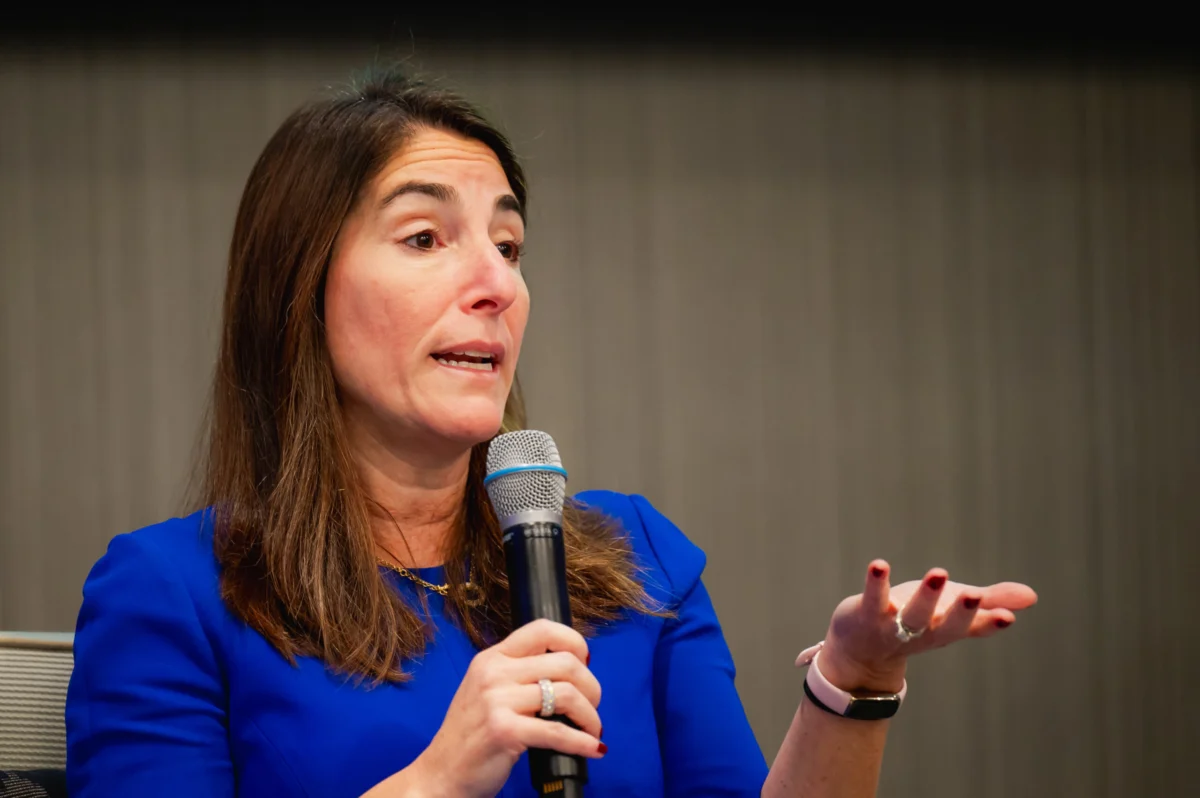
Cleveland Federal Reserve President Beth Hammack, a prominent voting member of the Federal Open Market Committee (FOMC), signaled on Monday that a more restrictive monetary policy stance, characterized by smaller, more frequent interest rate adjustments, is imperative to steer the nation’s stubbornly high inflation back to the central bank’s long-term target of 2%. Speaking at the annual gathering of the National Association of Business Economics (NABE), Hammack articulated a strategy favoring proactive, measured interventions over the risk of larger, more disruptive course corrections necessitated by prolonged inaction. Her remarks come at a critical juncture for the U.S. economy, as policymakers grapple with persistent price pressures following a significant shift in the Federal Reserve’s monetary tightening cycle.
"When feasible, I generally think it’s preferable to make smaller adjustments, and to do so relatively quickly, rather than to wait and risk needing a larger course correction," Hammack stated in her prepared remarks. This philosophy underscores a nuanced approach to monetary policy, seeking to calibrate the economy gently rather than applying blunt force. She further emphasized, "Considering all the inputs that factor into my reaction function, a restrictive monetary policy stance is appropriate to ensure a timely return to 2 percent inflation." These statements strongly imply that further interest rate increases are a distinct possibility, if not a necessity, in the Fed’s ongoing battle against inflation.
The Federal Reserve’s Shifting Stance and Recent Actions
Hammack’s comments are particularly noteworthy given the Federal Reserve’s recent actions and communications. Just last month, in September 2026, the FOMC voted to increase interest rates for the first time in three years, marking a significant pivot from a prolonged period of accommodative monetary policy. This decision ended an extended pause, during which the central bank maintained a steady rate environment while closely monitoring economic data. The minutes from that September meeting further reinforced the possibility of additional tightening, indicating that officials could indeed vote to raise rates again, although a clear timeline for such a decision remained unarticulated.
The three-year hiatus preceding the September 2026 hike speaks volumes about the dramatic shift in the economic landscape. From late 2023 through mid-2026, the Fed had largely maintained a steady-state policy, perhaps assessing the cumulative impact of previous actions or waiting for clearer signals on inflation’s trajectory. The decision to resume hikes signifies a renewed urgency among policymakers regarding the inflationary outlook, suggesting that previous measures were either insufficient or that new pressures have emerged. This period of stability, followed by a renewed tightening cycle, highlights the data-dependent nature of the Fed’s decision-making process and its responsiveness to evolving economic conditions.
Decoding the Inflation Challenge: Sticky Prices and Persistent Pressures
A central theme of Hammack’s address was the challenge posed by "sticky inflation" – price increases that prove resistant to moderation and permeate across various sectors of the economy. She acknowledged that such broad-based inflationary pressures make the task of monetary policymakers significantly more complex, affecting consumers, businesses, and the overall economic outlook. The Cleveland Fed chief expressed her expectation that, given the "breadth" of current inflationary pressures, it would take "some time" to bring annual price growth down to the central bank’s target of 2%.
Recent economic data underscore this persistent challenge. The personal consumption expenditures (PCE) price index, the Federal Reserve’s preferred gauge of inflation, registered a 3.4% year-over-year increase in August 2026. Even more concerning for policymakers was the so-called core reading of the index, which strips out volatile food and energy costs to provide a clearer picture of underlying price trends, which stood at 3.0% compared with a year prior. While these figures represent a moderation from peak inflation levels observed earlier in the cycle, they remain significantly above the Fed’s 2% target, indicating that the inflationary impulse has not yet been fully contained.
The "breadth" of inflation refers to its presence across a wide range of goods and services, rather than being concentrated in a few volatile categories. This broad-based nature suggests that the inflationary forces are deeply embedded in the economy, driven by factors such as strong labor markets leading to wage pressures, robust consumer demand, and lingering supply chain inefficiencies. Services inflation, in particular, has proven to be more persistent, often tied to labor costs which are slow to adjust. Housing costs, including rents and owners’ equivalent rent, also contribute significantly to the stickiness of core inflation, given their substantial weight in both the PCE and Consumer Price Index (CPI) baskets.
Anchoring Inflation Expectations: A Critical Battle for Credibility
Beyond current price levels, Hammack underscored the critical importance of maintaining well-anchored long-run inflation expectations. "Long-run inflation expectations have stayed remarkably well anchored despite actual inflation being above target for more than five years," she observed, adding a cautionary note: "But I’m not taking that for granted." This statement highlights a key concern for central bankers: while households and businesses currently expect inflation to return to the Fed’s target over the long run, prolonged periods of elevated actual inflation could erode this confidence.
The risk, as Hammack articulated, is that "With each passing month, persistently elevated inflation raises the risks of an inflationary mindset becoming entrenched in the economy." An entrenched inflationary mindset occurs when consumers and businesses begin to expect high inflation to continue indefinitely, leading to a self-fulfilling prophecy. Workers demand higher wages to offset rising costs, and businesses raise prices to cover increased labor and input costs, creating a wage-price spiral. Once this cycle takes hold, it becomes significantly harder and more painful to break, often requiring more aggressive monetary tightening that can lead to sharper economic downturns. The Fed’s credibility in achieving its price stability mandate hinges on preventing such an entrenchment of inflationary expectations.
The Federal Reserve’s Dual Mandate and Hammack’s Influence
As President and CEO of the Federal Reserve Bank of Cleveland, Beth Hammack plays a crucial role within the broader Federal Reserve System. Her position affords her a direct voice in the deliberations of the FOMC, the central bank’s primary monetary policymaking body, where she serves as a voting member. The Federal Reserve operates under a dual mandate set by Congress: to achieve maximum employment and maintain price stability. Balancing these two objectives is often a delicate act, particularly in an environment of high inflation and a relatively robust labor market.
Hammack’s remarks provide insights into how she interprets this dual mandate in the current economic climate. Her emphasis on a "restrictive monetary policy stance" to ensure a "timely return to 2 percent inflation" signals a clear prioritization of price stability at this juncture. This perspective aligns with a more hawkish view within the FOMC, suggesting a willingness to tolerate some potential softening in the labor market if necessary to bring inflation under control. Her background, often steeped in financial markets and economic analysis, provides a specific lens through which she evaluates economic data and policy options. The regional Federal Reserve banks, like Cleveland, also bring diverse regional economic perspectives to the national policy debate, enriching the FOMC’s understanding of conditions across the country.
Market’s Anticipation: Decoding Future Rate Trajectories
Financial markets are keenly attuned to such pronouncements from Federal Reserve officials, as they offer valuable clues about the future trajectory of interest rates. According to CME’s FedWatch tool, which tracks the probability of various FOMC actions based on futures market pricing, traders priced in a more than 78% likelihood that the central bank would keep rates unchanged at its policy meeting later this month (October 2026). This reflects a consensus that the Fed might pause after its September hike to assess its impact.
However, the outlook shifts dramatically for the Fed’s final meeting of the year in December. Market participants currently see a nearly 88% chance of a rate hike by then. Hammack’s statements, advocating for swift, incremental adjustments and a restrictive stance, are likely to reinforce these expectations for a December move, further cementing the market’s conviction that the tightening cycle is not yet over. The difference in probabilities between October and December suggests that the market anticipates a data-dependent approach, where economic indicators released over the coming weeks will be crucial in solidifying the FOMC’s decision. Strong employment reports, higher-than-expected inflation readings, or robust consumer spending figures between now and December would likely strengthen the case for another hike, aligning with Hammack’s hawkish posture.
A Broader Economic Landscape: Beyond Inflation
While inflation remains the immediate priority, the Federal Reserve’s policy decisions are also influenced by broader economic indicators. The U.S. labor market, despite some signs of cooling, has generally remained resilient, with a low unemployment rate and strong wage growth. This strength provides the Fed with some latitude to pursue tighter monetary policy without immediately risking a severe downturn in employment. However, an overly aggressive tightening could tip the economy into a recession, a scenario policymakers are keen to avoid. Gross Domestic Product (GDP) growth, consumer spending patterns, business investment, and global economic developments all factor into the FOMC’s complex calculus.
For instance, robust consumer spending, fueled by accumulated savings and wage gains, can contribute to demand-side inflationary pressures. Conversely, a slowdown in global growth or geopolitical instability could introduce new risks to the economic outlook, potentially necessitating a more cautious approach from the Fed. The delicate balance involves slowing demand sufficiently to curb inflation without stifling economic activity to the point of triggering a recession. This concept, often referred to as achieving a "soft landing," is the aspiration of central bankers but historically difficult to achieve.
The Path Ahead: Navigating Uncertainty
Beth Hammack’s remarks underscore the Federal Reserve’s unwavering commitment to achieving its 2% inflation target and preventing an entrenched inflationary mindset. Her advocacy for "smaller, quicker adjustments" suggests a strategic shift towards a more dynamic and responsive monetary policy, designed to gently guide the economy rather than jolting it with large, infrequent moves. This approach aims to provide the Fed with greater flexibility to adapt to incoming data without losing credibility in its fight against inflation.
However, the path ahead is fraught with uncertainty. The global economic environment remains volatile, with ongoing geopolitical tensions, supply chain vulnerabilities, and energy market fluctuations posing significant risks. Domestically, the lag effects of previous rate hikes are still working their way through the economy, and the precise impact of further tightening remains to be seen. Businesses face higher borrowing costs, consumers might see increased credit card interest rates and mortgage costs, potentially dampening spending and investment.
Ultimately, the Federal Reserve’s decisions in the coming months will be data-dependent, with each new economic report scrutinized for signs of inflation cooling, the labor market rebalancing, and overall economic stability. Hammack’s speech serves as a clear signal that the Fed remains vigilant and prepared to take further action, reinforcing the expectation of continued vigilance in monetary policy until price stability is unequivocally restored. The focus will remain on the delicate art of disinflation – bringing down prices without inflicting undue harm on economic growth and employment.

