

Gen Z traders on the Binance cryptocurrency exchange are demonstrating a significant and growing preference for exchange-traded funds (ETFs), with these investment vehicles now comprising a substantial portion of their equity trading activity. In early August, ETFs accounted for 25% of the cohort’s total equity trading volume, a notable increase that signals a strategic shift in how younger investors are approaching the market. This trend is further underscored by data from Binance Research, which indicates that ETFs represented 21.9% of Gen Z’s net equity inflows in July, a rise from 18.5% in June. Concurrently, the proportion of capital allocated to individual stocks within this demographic has seen a slight decline, falling from 77% to 74.2% over the same period.
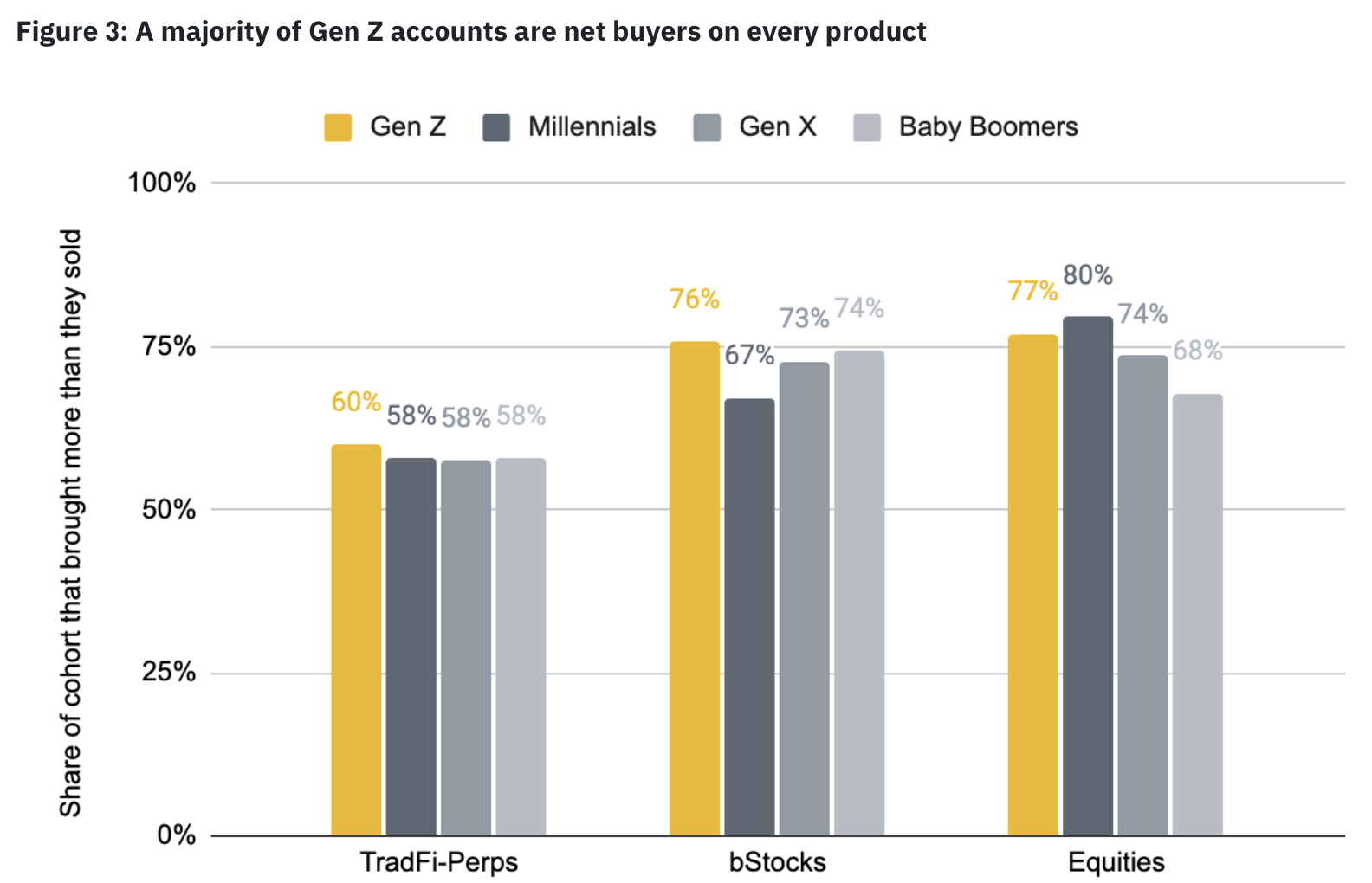
This evolving investment landscape among Gen Z was detailed in a comprehensive analysis by Binance Research, which scrutinized trading behaviors across direct equities, tokenized stocks, and traditional finance perpetual futures. The study meticulously compared the activity of Gen Z accounts with those of Millennials, Gen X, and Baby Boomers, examining key metrics such as trading frequency, net capital flows, and the utilization of leverage. The findings paint a picture of a generation that, while actively participating in financial markets, approaches trading with a distinct strategy, prioritizing diversification and potentially a less volatile entry point into equity markets through ETFs.
Gen Z’s Trading Habits: A Distinctive Approach
The Binance research highlights several key distinctions in Gen Z’s trading patterns compared to older generations. Across all three analyzed product categories—direct equities, tokenized stocks, and traditional finance perpetuals—Gen Z traders exhibited lower trading frequencies. On average, Gen Z accounts engaged in approximately 13 monthly trades within TradFi perpetuals. This figure is lower than their Millennial counterparts, who averaged 17 trades per month, and Gen X, who averaged 16.5 trades per month. This suggests a more measured or less day-trading-oriented approach from the younger demographic.
Furthermore, a significant portion of Gen Z direct-equity accounts demonstrate a long-term investment philosophy, with 22% of these accounts having never executed a sell order. This contrasts with Gen X, where 19% of accounts were buy-only, and Baby Boomers, where only 9% exhibited this behavior. Millennials, however, displayed the highest proportion of "buy-only" accounts, with a substantial 30% of their direct-equity portfolios consisting solely of purchases without any sales. For Gen Z accounts that exclusively buy assets, Binance research identified Broadcom, Tesla, and the Schwab US Dividend Equity ETF (SCHD) as top holdings based on cumulative purchase value. The inclusion of SCHD specifically within this buy-only group further reinforces the observed trend towards ETF adoption, particularly those focused on income generation and broad market exposure.

ETF Preference and Risk Appetite
Gen Z’s inclination towards ETFs appears to extend to a more conservative stance regarding leveraged and inverse ETFs. The Binance analysis revealed that a significant majority, 88.2%, of Gen Z accounts trading TradFi perpetuals reported no activity in these higher-risk, leveraged products. This risk aversion is also present in older demographics, with 84.5% of Millennials and 85.9% of Gen X also showing no engagement with leveraged or inverse ETFs. This suggests that while Gen Z is actively exploring investment avenues, they are largely opting for strategies that mitigate immediate downside risk, with ETFs offering a diversified and often less volatile exposure to underlying assets.
It is crucial to note a caveat provided by Binance regarding the data’s limitations. The platform’s direct equities product only achieved significant scale in June, meaning the analysis of longer-term trends for this specific asset class within Gen Z’s portfolio is based on a relatively short data window. As the platform matures and more historical data becomes available, a more nuanced understanding of Gen Z’s long-term equity strategies will be possible.
The Dynamic Landscape of Tokenized Stocks
Beyond the shift towards ETFs, the broader market for tokenized stocks, which allows for the fractional ownership and trading of traditional company shares on blockchain networks, is experiencing its own dynamic shifts. In a notable development, Binance’s own tokenized stock offering, "bStocks," briefly surpassed Kraken’s "xStocks" as the second-largest issuer of tokenized equities. This occurred less than two months after bStocks’ launch. As of Tuesday, bStocks commanded a tokenized stock value of $610.6 million, marginally edging out xStocks’ $601.2 million, according to data from Token Terminal.
However, this competitive dynamic was short-lived. By Friday of the same week, the positions had reversed. Token Terminal data indicated that xStocks had regained its lead, reaching $610.7 million in value, while bStocks saw its valuation decrease to $579.6 million. Collectively, these two offerings represented 22.3% and 21.2% of the roughly $2.7 billion tokenized stock market, respectively. The largest issuer in this burgeoning market remains Ondo Finance, which held a substantial $971.8 million in tokenized stock value.
The overall tokenized stock market has demonstrated consistent growth. RWA.xyz, a platform tracking the distributed value of tokenized assets, reported a total of $2.43 billion in tokenized stocks as of Friday. This figure represents an approximate 5% increase over the preceding 30 days, indicating sustained investor interest and market expansion in this innovative asset class. The competition between major exchanges like Binance and Kraken in offering tokenized equities reflects a broader trend of traditional finance assets being integrated into the digital asset ecosystem, offering new avenues for investment and potentially greater accessibility.
Broader Implications and Future Outlook
The observed trend of Gen Z traders favoring ETFs on Binance suggests a strategic maturation of their investment approach. ETFs, with their inherent diversification, lower cost structures compared to actively managed funds, and ease of trading, offer an attractive entry point for younger investors seeking broad market exposure without the complexities and risks associated with selecting individual stocks. This preference could be driven by a desire for stability, a response to market volatility, or a strategic move to build a diversified portfolio foundational to their long-term financial goals.
The increasing allocation to ETFs by Gen Z could also be interpreted as a signal to traditional financial institutions and ETF providers. As this generation’s purchasing power grows, their preferences will increasingly shape product development and market strategies. Financial education initiatives that highlight the benefits of diversified, low-cost investing through ETFs may resonate strongly with this demographic.
The ongoing competition and growth within the tokenized stock market underscore the increasing convergence of traditional and digital finance. While bStocks’ brief lead over xStocks highlights the rapid pace of innovation and competition, the overall expansion of the market signals a strong demand for accessible, blockchain-based representations of traditional securities. This innovation could lead to increased liquidity, fractional ownership of previously inaccessible assets, and potentially lower transaction costs for a wider range of investors.
However, the Binance research’s caution regarding the limited data window for direct equities is a reminder that long-term trends are still emerging. As Gen Z continues to navigate their financial journeys, their investment strategies will undoubtedly evolve. The interplay between their preference for ETFs, their engagement with tokenized assets, and their approach to risk will be critical indicators of future market developments and the evolving landscape of retail investing. The continued growth of both ETFs and tokenized stocks suggests a future where digital platforms play an increasingly central role in how individuals, particularly younger generations, access and manage their investments, blurring the lines between traditional and decentralized finance. The strategic positioning of platforms like Binance to cater to these evolving preferences will be key to their sustained success in the dynamic financial markets of the 21st century.

