
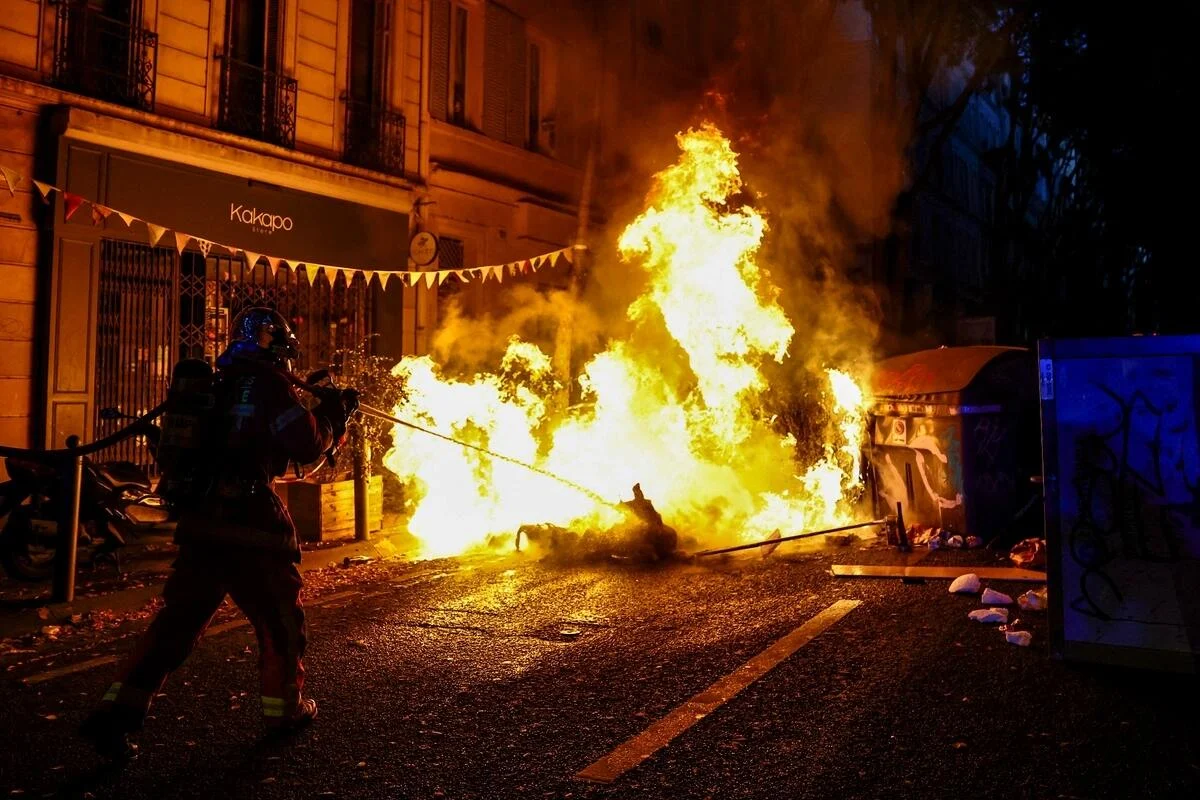
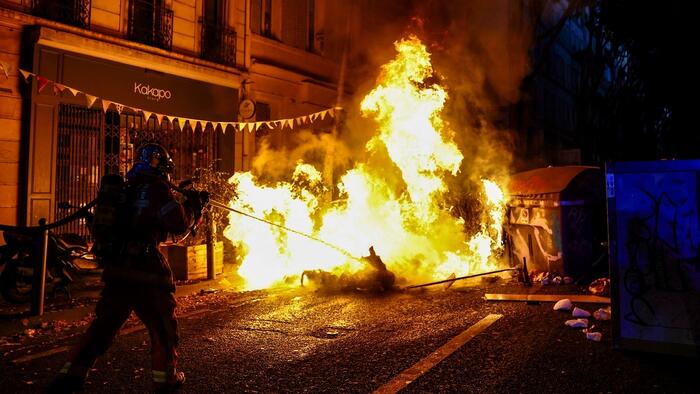
French authorities have reported the arrest of more than 1,300 individuals following a weekend of intense protests and riots across the nation, marking a significant escalation in a month-long period of social unrest. These widespread disturbances, which followed a substantial mass march in Paris just a day prior, have seen clashes erupt in major urban centers, resulting in property damage, looting, and injuries to both demonstrators and security forces. The Interior Ministry confirmed that the latest wave of unrest on Saturday alone led to responses to 75 fires and investigations into 24 looted shops, painting a stark picture of the challenges facing the French government.
Deepening Crisis: A Snapshot of Recent Unrest
The weekend’s events, particularly those on Saturday, saw a resurgence of volatile demonstrations across France. Beyond the capital, cities such as Marseille, Lyon, Grenoble, Nantes, Angers, and Lille experienced significant disruptions. Initial peaceful processions often devolved into chaotic scenes, particularly during their dispersal, as elements identified by authorities as from the "ultra-left and radical far-left" engaged in confrontations with law enforcement. The cumulative figure of 1,314 arrests over the weekend underscores the scale of the police operation mounted to contain the disorder. This widespread turbulence has been described by observers as among the most violent in France in recent years, reflecting deep-seated frustrations within segments of the population.
Roots of Discontent: A Month of Escalation
The current wave of unrest did not emerge in a vacuum but is the latest manifestation of a broader movement that began over a month ago. Initially, the protests were spearheaded by high school students advocating for increased funding for education and a greater number of teachers. These demands stemmed from concerns over perceived underinvestment in public education, overcrowded classrooms, and a shortage of qualified educators, issues that resonate deeply within a nation that prides itself on its public services.
Historically, France has a robust tradition of student-led activism and widespread social protests. From the student movements of May 1968 to more recent demonstrations against pension reforms or the Yellow Vest movement, public expression of discontent is a recurring feature of French political life. The initial student grievances, though specific to education, tapped into a wider current of socio-economic anxieties, including youth unemployment, a sense of political disenfranchisement, and broader frustrations with government policies. As these initial protests gained momentum, they attracted a more diverse array of participants, including various activist groups and individuals keen to voice their broader dissatisfaction, thus broadening the scope and intensity of the demonstrations beyond their original educational focus.
Chronology of Confrontation
The timeline of the recent unrest illustrates a rapid escalation from focused demonstrations to widespread civil disorder.
- Early October 2026: High school students initiate protests across France, demanding increased educational funding and more teaching staff. These initial demonstrations are largely peaceful, characterized by marches and sit-ins.
- Mid-October 2026: As government responses are perceived as insufficient, student protests begin to attract broader support from unions and left-wing political groups. Isolated incidents of minor clashes with police begin to occur, primarily around school premises and administrative buildings.
- Late October 2026 (leading up to the weekend): The movement intensifies, with larger, nationally coordinated marches taking place. A significant mass march in Paris occurs a day prior to the reported weekend unrest, drawing tens of thousands of participants and highlighting the growing national concern.
- Saturday, Late October 2026: The situation deteriorates dramatically. What begins as planned demonstrations in numerous cities, including Paris, Marseille, Lyon, and Grenoble, quickly descends into riots. Authorities report 75 fires, predominantly in public spaces and commercial areas, and confirm 24 instances of shop looting. Security forces are deployed in large numbers to manage the crowds and contain the violence. Clashes between protesters and police are reported throughout the day and into the night, leading to the reported 1,314 arrests across the country.
- Sunday, Late October 2026: The Interior Ministry issues statements detailing the damage and arrests, indicating that clashes had largely "died down" by late Saturday, though tensions remained high and investigations were immediately launched.
Government’s Stance and Response
In the wake of the extensive unrest, French Interior Minister Laurent Nuñez issued a strong statement on Saturday, unequivocally condemning the violence and expressing robust support for the nation’s security forces. He lauded the "exceptional commitment and professionalism of all the regional prefects, prefects, police officers, gendarmes, and firefighters mobilized across France to ensure the safety of our fellow citizens and allow the processions to proceed smoothly."
However, Nuñez specifically singled out elements from the "ultra-left and radical far-left," accusing them of deliberately seeking to "sow disorder, particularly during the dispersal of the processions." He declared these acts "unacceptable" and emphasized the government’s firm stance against such behavior. The Minister further highlighted the "intolerable" nature of the violence inflicted upon internal security forces, stating they are "deliberately targeted because of their uniforms and, above all, because they are the bulwarks of our Republic that these radical militants seek to bring down." This rhetoric underscores the government’s perception of the protests’ more violent factions as a direct challenge to the state’s authority and fundamental institutions.
Beyond condemnations, the ministry confirmed that "several investigations have been opened" into the incidents of violence, looting, and arson, indicating a clear intent to prosecute those responsible. The deployment of significant police and gendarmerie units across the country reflects a government strategy focused on maintaining public order through a visible and assertive law enforcement presence, even as it faces criticism from some quarters regarding police tactics.
The Political Battleground: Macron’s Challenge
The escalating unrest poses a significant and immediate challenge to President Emmanuel Macron’s administration, particularly as the country approaches the crucial May 2027 presidential election. Macron, nearing the end of his second term, finds his authority tested by a persistent wave of social discontent, reminiscent of previous challenges such as the Yellow Vest movement or the contentious pension reforms. The ongoing protests highlight a perceived disconnect between the government and segments of the French populace, providing fertile ground for political maneuvering by both the right and the left.
On the political right, Marine Le Pen’s National Rally party has seized upon the unrest, accusing Macron’s government of failing in its primary duty to protect public safety and maintain order. Le Pen and her allies have actively urged citizens to channel their anger and frustration into votes for the National Rally candidate in the upcoming election, framing the party as the sole credible guarantor of law and order and national security. This narrative appeals to a segment of the electorate concerned about public safety, social cohesion, and what they perceive as a decline in state authority.
Conversely, on the political left, presidential candidate Jean-Luc Mélenchon has adopted a different approach. He has voiced support for the demonstrators, emphasizing their legitimate grievances and criticisms of government policies. Simultaneously, Mélenchon has been a vocal critic of policing tactics employed during the protests, drawing attention to reports of some protesters sustaining "life-changing injuries." His stance resonates with those who feel the government is unresponsive to social demands and that police actions are overly aggressive, further polarizing the national debate around civil liberties and state power.
These contrasting political reactions underscore the high stakes involved. The unrest is not merely a public order issue but has become a central battleground in the pre-election political discourse, shaping public opinion and potentially influencing voter behavior in the lead-up to the 2027 polls.
Socio-Economic Undercurrents
Beyond the immediate triggers of educational funding, the pervasive unrest in France reflects deeper socio-economic and cultural undercurrents that have long simmered beneath the surface of French society. A persistent sense of youth disillusionment, particularly among those facing limited economic opportunities and a challenging job market, contributes significantly to the readiness of young people to participate in protests. Despite government efforts, high youth unemployment rates in certain areas, coupled with a perceived lack of social mobility, fuel a feeling of being left behind.

Furthermore, economic disparities, particularly in France’s suburban areas (banlieues), often exacerbate these frustrations. These regions frequently experience higher concentrations of poverty, less access to quality public services, and a sense of marginalization from the mainstream. The protests, therefore, become an outlet for expressing broader resentments against a system perceived as unequal and unresponsive. The perception of government policies, whether related to education, employment, or social welfare, as either inadequate or unjust further inflames public sentiment. This complex interplay of economic hardship, social marginalization, and political alienation creates a volatile environment ripe for social unrest, where specific grievances can quickly merge into a broader expression of collective dissatisfaction.
The International Gaze: US Perspectives and Broader Implications
The unfolding events in France have not gone unnoticed on the international stage, particularly drawing commentary from political figures in the United States. Former President Donald Trump and Vice President JD Vance have notably attributed the riots, looting, and violence in France, and across Europe more broadly, to "mass immigration policies." Their statements connect the civil unrest to a larger narrative concerning the challenges of integration, cultural identity, and social cohesion within European societies.
Speaking at a Kansas rally to bolster Republican candidates for the upcoming U.S. midterm elections on November 3, Trump issued a stark warning, claiming France is "being conquered, looted, and burned to the ground" by migrants who "hate, frankly, the Western civilization itself." This rhetoric positions the French unrest as a manifestation of a wider "culture war" and a threat to traditional Western values, a theme frequently echoed in conservative political discourse. Trump also explicitly warned that similar chaos could emerge in the United States if Republicans fail to secure victories in the midterm elections, linking the stability of American society directly to the outcome of its immigration policies and electoral results.
This international perspective highlights how domestic issues in one nation can be co-opted and reframed to serve political agendas elsewhere. The comments from Trump and Vance underscore a broader global debate about migration, national sovereignty, and the future of Western democracies, suggesting that the French unrest is seen by some as a cautionary tale with significant implications for other nations grappling with similar demographic and social shifts.
Looking Ahead: Pathways and Perils
As France navigates this period of intense social unrest, the path forward remains fraught with challenges. The immediate priority for the government will be to restore and maintain public order, ensuring the safety of citizens and property while addressing the root causes of the widespread discontent. The "several investigations" launched by the Interior Ministry signal a commitment to judicial action against those who engaged in violence and destruction, a measure intended to deter future acts of disorder.
However, a purely punitive approach risks further alienating segments of the population and potentially exacerbating tensions. The Macron administration faces the delicate task of balancing firm law enforcement with genuine efforts to engage in dialogue and address the underlying grievances that have fueled the protests, particularly those related to educational funding and socio-economic disparities. Failure to do so could lead to a cycle of recurring unrest, further destabilizing the country and deepening societal divisions.
The long-term implications for French society and politics are substantial. The current crisis will undoubtedly influence the political landscape leading up to the 2027 presidential election, shaping debates around national identity, public security, social justice, and the role of the state. The ability of the government to manage this crisis effectively will be a critical test of its legitimacy and its capacity to unite a deeply polarized nation, defining the legacy of the Macron presidency and setting the stage for France’s future trajectory.

