
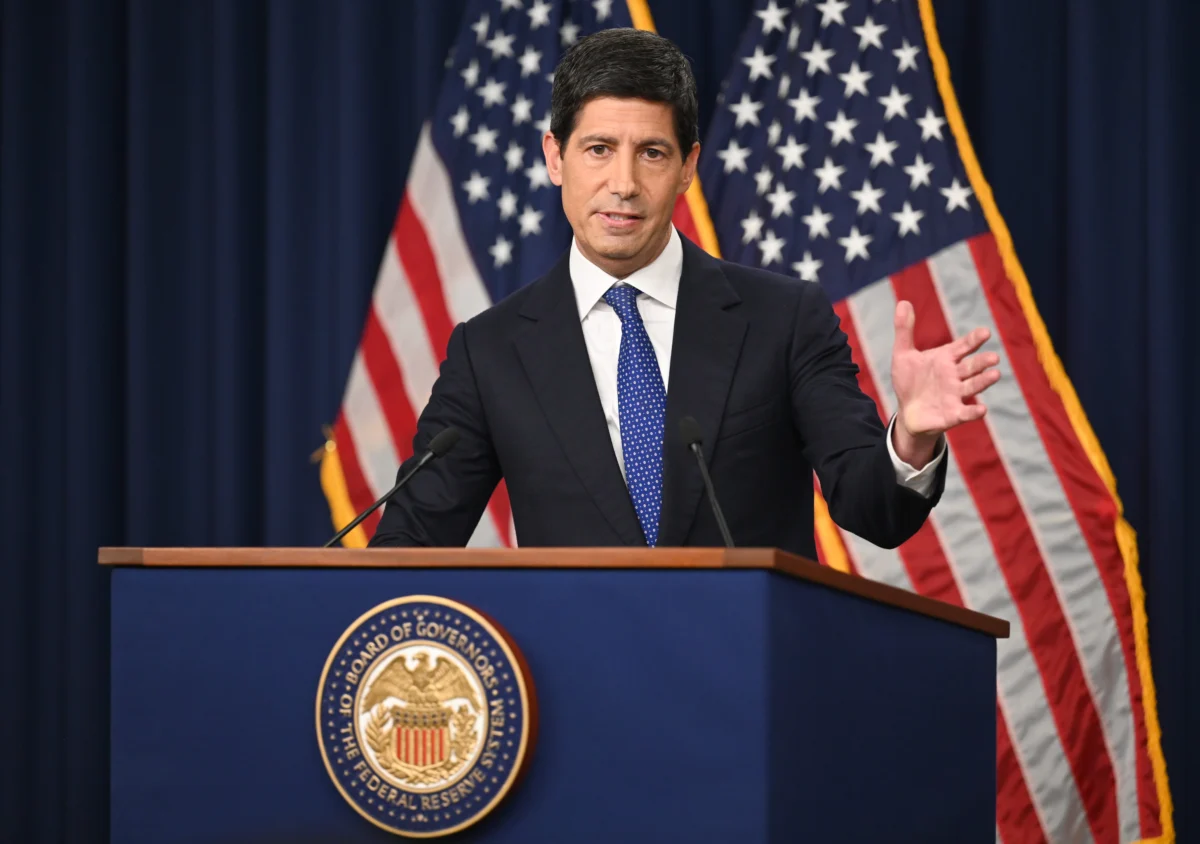
Federal Reserve Chair Kevin Warsh, speaking at a news conference at Federal Reserve headquarters in Washington on September 16, 2026, delivered a pronouncement that simultaneously clarified the central bank’s immediate policy direction and cast a shroud of uncertainty over its future course. The occasion marked a pivotal moment: the first increase in the benchmark interest rate since 2023, following the Federal Open Market Committee’s (FOMC) latest policy meeting. Warsh’s carefully articulated remarks, particularly his characterization of the rate hike not as a tightening of monetary policy but rather as the removal of "a dose of accommodation," immediately sparked intense debate among economists, analysts, and market participants globally.
Unpacking "A Dose of Accommodation": A Seminal Shift in Fed Rhetoric
The central bank’s decision to raise its benchmark rate by a quarter percentage point, pushing the target range to 3.75%-4%, was widely anticipated given the prevailing economic conditions. However, it was Warsh’s choice of language during the post-meeting press conference that truly captured attention. Describing the move as merely taking away "a dose of accommodation" — a term synonymous with monetary stimulus — implies a fundamentally different perspective than previous Fed communications. This subtle semantic shift suggests that despite the rate hike, the overall policy stance remains supportive of economic growth, signaling that further adjustments may be necessary to reach a truly neutral or restrictive position.
Warsh elaborated that this move was facilitated by a U.S. economy that has demonstrably "strengthened" and financial conditions that have become "less restrictive." This assessment underscored the Fed’s confidence in the economy’s resilience, even as it embarked on a path of higher borrowing costs. Yet, the implications of his specific phrasing were profound. Krishna Guha, head of economics and central bank strategy at Evercore ISI, highlighted this in a client note, calling it "the one stand-out hawkish element" of Warsh’s commentary. Guha emphasized that this was no accidental utterance; Warsh repeated the phrase multiple times, indicating a deliberate choice to frame policy in a new, perhaps more open-ended, manner. This framing, Guha noted, "is substantively different to that used by the Fed in recent years, and raises the possibility of a more open-ended approach to the number of hikes that might be required."
Historically, the Federal Reserve, under previous chairs such as Jerome Powell and Janet Yellen, often articulated its policy moves within a framework that calibrated the benchmark rate against the "neutral rate." The neutral rate, often referred to as r-star, is a theoretical interest rate that neither stimulates nor constrains economic growth, allowing the economy to operate at its full potential with stable inflation. Policy rates significantly above this neutral rate are considered restrictive, while those at or below it are deemed accommodative. Warsh’s departure from this established lexicon immediately posed vexing questions for markets attempting to discern the Fed’s long-term strategy and the ultimate destination for interest rates.
The Neutral Rate Conundrum: A Break from Tradition
Perhaps the most striking aspect of Warsh’s post-meeting remarks was his direct dismissal of the neutral rate as an operational guide for policy decisions. When pressed by CNBC’s Steve Liesman to clarify how far the current rate sat above neutral, Warsh effectively rejected the premise, stating, "It’s useful academically. It’s a discussion to help us think about policy. Do I think it has any operational effect of decisions that we make today? No, I don’t."
This declaration represents a significant philosophical shift from decades of central bank orthodoxy. For many, the neutral rate serves as a crucial benchmark for determining the appropriate stance of monetary policy. Its rejection by the current Fed Chair introduces a layer of ambiguity that contrasts sharply with the explicit forward guidance often provided by his predecessors. This lack of a clear, quantifiable anchor point leaves markets grappling with an unprecedented level of uncertainty regarding the terminal rate of this tightening cycle. If the Fed is no longer guiding its decisions by a discernible neutral rate, what metrics will define the end of accommodation? As Guha aptly put it, Warsh’s framing "raises the possibility that rates might have to keep going up until financial conditions facing the private sector are no longer ‘accommodative’ — however that is defined. This is a relatively open-ended prospect."
This deliberate ambiguity has quickly become a hallmark of Warsh’s tenure, cultivating a reputation for a cryptic approach to monetary policy communication. His predecessor, Jerome Powell, who now serves as a governor on the committee, was known for a more direct and transparent communication style, often emphasizing data dependency and clear guideposts for future actions. Warsh’s nuanced, almost philosophical, stance on policy mechanics signals a new era for the Federal Reserve, one where explicit quantitative guidance may take a back seat to qualitative assessments of economic and financial conditions.

Economic Landscape and Precedent: The Road to September 2026
The September 2026 rate hike did not occur in a vacuum. It was the culmination of evolving economic conditions and a strategic recalibration following a period of unprecedented monetary policy interventions. The last rate increase occurred in 2023, after which the global economy faced new challenges, leading to a period of stability or even modest easing. Notably, the Fed under former Chair Powell had implemented "insurance cuts" in the fall of 2025. These preemptive reductions were likely designed to safeguard against potential economic headwinds or to provide additional stimulus in the face of perceived downside risks, even as inflation remained a concern.
By late 2025 and into 2026, several key economic indicators began to signal a robust recovery and persistent inflationary pressures. Employment figures consistently surprised on the upside, with the unemployment rate hovering near historical lows, indicating a tight labor market. Wage growth, while welcomed by workers, also contributed to upward pressure on prices. Furthermore, supply chain disruptions, a lingering effect of earlier global events, continued to exert inflationary forces, alongside strong consumer demand fueled by accumulated savings and government stimulus.
The Fed’s dual mandate — to achieve maximum employment and maintain price stability (typically defined as 2% inflation) — increasingly pointed towards the need for tighter monetary policy. Despite the earlier insurance cuts, policymakers observed that inflation, while potentially moderating from its peaks, was not sustainably returning to the 2% target. Financial conditions, far from being restrictive, remained relatively loose, suggesting that the economy could absorb higher borrowing costs without derailing growth. It was against this backdrop that the FOMC convened, ultimately deciding that the time was ripe to begin withdrawing some of the monetary support that had been in place. Warsh’s statement regarding the economy having "strengthened" and financial conditions becoming "less restrictive" served as the official justification for this shift.
Market’s Immediate Response and Future Outlook
The market’s reaction to Warsh’s commentary was swift and decisive. The cryptic phrasing, coupled with the actual rate hike, immediately spurred a wave of speculation on Wall Street regarding the Fed’s future moves. Analysts and traders began pricing in higher probabilities for subsequent rate increases in the near term.
Goldman Sachs and Bank of America, two prominent financial institutions, both adjusted their forecasts to include an October increase. Bank of America went further, anticipating an additional move in December 2026. The CME Group’s FedWatch tool, a widely followed indicator of market expectations for Fed policy, showed a dramatic shift. On the Friday morning following the meeting, the market-implied odds of an October increase stood near 58%, a significant jump from 42% just a week prior. This immediate repricing reflected a consensus that Warsh’s "dose of accommodation" remark strongly signaled a more aggressive tightening path than previously assumed.
James Egelhof, chief U.S. economist at BNP Paribas Securities, echoed this sentiment. He clarified that in Fed parlance, "accommodation" means "stimulus," and Warsh’s comment therefore "implies that the current monetary policy stance is meaningfully stimulative." Egelhof concluded, "With policy starting at a stimulative stance, a strong cyclical impulse, and persistent inflation, we think significant rate increases, perhaps more than the three we expect, may be necessary to stabilize the unemployment rate from below and prevent overheating next year." He, too, identified the "dose of accommodation" remark as "the most striking feature" of Warsh’s truncated news conference.
Looking further out, futures markets are now implying a fed funds rate of 4.635% near the end of 2027. This projection suggests that traders anticipate three to four additional quarter-percentage-point hikes beyond the September 2026 move. Such a trajectory would not only reverse the "insurance cuts" of late 2025 but also unwind many of the rate reductions approved under former Chair Jerome Powell, effectively ushering in a higher interest rate environment than the one seen in recent years.

Jack Janasiewicz, portfolio manager and lead portfolio strategist at Natixis Investment Managers Solutions, provided a nuanced perspective, suggesting that while the "dose of accommodation" remarks "seemingly helped to underscore this hawkish tone, implying that [the] committee no longer views policy as modestly restrictive," he remained "unconvinced that this is the start of an aggressive new tightening cycle." Instead, Janasiewicz proposed that this might primarily be a "removal of the insurance cuts the Fed delivered in the fall of 2025," suggesting a more measured, though still upward, path for rates.
Broader Economic Repercussions and the Path Ahead
The implications of the Fed’s latest rate hike and Chair Warsh’s unique communication strategy extend far beyond financial markets, touching various sectors of the economy and impacting daily lives.
For consumers, higher interest rates translate directly into increased borrowing costs. Mortgage rates, already trending upwards, are expected to climb further, making homeownership less affordable. Similarly, interest rates on credit cards, auto loans, and personal loans will likely rise, increasing the financial burden on households. Conversely, savers might see slightly better returns on their deposits, though these gains are often modest and tend to lag behind borrowing cost increases. The cumulative effect could be a dampening of consumer spending, particularly on big-ticket items, as discretionary income is diverted to servicing debt.
Businesses will also face a higher cost of capital. Companies looking to expand, invest in new equipment, or manage working capital through borrowing will find it more expensive. This could potentially slow down corporate investment, hiring, and overall economic expansion, especially for smaller businesses and startups that are more sensitive to financing costs. Sectors heavily reliant on borrowing, such as real estate and construction, could experience a noticeable slowdown.
Globally, a rising U.S. interest rate environment typically strengthens the U.S. dollar. A stronger dollar makes American exports more expensive and imports cheaper, potentially impacting the trade balance. For emerging markets, a strong dollar can create headwinds, making dollar-denominated debt more expensive to service and potentially leading to capital outflows as investors seek higher returns in the U.S. These dynamics could create ripple effects across the international financial system, prompting other central banks to reassess their own monetary policies.
Perhaps the most significant long-term implication lies in the shift in the Fed’s communication and policy framework. By downplaying the operational relevance of the neutral rate and employing a more open-ended approach to policy adjustments, Warsh’s Fed introduces a new paradigm. This could lead to increased market volatility as investors grapple with less explicit forward guidance. The lack of clear benchmarks might necessitate a more dynamic, data-dependent approach from market participants, focusing intensely on every piece of economic data and every word from Fed officials.
The coming months will be critical in understanding the Warsh Fed’s ultimate policy destination and its preferred mode of communication. The central bank is embarking on a delicate balancing act: reining in inflation without stifling economic growth, all while navigating a new rhetorical landscape. Whether this "dose of accommodation" is merely the first of many, or a more isolated adjustment, remains the central question facing the U.S. economy and global financial markets as 2026 draws to a close and the Fed charts an increasingly uncertain course.

