
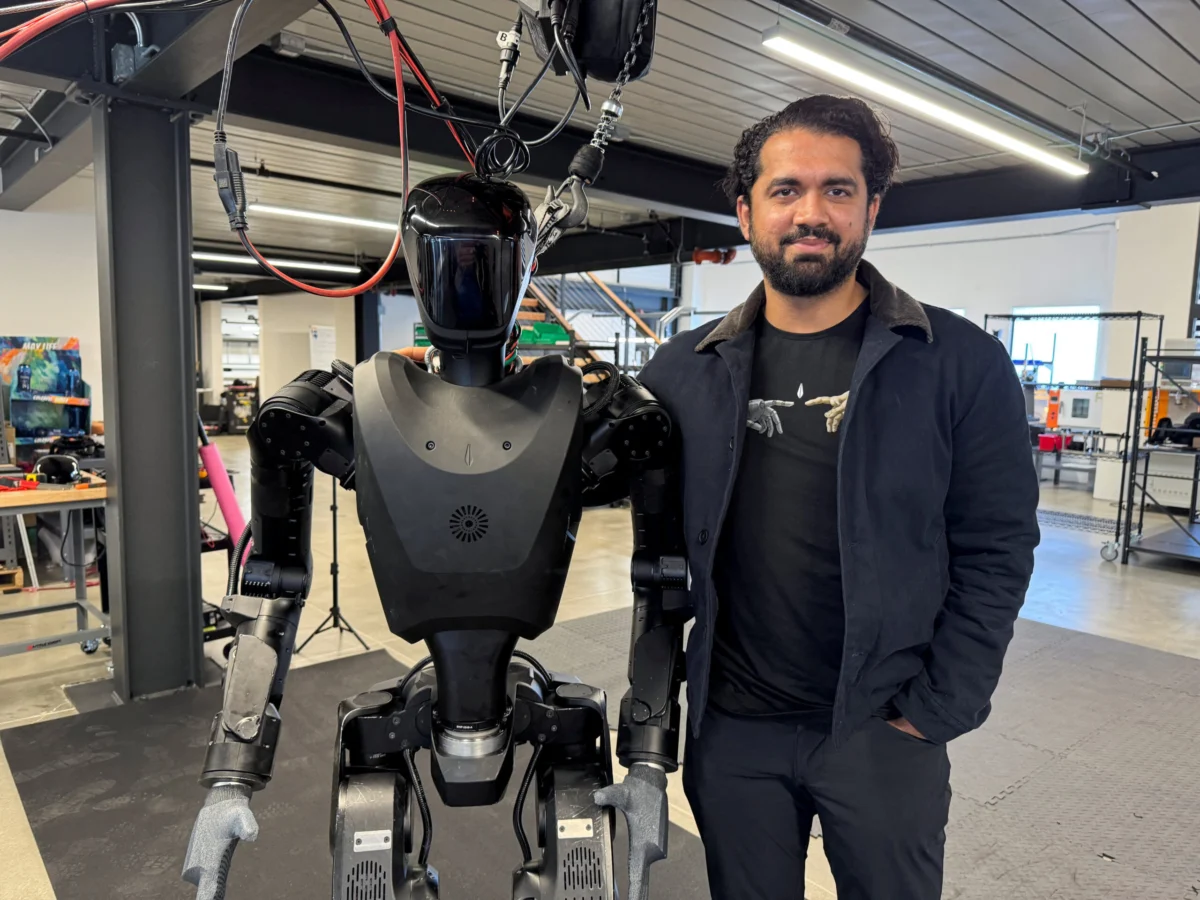
San Francisco, CA – Foundation Future Industries, a startup aiming to revolutionize military robotics with its humanoid robot Phantom-01, is grappling with a severe financial crisis, leaving employees unpaid and raising critical questions about its corporate governance and the contentious past of its CEO and co-founder, Sankaet Pathak. The San Francisco-based company, which boasts Eric Trump as an advisor and investor, failed to disburse employee paychecks on October 30, compounding internal anger over Pathak’s substantial personal loan from the company for a luxury home purchase last year. This cash crunch comes at a pivotal moment as Foundation seeks hundreds of millions in new funding at a $3 billion valuation, even as Pathak claims to be on the verge of unveiling a next-generation, weapons-ready robot designed to bolster U.S. defense capabilities against global rivals.
The Immediate Financial Turmoil and Employee Discontent
Sources with direct knowledge of the situation, who requested anonymity to discuss the private company candidly, confirmed that Foundation missed its scheduled payroll last month, leaving numerous workers without their expected earnings. This marks the second instance of payroll delays within a few months, following a similar lapse in August that was temporarily resolved by a bridge loan from an existing investor. The repeated financial instability has severely eroded employee morale and trust.
Compounding the frustration among staff is the revelation that CEO Sankaet Pathak borrowed a substantial $4.6 million from Foundation in 2025. Public records indicate that an LLC with Pathak as its sole principal used this capital to acquire a $4.6 million property in Sausalito, California, in October 2025. This opulent residence, described as having "sweeping, cinematic views" of the San Francisco Bay, stands in stark contrast to the company’s current inability to meet basic payroll obligations. Insiders are particularly incensed, viewing Pathak’s personal financial maneuver as a direct misuse of funds that could have secured employee compensation. Pathak’s spokesperson acknowledged receipt of detailed inquiries regarding these points but did not provide a comment by publication time.
A Troubled History: The Synapse Collapse Echoes
The current crisis at Foundation is intensified by the shadow of Sankaet Pathak’s previous venture, Synapse, a fintech firm that collapsed in 2024. Synapse operated as a crucial intermediary, enabling fintech companies to offer banking services to their customers through partnerships with smaller community banks. Its spectacular failure left over 100,000 Americans locked out of accounts containing a combined $265 million in deposits, many of which were supposedly FDIC-insured.
The aftermath of Synapse’s bankruptcy has been protracted and devastating for its former customers. Despite the involvement of a bankruptcy trustee, former FDIC chair Jelena McWilliams, and a subsequent lawsuit by the Consumer Financial Protection Bureau (CFPB), thousands still lack access to their savings more than two years later. Investigations revealed a staggering $96 million in customer funds went missing, with Pathak blaming banking partner Evolve, and Evolve, in turn, pointing fingers at Synapse. Federal prosecutors have reportedly convened a grand jury to investigate potential criminal misconduct at Synapse, though Pathak himself was not specifically named in public reports regarding this investigation. Notably, as Synapse spiraled towards bankruptcy in 2024 amid disputes over unmatched ledgers, Pathak reportedly withdrew $320,000 in loans from the struggling company, a detail highlighted by independent financial journalists. This pattern of personal withdrawals from financially distressed companies led by Pathak has become a significant point of concern for current and prospective Foundation stakeholders.
Foundation’s Ambitious Vision and Political Entanglements
Despite Pathak’s controversial past, Foundation Future Industries has garnered significant attention, largely due to its ambitious goals and high-profile affiliations. The company aims to develop advanced humanoid robots like the Phantom-01, not merely for industrial automation but for military applications. Pathak has publicly stated that these robots are close to being "weapons-ready" and could play a crucial role in enhancing U.S. competitive advantage against nations like China. He has even floated the prospect of deploying these robots for battlefield tasks in Ukraine or to patrol the U.S. southern border, claims that have generated widespread media coverage, including broadcast interviews and articles in prominent publications.
A significant aspect of Foundation’s public profile emerged in an April television interview, which introduced Eric Trump, son of the former U.S. president, as a Foundation investor and chief strategy advisor. While the extent of his stake remains undisclosed, Eric Trump and his brother, Donald Trump Jr., have a documented history of investing in defense firms, including those developing military drones and autonomous weapons. A July 2026 Washington Post investigation revealed that startups backed by investment vehicles linked to the Trump brothers had secured at least $3.2 billion in government contracts. Eric Trump, in the April interview, lauded Foundation’s technology, stating, "When you go up and interact with these robots… they fist bump you, they high five you, they follow your commands."
This high-profile endorsement, however, swiftly drew the ire of Senator Elizabeth Warren (D-Mass.), who publicly questioned whether Foundation’s defense contracts were a result of nepotism. In an April 23 social media post, Warren stated, "Eric Trump went on FOX to brag about winning ANOTHER multimillion-dollar contract from the Trump administration. This looks like corruption in plain sight." Eric Trump did not respond to requests for comment regarding the current financial situation. His spokesperson recently told the Financial Times that Eric Trump has "no involvement in Foundation’s management, operations, strategic decisions or commercial activities, including the solicitation, negotiation, procurement or execution of any government contracts," aiming to distance him from the company’s day-to-day operations and any potential impropriety.
Clarifying Pentagon Contracts and Previous Exaggerations
Amidst the claims of significant Pentagon contracts, a closer examination reveals a more nuanced picture. While Pathak asserted in an April television interview that the company had "landed a $24 million Pentagon deal," and this was widely reported, Foundation itself did not directly win these contracts. Instead, the reported $24 million in government research contracts originated from Florida-based Boardwalk Robotics, which Foundation acquired in late 2024. According to a person familiar with the acquisition, Foundation utilized Boardwalk’s robot, Alex, as the foundational design for its own Phantom MK-1 model. Furthermore, this acquisition deal included performance milestones for Boardwalk’s robot that reportedly have yet to be met, adding another layer of complexity to Foundation’s claims of success.
This is not the first instance where Foundation, or Pathak, has faced scrutiny over exaggerated claims. In 2024, CNBC reported that letters sent by Pathak to prospective investors for Foundation cited an imminent investment and a $300 million purchase order from General Motors. These claims were subsequently rejected by the automaker, leading Foundation co-founder Mike LeBlanc to express embarrassment about the company’s marketing materials at the time. Such a history of inflated claims inevitably casts doubt on the company’s current assertions regarding its technological readiness and financial prospects.
Corporate Governance, Funding Challenges, and Insider Concerns
Foundation’s current financial woes are exacerbated by what insiders describe as highly centralized corporate governance. Sankaet Pathak serves as the company’s sole board member and holds the majority of its shares. This structure, which allowed Pathak to secure the $4.6 million loan from the company with minimal oversight, has raised significant concerns among prospective investors regarding accountability and transparency. Existing investors, while aware of the loan through financial disclosures, are reportedly frustrated by the lack of checks and balances. "This is what happens in a company with no governance," commented one insider, questioning if the company will "just going to let it ride into the ground, and you ride off into the sunset?"
Pathak has been actively seeking to raise hundreds of millions of dollars at a $3 billion valuation since at least January 2026, a target that appears increasingly challenging given the company’s current liquidity issues and the founder’s history. The capital market for hardware startups, especially those with long development cycles and high capital expenditure like robotics, remains competitive. Investors are increasingly cautious, prioritizing robust governance, clear paths to profitability, and trustworthy leadership. The current situation at Foundation, with missed payrolls, a CEO’s controversial personal loan, and past exaggerations, presents a formidable obstacle to securing the necessary fresh funding. Insiders openly express fears that without a significant infusion of capital, Foundation could soon collapse, mirroring the fate of Pathak’s previous enterprise.
Foundation was co-founded in April 2024 by Pathak, Tribe Capital CEO Arjun Sethi, and Mike LeBlanc of Cobalt Robotics. The company successfully attracted dozens of robotics engineers and artificial intelligence experts, some from industry giants like Tesla and Amazon-owned Zoox, drawn by the promise of groundbreaking work in humanoid robotics. The current crisis, however, puts these highly skilled employees in a precarious position, facing delayed payments and an uncertain future. Pathak reportedly sent a memo to employees this week, assuring them he was actively working to secure funds for back wages, but without a concrete resolution, the talent drain could become a critical challenge.
Broader Implications: Military AI, Venture Capital, and Accountability
The unfolding situation at Foundation Future Industries carries broader implications for several sectors. For the burgeoning field of military AI and humanoid robotics, it highlights the immense capital requirements and the intense scrutiny faced by companies operating in such sensitive domains. The ethical debates surrounding autonomous weapons systems are already complex, and questions about the financial stability and integrity of developers only add to the challenges.
For the venture capital community, Foundation’s struggles serve as a cautionary tale regarding due diligence, especially when founders have a history of corporate failures or questionable financial practices. The allure of high-tech defense contracts and politically connected investors can sometimes overshadow fundamental business principles and robust governance requirements. The case also underscores the need for greater transparency and accountability within private companies, particularly those dealing with significant public interest and potential government funding.
Ultimately, the Foundation Future Industries saga is a complex narrative weaving together technological ambition, financial precariousness, political connections, and a troubling history of corporate governance. As the company struggles to secure its financial footing and fulfill its bold promises, the eyes of employees, investors, government watchdogs, and the public will remain fixed on its trajectory, questioning not only its viability but also the broader ethical and operational standards within the rapidly evolving world of advanced robotics.

