
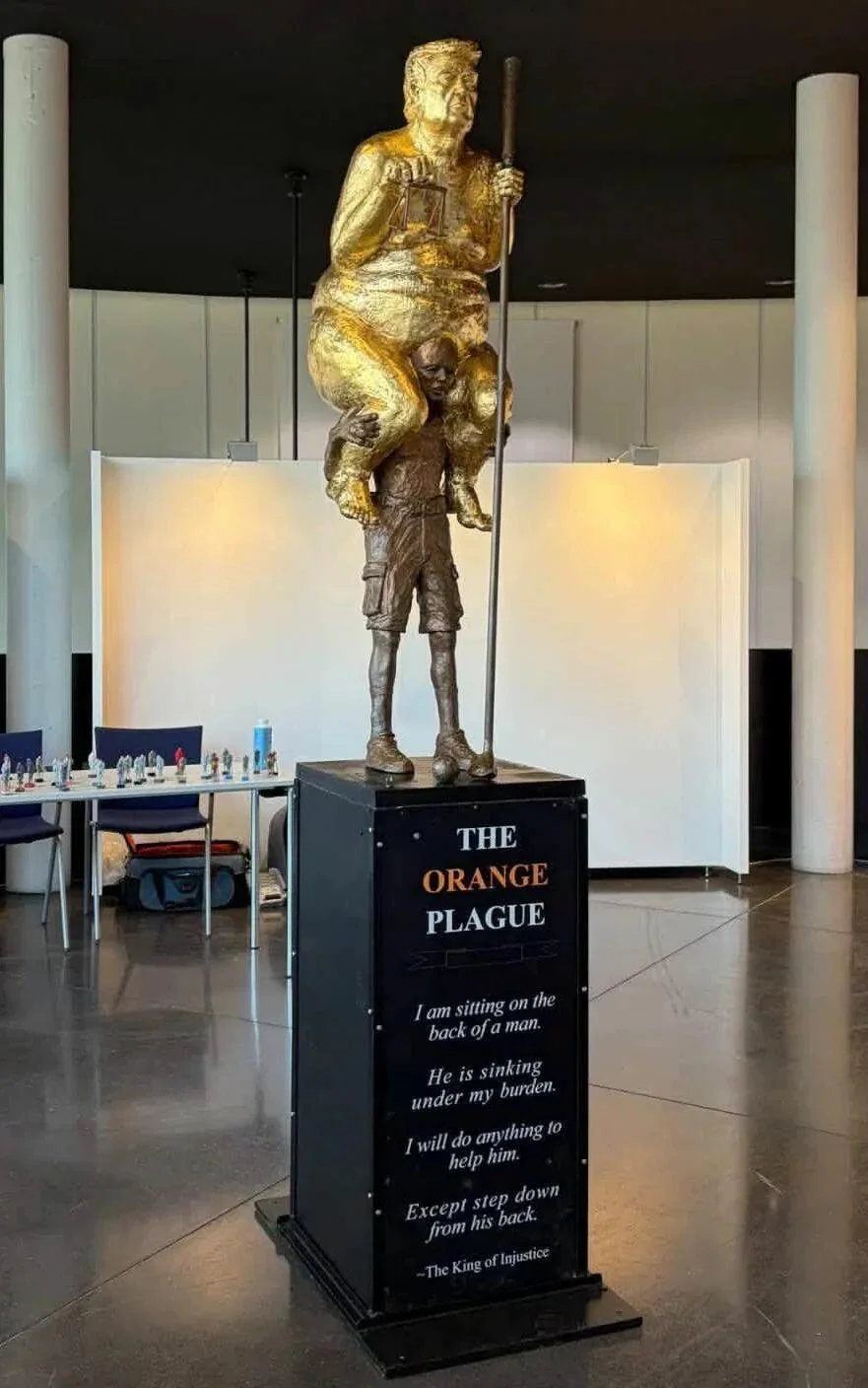
A striking golden statue depicting a naked Donald Trump, titled "Orange Plague," has become a focal point of discussion and debate at the European Parliament in Strasbourg, France. Standing at an imposing 8.5 feet tall, the sculpture is strategically positioned at one of the busiest intersections connecting two of the Parliament’s principal buildings, ensuring maximum visibility for MEPs, staff, and visitors alike. The provocative artwork, which is scheduled to remain on display until Thursday, features the former U.S. President holding scales of justice in one hand and a long golf club in the other, with the golf ball uniquely fashioned to resemble the globe. He is depicted sitting precariously on the shoulders of a smaller, clothed man, who appears to be struggling under the burden. A compelling inscription on the plinth accompanying the statue reads: "I am sitting on the back of a man. He is sinking under my burden. I will do anything to help him. Except stepping down from his back."
This bold display is the latest iteration of a series of exhibitions for the "Orange Plague" statue, which has previously graced significant international events, including the 30th United Nations Climate Change Conference (COP30) held in Brazil last year, and the Munich Security Conference in Germany earlier this year. Its presence in the heart of European democracy underscores a deliberate effort by its creator to ignite political discourse and draw attention to perceived global challenges.
Artistic Vision and Symbolism: Unpacking "Orange Plague"
The provocative sculpture is the brainchild of renowned Danish artist Jens Galschiot, known for his politically charged and socially conscious works. Galschiot explicitly stated that his intention with "Orange Plague" is to highlight what he views as significant threats posed by Donald Trump to the rules-based world order, democratic values, and the collective global effort to address the climate crisis. "Trump represents one of the greatest threats to the rules-based world order, democratic values and our common effort to solving the climate crisis," Galschiot articulated, emphasizing the urgency of his artistic statement. He further urged, "We must address this issue and stand together against such destructive influence."
The statue itself is meticulously crafted, covered in 23-carat gold leaf, lending it an opulent yet ironic sheen that contrasts sharply with the vulnerability suggested by Trump’s nakedness. The symbolism embedded within the artwork is multifaceted. The scales of justice, traditionally representing fairness and impartiality, are held by a figure depicted as lacking clothes, suggesting a lack of transparency or a disregard for established legal principles. The golf club, a leisure item, with the world as its ball, implies a cavalier approach to global affairs, perhaps even a playful manipulation of international destinies. The image of a larger, naked figure sitting on a smaller, burdened man is a clear visual metaphor for perceived exploitation or an imbalance of power, with the plinth’s text reinforcing this message of self-serving leadership that purports to help while refusing to relinquish its position of dominance.
Galschiot openly acknowledges that the inspiration for "Orange Plague" draws heavily from Hans Christian Andersen’s classic fairytale, The Emperor’s New Clothes. In this timeless narrative, a vain emperor parades naked through the streets, believing himself to be adorned in magnificent attire woven from magical cloth visible only to the intelligent. His subjects, fearful of appearing foolish or unintelligent, refrain from pointing out his nudity, until an innocent child bravely speaks the truth. The emperor then becomes a figure of ridicule, his vanity exposed. By invoking this tale, Galschiot implies that the statue serves as the child, unafraid to expose what he perceives as the true nature of leadership, encouraging viewers to critically examine power and its abuses without fear or flattery. The choice of gold leaf further satirizes the idea of perceived grandeur and wealth masking underlying vulnerabilities or moral failings.
A Strategic Location for Political Commentary: The European Parliament
The decision to exhibit "Orange Plague" within the European Parliament in Strasbourg is highly significant. Strasbourg serves as one of the three official seats of the European Parliament, alongside Brussels and Luxembourg, symbolizing the heart of European democracy and political debate. It is where crucial legislative decisions are made, and where diverse political views from across the 27 member states converge. The Parliament prides itself on being a forum for open discussion, democratic values, and the protection of fundamental rights, including freedom of expression.

The specific placement of the statue at "one of the busiest intersections connecting two of the Parliament’s buildings" maximizes its exposure to a constant stream of politicians, diplomats, journalists, and institutional staff. This strategic location ensures that the artwork is not merely a background piece but an active participant in the daily discourse within the European Union’s legislative body. Hosting such a controversial piece of political art signals the Parliament’s willingness to engage with critical commentary, even when it targets prominent global figures. It underscores a commitment to artistic freedom and the role of art as a medium for political critique, often seen as a cornerstone of democratic societies.
The European Parliament, representing nearly 450 million citizens, often positions itself as a bastion of multilateralism, international cooperation, and environmental protection – principles that Galschiot suggests are under threat from the political ideology he attributes to Trump. Displaying "Orange Plague" in this setting thus transforms the artwork from a mere sculpture into a political statement endorsed, by virtue of its presence, as a valid contribution to public debate within a key international institution.
A Global Tour of Provocation: Chronology of Exhibitions
The exhibition at the European Parliament is part of a deliberate and expanding itinerary for "Orange Plague," indicating the artist’s sustained effort to reach global audiences and influence international dialogue. Its previous appearances provide crucial context for its current display.
The statue first gained significant international attention when it was showcased during the 30th United Nations Climate Change Conference (COP30) in Brazil last year. COP conferences are pivotal global gatherings where world leaders, environmental experts, and activists convene to negotiate and commit to actions aimed at mitigating climate change. Donald Trump’s past actions and statements regarding climate policy, including the withdrawal of the United States from the Paris Agreement during his presidency, have been a source of considerable contention on the international stage. His administration’s stance on environmental regulations often contrasted sharply with the consensus among European nations and global climate advocates. Exhibiting "Orange Plague" at COP30 served as a pointed critique of leadership perceived as undermining climate action, placing the artwork directly within a relevant and highly charged political context. The golf ball shaped like the world, held by the golf club, would have resonated particularly strongly in this setting, symbolizing a potentially destructive play with the planet’s future.
Following its appearance in Brazil, the statue traveled to Germany, where it was displayed during this year’s Munich Security Conference. The Munich Security Conference is one of the world’s leading forums for debate on international security policy, bringing together heads of state, defense ministers, and security experts from around the globe. Discussions at Munich frequently touch upon geopolitical stability, transatlantic relations, and the future of the rules-based international order. Given Trump’s "America First" foreign policy, his questioning of alliances like NATO, and his generally unpredictable approach to international diplomacy, his policies have been a recurring topic of concern and debate among European security establishments. Placing "Orange Plague" at the Munich Security Conference underscored concerns about the stability of international alliances and the potential for unilateral actions to destabilize global security frameworks. The statue’s presence at these two high-profile events demonstrates Galschiot’s strategy of deploying his art at the epicenters of global policy-making to maximize its impact and provoke critical reflection among influential audiences.
Official Responses and Institutional Stance
The exhibition of "Orange Plague" within the European Parliament has naturally elicited responses from those directly involved and offers insight into the institution’s approach to such political art.
Per Clausen, a Left-wing Danish Member of the European Parliament (MEP), played a pivotal role in bringing Galschiot’s sculpture to Strasbourg. Clausen explicitly extended the invitation to the artist, signaling his support for the artwork’s message and its presence within the Parliament’s walls. His comments reveal a robust defense of artistic freedom and political critique. When asked about potential reactions from Donald Trump or his supporters, Clausen expressed no concern, stating emphatically: "If someone is so thin-skinned that they cannot tolerate this sculpture being exhibited in the European Parliament, then they have no place on the world stage." This statement not only champions the right to critique but also frames sensitivity to such criticism as a disqualifying trait for global leadership, aligning with the "Emperor’s New Clothes" allegory where a leader’s inability to face truth leads to ridicule. Clausen’s stance underscores a segment of European political thought that views direct, even provocative, artistic commentary as a vital component of a healthy democracy.

While the European Parliament as an institution has not issued a formal statement on the content of the artwork itself, its approval for the exhibit within its premises speaks volumes. The Parliament’s decision to host "Orange Plague" implies a tacit endorsement of the principles of freedom of expression and the importance of open political debate, even on controversial subjects and figures. It suggests that the institution prioritizes its role as a forum for diverse viewpoints and critical engagement, rather than shying away from potentially polarizing art. This approach is consistent with European democratic traditions that value satire and political commentary as legitimate forms of public discourse. The Parliament’s administrative protocols for exhibitions typically require vetting to ensure compliance with safety and decorum standards, meaning the statue’s display has been formally sanctioned, further cementing the institution’s implicit support for its presence.
Broader Implications and Ongoing Debate
The exhibition of "Orange Plague" at the European Parliament carries several broader implications, touching upon political discourse, artistic expression, and international relations.
Firstly, it significantly contributes to the ongoing global political discourse surrounding Donald Trump’s legacy and potential future influence. By presenting this critical commentary within a prominent European institution, the artwork keeps the conversation about his impact on democratic values, global cooperation, and climate policy alive and visible. It serves as a reminder of the concerns many Europeans hold regarding the populist movements and nationalist tendencies often associated with his political style. The statue becomes a tangible representation of these anxieties, prompting reflection among those who encounter it.
Secondly, the exhibit reinforces the crucial role of art as a medium for political expression and social commentary. Galschiot’s work exemplifies "artivism" – the fusion of art and activism – where aesthetic creation is employed to challenge power, provoke thought, and inspire change. The controversy, discussion, and media attention generated by "Orange Plague" demonstrate art’s enduring capacity to transcend traditional political channels and engage the public in critical ways. It also highlights the tension that often exists between artistic freedom and political sensitivities, particularly when powerful figures are the subject of critique.
Thirdly, while the artwork is clearly a commentary by an artist and an inviting MEP, its presence within the European Parliament could be interpreted in various ways on the diplomatic stage. While unlikely to trigger a formal diplomatic protest, it could be perceived by some in the United States, particularly Trump’s supporters, as an antagonistic gesture from a major European institution. Conversely, for those critical of Trump’s policies, it might be seen as a reaffirmation of shared European values and a principled stand. The European Union has historically maintained a complex relationship with the former U.S. President, often disagreeing on issues ranging from trade to security and climate. The statue, therefore, subtly reflects these underlying geopolitical dynamics and the divergence in political philosophies.
Ultimately, "Orange Plague" is more than just a statue; it is a catalyst for dialogue. Its presence in Strasbourg invites contemplation on the nature of leadership, the responsibilities of power, and the courage required to speak truth to it. As the exhibition draws to a close on Thursday, the discussions and interpretations it has sparked are likely to resonate long after the golden figure departs from the bustling corridors of the European Parliament, leaving behind a vivid impression of art’s unwavering power to challenge and provoke in the political arena.

