
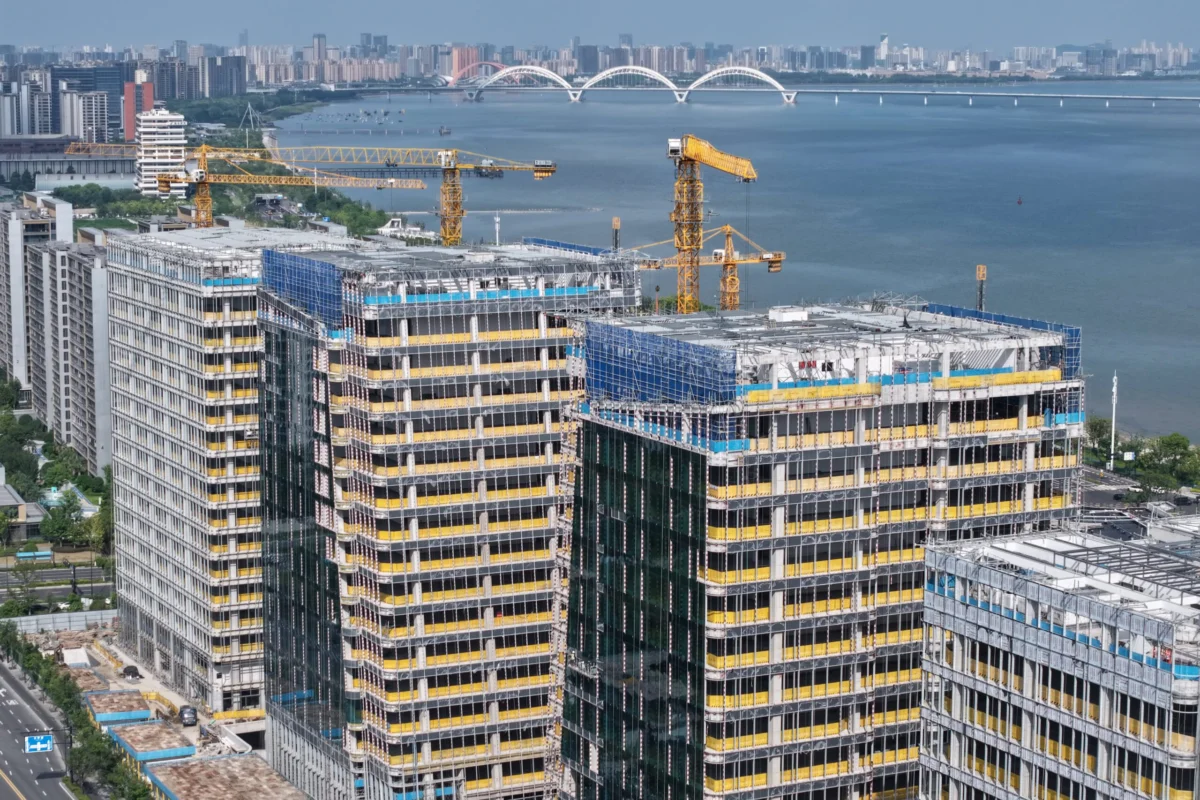
BEIJING – A multi-year downturn in China’s vast property market, a sector critical to the nation’s economic stability, is finally approaching its conclusion, according to a new report from S&P Global Ratings. Analysts at the credit rating agency, in a report distributed Thursday, predict that residential real estate prices across China may hit a definitive bottom in the third quarter of 2028. More immediately, the report offers a glimmer of hope for the country’s most significant urban centers, forecasting a price recovery as early as next year in major metropolitan hubs like Beijing and Shanghai. This revised outlook marks a significant departure from S&P’s more pessimistic assessment just months prior in February 2026, when the agency indicated that high levels of unsold housing inventory kept "a property market recovery out of reach."
The turnaround in S&P’s sentiment is largely attributed to two decisive policy shifts enacted by the Chinese government in the latter half of 2026, as highlighted by Edward Chan, a credit analyst at S&P Global Ratings and the report’s author. In August, Beijing introduced new, stricter regulations targeting developers’ ability to sell unfinished properties. This was swiftly followed in September by Chinese Premier Li Qiang’s public commitment to rolling out comprehensive policies aimed at stabilizing the beleaguered real estate sector. Subsequent actions included the launch of a crucial mortgage rate subsidy program, specifically designed to aid first-time homebuyers purchasing units priced under 1.5 million yuan (approximately $220,000) and smaller than 120 square meters (1291.67 square feet). These measures signal a concerted effort from the highest levels of government to address the systemic issues plaguing the sector.
The Genesis of China’s Property Crisis: A Decade of Unbridled Growth and Reckoning
To fully appreciate the significance of S&P’s revised forecast, it is essential to understand the origins and trajectory of China’s property market crisis. For decades, real estate served as a primary engine of China’s economic growth, contributing an estimated 25-30% of its GDP when factoring in related industries. It became the favored investment vehicle for Chinese households, accounting for a substantial portion of their wealth, while land sales provided local governments with a critical revenue stream. This symbiotic relationship fueled an era of rapid urbanization and construction, characterized by aggressive land acquisition by developers and a widespread reliance on the "pre-sale" model, where apartments were sold before completion to finance ongoing projects.
The first major tremors of instability began to be felt in August 2020, when Beijing introduced the "Three Red Lines" policy. This set strict debt-to-asset ratios, debt-to-equity ratios, and cash-to-short-term debt requirements for developers, effectively limiting their ability to take on new debt. The policy, intended to deleverage the highly indebted sector and mitigate systemic financial risks, had an immediate and profound impact. Developers, suddenly starved of traditional financing channels, struggled to complete existing projects and service their massive debts. This regulatory tightening exposed the fragility of the pre-sale model, leading to widespread project delays and, ultimately, defaults by some of the country’s largest developers.
The most prominent example of this unfolding crisis was Evergrande Group, once China’s second-largest property developer, which began defaulting on its offshore debt in late 2021. This was followed by a cascade of defaults from other major players, including Kaisa Group, Fantasia Holdings, and, most notably, Country Garden in 2023, which had previously been China’s largest non-state-owned developer by sales. These defaults sent shockwaves through the global financial markets, eroded consumer confidence domestically, and left millions of homebuyers in limbo, waiting years for the completion of properties they had paid for upfront. The scale of the problem was immense; Nomura estimated in 2023 that the volume of unfinished, pre-sold homes in China was approximately 20 times the size of Country Garden’s inventory as of the end of 2022, highlighting the severe oversupply and social implications. Homebuyers in cities like Tianjin, near Beijing, have publicly shared their frustrations, reporting waits of up to eight years for units they purchased ahead of completion.
The Turning Point: 2026’s Strategic Policy Interventions
The year 2026 has emerged as a pivotal period, witnessing a shift from piecemeal support to more comprehensive, sector-wide interventions. The August 2026 restrictions on developers selling unfinished properties are particularly significant. This measure aims to directly address the core issue of developer accountability and buyer trust. By making it harder for developers to use pre-sales as a primary funding mechanism without ensuring project completion, the government is forcing a more prudent and sustainable development model. As Edward Chan explained, this policy implies that "Developers will now be very cautious in buying land, so they will basically buy less land and develop less new projects going forward." While acknowledging that this might not immediately boost developer revenue, Chan emphasized its crucial role in "help[ing] China’s oversupplied property market."
This supply-side management is seen as the critical lever for stabilization. Chan further elaborated, stating, "Going forward in the next one to two years, the major factor in helping stabilize China’s home price is the continued reduction of supply." He noted a crucial detail: despite a multi-year property slump that saw prices decline and confidence wane, 2026 is the first year of genuine real estate inventory destocking. This indicates that previous measures were insufficient to tackle the root cause of oversupply, a situation now being actively addressed through stricter regulation and developer caution.
Premier Li Qiang’s subsequent statement in September 2026 underscored the central government’s unwavering commitment to resolving the crisis. This high-level endorsement signaled to both markets and citizens that Beijing was prepared to deploy all necessary tools to restore order and confidence. The immediate follow-up, the mortgage rate subsidy for first-time homebuyers, represents a demand-side intervention designed to inject liquidity and stimulate purchases, particularly among a demographic crucial for long-term market health. By reducing the financial burden for eligible buyers, the government aims to unfreeze stalled demand and encourage market activity.
Global Comparisons: Learning from Past Crises
S&P Global Ratings’ analysis also places China’s current situation within a global historical context, comparing the depth of its real estate downturn to housing crises experienced in Japan, the United States, and Spain in recent decades. This comparative perspective offers valuable insights into potential recovery pathways and the unique aspects of China’s approach.
The report highlights that China is actively working on two key factors that proved instrumental in stabilizing other market slumps: reducing supply and corporate deleveraging. Notably, S&P observes that "China’s supply contraction is occurring much earlier and with greater magnitude" than during Japan’s protracted housing crisis, which lasted from 1991 to 2014. Japan’s "lost decades" were characterized by a massive property and asset bubble followed by a prolonged period of deflation and stagnation, where residential prices ultimately fell by a staggering 67% after an even greater preceding run-up. China’s proactive, albeit belated, efforts to manage supply are aimed at preventing such a prolonged and debilitating economic aftermath.
In comparison, the U.S. real estate slump around the 2008 financial crisis saw a 26% drop in residential prices, a severe but relatively shorter-lived downturn compared to Japan’s. Spain also experienced a significant housing bubble and subsequent collapse following the 2008 global financial crisis, leading to high unemployment and banking sector distress. By strategically intervening to control supply and force developers to deleverage, China seeks to navigate its crisis with greater agility, aiming for a less severe and more contained correction than Japan’s protracted experience. China’s residential prices have already fallen by 22% since their 2021 peak, a significant correction but still less than the historical precedents of Japan and comparable to the US experience.
Emerging Green Shoots: Tier-One Cities Lead the Way
Beyond S&P’s overarching forecast, other market indicators and expert analyses corroborate a cautious optimism, particularly for China’s most economically vibrant cities. Guotai Junan International’s Chief Economist Hao Zhou published a separate report on Thursday, predicting that the fourth quarter of 2026 could witness the first growth in existing home prices for large, or "tier-one," cities since the 2021-2023 slump. Tier-one cities typically refer to Beijing, Shanghai, Shenzhen, and Guangzhou – economic powerhouses that attract significant investment and population inflows.
Zhou noted that since March 2026, tier-one cities have shown a greater propensity than smaller cities to record flat or rising prices. Specifically, existing home prices in Shanghai have seen their year-on-year decline narrow, while those in Beijing have stabilized, rising by 1.4% from a low point in January 2026. Hangzhou, a rapidly developing tech hub home to DeepSeek and Alibaba, stands out with a record high in its new home sales index. Prices for new homes in Hangzhou are only 14.2% below their peak, having fallen less significantly than in most other cities, underscoring the resilience of its local economy driven by the artificial intelligence boom and robust tech sector.
According to Zhou, "The next three months are a key window." He emphasized that if Shanghai, Shenzhen, and Guangzhou manage to avoid a monthly decline through the November 2026 data, "this rebound will have outlasted the 2024–25 episode. In our view, that would be strong evidence of a Tier-1 bottom and an important signal for the wider market." This suggests that sustained performance in these bellwether cities could serve as a leading indicator for a broader market recovery across China.
Demand-side data also offers encouraging signs. China’s efforts to subsidize mortgages, combined with wealth effects potentially generated by the burgeoning artificial intelligence sector, are beginning to lift property demand. Data from Chinese research firm Bingshan, cited by Morgan Stanley equity analyst Stephen Cheung in a report Wednesday, revealed a significant surge in existing home sales. During the Oct. 1-6 public holiday period, sales in 25 cities rose by a substantial 50% from a year ago, accelerating sharply from the 20% growth observed in September. This short-term spike suggests that the government’s stimulus measures are having an immediate, albeit potentially temporary, impact on buyer sentiment and transaction volumes.
Challenges and the Path Forward: A Cautious Optimism
Despite the emerging signs of stabilization and the revised optimistic forecasts, significant uncertainties persist regarding the long-term sustainability of demand. Morgan Stanley’s Stephen Cheung cautions that the mortgage subsidy program, while effective in boosting immediate sales, may primarily serve to "bring forward planned purchases rather than creating substantial new demand." This implies that the current uptick might represent a temporary acceleration of existing demand rather than a fundamental expansion of the buyer pool.
Moreover, while tier-one cities show promising signs of recovery, the outlook for smaller cities across China remains more complex. Many tier-two, tier-three, and tier-four cities continue to grapple with persistent oversupply, weaker economic fundamentals, and demographic shifts including an aging population and declining birth rates, which pose long-term headwinds for housing demand. The government faces a delicate balancing act: providing sufficient support to prevent further market collapse while avoiding the pitfalls of re-inflating a new speculative bubble. The structural issues of local government reliance on land sales and the still-sizable debt burdens of many developers also represent ongoing challenges that will require sustained policy attention.
The journey towards a healthy, sustainable property market in China is far from over. While S&P Global Ratings’ updated forecast provides a much-needed injection of optimism, suggesting that the worst may soon be behind the sector, the path to full recovery will be complex and uneven. The effectiveness of Beijing’s strategic policy interventions in managing supply, restoring buyer confidence, and addressing developer solvency will determine whether the current green shoots blossom into a robust and balanced real estate ecosystem for years to come.

