
Kinshasa, DRC – What began as a seemingly mundane mission to streamline tax collection in the mineral-rich Democratic Republic of Congo (DRC) has dramatically escalated, culminating in a violent ambush that left approximately 20 individuals killed or wounded. The September 17 incident, which occurred in South Kivu, eastern Congo, saw a team working for Erik Prince’s private security firm, Vectus Global, targeted, with casualties including a former New Zealand special forces soldier and at least seven Congolese personnel. Among the wounded was Tim Kennedy, a retired U.S. Army Green Beret, former UFC fighter, and prominent podcaster, who sustained three gunshot wounds to the leg and is currently recovering at Walter Reed Medical Center.
The attack, first brought to light by a Reuters exclusive published last Friday, casts a stark light on the increasingly volatile and complex security landscape in the eastern DRC, and the blurring lines between commercial interests and active conflict zones. Prince’s initial mandate in 2025, when he signed on with the Congolese government, was primarily administrative: to assist the finance ministry in more effectively collecting taxes on its vast mineral resources, particularly in the copper-rich Katanga province. However, subsequent developments have seen Vectus Global’s operations shift from spreadsheets to front-line engagements, placing them directly in the crosshairs of long-standing regional conflicts.
The Ambush in South Kivu: A Detailed Account
The September 17 ambush reportedly occurred as the Vectus Global team was in transit between locations in South Kivu, a region notorious for its chronic instability and the presence of numerous armed groups. While specific details surrounding the perpetrators remain officially unconfirmed, the area is a hotbed of activity for groups like the M23 rebels, as well as various other local and foreign militias vying for control over territory and resources. The sophisticated nature of the attack, which resulted in a significant casualty count, suggests a well-coordinated operation by an experienced adversary.
Sources with direct knowledge of the attack, or those briefed on it, indicate that the incident involved a direct confrontation, highlighting the inherent dangers faced by private security contractors operating in such environments. The presence of a former New Zealand special forces soldier among the casualties, alongside Congolese personnel, underscores the multinational composition of Prince’s teams. Tim Kennedy, known for his distinguished military career and high public profile, sustained severe injuries, requiring medical evacuation and specialized treatment. His involvement and subsequent injury have injected a new dimension into the narrative, drawing international attention to a conflict that often remains overlooked by mainstream Western media. The fact that a drone allegedly gave away the team’s position adds another layer of irony, given Prince’s prior deployment of similar aerial technology in other conflict zones, such as Haiti, with lethal effect.
From Tax Reform to Frontline Engagements: The Shifting Mandate of Vectus Global
Erik Prince’s entry into the Congolese scene in April 2025 was initially framed as a business venture focused on governance and economic efficiency. The reported goal was to help Kinshasa recover an estimated $40 million per month in lost revenue due to mineral smuggling and inefficient tax collection in areas like Kolwezi. At the time, sources emphasized that there were "no plans to send security contractors into active conflict zones," a statement that now appears to have been contradicted by events on the ground.
This distinction proved short-lived. By January and early February of the following year (2026), Prince’s operations had visibly expanded into security roles. Following a brief seizure of Uvira on the Burundi border by M23 rebels and subsequent pressure from Washington for the rebels to withdraw, Vectus Global personnel, along with drones and Israeli trainers, were deployed to assist the Congolese army in securing the town. This marked a significant pivot from administrative support to direct involvement in securing strategic locations within an active conflict zone. The latest ambush in South Kivu is a further extension of this mission creep, demonstrating how a commercial contract in a volatile region can rapidly evolve into high-stakes military-style operations.
Erik Prince’s Controversial Legacy and the Role of Private Military Contractors
Erik Prince, founder of the infamous Blackwater security firm, has a long and controversial history in the world of private military contracting. Blackwater, later rebranded as Xe Services and then Academi, became synonymous with the use of private forces in post-9/11 conflicts, particularly in Iraq, where incidents like the Nisour Square massacre drew intense scrutiny and condemnation. Following the controversies surrounding Blackwater, Prince diversified his ventures, including Frontier Services Group (FSG), which focused on logistics and security in Africa, notably with significant backing from China’s state-owned Citic Group.

His current involvement in the DRC through Vectus Global represents another chapter in this complex career. The shift from Chinese-backed African ventures to operations that now appear to align with broader American strategic interests in the DRC’s mineral sector highlights the flexible and often opaque nature of private military contracting. Critics argue that the use of such private entities allows governments to pursue geopolitical objectives with a degree of plausible deniability, avoiding direct military engagement while still influencing outcomes in critical regions. This model inherently carries risks, as the recent ambush vividly illustrates, placing contractors in perilous situations without the full diplomatic and logistical backing afforded to official state forces.
The M23 Conflict and Regional Instability in Eastern Congo
The eastern DRC has been plagued by conflict for decades, a complex web of ethnic tensions, competition over natural resources, and regional proxy wars. The M23 rebel group, which resurfaced in late 2021, is a key player in the current crisis. Composed largely of Congolese Tutsis, the group claims to be defending its community against ethnic discrimination and attacks, but its actions have led to widespread displacement and humanitarian crises.
The DRC, along with the United Nations and numerous Western governments, has consistently accused neighboring Rwanda of providing military and logistical support to M23, an allegation vehemently denied by Kigali. Rwanda, under President Paul Kagame, has often cited security concerns along its border and the presence of Rwandan Hutu génocidaires in eastern Congo as justification for its involvement in the region. However, independent reports and expert analyses frequently point to Rwanda’s strategic interests in the DRC’s vast mineral wealth as a significant driver of its actions. This geopolitical rivalry between Kinshasa and Kigali fuels the M23 insurgency, creating a perpetually unstable environment where private security firms like Vectus Global are increasingly finding themselves caught in the crossfire. The lack of response from Kigali, Kinshasa, and M23 regarding the ambush, as noted by Reuters, reflects the deep-seated political and diplomatic deadlock that characterizes the conflict.
DRC’s Mineral Wealth: The Geopolitical Prize
The underlying driver for much of the international interest and conflict in the DRC is its unparalleled mineral wealth. The country holds the world’s largest reserves of cobalt and significant deposits of copper, gold, diamonds, and coltan – minerals crucial for the global technology and renewable energy sectors.
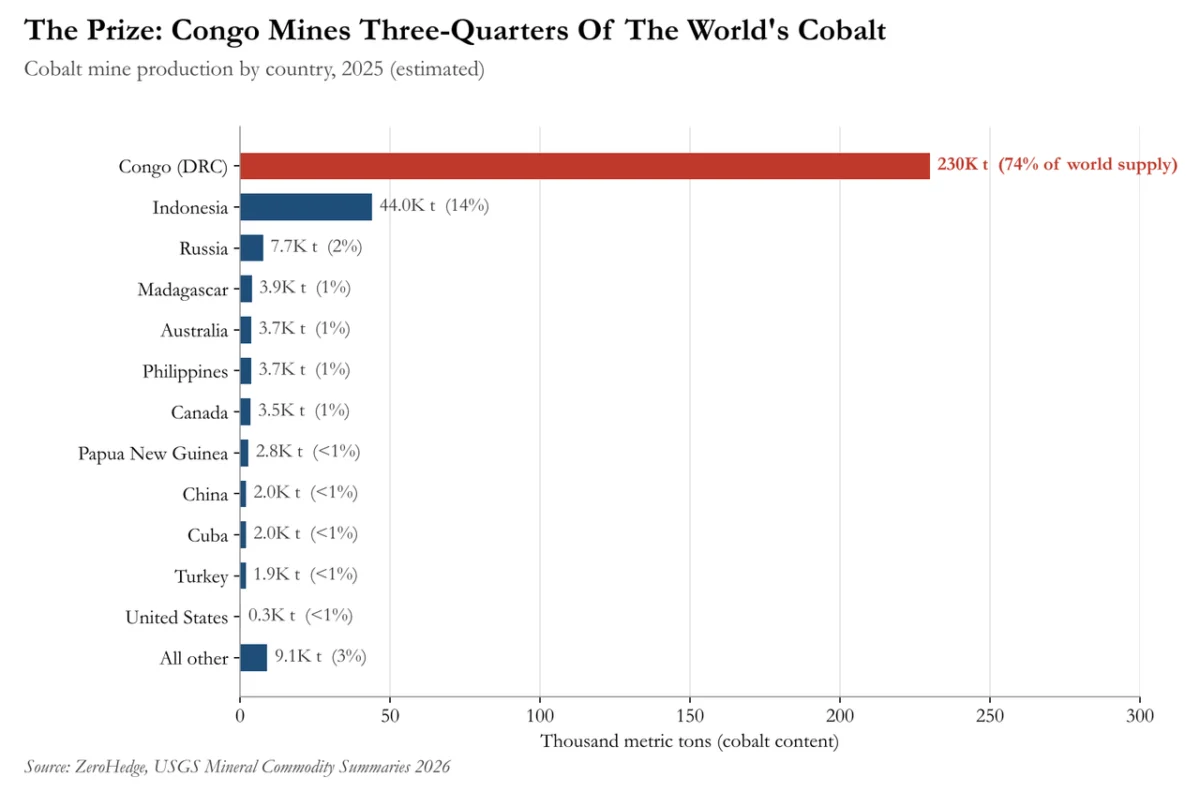
Cobalt: The DRC is not merely "rich in minerals"; it effectively is the cobalt market. According to the U.S. Geological Survey (USGS), the DRC mined approximately 230,000 tons of cobalt in 2025, representing a staggering 74% of the world’s total output of about 310,000 tons. Indonesia, the distant second producer, managed only 14%, while the U.S. produced a mere 0.1%. This near-monopoly gives Kinshasa immense leverage, which it has demonstrated by strategically manipulating global cobalt prices. In February 2025, Congo suspended cobalt exports entirely when prices hit nine-year lows. This ban was later replaced by quotas in October, set to run through at least the end of 2027. The result was dramatic: cobalt metal prices surged to $26/lb by spring, a 160% increase since the initial ban. This ability of a single nation to more than double a strategic mineral’s price by controlling its borders underscores cobalt’s critical importance.
Copper: Beyond cobalt, the DRC is also a vital swing source for new copper supply, a metal trading near $14,500/ton and essential for electrification and industrial growth. Goldman Sachs’ metals specialist, James McGeoch, highlighted in an October 7 morning note that while global copper output was down 1% in 2026, a projected 2.6% increase in 2027 heavily relies on growth from the DRC. Specifically, the bank forecasts a 6% year-on-year increase from the DRC, including a significant 90 kilotons from the Kamoa-Kakula mine. While Kamoa-Kakula is situated in Lualaba province, hundreds of miles south of South Kivu, the security challenges in eastern Congo cast a shadow over all projections for the nation’s mineral output. Every security incident in the east serves as a potent reminder that "DRC +6%" is a forecast tethered to a substantial and escalating security cost.
The US-China Rivalry and "Plausible Deniability"
The struggle for the DRC’s minerals is a key arena in the broader geopolitical competition between the United States and China. Historically, China has held a dominant position in the Congolese mining sector, investing heavily and controlling a significant portion of the supply chain for critical minerals. However, Washington has recently stepped up its efforts to counter this influence.
The Pentagon’s move to seek its largest cobalt stockpile since 1990 in August 2025, although later cancelled, signaled a renewed American strategic interest. This was followed by more concrete actions: in December, former President Trump hosted Rwandan President Kagame and DRC President Tshisekedi to sign the "Washington Accords," pledging US commitment to buying their minerals and forging bilateral access deals. More recently, in April, a small eight-person US firm, founded by an ex-Green Beret, gained control of Chemaf, one of the world’s largest non-Chinese cobalt producers, after a $920 million sale to a Chinese state-owned defense group collapsed. These events underscore a concerted US effort to "catch up" in the race for Congolese minerals.

Amidst this geopolitical maneuvering, the official stance of the US government regarding Erik Prince’s operations in the DRC remains one of "plausible deniability." The State Department asserts it has no contracts with Prince in Congo, even as US officials have publicly stated plans to collaborate more closely with Vectus in other regions, such as Haiti. This creates a precarious situation: a private army, led by an ally of a former US president, is effectively guarding minerals of strategic importance to America, under the auspices of a peace accord brokered by the US, yet without an official American contract. This intricate arrangement allows Washington to pursue its strategic interests in the region without direct military entanglement or the political ramifications of an overt deployment, but the thin veil of plausible deniability is increasingly challenged by incidents like the South Kivu ambush.
Broader Implications and Future Outlook
The ambush in South Kivu, and particularly the injury of a high-profile American like Tim Kennedy, marks a critical turning point. The conflict in eastern Congo, often viewed as a regional humanitarian crisis, now has a tangible American celebrity casualty, making it significantly harder for Washington to continue pretending it isn’t involved.
The immediate aftermath presents two primary paths forward. One possibility is that the increased visibility of casualties, amplified by figures like Kennedy and his extensive social media following, will compel the US administration to exert more substantial diplomatic pressure on Kigali to adhere to and enforce the existing peace accords. This could involve stricter sanctions, conditional aid, or more robust international monitoring mechanisms to curb Rwandan support for M23.
The alternative, and arguably more probable, scenario is that the strategic importance of the DRC’s minerals – particularly cobalt and copper – will outweigh the political cost of indirect involvement. In this path, the privatized security footprint in the region is likely to expand, drones may become more prevalent and sophisticated, and the initial assurances of "no plans to deploy to active conflict areas" will continue to be retrospectively ironic. The official narrative of "no contracts" will become even more strained as American strategic interests deepen and the security requirements escalate.
The eastern Congo war, while declared "ended" on paper in Washington last December, continues to rage on the ground. M23 still controls significant swathes of territory, Kigali and Kinshasa remain locked in accusations, and the region grapples with concurrent crises, including an Ebola outbreak that has now spread to Kenya. The recent ambush serves as a stark reminder that eastern Congo is, as one Reuters source succinctly put it, "an incredibly dangerous place right now."
Ultimately, the price of three-quarters of the world’s cobalt, and a substantial portion of its future copper supply, is no longer solely measured in dollars per pound. It is increasingly measured in human lives, both Congolese and foreign contractors, underscoring the profound and often brutal cost of securing the world’s critical mineral resources. The international community, and particularly the major powers vying for these resources, now face a renewed imperative to address the root causes of instability in the DRC, rather than simply managing its symptoms through opaque and increasingly dangerous private security operations.

