
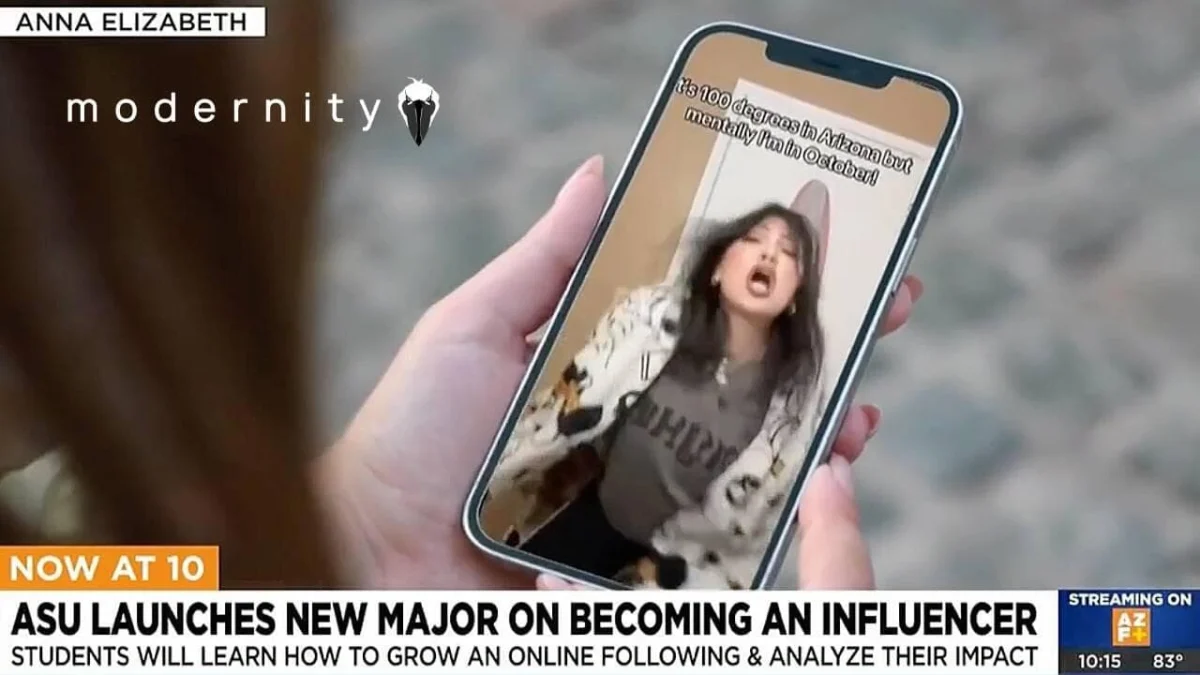
Arizona State University (ASU) has announced the introduction of a new Bachelor of Arts degree in Content Creation, offered through its esteemed Walter Cronkite School of Journalism and Mass Communication. This program, explicitly designed to cultivate future social media influencers, aims to equip students with the skills necessary to navigate and thrive within the rapidly expanding creator economy, a sector increasingly central to modern digital communication and marketing. The curriculum is set to focus on practical skills ranging from TikTok dances and personal branding to advanced "strategic storytelling" and video production.
The Genesis of a New Major: Responding to the Creator Economy
The decision by ASU to offer a full bachelor’s degree dedicated to content creation reflects a significant pivot in higher education, attempting to formalize and professionalize a field that has largely been self-taught. According to the program description, students will delve into core competencies such as content planning, video and podcast production, global perspectives in digital media, and sophisticated personal branding techniques. A crucial component of the degree involves analyzing performance metrics, experimenting with diverse content strategies, and undertaking a capstone project where students choose a major platform—be it TikTok, Instagram, or YouTube—and dedicate a semester to growing a verifiable audience with measurable results. The ultimate goal is for graduates to emerge with a tangible online following and documented proof of successfully building a digital brand, alongside their academic credential.
Jessica Pucci, senior associate dean at the Cronkite School, articulated the university’s vision for the program, emphasizing that the curriculum extends far beyond superficial trends like "ring lights and dance challenges." She stated that the program is engineered to provide "professional-level guidance from faculty dedicated to helping students succeed in the rapidly evolving creator economy." Pucci highlighted that students would graduate with more than just a diploma; they would possess a demonstrable following, a portfolio of published content, and data-driven evidence of their brand-building capabilities. This approach, ASU suggests, positions its graduates uniquely in a competitive digital landscape.
The Rise of the Creator Economy: A Digital Frontier
The introduction of such a major is set against the backdrop of the explosive growth of the creator economy. This sector, characterized by individuals leveraging digital platforms to produce and monetize content, has seen unprecedented expansion over the past decade. Industry analyses estimate the global creator economy to be worth over $104 billion as of 2021, with projections indicating continued rapid growth. Major platforms like YouTube, TikTok, and Instagram have not only facilitated this expansion but have also become significant avenues for advertising, marketing, and cultural dissemination. Millions of individuals worldwide identify as creators, with a subset achieving substantial financial success and cultural influence. The allure of the creator economy lies in its perceived low barrier to entry, the potential for high earnings, and the promise of creative autonomy.
However, the reality for many aspiring creators is challenging. The market is intensely saturated, with fierce competition for audience attention. Algorithms are constantly evolving, and monetization models can be precarious, relying heavily on ad revenue, brand partnerships, or direct audience support. While top-tier influencers can command significant incomes, the vast majority struggle to make a sustainable living, often juggling content creation with other employment. Data suggests that only a small percentage of creators generate substantial income, making sustained success an elusive goal for many.
Higher Education’s Shifting Landscape: Adaptation and Scrutiny
ASU’s new major represents a broader trend within higher education institutions to adapt to changing societal and economic landscapes. Universities are increasingly exploring vocational and trend-driven programs to attract students and remain relevant in a dynamic job market. This shift has ignited a robust debate about the core purpose of a university education. Historically, journalism schools, like the Walter Cronkite School, have adapted to technological advancements, moving from print-centric curricula to embrace broadcast, then digital journalism, and now, arguably, content creation.
Despite ASU’s stated commitment to professional rigor, the announcement has drawn varied reactions, particularly across social media and among educational critics. Many commenters questioned the value proposition of a formal degree for skills that, as one noted, could be "learned in their bedroom at 14 for free on YouTube." Others expressed skepticism about the financial implications, particularly given the rising costs of higher education. The average student loan debt in the U.S. currently stands at over $37,000 per borrower, and critics argue that investing significant sums—potentially hundreds of thousands of dollars over four years—into a degree with an uncertain return on investment in an already saturated market is financially irresponsible for students and their families. Some critics specifically advocated for parents to reconsider bankrolling such an education, preferring degrees with more traditional or demonstrably stable career paths.
The Broader Debate: Value, Utility, and Ideology in Academia
The introduction of ASU’s content creation major also inadvertently highlights a broader, more contentious discussion about the value and utility of contemporary higher education, particularly in liberal arts and emerging vocational fields. Critics often contrast these new degrees with traditional vocational skills, such as those of plumbers or electricians, who frequently achieve robust financial stability without incurring substantial student debt. As commentator Clay Travis observed, a perceived disconnect exists between the market value of certain academic credentials and the practical skills demanded by the economy, leading to frustration among graduates who feel their expensive degrees are undervalued.
This sentiment often intertwines with criticisms regarding the perceived ideological shifts within academic institutions. Over the past decade, numerous universities have faced scrutiny over the content of their curricula, campus speech policies, and student activism, leading to accusations of prioritizing ideological formation over core academic competencies. These criticisms often allege that some programs are becoming "ideological finishing schools" or "propaganda factories," producing graduates equipped with specific political perspectives but lacking universally applicable skills.
Several high-profile incidents have fueled this debate:
- University of Illinois Urbana-Champaign (UIUC): A required first-year education course for aspiring teachers at UIUC drew significant controversy for allegedly pushing extreme ideological viewpoints on immigration, race, and gender. Leaked slides reportedly urged "humanizing language," framed border enforcement as "white supremacy," and trained students to resist ICE, with whistleblowers claiming the course emphasized activism at the expense of fundamental teaching methodologies for subjects like math and reading.
- Kent State University: An art display at Kent State depicting a severed head of former President Trump with the caption "We only have to get lucky once" sparked outrage. University administrators initially defended it under the guise of protected expression, but public pressure eventually led to its removal, highlighting the tension between artistic freedom and community standards.
- Princeton University: During pro-Palestinian protests, student hunger strikers at Princeton complained that the university was not adequately monitoring their vital signs, accusing officials of deliberately weakening them. Such claims, framed as demands for "basic humanitarian aid," drew widespread criticism and accusations of dramatic performativity.
- Columbia University: Protesters occupying campus buildings at Columbia similarly demanded food and water as "basic humanitarian aid," with one PhD student provocatively asking if the university wanted "students to die of dehydration and starvation." This narrative, comparing the occupiers to refugees, collapsed under public mockery following police intervention.
These incidents, along with broader cultural commentary, have led figures like podcaster Joe Rogan to describe universities as "cult camps" that "radicalize kids" with "stupidest ideas," leading to a focus on identity politics and abstract concepts over practical experience. Rogan’s critique, while highly charged, reflects a growing public concern about the perceived detachment of some academic discourse from real-world application.
Beyond specific events, the ideological capture is also observed in shifts in academic language and foundational scientific definitions:
- Scientific Definitions: A survey of 200 UK university scientists revealed a significant departure from traditional biological definitions, with only 58% agreeing that sex is binary, and nearly two-thirds asserting that gender is fluid. This indicates a profound shift in how fundamental biological and social concepts are understood and taught within academia.
- Language Revisions: Institutions like the University of the Arts London have controversially "erased" the word "woman" from maternity and menopause policies, stating that these processes apply "irrespective of gender" and that "not all pregnant people are women." Similarly, the University of North Carolina issued an inclusive language guide discouraging terms like "mother" and "father" in favor of "guardian" and purging words containing "man." Stanford University’s "Elimination of Harmful Language Initiative" even proposed adding "American" to a blacklist for being too U.S.-centric, recommending "U.S. citizen" as an alternative.
These changes, critics argue, are not isolated instances but rather a systemic output of institutions that increasingly prioritize political formation and identity politics, sometimes at the expense of objective inquiry or the development of broadly applicable skills.
Implications for Graduates and Society
The confluence of these trends—the rise of specialized, trend-driven majors like content creation, coupled with the ongoing debates about academic value and ideological shifts—presents significant implications for both students and society. Graduates emerging with expensive credentials that may signal ideological alignment rather than practical competence often face a stark reality: the labor market judges by results, not by feelings or theoretical frameworks.
When the economic realities fail to align with the expectations fostered by their education, the resulting resentment can be profound. This disillusionment, according to some analyses, is then redirected towards broader societal structures, including capitalism, national borders, and even biological realities, fueling radical politics that increasingly permeate academic discourse.
ASU’s content creation major, while seemingly a pragmatic response to a burgeoning industry, becomes a focal point in this larger debate. It packages the attention economy as an academic discipline, charges premium tuition for skills often acquired freely online, and sends graduates into a highly competitive market where sustained success is far from guaranteed. The university, in this model, collects its fees, while the student potentially bears the long-term economic and psychological costs of a degree whose market value is yet to be definitively proven. The broader society is then left to contend with the social cost of an education system that, in the eyes of its critics, increasingly prioritizes "branding" and ideological conformity over the cultivation of durable skills and lasting value.

