
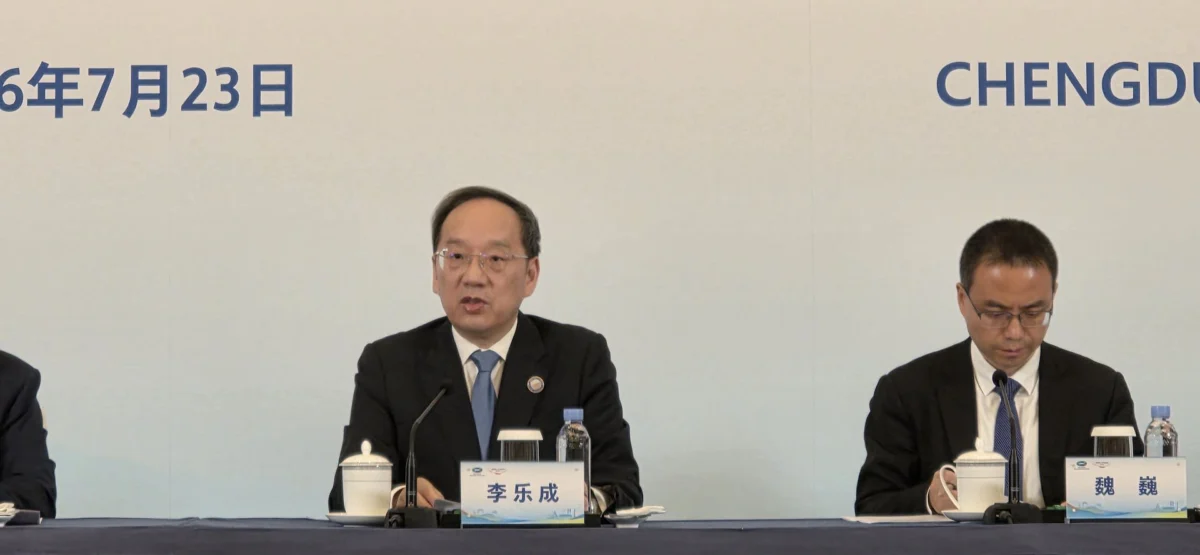
CHENGDU, China – In a significant diplomatic and technological development, the 21 member economies of the Asia-Pacific Economic Cooperation (APEC) forum have issued a multilateral statement emphasizing the need for governmental oversight in the burgeoning field of artificial intelligence, even as they commit to supporting open-source development. The "Chengdu Statement on AI," released on Thursday, July 23, 2026, during the APEC Digital Weeks in Chengdu, China, marks a pivotal moment in the global effort to regulate AI, particularly given the diverging approaches to AI development and control between major economic blocs. The statement underscores a growing international recognition that powerful open-source AI models, while fostering innovation, necessitate robust frameworks for security, data protection, and intellectual property rights.
The consensus achieved by APEC, which includes economic powerhouses like the United States and China, signifies a delicate balance between promoting innovation and mitigating the inherent risks associated with advanced AI. The statement explicitly calls for supporting open-source development, but crucially adds a requirement for models and projects that "employ strong security assurance through development and deployment." This nuanced stance reflects an evolving understanding of open source, moving beyond its traditional libertarian ethos towards a model that incorporates greater state oversight and accountability, particularly for foundational AI technologies.
The Chengdu Statement: A New Era for AI Governance
The APEC Digital Weeks, an annual series of high-level meetings focusing on digital economy and technological cooperation, served as the backdrop for this landmark declaration. Hosted in Chengdu, a rapidly growing technological hub in southwestern China, the event brought together ministers and senior officials to deliberate on the digital future of the Asia-Pacific region. Li Lecheng, China’s Minister of Industry and Information Technology, who chaired the leaders’ meeting on Thursday, highlighted the collaborative spirit that led to the statement. He noted that all participating economies recognized the multifaceted risks posed by AI, advocating for enhanced dialogue across government, private sector, and academic institutions to share best practices on cybersecurity, supply chain resilience, and combating online scams.
The "Chengdu Statement" stands out as the first minister-level agreement within APEC to explicitly include open-source cooperation. This is particularly noteworthy given the global landscape where various nations and blocs are grappling with how to best regulate AI. For instance, the European Union has moved ahead with its comprehensive AI Act, focusing on risk-based regulation, while the United States has largely relied on executive orders and voluntary industry commitments. The APEC statement, by contrast, seeks to establish common ground across a diverse set of economies, bridging different regulatory philosophies.
Winston Ma, an adjunct professor of law at New York University and an expert on digital economy, observed that the statement’s "explicit alignment around open-source ecosystems and compute infrastructure" confirms a broader trend within the Asia-Pacific region. According to Ma, this indicates a strategic shift away from purely closed models towards open-weight systems, which are increasingly being combined with state-coordinated energy, telecom, and digital infrastructure initiatives. This integrated approach suggests a more structured and potentially government-guided development of AI capabilities across the region.
The Evolving Landscape of Open Source and Geopolitical Undercurrents
The inclusion of "strong security assurance" in the statement marks a significant departure from the traditional perception of open-source software, which has historically prioritized transparency and community-driven development over centralized control. While open-source has been a cornerstone of the internet and modern software development, the advent of powerful AI foundation models, capable of generating sophisticated content, code, and even misinformation, has introduced new layers of complexity and risk. These models, often trained on vast datasets and exhibiting emergent capabilities, raise concerns about their potential for misuse, national security implications, and the difficulty of auditing their behavior.
This shift in perspective is particularly salient in the context of the ongoing technological rivalry between the United States and China. China has been a major proponent and developer of open-source AI models, with companies like DeepSeek and GLM 5.2 offering their powerful models free for use and download. This contrasts sharply with the business models of many leading U.S. AI firms, such as Anthropic, which predominantly offer closed, proprietary, and pay-to-use AI models. The accessibility of Chinese open-source models has fueled concerns in the U.S. regarding intellectual property theft and the potential for these technologies to be leveraged for purposes inimical to American interests, as evidenced by past claims from U.S. officials regarding the alleged pilfering of American tech.
However, the "Chengdu Statement" suggests a potential convergence, or at least a diplomatic bridge, in how these leading economies view AI. Wei Sun, principal analyst for artificial intelligence at Counterpoint Research, highlighted the significance of 21 diverse economies, including both the U.S. and China, recognizing "trusted open-source AI as something worth supporting." Sun noted that the phrase "strong security assurance" provides "security-conscious economies room to support open models while still demanding testing, transparency, data protection and deployment controls." This redefines the debate, moving it beyond a simple "open versus closed" dichotomy towards a more complex discussion about "who can now build an open ecosystem that is also trusted enough for governments and enterprises to deploy."
Broader Implications and the Race Towards Future Technologies
The APEC consensus arrives amidst growing reports that both Washington and Beijing are seeking tighter controls on their respective homegrown AI capabilities. The U.S., through various initiatives and executive orders, has aimed to secure its technological leadership and prevent critical AI technologies from falling into the hands of rivals. Simultaneously, China has implemented its own set of comprehensive AI regulations, focusing on ethical guidelines, data security, and algorithmic transparency, particularly for generative AI services. The "Chengdu Statement" thus represents a rare point of agreement on a crucial technological frontier, indicating a shared understanding of the need for some form of governance, even if the specifics of implementation will vary.
The economic ramifications of this APEC stance are considerable. The Asia-Pacific region accounts for approximately 60% of global GDP and 48% of world trade, making its collective approach to AI governance highly influential. The global AI market, projected to reach over $1.8 trillion by 2030 from an estimated $200 billion in 2023, stands at a critical juncture. The APEC statement, by advocating for trusted open-source AI, could foster an environment where innovation is encouraged while mitigating risks that could otherwise deter investment or lead to market fragmentation. It suggests a pathway for member economies to leverage the benefits of open collaboration without compromising national security or data integrity.
Beyond current AI models, the APEC discussions also touched upon the horizon of future technological challenges. Janet De Silva, chair of the APEC Business Advisory Council Digital and Innovation Working Group, used the platform to urge ministers to prepare for the quantum computing era. Her warning underscored the exponential pace of technological advancement and its potential to disrupt existing security paradigms. "We need trusted encryption to ensure the security of our entire financial system, ensuring that quantum computing is not only a security measure but also an opportunity to bring competitiveness," De Silva stated. The implications of quantum computing for AI are profound; quantum AI could accelerate model training, enhance data analysis, and potentially break current cryptographic standards, necessitating entirely new approaches to cybersecurity and data protection within AI systems. The "strong security assurance" clause in the Chengdu Statement, therefore, takes on an added layer of foresight, preparing for a future where existing security measures might prove inadequate.
A Framework for Responsible Innovation
The "Chengdu Statement on AI" represents more than just a diplomatic declaration; it is a framework for responsible innovation in a rapidly evolving technological landscape. By acknowledging the power of open-source development while simultaneously demanding robust security assurances, APEC members are attempting to chart a middle course. This approach recognizes that AI, particularly powerful foundation models, can be a dual-use technology, offering immense benefits for economic growth, scientific discovery, and societal well-being, but also posing significant risks if left unchecked.
The emphasis on data protection and intellectual property rights within the context of open-source AI is particularly pertinent. As AI models ingest vast amounts of data, ensuring privacy and preventing the misuse of personal information becomes paramount. Similarly, protecting the intellectual property embedded in both proprietary and open-source models is crucial for incentivizing continued research and development. The statement’s call for cross-sector dialogue on cybersecurity and supply chain resilience also highlights the interconnected nature of the digital economy and the need for collective defense against emerging threats.
In conclusion, the APEC "Chengdu Statement" on AI signifies a maturing global conversation around artificial intelligence. It underscores a shared understanding among a diverse group of economies that while innovation must be fostered, it cannot come at the expense of security, trust, and responsible governance. As the world navigates the complexities of advanced AI and prepares for the advent of quantum computing, the principles outlined in Chengdu could serve as a vital blueprint for building a more secure, inclusive, and prosperous digital future in the Asia-Pacific region and beyond.

