
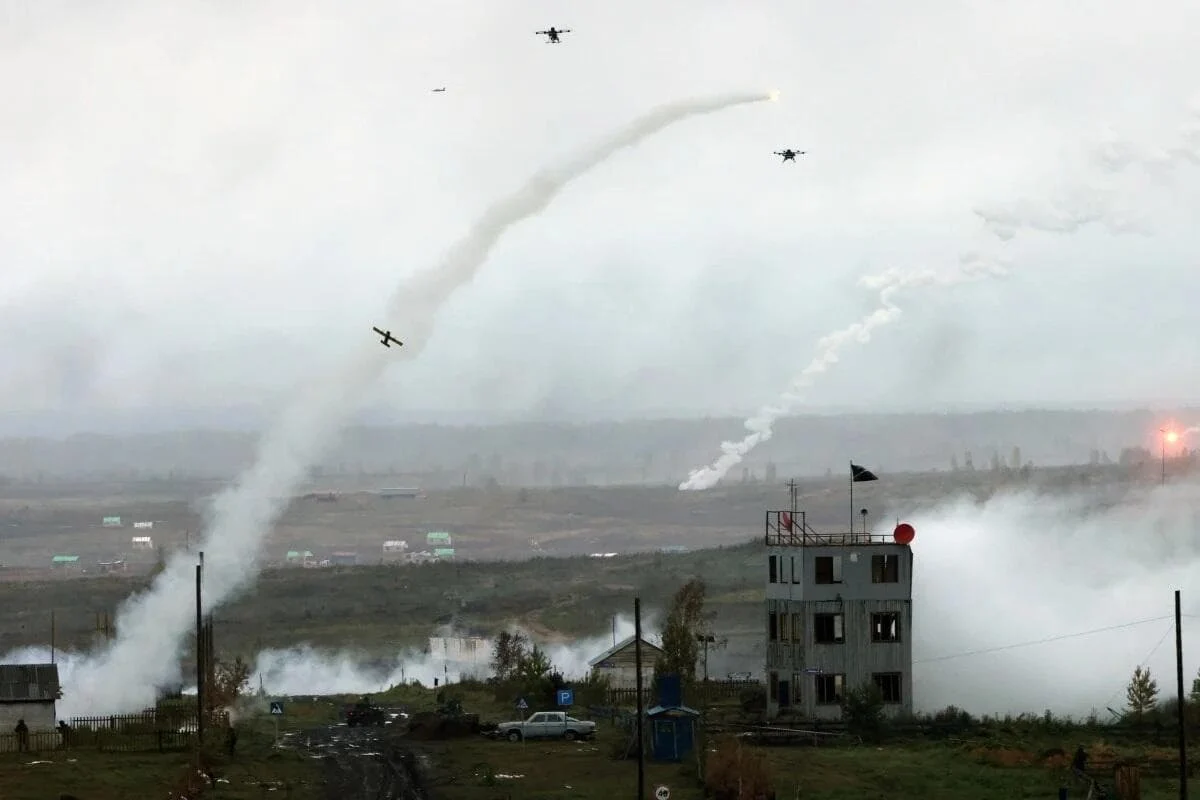
Russia has recently concluded its extensive "Tsentr-2026" (Centre-2026) mass military drills, a significant multinational exercise involving troops and advanced defense technology from eight nations. State media prominently highlighted the application of "lessons learned from the Ukraine war" as a core tenet of the maneuvers, underscoring a strategic adaptation in military doctrine. The exercises, which ran throughout the last week and concluded on Saturday, were staged in the central-western Chelyabinsk region, nestled within the southern Ural Mountains, with President Vladimir Putin personally observing the final phases of the exercise on Friday.
Overview of the Tsentr-2026 Exercises
The Tsentr-2026 drills represent a recurring series of strategic command-and-staff exercises conducted by Russia, typically held every four years, rotating through Russia’s four main military districts. These exercises are designed to test the combat readiness of Russian forces and their allies, focusing on large-scale conventional warfare scenarios. The 2026 iteration involved an impressive contingent of over 47,000 troops, drawn from the armed forces of Russia, China, Belarus, Kazakhstan, Kyrgyzstan, Mongolia, Pakistan, and Tajikistan. This diverse participation underscores Russia’s efforts to strengthen military alliances and interoperability with key strategic partners, particularly within the framework of the Collective Security Treaty Organization (CSTO) and the Shanghai Cooperation Organization (SCO).
The scale of the exercise was substantial, encompassing various combat scenarios at the Chebarkul training ground. Key elements included rehearsals for long-distance troop deployment, intricate joint operational planning, and the execution of complex operations against an entrenched enemy. These facets are particularly relevant given the protracted nature of modern conflicts and the challenges of maintaining supply lines and coordinating diverse units over vast operational areas. The emphasis on "repelling external aggression in the Central Asian direction," as stated by the Russian Ministry of Defense, further defines the geopolitical focus of these exercises, hinting at perceived threats to the stability of Russia’s southern flanks and its allies in Central Asia.
Integration of Ukraine War Lessons: A New Paradigm
Perhaps the most striking aspect of Tsentr-2026 was the explicit incorporation of combat experiences and technological advancements observed in the ongoing conflict in Ukraine. The Russian Ministry of Defense’s statement regarding the application of these lessons signals a clear intention to adapt and modernize its military doctrine based on contemporary battlefield realities. This adaptation was most evident in the pervasive use and defense against unmanned systems.
Chinese state broadcaster CCTV and the PLA Daily provided detailed insights into the People’s Liberation Army (PLA) contingent’s contributions, highlighting their advanced capabilities. PLA troops, primarily from the Central Theater Command, including elements of the 82nd Group Army and a combined-arms brigade, showcased a sophisticated integration of crewed and unmanned systems. Reports indicated the deployment of Type 99A main battle tanks alongside drones, uncrewed ground vehicles (UGVs), and helicopters. A particularly advanced demonstration involved the deployment of drone swarms, which were utilized to provide precise target data to ground combat groups. Tactical unmanned aerial vehicles (UAVs), armed helicopters, and UGVs coordinated strikes against designated targets, illustrating a burgeoning capability for automated and semi-automated warfare.
A critical defensive innovation, directly attributable to lessons from Ukraine, was the reported practice of stationing all troops involved in the exercise underground to avoid drone strikes. This measure underscores the profound impact of drone warfare on modern battlefields, where persistent aerial surveillance and precision strike capabilities necessitate new forms of troop protection and concealment. The Ukrainian conflict has indeed transformed the battlefield into an environment where unmanned aircraft are ubiquitous, constantly searching for targets, compelling militaries to develop countermeasures and adapt their tactical approaches. This defensive adaptation reflects a grim reality akin to scenarios previously confined to science fiction, with the battlefield increasingly resembling something out of a "Terminator 2" or "Skynet" narrative.

Chronology and Key Events
The Tsentr-2026 exercises unfolded systematically over a week, culminating on Saturday. Preparatory phases likely involved extensive logistical arrangements for the intercontinental deployment of troops and equipment from various participating nations. Throughout the week, units engaged in simulated combat scenarios, honing their skills in areas such as reconnaissance, communication, coordinated fire support, and maneuver warfare. President Putin’s presence on Friday to observe the drills served as a high-profile endorsement of their strategic importance, both domestically and internationally. His observation typically involves reviewing the culmination of major tactical operations, often including live-fire exercises, and receiving briefings from top military commanders. This public display of leadership reinforces the message of national resolve and military prowess.
Geopolitical Context and Participating Nations
The selection of participating nations for Tsentr-2026 reflects Russia’s intricate web of military alliances and strategic partnerships.
- China: China’s prominent role, with its advanced military technology and significant troop contingent, highlights the deepening strategic alignment between Moscow and Beijing. This military cooperation is not merely symbolic; it signifies a growing interoperability and a shared vision for regional security, particularly in response to perceived Western geopolitical influence. The PLA’s participation also serves as a valuable opportunity for its forces to test logistical reach, troop deployment capabilities, and combined-arms coordination in unfamiliar terrain, further enhancing its expeditionary capabilities.
- Belarus: As a close ally and member of the Union State, Belarus consistently participates in Russian military exercises, reinforcing their shared defense architecture and strategic integration.
- Central Asian States (Kazakhstan, Kyrgyzstan, Tajikistan): These nations are members of the Collective Security Treaty Organization (CSTO), a post-Soviet intergovernmental military alliance. Their participation in Tsentr-2026 underscores their commitment to collective security arrangements and allows them to train alongside Russia, enhancing their defensive capabilities against common threats, which often include cross-border terrorism, drug trafficking, and regional instability.
- Mongolia and Pakistan: The inclusion of Mongolia and Pakistan, while not CSTO members, signifies expanding military-to-military ties beyond traditional blocs. Pakistan, a nuclear power with significant regional influence, has been steadily deepening its defense cooperation with Russia, often driven by a desire to diversify its military hardware suppliers and strengthen its strategic autonomy. Mongolia maintains a delicate balance in its foreign policy but has historically engaged in military cooperation with its large neighbors, Russia and China.
The "Central Asian direction" emphasis in the drills’ stated objective is particularly pertinent. This region is critical for its energy resources, geopolitical location, and vulnerability to extremist influences originating from Afghanistan and other volatile areas. Russia, as the dominant security actor in the region, uses such exercises to project stability and demonstrate its capacity to protect its interests and those of its allies.
Broader Impact and Implications
The Tsentr-2026 exercises carry significant implications for regional and global security dynamics:
- Strengthening of the Sino-Russian Axis: The exercises serve as a powerful symbol of the growing military and strategic partnership between Russia and China. This collaboration extends beyond arms sales to include joint strategic planning, intelligence sharing, and interoperability, potentially forming a counterweight to Western alliances. For China, participating in such large-scale drills with Russia offers invaluable experience and a platform to showcase its evolving military capabilities, particularly in drone technology and combined-arms integration.
- Modernization of Military Doctrine: The explicit adoption of "lessons from Ukraine" and the focus on drone warfare signal a critical evolution in Russian and allied military thinking. This includes adapting tactics, developing new technologies (like anti-drone measures and advanced unmanned systems), and revising training protocols to effectively operate in a highly surveilled and automated battlefield. The emphasis on troop protection through underground shelters highlights a stark recognition of the lethality of modern precision weaponry and ubiquitous drone surveillance.
- Regional Stability and Power Projection: For the Central Asian participants, these drills enhance their military capabilities and reinforce their security ties with Russia, which remains a crucial guarantor of stability in the region. For Russia, the exercises project power and deter potential adversaries, demonstrating its ability to coordinate large-scale military operations with diverse partners. The focus on "repelling external aggression" could be interpreted broadly, encompassing not only conventional military threats but also hybrid warfare tactics, terrorism, and attempts at destabilizing regional governments.
- Signaling to the West: The timing and nature of these exercises, especially with the ongoing conflict in Ukraine, send a clear message to NATO and Western powers. They underscore Russia’s resilience, its continued military capabilities despite Western sanctions, and its deepening strategic alliances outside the Western sphere. The demonstration of advanced drone capabilities, particularly by China, also suggests a convergence of military technological prowess that could challenge traditional Western advantages.
- Technological Innovation and Warfare Evolution: The detailed reports from Chinese state media on drone swarms, uncrewed ground vehicles, and the integration of these systems with traditional armored units provide a glimpse into the future of warfare. This shift towards a more automated and networked battlefield, driven by AI and advanced robotics, is a trend that all major military powers are closely observing and investing in. The "underground troops" anecdote is a stark reminder of how rapidly defensive strategies are evolving in response to these technological shifts.
In conclusion, the Tsentr-2026 military drills were far more than routine exercises. They represented a critical juncture where Russia and its strategic partners, notably China, demonstrably integrated the harsh realities and technological lessons of contemporary conflicts into their military doctrines. By showcasing advanced drone warfare capabilities, emphasizing defensive measures against such threats, and strengthening multinational interoperability, these exercises have profound implications for the future of warfare, regional security dynamics, and the evolving geopolitical landscape.

