
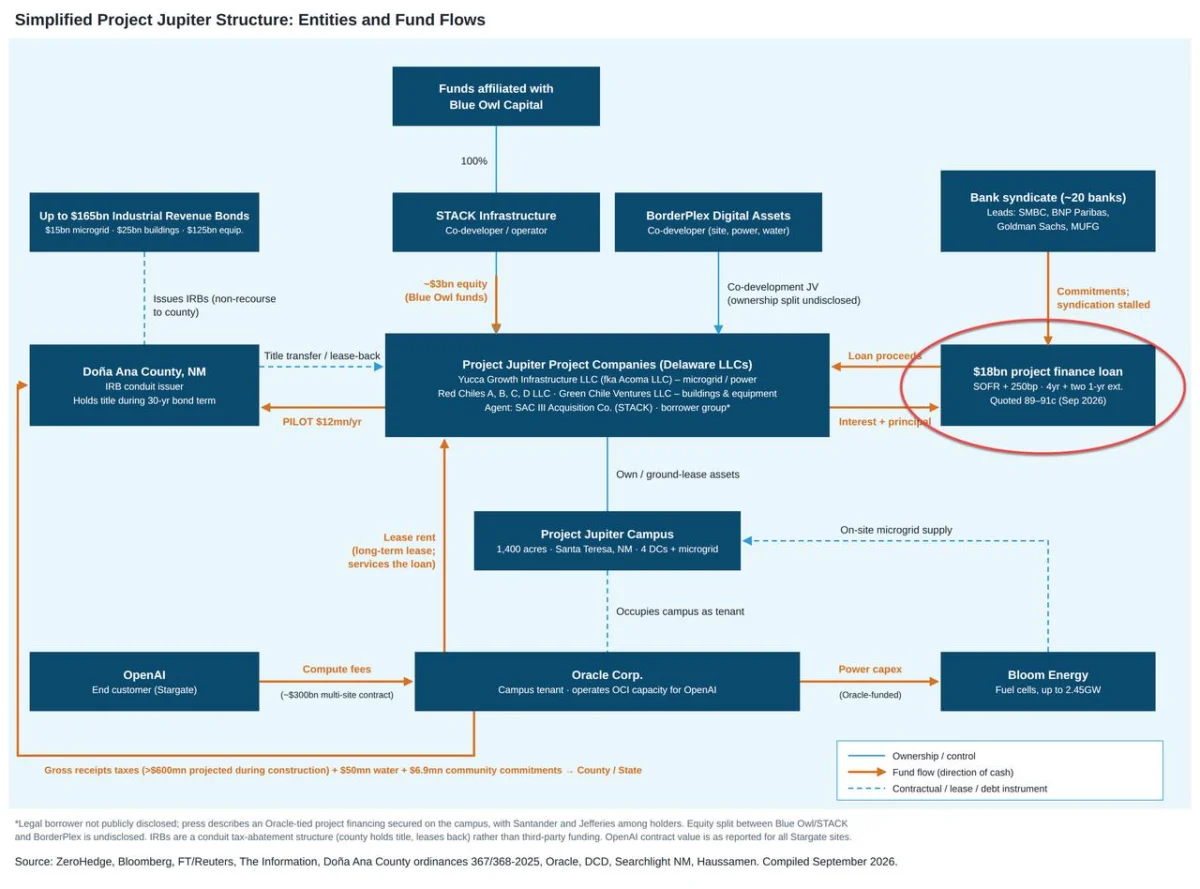
The ambitious vision of an "AI supercycle," predicated on exponential growth and transformative technological advancements, is confronting significant headwinds as the financial mechanisms underpinning its massive infrastructure buildout show increasing signs of strain. At the core of this burgeoning concern is the escalating reliance on debt to fund trillions in capital expenditures projected for the coming years, a strategy now facing critical scrutiny from increasingly wary credit markets. This precarious balancing act is starkly exemplified by recent developments surrounding Oracle’s colossal "Project Jupiter" data center in New Mexico, where $18 billion in associated leveraged loans have recently plummeted into "stressed territory," signaling a potential inflection point for the broader AI investment landscape.
The Precarious Pillars of the AI Supercycle
For months, financial analysts have posited that the sustained momentum of the AI supercycle, characterized by a relentless drive to develop and deploy advanced artificial intelligence capabilities, fundamentally hinges on the ever-accelerating issuance of debt. This unprecedented demand for capital is necessary to finance the construction of sprawling data centers, the acquisition of specialized AI hardware, and the development of sophisticated software platforms. Goldman Sachs, among other leading financial institutions, has underscored the staggering scale of this investment, forecasting trillions of dollars in capital expenditure globally to meet the burgeoning needs of AI infrastructure.
However, the optimistic outlook is being tempered by an increasingly pragmatic assessment within credit markets. As investors begin to perform what some refer to as "the ugly math"—a detailed evaluation of risk versus reward—the pace of new debt issuance is reportedly decelerating. This shift reflects growing unease over the massive borrowing requirements, the long-term viability of some projects, and the potential for a softening in future returns. Spreads, which represent the additional yield investors demand for holding riskier debt compared to benchmark safe assets, have begun to widen, making borrowing more expensive for companies venturing into large-scale AI infrastructure. This growing "cold feet" among lenders and investors signals a potential re-evaluation of the risk profile associated with the AI sector’s aggressive expansion.
Oracle’s Project Jupiter: A Microcosm of Macro Challenges
Oracle, a titan in the enterprise software and cloud computing space, has been at the forefront of this AI infrastructure push. Its monumental Project Jupiter data center, situated across a sprawling 1,400-acre campus in Doña Ana County, New Mexico, is not merely a significant investment but a strategic lynchpin. Valued at an estimated $165 billion overall, this facility is designed to be central to Oracle’s landmark $300 billion contract with OpenAI, aiming to provide the colossal computing power required for next-generation AI models.
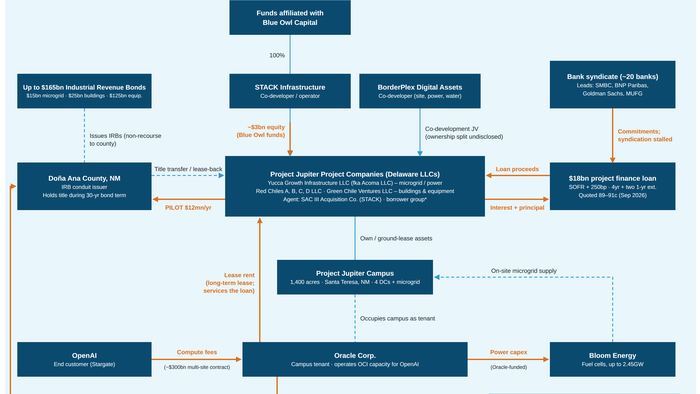
To kick-start construction, Oracle secured $18 billion in leveraged loans from a consortium of prominent banks, including Santander and Jefferies, late last year. Additionally, billions in equity investment flowed from firms like Blue Owl, underscoring the initial confidence in the project’s prospects. Yet, in a troubling development for the project and the broader market, these loans slid into stressed territory on Friday, a mere few months after their issuance. Quoted at 89 to 91 cents on the dollar by syndicate banks, these loans now trade significantly below par (100 cents), where healthy debt typically resides. This steep discount reflects a palpable erosion of investor confidence, driven by a confluence of financial concerns and mounting local opposition that threatens to derail the ambitious build-out.

Chronology of Financial and Operational Hurdles
The trajectory of Project Jupiter’s financial and operational challenges paints a clear picture of the escalating risks:
- Late 2024: Oracle secures $18 billion in leveraged loans from a consortium of banks and billions in equity from Blue Owl to fund Project Jupiter. The project is seen as a critical component of Oracle’s strategic partnership with OpenAI.
- July 2025: S&P downgrades Oracle’s corporate credit rating to just one notch above junk status. This move signals increased credit risk for the company, making future borrowing potentially more expensive and challenging.
- August 2025: Oracle’s air permit application for Project Jupiter is paused following lawsuits from two environmental advocacy groups, highlighting significant local and environmental resistance.
- November 2025: Reports emerge from ZeroHedge, profiling Oracle as the "first AI domino to fall," specifically referencing the growing financial concerns around Project Jupiter.
- Early 2026 (Recent): The $18 billion leveraged loans tied to Project Jupiter are quoted at 89 to 91 cents on the dollar, signaling a significant deterioration in market perception and investor fear. This development prompts banks to hold more Oracle-linked project debt on their balance sheets than initially planned, further exposing them to potential losses.
- Recent (Exact Date Unspecified): Oracle’s 82-year-old co-founder, Larry Ellison, abruptly cancels a $7.5 billion share-trading plan just one day after its announcement, offering no public explanation. This unusual move further fuels market uncertainty about the company’s financial stability and strategic direction.
- Ongoing: Project Jupiter faces significant construction delays, with market intelligence firm SynMax reporting it is at least seven months behind its proposed online date of November this year. Concerns are now mounting that completion could be delayed for years.
The Intricacies of Project Financing and Creditworthiness
The decline in the value of Project Jupiter’s debt is particularly concerning given the sophisticated financing structure employed. The debt secured a private investment-grade rating from credit rating agencies, a feat largely attributed to a Special Purpose Vehicle (SPV) structure. While common in project finance, an SPV can synthetically boost a project’s perceived creditworthiness by isolating its assets and liabilities from the parent company’s broader financial health. However, as credit markets tighten and investor scrutiny intensifies, the effectiveness of such structures in mitigating underlying risks is being questioned.

Barclays, in its latest credit report on Oracle, explicitly voiced discomfort regarding "the timeline for its data center projects, particularly for those that have faced setbacks such as New Mexico/Jupiter." This sentiment underscores a growing apprehension among institutional lenders and analysts, suggesting that even carefully structured project finance can buckle under the weight of escalating corporate debt and operational challenges.
Oracle’s overall debt load is gargantuan, and its capital expenditures are growing at an explosive pace. The market’s skepticism is evident not only in the project loan performance but also in Oracle’s stock, which has plunged 50% since its $300 billion deal with OpenAI was announced a year ago. This substantial decline indicates that investors are not granting the company much credit for its massive, albeit questionable, backlog, which has been facilitated primarily by its aggressive debt accumulation.
Environmental Backlash and Political Roadblocks
Beyond the financial intricacies, Project Jupiter has encountered formidable opposition on the ground, adding another layer of complexity and risk. The rapid expansion of data centers across the United States, while crucial for the digital economy, has sparked growing grassroots pushback, largely centered on environmental concerns. In New Mexico, local communities and environmental groups have fiercely contested Project Jupiter due to its anticipated impact on the region’s already strained water supply and air quality.

The project’s initial plan to power the facility with 2.2 gigawatts of natural gas turbines was met with a significant setback when the state land office blocked a request to run a natural gas pipeline to the data center. In response, Oracle announced a pivot to Bloom Energy fuel cells, which promise lower emissions of sulfur and nitrogen oxides. However, permission to connect a pipeline to feed these fuel cells was also subsequently blocked, further exacerbating delays. The project’s air permit application was paused in August after lawsuits from two environmental groups, though a judge recently allowed the process to continue, albeit with continued delays.
The political landscape in New Mexico has also proven challenging. Deb Haaland, the state’s Democratic gubernatorial nominee and a former U.S. Interior secretary, has taken a firm stance against unchecked data center expansion. She declared that if elected in November, she would pause all new data centers and mandate that developers heavily invest in renewable energy sources. This position aligns with widespread public sentiment; a recent poll by New Mexico’s Albuquerque Journal revealed that a significant 65% of residents opposed the development of large data centers, with only 20% expressing support.
Interestingly, state filings show Oracle donated more than $12,000 to Haaland’s campaign in late August. While the implications of such a donation amidst her critical stance are unclear, a potential moratorium on new data centers could significantly affect Oracle’s existing and planned sites, leading to even more protracted delays. Haaland’s statement, "Big Tech’s mantra may be ‘move fast and break things,’ but here in New Mexico, we do things our way," encapsulates the growing resistance from local communities and policymakers to the perceived unchecked expansion of tech giants.
Broader Implications for the AI Industry and Capital Markets

Oracle’s predicament with Project Jupiter serves as a stark warning sign for the entire AI industry and the capital markets that fund it. The challenges faced by such a prominent player highlight several critical implications:
- Sustainability of Debt-Fueled Growth: The current model of financing massive AI infrastructure through ever-increasing debt loads may be unsustainable if credit markets continue to grow more risk-averse. Higher borrowing costs and tighter lending standards could impede future projects.
- Environmental Scrutiny: Data centers are enormous consumers of energy and water, and as AI demand scales, so too will their environmental footprint. Project Jupiter’s struggles underscore that environmental impact and local community concerns are no longer secondary issues but critical factors that can significantly delay or even derail major infrastructure projects. This will likely lead to more stringent regulatory frameworks and public expectations for sustainable development.
- Increased Due Diligence for Investors: The slide in Project Jupiter’s debt value will undoubtedly prompt investors to conduct more rigorous due diligence on AI-linked infrastructure projects, especially those relying on complex SPV structures. The distinction between a project’s perceived creditworthiness and the parent company’s actual financial health will become increasingly important.
- Regulatory and Political Headwinds: Local and state governments, driven by public sentiment and environmental advocacy, are likely to become more assertive in regulating data center development. Companies may face a patchwork of differing regulations, permitting challenges, and political opposition, necessitating more robust community engagement and environmental planning from the outset.
- Innovation in Financing and Sustainability: To maintain the momentum of the AI supercycle, companies may need to innovate not only in technology but also in financing models and environmental sustainability. This could involve greater reliance on equity financing, green bonds, or partnerships that distribute risk more broadly and prioritize environmentally sound practices.
The unfolding narrative around Oracle’s Project Jupiter demonstrates that the "AI supercycle" is not immune to fundamental economic principles or the complexities of real-world infrastructure development. The convergence of financial skepticism, unprecedented capital expenditure, and potent environmental and local opposition is forcing a critical re-evaluation of how the future of AI will be built and, crucially, paid for. The era of "move fast and break things" appears to be colliding with the reality that large-scale infrastructure, even for cutting-edge technology, must navigate a complex web of financial, environmental, and social considerations. The ability of the AI industry to adapt to these burgeoning challenges will ultimately determine the pace and scope of its long-term growth.

