
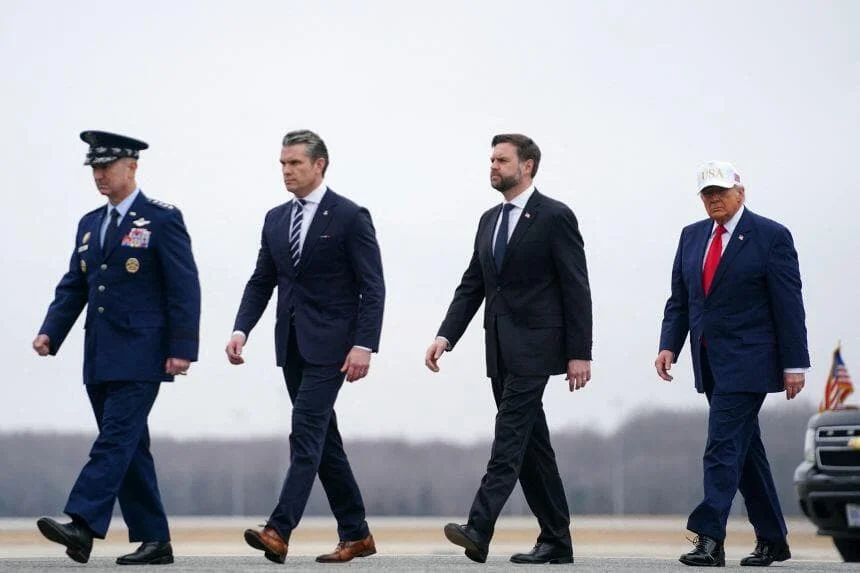
Vice President JD Vance, widely reported to have expressed reservations about the initiation of Operation Epic Fury, has recently issued a series of statements suggesting a potential shift in the trajectory of the ongoing conflict with Iran, hinting at an "off-ramp" scenario. These remarks, while potentially reflecting his personal aspirations, signal a notable divergence from some of the administration’s previous messaging regarding the duration and scope of hostilities. Vance proclaimed that the conflict "will soon enter ‘a much different phase’ in the coming months," though he acknowledged the ultimate authority of the Commander-in-Chief in determining its conclusion, a point that implicitly raises questions about the roles of Congress and the American populace in such critical decisions.
Vance’s Strategic Outlook and a New Phase
Speaking to the New York Post, Vice President Vance elaborated on his perspective, stating, "We can’t predict the future, but I think the [US] President [Donald Trump] is right to say that this thing [the conflict in Iran] will enter a much different phase in a couple of months." This statement served as a defense, or at least an alignment, with President Trump’s earlier assertion last week that hostilities would likely conclude after the upcoming November mid-term elections. The timing of such declarations, particularly with an election cycle looming, often invites scrutiny regarding political motivations alongside strategic considerations.
Vance delineated what he perceives as two distinct phases of the conflict. He described the initial phase as having been successfully completed by the US military, with the objectives of "destroy[ing] the nuclear program" of Iran and dismantling "their conventional military." According to Vance, the second phase will focus on ensuring that Iran is "not able to rebuild" its military capabilities and on striving to "maintain as much global stability in the wake of that." This two-phase framework offers a glimpse into the administration’s envisioned endgame, emphasizing both destructive and stabilization efforts. However, the claims of success in the first phase face immediate challenges from recent intelligence and battlefield reports.
Operation Epic Fury: Background and Initial Objectives
Operation Epic Fury, initiated on an unspecified date prior to July 25, 2026, reportedly aimed at neutralizing Iran’s nuclear ambitions and significantly degrading its conventional military capacity. The stated objectives were ambitious, targeting critical infrastructure related to nuclear development and conventional arms production, command-and-control centers, and strategic military assets. The deployment of substantial US air, naval, and ground forces to the region, including increased presence in the Persian Gulf, Saudi Arabia, UAE, and Jordan, underscored the seriousness of the operation. Early reports, often filtered through official channels, suggested significant damage to Iranian facilities and a substantial setback to their military apparatus.
The operation’s genesis can be traced back to escalating tensions over Iran’s nuclear program, alleged support for regional proxy groups, and a series of maritime incidents in the Strait of Hormuz. Following years of "maximum pressure" campaigns involving stringent economic sanctions, the decision to launch direct military action marked a dramatic shift in US policy. Critics, including reportedly Vice President Vance himself prior to the operation, raised concerns about the potential for protracted conflict, regional destabilization, and the immense human and economic costs involved. Proponents, however, argued for the necessity of decisive action to prevent Iran from acquiring nuclear weapons and to curb its regional hegemonic aspirations.
Contradictory Evidence: Iran’s Enduring Resilience
Despite the Vice President’s optimistic assessment of the conflict’s first phase, recent developments suggest a more complex and resilient reality on the ground. Iran has demonstrably continued to project military power and defy US claims of comprehensive destruction. Just earlier this month, overnight from September 8-9, Iran launched approximately 20 ballistic missiles at US bases in Jordan, marking a significant flare-up in fighting and directly contradicting the notion of a crippled conventional military. This volley of missiles not only inflicted damage but also served as a potent symbol of Iran’s continued operational capacity and willingness to retaliate.
Further eroding the administration’s claims, a report from The Wall Street Journal approximately a week prior to Vance’s statements (around September 8, 2026), citing US and Middle Eastern officials, revealed that "Iran has resumed its production of ballistic missiles using stockpiled components and working in underground facilities." This intelligence suggests that despite "heavy attacks on its missile sites and industrial facilities during the initial phase of the war," Iran has been actively assembling both liquid-propellant and solid-propellant missiles. The report explicitly noted that this resurgence "erod[es] what the U.S. and Israel have touted as a major achievement of the war." The consistent firing of advanced missiles by Tehran, even after repeated US administration claims of their destruction or severe degradation, points to a sophisticated and deeply entrenched military industrial complex, capable of adapting and continuing production under duress.
The Broader Regional Contagion and Proxy Warfare
The conflict with Iran has not been confined to direct US-Iran confrontations but has ignited and exacerbated a broader regional conflagration. Iran’s extensive network of proxy forces, including the Houthis in Yemen, various Shiite militias in Iraq, and Hezbollah in Lebanon, has played a crucial role in Tehran’s strategy of asymmetric warfare, extending the battlefield beyond its borders and complicating US efforts to contain the conflict.
A recent incident highlighted the perilous expansion of hostilities: a drone attack struck Saudi Arabia’s East-West pipeline, a critical piece of energy infrastructure. While the exact origin of the drone attack remains under investigation, initial assessments pointed towards either Iraq, where Iranian-backed militias operate, or Yemen, where the Houthi movement has demonstrated increasing capabilities in drone and missile warfare. Vice President Vance acknowledged the complexity of this regional dynamic, stating that the US is "in direct contact with Yemen’s Houthis as well as with Saudi Arabia and the UAE over recent developments there." This engagement with the Houthis, a group traditionally seen as an adversary, underscores the desperate need for de-escalation channels amidst the widening conflict. The involvement of non-state actors adds layers of complexity, making clear attribution and targeted response exceedingly difficult, thereby increasing the risk of miscalculation and further escalation.

Many geopolitical analysts have long observed that Iran’s Islamic Revolutionary Guard Corps (IRGC) and its associated government structures have been preparing for a potential conflict with the US and Israel for decades. This strategic foresight has manifested in the development of dispersed, hardened, and often underground military infrastructure, as well as a doctrine emphasizing asymmetric capabilities and proxy warfare. Consequently, Washington’s perceived "underpreparedness for the Iranian retaliation," as suggested by various reports including those detailing US troops leaking photos of major damage at Gulf bases, indicates a potential underestimation of Iran’s long-term resilience and strategic planning.
Political Dynamics and Congressional Oversight
The public pronouncements by Vice President Vance also cast a spotlight on the internal political dynamics within the Trump administration. Vance’s alleged initial skepticism about Operation Epic Fury, as highlighted by "bombshell leaks" seeking to distance him from the war, suggests a potential division within the executive branch regarding the wisdom and execution of the conflict. Such internal debates are not uncommon in wartime, but their public emergence can signal cracks in unified messaging and potentially embolden political opposition.
President Trump’s assertion that hostilities would wrap up after the November mid-term elections adds another layer of political calculation to the conflict. This timeline suggests a desire to manage the war’s narrative and potential costs relative to the domestic political calendar, rather than solely on military objectives. Such statements often raise concerns among lawmakers and the public about the politicization of military engagements and the potential for strategic decisions to be influenced by electoral considerations.
Congress, constitutionally vested with the power to declare war, has found itself in a challenging position throughout Operation Epic Fury. While the initial strikes may have been framed under existing authorizations or as defensive measures, the prolonged nature and expansion of the conflict have intensified calls for greater Congressional oversight and debate. Legislators from both parties have expressed concerns about the lack of a formal war declaration, the economic burden of the conflict, and the potential for mission creep. The implicit suggestion by Vance that "it would be nice if Congress or the American people had a word" on the conflict’s end underscores a growing sentiment that the executive branch has overstepped its authority, or at least failed to adequately engage legislative and public opinion.
International Reactions and Economic Fallout
The Iran conflict has reverberated globally, eliciting varied reactions from the international community. US allies in Europe and Asia have expressed concern over regional stability, the safety of global shipping lanes, particularly the Strait of Hormuz which is critical for oil transit, and the broader implications for non-proliferation efforts. While some allies have offered rhetorical support, direct military involvement has been limited, reflecting a cautious approach to avoid further entanglement. Adversaries, meanwhile, have sought to exploit the situation, potentially deepening existing geopolitical fault lines.
The economic fallout has been significant. Global oil prices have experienced considerable volatility, directly impacted by threats to shipping and attacks on critical energy infrastructure like the Saudi East-West pipeline. Sanctions against Iran, while designed to cripple its economy, have also had ripple effects on global markets and supply chains. The cost of maintaining a substantial military presence in the region and conducting ongoing operations has placed an immense strain on the US defense budget, diverting resources from other domestic and international priorities. Furthermore, the conflict has disrupted humanitarian efforts in an already fragile region, exacerbating existing crises and displacing populations.
The Path Forward: Challenges and Uncertainties
Vice President Vance’s "off-ramp" rhetoric, while perhaps offering a glimmer of hope for de-escalation, is met with substantial challenges and uncertainties. The disconnect between the administration’s claims of success in dismantling Iran’s military capabilities and the verifiable evidence of Iran’s continued missile production and attacks suggests a fundamental misreading of the situation or a significant underestimation of Iranian resilience. For the conflict to genuinely enter "a much different phase" that leads to stability, several critical questions must be addressed.
Firstly, a realistic assessment of Iran’s military capabilities and strategic objectives is paramount. Secondly, a coherent strategy for engaging with Iran and its proxies, beyond purely military means, needs to be articulated, potentially involving robust diplomatic efforts. Thirdly, the role of Congress and public opinion in shaping the war’s trajectory will be crucial for legitimacy and sustained support. Finally, the broader regional context, including the ongoing conflicts in Yemen and Iraq, and the security concerns of US allies like Saudi Arabia and the UAE, must be integrated into any comprehensive "off-ramp" strategy.
The coming months will be critical in determining whether Vice President Vance’s optimistic vision of a "different phase" for the Iran conflict can materialize, or if the region is destined for further entanglement in a protracted and costly struggle with no clear end in sight. The credibility of the administration, regional stability, and the geopolitical landscape of the Middle East hang in the balance.

