
The Alternative for Germany (AfD), a prominent right-wing populist party known for its pro-Germany, anti-globalist, and anti-mass migration stance, delivered its most significant electoral performance to date in Saxony-Anhalt on Sunday, September 7, 2026. This landmark result has sent shockwaves through Germany’s political establishment, fundamentally reshaping the regional power dynamics and posing profound questions for the federal government. The AfD secured an unprecedented 43.8% of the vote in the regional election, far exceeding pre-election polling estimates and signaling a dramatic shift in voter sentiment within the eastern German state. This victory represents a stark repudiation of mainstream political parties and a powerful affirmation of the AfD’s growing influence across the nation.
A Seismic Shift in Saxony-Anhalt’s Political Landscape
Sunday’s election saw the Alternative for Germany garner a commanding lead, translating into 39 seats within the 83-member Saxony-Anhalt legislature. This impressive haul places the party tantalizingly close to an absolute majority, falling just three seats short of being able to govern alone. The magnitude of this shift is underscored by the significant losses incurred by established parties. Chancellor Friedrich Merz’s Christian Democrats (CDU), traditionally a dominant force in German politics, experienced a precipitous decline, losing approximately 19 percentage points compared to the 2021 election. This substantial erosion of support reflects a broader discontent among the electorate, which appears increasingly drawn to the AfD’s populist narratives and critique of current national policies.
The election was also marked by a notable surge in voter engagement, with turnout climbing to 77.8% from 60.3% in the previous regional election held in 2021. Such a substantial increase in participation suggests a highly mobilized electorate, keen to express its preferences at the ballot box. This heightened engagement, however, largely favored the AfD, indicating a strong mandate for their platform among a significant portion of Saxony-Anhalt’s population. The collective vote share of the CDU, Social Democrats (SPD), Greens, and Left party now stands at 39 seats, mirroring the AfD’s count and setting the stage for complex and potentially protracted coalition negotiations.
The Rise of the AfD: A Background of Discontent
The Alternative for Germany was founded in 2013, initially as an anti-Euro party, but quickly evolved to focus on immigration, national sovereignty, and criticism of the European Union. Its growth has been fueled by a combination of factors, including public anxieties over migration policy, economic stagnation, concerns about energy transition costs, and a general disillusionment with traditional political parties. In recent years, the party has successfully tapped into a vein of anti-establishment sentiment, particularly in Germany’s eastern states, which often feel overlooked by the federal government and perceive a decline in their economic and social standing.
Saxony-Anhalt, like many parts of eastern Germany, has a demographic profile and economic challenges that have made it fertile ground for the AfD’s message. With a history of industrial decline and a slower pace of economic recovery compared to western Germany, the state has grappled with issues such as outward migration of skilled workers and a sense of cultural alienation. The AfD’s promises of tighter border controls, a more national-centric economic policy, and a rejection of what it often terms "woke" cultural trends resonate strongly with a significant segment of the electorate here. The 2021 state election saw the AfD emerge as the second-strongest party, but their latest result represents an almost doubling of their previous vote share, signaling a profound consolidation of their support base.
Statements from AfD Leaders and the Broader Political Climate
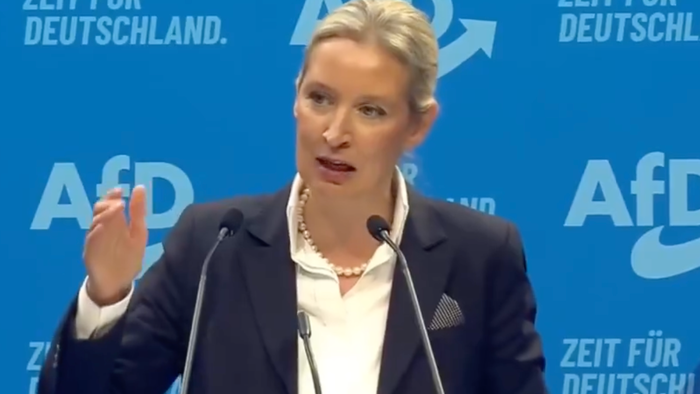
The AfD’s leadership has wasted no time in capitalizing on their electoral success. Alice Weidel, co-leader of the federal AfD, has been a vocal critic of the current federal government, asserting that "Germany is de facto bankrupt" and that the nation’s financial realities are being concealed from the public. Her statements, shared widely on social media platforms such as X (formerly Twitter), underscore the party’s narrative of economic mismanagement by the established parties. Weidel has also publicly criticized Chancellor Merz, stating that "No chancellor before him has been as unpopular as Friedrich Merz, who has become a major burden on Germany’s positive development." These comments reflect the AfD’s strategy of directly challenging the legitimacy and competence of mainstream political figures and institutions.
The federal political landscape has been characterized by increasing fragmentation and a struggle for the ruling coalition – comprised of the Social Democrats (SPD), Greens, and Free Democrats (FDP) – to maintain public confidence amidst various crises, including energy security concerns stemming from geopolitical conflicts and persistent inflation. Merz, leading the opposition CDU, has been tasked with revitalizing his party and presenting a credible alternative, but the AfD’s surge suggests his efforts have yet to stem the tide of populist discontent. The election results in Saxony-Anhalt serve as a potent reminder of the challenges facing Germany’s traditional political order and the growing appeal of radical alternatives.
Navigating the Post-Election Landscape: Scenarios for Saxony-Anhalt
With no single party securing an absolute majority, the political future of Saxony-Anhalt now hinges on complex negotiations. According to Marion Mühlberger, a senior economist at Deutsche Bank, two primary outcomes appear most likely. The first is an AfD minority government, potentially tolerated by the newly formed populist Bündnis Sahra Wagenknecht (BSW). The second is a political stalemate leading to snap elections, which could provide the AfD with another opportunity to secure outright control.
The BSW, with its five seats in the 83-member legislature, has emerged as the decisive "kingmaker" in these negotiations. Founded by former Left party leader Sahra Wagenknecht, the BSW positions itself as a left-wing conservative party, sharing some populist and anti-establishment sentiments with the AfD, particularly on issues such as energy policy, sanctions against Russia (though these are set at the EU level), education, and public broadcasting. While BSW leaders Wagenknecht and Ali have indicated an unwillingness to enter a formal coalition with the AfD, their federal-level statements suggest a potential for informal cooperation.

Mühlberger outlines three theoretical options for the BSW once the new parliament convenes: electing the AfD lead candidate as state premier (without a formal coalition), electing the CDU lead candidate, or abstaining in the initial ballots for state premier. Based on statements from BSW co-leaders, the first option – electing the AfD lead candidate through informal cooperation – is deemed the most probable. This arrangement would see the BSW providing crucial support for an AfD minority government without officially joining their ranks.
However, internal divisions within the AfD itself regarding the preferred path forward complicate matters. While national co-leader Tino Chrupalla has indicated openness to attempting a minority government, the AfD’s lead candidate in Saxony-Anhalt, Ulrich Siegmund, has suggested snap elections as his preferred option. Siegmund’s stance stems from the party’s unwillingness "to make far-reaching compromise to form a coalition." This suggests that even with BSW’s potential tolerance, the AfD may prefer to seek a stronger mandate directly from the voters rather than compromise its core principles in a power-sharing arrangement.
The path to snap elections is not straightforward. It could arise if the parliament fails to elect a state premier after multiple ballots, or if a newly formed government loses a vote of no confidence. Such an outcome carries both risks and opportunities for the AfD. It could reinforce the narrative that mainstream parties are attempting to exclude the AfD from power, potentially galvanizing their base and leading to an even stronger performance. Moreover, snap elections often disadvantage smaller parties, as they might struggle to clear the 5% electoral hurdle, thereby consolidating votes for larger parties like the AfD. Conversely, a rerun election could also mobilize centrist forces, uniting to prevent an AfD absolute majority. Until a new government is elected, Sven Schulze will remain in office, leading a caretaker administration. The regional constitution mandates that the newly elected parliament must convene by October 6 at the latest, but sets no deadline for electing a state premier, indicating that the period of political uncertainty could be prolonged.
Economic Outlook and Regional Vulnerabilities
The potential for an AfD-led government in Saxony-Anhalt has raised concerns among economic analysts. Marion Mühlberger of Deutsche Bank has provided a sober assessment, predicting "materially detrimental ramifications for the economic prospects of Saxony-Anhalt over the coming years." Her analysis highlights several key areas of vulnerability. Direct investment in the state is likely to decline amid significant policy uncertainty, as businesses may become hesitant to commit capital in an environment of political instability and unpredictable regulatory changes. Furthermore, skilled worker shortages, already a pressing issue in the region, are expected to become even more pronounced. The AfD’s anti-mass migration agenda, a cornerstone of its platform, could exacerbate these shortages by limiting the influx of foreign talent necessary to fill critical labor gaps.
Mühlberger also points to potential conflicts with the civil service, which could face pressure to implement policies that may run counter to established norms or constitutional principles. However, the economist also offers a reassuring perspective for the broader German economy, noting that Saxony-Anhalt contributes less than 2% of Germany’s GDP. Consequently, any structural damage inflicted upon the regional economy is "unlikely to spill over to the rest of the German economy." While an AfD state government might "test some of Germany’s federal institutions," it will possess "no leverage over national economic or fiscal policy, not even via the constitutional court." This suggests that while the political tremors in Saxony-Anhalt are significant locally, their direct economic impact on the federal level would be contained.
This perspective is somewhat echoed by Nomura analyst Andrzej Szczepaniak, whose recent report on the "seeds of political change" in Europe suggests that markets are often "less concerned about right-wing populism" and more apprehensive about "populist left-wing parties being elected due to their desire to increase spending." This implies that from a market stability perspective, the fiscal prudence often associated with right-wing parties might be viewed as less disruptive than the expansionary spending policies typically favored by the left.

Broader Political Ramifications and Future Contests
The outcome in Saxony-Anhalt is not an isolated event but rather a harbinger of potential shifts in the broader German political landscape. For Chancellor Friedrich Merz and the federal CDU, the most immediate and consequential challenge lies in containing the AfD’s momentum in the upcoming state elections. Two critical contests are scheduled for September 20: Berlin and Mecklenburg-Vorpommern.
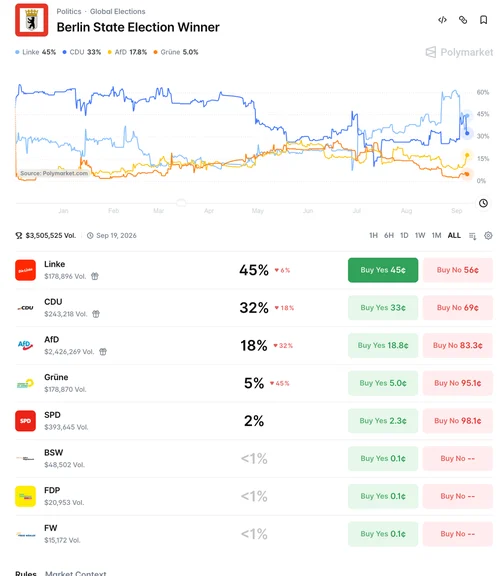
Market predictions from Polymarket underscore the gravity of the situation. The "Mecklenburg-Vorpommern Parliamentary Election Winner" market currently places the AfD’s odds of winning at a substantial 82%. This suggests that another significant victory for the party in an eastern state is highly anticipated, which would further solidify their regional dominance and intensify pressure on mainstream parties. In contrast, the AfD’s odds of winning the Berlin election are considerably lower, at around 18%, reflecting the capital city’s more diverse and often more liberal electorate. Nevertheless, even a strong showing in Berlin, where the party has historically struggled, would be interpreted as a sign of its expanding reach.
The weeks leading up to these elections are expected to be characterized by "considerable political noise," as foreseen by Mühlberger. There will likely be intense scrutiny of party leaderships and renewed calls for reform proposals from within the mainstream parties. However, once these final state elections of the year conclude, the emergence of an AfD government in Saxony-Anhalt is likely to provide "an additional impetus for the federal government coalition to double down on reforms." This suggests that the establishment parties, confronted with the reality of a powerful populist challenge, may be forced to adapt their policies and strategies to address the underlying grievances fueling the AfD’s rise. The AfD’s historic victory in Saxony-Anhalt thus marks a pivotal moment, signaling a deepening political realignment in Germany and setting the stage for an era of increased fragmentation and ideological contestation.

