
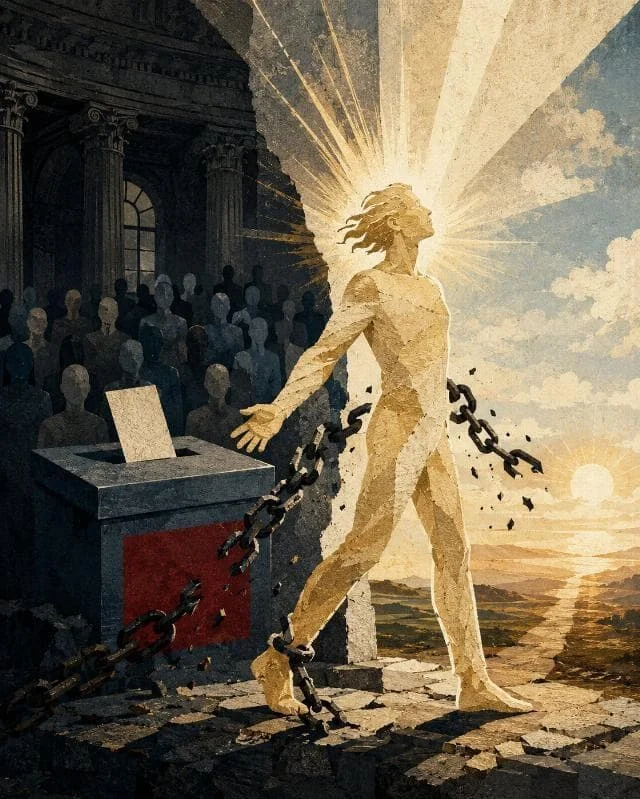
The inherent tension between the concept of democracy, often interpreted as simple majority rule, and the safeguarding of individual liberty has been a foundational debate in political philosophy and constitutional design. A recent perspective, articulated by J.B. Shurk via American Thinker, posits that "democracy invites despotism" when unconstrained by robust moral virtues and explicit constitutional protections for inviolable rights. This viewpoint underscores a critical distinction, arguing that freedom, rooted in unalienable natural rights, must supersede mere majoritarian processes to prevent governmental overreach and preserve a truly free society. This exploration delves into the historical, philosophical, and constitutional underpinnings of this argument, examining how the American system was designed to navigate this very challenge and the implications of its evolution.
Philosophical Foundations: Democracy, Republics, and Rights
The discussion of "democracy" often conflates various forms of governance. Historically, pure democracy, or direct rule by the majority, has been viewed with skepticism by many political thinkers. Ancient Greek democracies, notably Athens, while pioneering citizen participation, also demonstrated vulnerabilities to demagoguery, factionalism, and the tyranny of the majority, where the rights of minorities could be easily overridden. The Roman Republic, in contrast, introduced a system of mixed government with checks and balances, aiming to temper popular will with aristocratic and monarchical elements, emphasizing the rule of law over direct popular decree.
Enlightenment philosophers profoundly influenced the American Founders’ understanding of governance. Thomas Hobbes, in Leviathan, described a pre-governmental "state of nature" as chaotic and violent, necessitating a strong sovereign to maintain order. While Hobbes did not explicitly advocate for democracy, his emphasis on avoiding societal breakdown resonated. John Locke, a towering figure, articulated the concept of natural rights—life, liberty, and property—as inherent and preceding government. For Locke, government’s legitimate purpose was to protect these rights through a social contract, not to infringe upon them. Baron de Montesquieu’s Spirit of the Laws championed the separation of powers as a crucial safeguard against tyranny, a principle vigorously adopted by the American system. Even Adam Smith’s "invisible hand" concept in economics, which posits that individual self-interest can collectively benefit society in free markets, highlights the powerful, sometimes unchecked, nature of individual drives, suggesting that political systems, too, require careful structuring to channel these impulses constructively.
The American Founding Fathers, deeply steeped in these philosophies and wary of the historical pitfalls of pure democracy, explicitly sought to establish a constitutional republic rather than a direct democracy. Figures like James Madison, in Federalist No. 10, famously warned against the dangers of factions and majoritarian tyranny, arguing that a large republic, with its diverse interests and representative structure, would be better equipped to protect individual liberties than a small, direct democracy. Their design aimed to create a government powerful enough to govern but constrained enough to prevent abuses, with a focus on protecting individual rights against the transient will of any majority.
The American Constitutional Framework: Guardrails for Freedom
The bedrock of American liberty is laid out in the Declaration of Independence, which asserts "self-evident truths, that all men are created equal, that they are endowed by their Creator with certain unalienable Rights, that among these are Life, Liberty, and the pursuit of Happiness." This declaration establishes that fundamental rights are not granted by government or popular vote, but are inherent and divinely bestowed, existing prior to and independent of governmental authority. This crucial distinction positions freedom as an intrinsic state, not a concession from a ruling majority.
The U.S. Constitution, subsequently, was crafted as a document of delegated and limited powers. The Preamble, "We the People of the United States, in Order to form a more perfect Union… do ordain and establish this Constitution," signifies that the government’s legitimacy and power derive from the people, but these powers are lent, not surrendered entirely. The Constitution delineates specific powers for the legislative, executive, and judicial branches, and through federalism, reserves significant authority to the states. This intricate web of checks and balances and division of powers was designed precisely to prevent any single branch or level of government from accumulating unchecked power.
A pivotal element in safeguarding individual liberties was the Bill of Rights. Initially, some Federalists argued against a Bill of Rights, fearing that enumerating certain rights might imply that unlisted rights were not protected. However, Anti-Federalists insisted on explicit protections, leading to its adoption. The Ninth and Tenth Amendments are particularly crucial in this context:
- Ninth Amendment: "The enumeration in the Constitution, of certain rights, shall not be construed to deny or disparage others retained by the people." This amendment explicitly refutes the idea that the listed rights are exhaustive, affirming that citizens possess additional, unenumerated rights.
- Tenth Amendment: "The powers not delegated to the United States by the Constitution, nor prohibited by it to the States, are reserved to the States respectively, or to the people." This amendment reinforces the principle of limited federal government, stipulating that any power not explicitly granted to the federal government remains with the states or the citizenry.
Together, these amendments act as powerful constitutional "guardrails," reinforcing the idea that the federal government’s authority is circumscribed and that the vast sphere of human liberty and self-governance remains outside its purview. They represent a fundamental rejection of the notion that government is the ultimate arbiter of rights or that the majority’s will can legitimately extinguish inherent freedoms.
The Historical Arc: Expansion of Federal Power and the Erosion of Limits

Despite these foundational principles and constitutional safeguards, the history of the United States has seen a progressive expansion of federal power, leading to what some argue is a departure from the Founders’ original intent. This expansion can be traced through several key periods:
- Early Republic (Late 18th – Early 19th Century): The federal government was comparatively small, with its primary functions focused on national defense, foreign policy, and a limited set of interstate affairs. Debates over states’ rights and federal authority were constant, notably in the Nullification Crisis.
- Civil War and Reconstruction (1860s-1870s): The Civil War solidified federal supremacy over states in matters of national unity. Reconstruction amendments (13th, 14th, 15th) significantly expanded federal power to protect civil rights, fundamentally altering the relationship between citizens, states, and the federal government.
- Progressive Era (Early 20th Century): Fueled by industrialization and social problems, this era saw the rise of regulatory agencies (e.g., Federal Reserve, FDA, FTC) aimed at addressing economic monopolies, public health, and worker safety. The 16th Amendment (income tax) and 17th Amendment (direct election of senators) further centralized power and democratized aspects of governance, though arguably at the cost of original federalist designs.
- The New Deal (1930s): In response to the Great Depression, President Franklin D. Roosevelt’s New Deal programs dramatically expanded federal intervention in the economy and social welfare. Agencies like the Social Security Administration, Civilian Conservation Corps, and others created an extensive federal apparatus. Judicial interpretation, particularly regarding the Commerce Clause, broadened the scope of federal regulatory power, moving away from strict constructionism.
- The Great Society (1960s): President Lyndon B. Johnson’s initiatives further expanded social programs (Medicare, Medicaid), civil rights legislation, and environmental protection, embedding the federal government deeper into social and economic life.
- Post-9/11 Era and Beyond: National security concerns led to increased federal surveillance powers (e.g., PATRIOT Act) and the growth of the security apparatus. Subsequent financial crises and economic downturns prompted significant federal interventions and bailouts.
This historical trajectory reveals a consistent pattern of federal growth. For instance, the federal budget, which constituted less than 3% of GDP in 1900, now consistently accounts for over 20% of GDP. The number of federal agencies, commissions, and bureaucratic entities has multiplied from a handful in the early republic to hundreds today, issuing thousands of pages of regulations annually. This growth, critics argue, has occurred as generations incrementally "traded freedom for democracy," prioritizing collective action and perceived majoritarian will over the strictures of constitutional limitations and individual autonomy.
The "Democracy as Despotism" Argument in Practice
The perspective that democracy, without strong guardrails, can lead to despotism is often illustrated by the observation that even highly repressive regimes frequently adopt "democratic" or "people’s" labels. North Korea, for instance, is officially the Democratic People’s Republic of Korea, and China the People’s Republic of China, despite being authoritarian states. These examples highlight that the mere process of popular participation or nominal representation does not inherently guarantee freedom or just outcomes.
The argument posits that when a society focuses solely on "majoritarianism"—the idea that the majority’s decision is inherently correct and legitimate—it risks sacrificing minority rights and individual liberties. If 51% of the population can dictate to the other 49% on matters of property, speech, religion, or even child-rearing, without constitutional restraint, then the system is vulnerable to the same impulses that drive individual self-interest, but magnified by collective power. This "coin toss" analogy suggests that a majority is no more inherently virtuous or prudent than an individual ruler; a majority of communists would still dispossess individuals, just as a single communist would.
The underlying concern is that without a "strong sense of moral virtue that fosters personal discipline, duty, and honor," collective self-interest can quickly descend into a state where "base selfishness becomes the driving motivation behind all political action." In such a scenario, "democratic majorities devour those rights whenever expedient," turning the process into a veneer for authoritarianism, making it "shiny and sparkly" while eroding fundamental freedoms.
Contemporary Debates and Implications
The tension between democracy and freedom remains a central theme in contemporary American political discourse. Debates over the scope of federal power—whether in healthcare mandates, environmental regulations, gun control, free speech limitations, or educational policies—often boil down to differing interpretations of where individual liberty ends and governmental authority begins.
Movements advocating for strict constitutionalism and limited government frequently invoke the Ninth and Tenth Amendments, arguing that the federal government has exceeded its delegated powers and infringed upon rights "retained by the people" or "reserved to the States." They contend that judicial interpretations, legislative expansions, and executive actions have progressively chipped away at the Founders’ original design, leading to a sprawling federal bureaucracy that increasingly intrudes into private life.
Conversely, proponents of a more expansive federal role often argue that government intervention is necessary to address complex societal problems, ensure social justice, protect vulnerable populations, or promote the "general Welfare" as outlined in the Preamble. They might argue that the evolving needs of a modern industrial society necessitate a more active federal government than envisioned in the 18th century, and that democratic processes are the legitimate means to achieve these collective goals.
The implications of this ongoing debate are profound. It shapes policy decisions, electoral outcomes, and the very character of American society. A society that prioritizes freedom over an unconstrained democracy must constantly reassess its constitutional fidelity, the balance of power, and its commitment to the inherent dignity and rights of the individual. It requires vigilance against the seductive appeal of majoritarian power and a continuous effort to reinforce the constitutional guardrails designed to protect individual liberty from both governmental overreach and the potential tyranny of the majority. The health of the republic, in this view, depends not merely on the existence of democratic processes, but on the unwavering protection of those unalienable rights that define a truly free people.

