
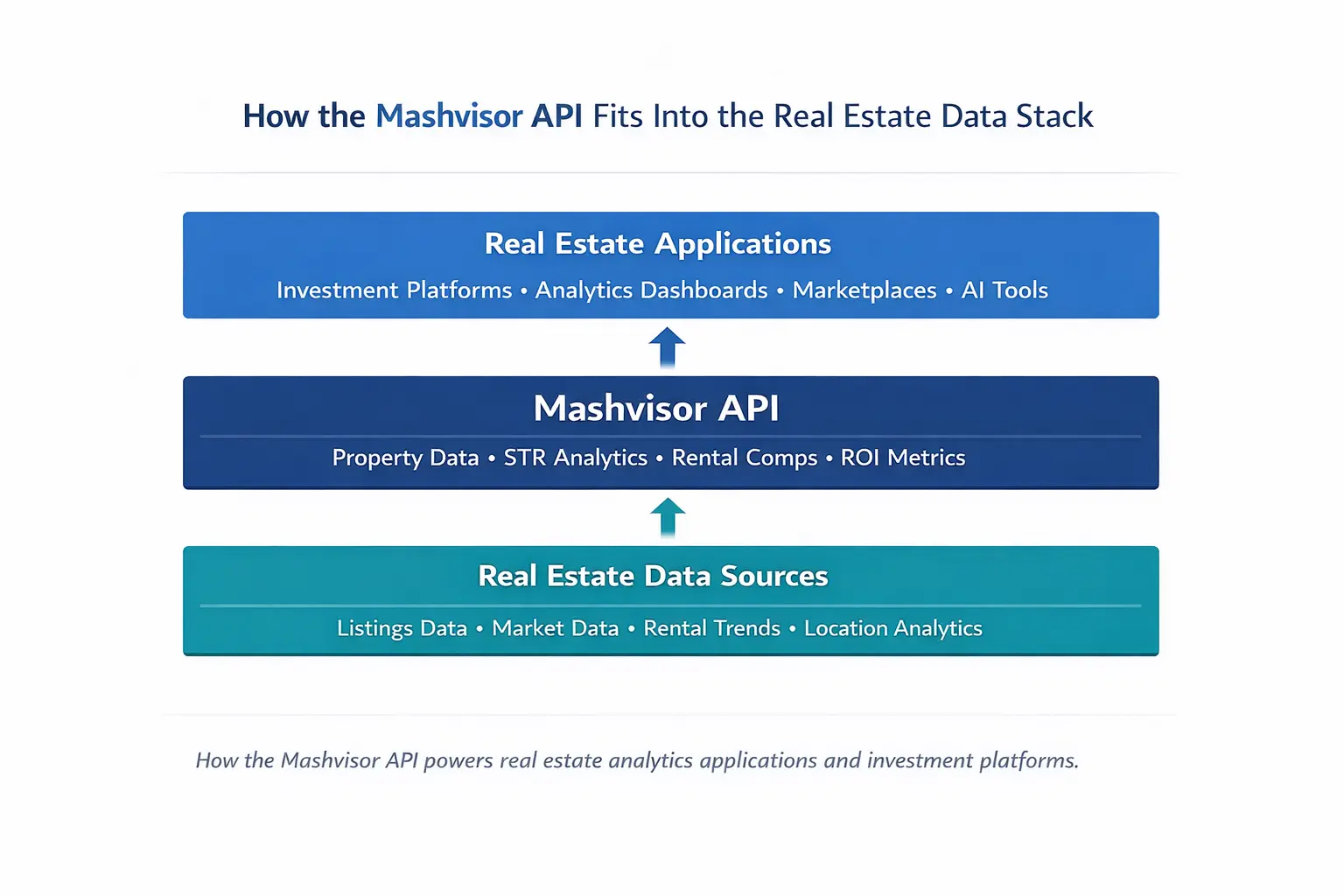
For real estate professionals, investors, PropTech companies, and analytics teams, the decision to integrate a new data solution often hinges on a delicate balance between features, dataset breadth, and, critically, pricing. As businesses increasingly rely on programmatic access to real estate data for everything from investment property analysis to underwriting and short-term rental revenue modeling, a clear understanding of anticipated costs is paramount. This clarity is especially crucial when planning for scalability and long-term integration into complex workflows. Addressing this industry need, Mashvisor has unveiled a revised API pricing structure designed to offer unparalleled transparency and flexibility, moving away from traditional fixed monthly licensing fees towards a usage-based model. This approach ensures that costs are directly tied to actual data extraction, catering to a diverse range of applications without the risk of overpaying for unused capacity.
The core innovation of Mashvisor’s API pricing lies in its credit-based system, where each API call consumes a portion of a pre-defined monthly allocation. This stands in stark contrast to the often opaque and substantial upfront commitments associated with conventional data licensing agreements. The new structure empowers businesses to begin with smaller workloads and scale their data access incrementally as their needs and analytical demands evolve. This flexibility is particularly beneficial for startups and rapidly growing companies, allowing them to manage expenses effectively while accessing the precise data required for market research, investment property analysis, rental comparable (comps) intelligence, and short-term rental performance modeling.
Understanding the Mashvisor API’s Credit-Based Pricing Model
Mashvisor’s API pricing model is engineered for transparency and adaptability, allowing businesses to procure precisely the real estate data they require without being locked into rigid, fixed monthly costs. This usage-based structure directly contrasts with the common practice of offering fixed data packages, which frequently lead to users incurring expenses for data they do not utilize. This pricing philosophy makes the API accessible and cost-effective for a broad spectrum of users, from nascent startups exploring new markets to established real estate analytics platforms managing sophisticated operational workflows.
The company offers both monthly and annual subscription options, with annual plans providing an added value proposition by including several months of access at no additional cost. API access can commence at approximately $129 per month for users with more modest data requirements. The precise cost is ultimately determined by individual usage needs and is finalized following a comprehensive demo consultation. This consultative approach ensures that clients fully comprehend the API’s capabilities and that the selected plan precisely aligns with their organization’s specific operational and analytical objectives.
At its heart, the Mashvisor API operates on a credit-based pricing system. Usage is quantified through API calls, which are meticulously tracked on a monthly basis. Every request directed to an API endpoint depletes a segment of the monthly plan’s allocated credits. This differs significantly from traditional real estate data licensing, which typically necessitates a substantial upfront financial commitment. Mashvisor’s model facilitates a gradual ramp-up, allowing users to initiate with smaller data volumes and expand their usage as their projects and analytical requirements mature.
Crucially, all subscription tiers provide unrestricted access to the comprehensive Mashvisor API documentation and all available endpoints. This ensures that the functional capabilities of the API remain consistent across all pricing tiers, with the primary differentiator being the volume of monthly API calls permitted. This design allows professionals and enterprises to acquire the necessary data for tasks such as market research, detailed investment property analysis, obtaining accurate rental comps, and modeling the performance of short-term rentals, all without the financial burden of paying for data access they do not actively consume.
Factors Influencing Mashvisor API Pricing
Several key variables contribute to the final cost of the Mashvisor API. Understanding these factors is essential for businesses seeking to accurately estimate their potential expenditure before initiating integration. The primary drivers of Mashvisor’s real estate data API pricing include:
- Volume of API Calls: The most significant determinant of cost is the sheer number of requests made to the API endpoints each month. Higher usage translates directly to a higher credit consumption.
- Type of Data Requested: While all endpoints are accessible across plans, certain data-intensive queries or requests for aggregated market-level data might consume more credits per call than simpler property-specific lookups. Mashvisor aims to make these distinctions clear during the consultation process.
- Subscription Term (Monthly vs. Annual): As mentioned, annual plans offer cost savings, effectively reducing the per-month expenditure and providing additional value.
- Customization Needs: For exceptionally large enterprises or those with unique data integration requirements, Mashvisor offers custom packages that can be tailored beyond the standard tiered offerings.
Given the wide variability in pricing based on data utilization patterns, Mashvisor offers a range of flexible packages and custom solutions to accommodate the distinct needs of both small startups and large enterprises. This approach ensures that the price paid is directly aligned with the measurable business outcomes derived from the data.
For the most accurate estimation of expected costs and to fully leverage the Mashvisor API, engaging with their Data Experts is highly recommended. Scheduling a free demo is the most effective way to determine the optimal plan for a specific business’s requirements.
Mashvisor API Pricing Tiers: A Practical Overview
Mashvisor provides four distinct API plans, each structured around a specific monthly volume of API requests. The fundamental difference among these plans lies in the allocated number of API calls, enabling businesses to select a tier that accurately reflects their operational scale. Importantly, all plans grant full access to all API endpoints and comprehensive documentation, ensuring consistent functionality regardless of the chosen tier.
The following table offers a clear visualization of the four Mashvisor API pricing tiers:
| Plan | Best For | Monthly API Calls | Typical Users | Common Use Cases |
|---|---|---|---|---|
| Starter | Testing & validation | 500 | Investors & developers | Testing & prototypes |
| Professional | Growing analytics tools | 1,000 | Small startups | Analytics dashboards |
| Growth | Scalable platforms | 3,000 | SaaS products | Production analytics |
| Enterprise | Large-scale apps | 10,000+ | Large platforms | Marketplaces & underwriting |
Note: Enterprise tier pricing is custom and tailored to specific high-volume needs.
Navigating to the Right Tier
The selection of the most appropriate Mashvisor API plan should primarily be guided by the frequency with which an application will access data and the depth of analytical integration within the existing workflows. The following guidelines can assist in estimating the most suitable starting tier:
- Starter Plan: Ideal for individual investors, developers, or small teams who are in the initial stages of exploring real estate data for testing purposes, validating hypotheses, or building proof-of-concept applications. With 500 monthly API calls, it offers a low-risk entry point.
- Professional Plan: Geared towards small startups or growing analytics tools that require more robust data access for developing dashboards, performing basic market research, or supporting a limited number of users. The 1,000 monthly API calls provide a step up in capacity.
- Growth Plan: Designed for Software-as-a-Service (SaaS) products and businesses with scalable platforms that require consistent data feeds for production analytics, automated reporting, or supporting a larger user base. The 3,000 monthly API calls accommodate more intensive usage.
- Enterprise Plan: Tailored for large-scale applications, established platforms, and enterprises with significant data processing needs, such as large marketplaces, extensive underwriting operations, or complex portfolio management systems. This tier offers a substantial volume of API calls (starting at 10,000) and is often customized to meet highly specific requirements.
It is important to remember that Mashvisor emphasizes maximum flexibility. Users can initiate their subscription with one tier and seamlessly transition to a higher tier as their data needs and operational demands increase. This tiered structure ensures that businesses are not constrained by their initial choices and can adapt their API access as their growth trajectory dictates.
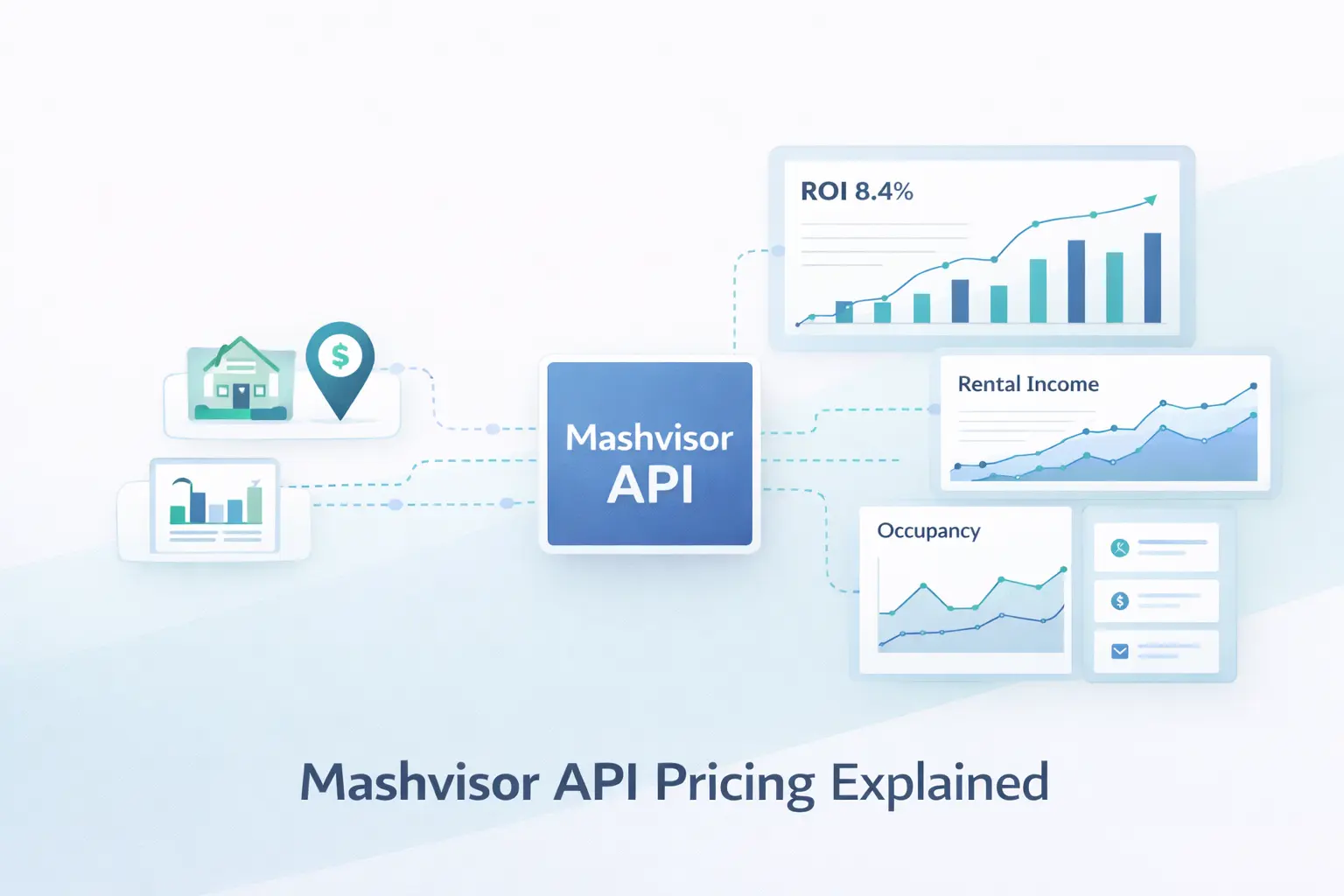
Real-World Applications of Mashvisor API Pricing
The pricing tiers of the Mashvisor API are strategically aligned with how businesses actually leverage market and property data within their production environments. This ensures that companies can scale their data access precisely in accordance with their operational workflows, whether they are analyzing individual rental properties or powering sophisticated, large-scale analytics platforms. The following examples illustrate how different organizations effectively match their API access requirements to specific business objectives:
Investment Property Analysis Applications
PropTech platforms and investor-focused tools frequently integrate the Mashvisor API to automate the process of rental property analysis. This includes calculating expected returns, such as cash-on-cash return and cap rate, and facilitating the comparison of investment opportunities across diverse markets. Instead of manually collecting and organizing data, these applications can programmatically retrieve rental estimates, crucial property metrics, and vital market insights. This workflow often involves numerous recurring queries as users explore different markets or evaluate multiple property listings. Consequently, usage-based pricing proves exceptionally effective for investment property analytics, allowing costs to scale directly with user engagement and analytical depth.
A sample API request for property data might look like this:
GET /property?address=Miami&state=FL
Authorization: Bearer API_KEY
Short-Term Rental Revenue Modeling
Short-term rental (STR) platforms and specialized analytics teams utilize the Mashvisor Airbnb data API to build sophisticated models for forecasting STR performance. This includes projecting revenue potential, analyzing market demand, and understanding supply trends. Access to historical performance data is critical for these applications, enabling them to accurately estimate key metrics like Airbnb occupancy rates and average daily rates (ADR) across various locations. Since this type of analysis is often automated across a large number of properties, the usage of the Airbnb API naturally scales with business growth. Mashvisor’s pricing model directly reflects this reality, ensuring cost-effectiveness as STR businesses expand their portfolios and analytical capabilities.
A typical API request for historical Airbnb performance data could be:
GET /airbnb/historical-performance?city=Austin
DSCR and Lending Underwriting Automation
Financial institutions and FinTech platforms integrate real estate data APIs to streamline their underwriting processes and automate Debt Service Coverage Ratio (DSCR) calculations. By programmatically retrieving estimated rental income and comparable property data, these teams can significantly reduce manual analysis efforts, leading to more standardized investment evaluations and more efficient underwriting of real estate. For lenders focused on investment properties, API usage tends to increase proportionally with loan volume. Therefore, scalable property data API pricing models are highly beneficial for underwriting automation, ensuring that costs remain manageable as lending operations expand.
A sample API request for fetching rental estimates for underwriting purposes might be:
GET /rental-estimates?property_id=12345&strategy=traditional
Authorization: Bearer YOUR_API_KEY
Accept: application/json
The rent estimate obtained from this request can then be used to compute Net Operating Income (NOI) and run a DSCR check within the underwriting model.
Rental Comps Analysis and Market Benchmarking
Real estate investors and analytical PropTech firms rely heavily on comparable real estate and rental data to accurately assess property values and validate their investment assumptions. The Mashvisor API empowers these applications to programmatically retrieve comparable property performance data and neighborhood-level benchmarks. This capability helps users determine whether their projected returns align with prevailing local market conditions. Rental comps analysis and broader market benchmarking are typically iterative processes, often conducted across numerous properties and markets. Usage-based API pricing enables businesses to scale these intensive workflows efficiently without being obligated to fixed data packages.
A sample API request to retrieve rental comps data could be:
GET /rental-comps?property_id=12345
Real Estate Marketplaces and Data Platforms
Property marketplaces and data aggregation platforms leverage the Mashvisor API to enrich their listings with valuable investment insights, comprehensive neighborhood analytics, and precise rent projections. These integrations necessitate continuous background queries to ensure data is dynamically updated as users navigate through property listings. For such businesses, API usage typically grows in tandem with platform adoption, supporting long-term expansion without requiring drastic pricing restructures.
A sample API request to enrich a property listing with investment metrics might be:
GET /property/analysis?address=Miami&state=FL&strategy=airbnb
Authorization: Bearer YOUR_API_KEY
Accept: application/json
This request retrieves detailed investment analytics for a specific property, enabling platforms to enhance their listings with critical metrics such as estimated rental income, occupancy rates, and projected Return on Investment (ROI).
While these examples represent some of the most common applications, the Mashvisor API supports a significantly broader array of use cases. Teams are integrating the API into market research tools, automated investment screening systems, portfolio monitoring dashboards, and bespoke real estate analytics solutions, thereby adapting data access to their unique operational and product development needs.
Comparative Analysis: Mashvisor API Pricing vs. Competitors
When evaluating real estate data API pricing, understanding how Mashvisor’s model stacks up against other prominent providers is essential. Platforms like Zillow and AirDNA offer valuable datasets, but their pricing and access structures are often tailored to different primary functions. Zillow’s API primarily focuses on property lookup and listing data, while AirDNA specializes in short-term rental analytics. Mashvisor, in contrast, aims to consolidate property records, rental analytics, comps data, and performance trends into a single, unified API. This integrated approach influences not only the available datasets but also how businesses scale their data usage and manage costs over time.
The following table provides a comparative overview of the investment property API pricing models offered by these key providers:
| Feature | Mashvisor | Zillow | AirDNA |
|---|---|---|---|
| Best For | Investment platforms, Property search, analytics tools & listing apps | Property search & listing apps | STR operators & market research |
| Primary Focus | Property listings, home values, STR & LTR analytics, comps, investment metrics | Property listings & home values | Short-term rental analytics |
| Pricing Model | Credit-based usage model | Access-restricted or partnership-based | Subscription-based market access |
| Scalability | High – scales with usage | Limited for analytics workflows | Moderate – tied to market scope |
Mashvisor’s API is utilized by PropTech startups, STR operators, and real estate analytics platforms for production environments. Unlike the Zillow API and the AirDNA API, the Mashvisor API integrates both property- and market-level data and analytics for both short-term and long-term rentals. This comprehensive approach facilitates efficient rental analysis for investors and platforms employing diverse strategies. Furthermore, Mashvisor distinguishes itself with a flexible and transparent cost structure that is solely dependent on usage.
Estimating Your Mashvisor API Costs
Given Mashvisor’s usage-based pricing for API access, estimating the total API cost begins with a clear definition of how the data will be utilized within your workflow or application. Users can bypass the need to select a plan based on features, as all four standard plans provide access to all endpoints and documentation. The following steps offer a straightforward framework for estimating potential Mashvisor API costs prior to requesting access:
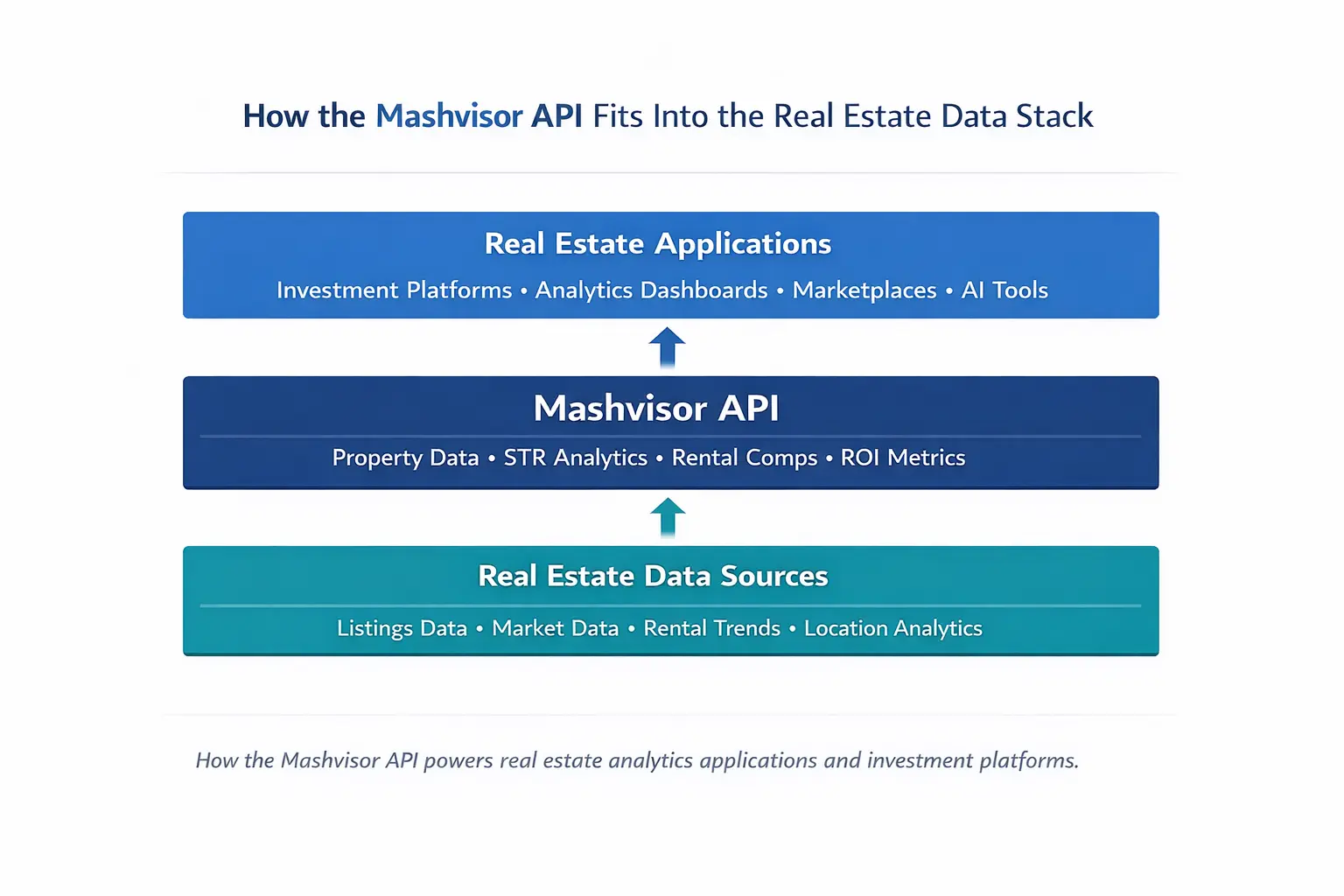
Step 1: Define Your Data Use Case
The initial step involves identifying precisely how the API will support your business operations. Internal research tools, investment analysis workflows, and customer-facing analytics platforms all generate distinct levels of API activity.
- Internal Tools: If the API is used for internal research and analysis, estimate the number of analysts and the frequency of their data queries.
- Automated Workflows: For automated processes like batch analysis or data enrichment, determine the volume of transactions or properties processed per day or month.
- Customer-Facing Applications: If the API powers user-facing features, project the number of active users and their average interaction frequency with data-driven components.
Clearly defining the use case establishes a realistic baseline for expected usage and, consequently, the associated costs.
Step 2: Estimate Monthly API Requests
The next crucial step is to approximate how frequently your application will interact with the API. Each request—whether it’s for retrieving property analytics, rental comps, or historical performance data—contributes to your monthly allocation. A simple estimation formula can be applied:
Estimated Monthly API Calls = (Number of Users or Automated Jobs) x (Average Requests per Session) x (Sessions per Month)
Even preliminary projections can provide a strong indication of whether a Starter, Professional, Growth, or Enterprise plan is the most appropriate choice for your specific situation.
Step 3: Match Data Needs with a Pricing Tier
Once your estimated usage is calculated, you can align your projected request volume with the available Mashvisor API pricing tiers. Because all plans offer complete endpoint access, the decision primarily revolves around the scale of usage rather than functional differences. Many businesses opt to begin with a tier that comfortably supports their current workloads, while also incorporating some buffer for future growth as adoption increases or automation capabilities expand.
Step 4: Request a Custom Pricing Recommendation
After estimating your usage, the final and most impactful step is to request a personalized pricing consultation. Mashvisor provides customized recommendations tailored to each user’s integration goals, anticipated data volume, and long-term scaling strategies. Specific pricing details are communicated during a demo session to ensure that businesses select a plan that aligns with their actual operational requirements, rather than relying on generic assumptions.
To receive personalized assistance and a custom quote, booking a free demo is the recommended course of action.
Who Mashvisor API is Best For (and Who It’s Not)
- Ideal For: PropTech startups, individual real estate investors, small to medium-sized real estate firms, data analytics teams, SaaS providers in the real estate sector, and lenders seeking to automate underwriting processes.
- Potentially Less Ideal For: Businesses with extremely minimal data needs that could be met by free public data sources, or organizations with highly specialized data requirements not covered by Mashvisor’s extensive dataset.
For those uncertain about which tier best fits their use case, booking a brief call with a Mashvisor expert can provide clarity. These consultations are designed to map specific workflows to the most suitable plan, without any pressure or upselling.
Conclusion: Scalable Data Solutions for a Dynamic Market
In the rapidly evolving landscape of real estate technology and investment analysis, understanding API costs is not merely a budgetary consideration but a critical component of strategic planning. Mashvisor’s API pricing structure departs from rigid licensing models, embracing flexibility to empower companies to align their data access with actual usage patterns and operational growth. With tiered plans based on monthly API calls, universal access to all endpoints across every tier, and customizable packages for high-volume requirements, the Mashvisor API effectively supports a diverse spectrum of applications. These range from essential investor tools and sophisticated underwriting systems to comprehensive analytics platforms and seamless marketplace integrations. For organizations prioritizing a scalable and predictable real estate data infrastructure, this usage-based approach offers both financial foresight and ample room for expansion as data requirements inevitably evolve.
For those wishing to test the practical application of the Mashvisor API before committing to a paid plan, a one-week free trial offering 30 credits is available, providing a risk-free opportunity to explore its capabilities.
Frequently Asked Questions (FAQs)
How Much Does Mashvisor API Cost?
Mashvisor API plan costs begin at approximately $129 per month, with pricing entirely contingent on monthly API usage. The precise cost is variable and depends on the volume of requests and specific integration needs. Businesses typically receive tailored pricing recommendations during a demo session to ensure the selected plan precisely matches their workflow and data requirements.
Is Mashvisor API Pricing Pay-per-Request?
Mashvisor employs a credit-based pricing model rather than a strict pay-per-request billing system. Each plan includes a predetermined monthly allocation of API calls, which allows teams to scale their usage predictably and avoid the potentially unpredictable per-call costs associated with some real estate data API pricing models.
Does Mashvisor Offer Enterprise API Pricing?
Yes, in addition to its standard tiered plans, Mashvisor offers Enterprise solutions specifically designed for high-volume platforms and advanced analytics applications. Custom packages can also be developed for organizations with unique use cases, extensive datasets, or request volumes that exceed standard monthly allocations.
What Is Included in the Mashvisor API Access?
All Mashvisor API plans grant access to the complete API documentation and all available endpoints. This comprehensive access covers property analytics, rental comps, detailed investment metrics, and historical performance data, all crucial for underwriting, DSCR analysis, and short-term rental revenue modeling workflows.
Is the Mashvisor API Worth the Cost?
For businesses that depend on automated investment analysis or require scalable real estate analytics capabilities, the Mashvisor API can deliver substantial efficiency gains compared to manual data collection or the integration of multiple disparate data providers. Its usage-based structure enables companies to start with a modest investment and expand their data access as their products or analytical needs mature.

