
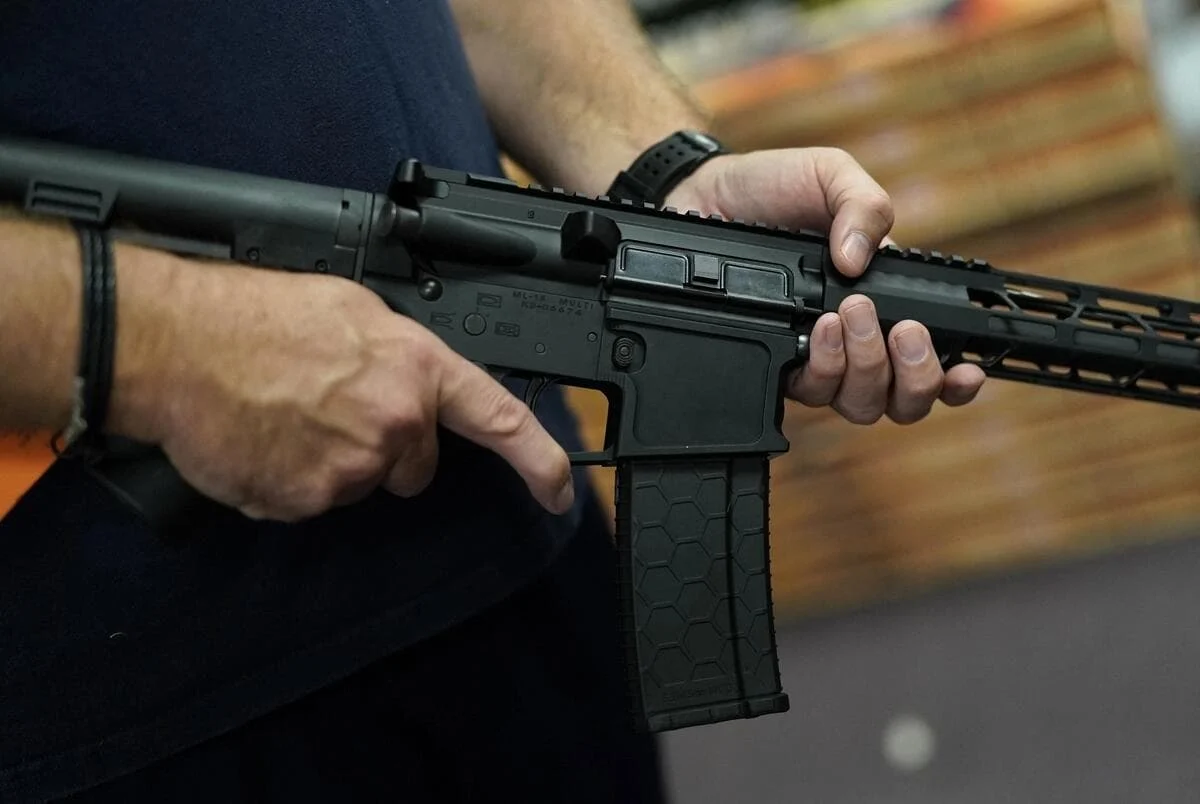
The federal government has formally intervened in a pivotal Second Amendment case, filing a brief with the U.S. Supreme Court that urges justices to rule in favor of gun owners challenging state and local prohibitions on AR-15-style rifles. This move signals a significant alignment between the Justice Department and gun rights advocates, potentially setting the stage for a landmark decision that could reshape firearm regulations nationwide. The Solicitor General, D. John Sauer, representing the Biden administration, submitted the amicus curiae brief on Friday, specifically asking the high court to reverse previous rulings by the U.S. Courts of Appeals for the Second and Seventh Circuits. These lower court decisions had upheld bans on "assault weapons" in Connecticut and Cook County, Illinois, respectively, triggering the current appeal to the nation’s highest judicial body.
At the heart of the federal government’s argument is the assertion that the AR-15 rifle is "unquestionably in common use among law-abiding citizens for lawful purposes." This statement directly addresses a central legal test derived from the Supreme Court’s own Second Amendment jurisprudence, which holds that weapons "in common use" for lawful purposes are generally protected. The consolidated cases, Viramontes v. Cook County and Grant v. Higgins, now present the Supreme Court with an opportunity to clarify the scope of this protection in an era of intense debate over firearm availability and public safety.
Contextualizing the Federal Government’s Stance
The decision by the Justice Department, under the Biden administration, to side with gun owners in this challenge has drawn considerable attention, as it marks a departure from typical progressive stances on gun control. While President Biden has consistently advocated for stricter gun laws, including a federal ban on "assault weapons," the Solicitor General’s brief operates within the framework of existing Supreme Court precedent. The role of the Solicitor General is to represent the legal position of the U.S. government before the Supreme Court, often navigating complex constitutional questions independently of direct political directives. In this instance, the brief interprets the Second Amendment in light of the Court’s recent pronouncements, particularly District of Columbia v. Heller (2008) and New York State Rifle & Pistol Association Inc. v. Bruen (2022). These cases affirmed an individual’s right to keep and bear arms for self-defense and established a historical and textual approach to Second Amendment challenges, respectively.
The federal government’s brief acknowledges the deeply divisive nature of the issue but emphasizes adherence to the established legal framework. It argues that regardless of policy preferences, the current legal standard requires a recognition of AR-15s as commonly used firearms. This position underscores the challenging tightrope walk the Justice Department must undertake when interpreting constitutional rights, even when those interpretations may conflict with the broader policy goals of the executive branch.
The Core Legal Battle: "Common Use" and the Second Amendment
The central legal question revolves around the interpretation of the Second Amendment’s protection for arms "in common use." This concept first emerged in United States v. Miller (1939), where the Court upheld a federal ban on short-barreled shotguns, reasoning that such weapons were not part of the ordinary military equipment or "in common use" for lawful purposes. Decades later, Heller (2008) explicitly reaffirmed the "common use" test when it invalidated Washington D.C.’s ban on handguns, declaring them "the most popular weapon chosen by Americans for self-defense in the home." This landmark ruling established that the Second Amendment protects an individual’s right to possess firearms for traditionally lawful purposes, especially self-defense in the home.
The Bruen decision in 2022 further solidified this framework, striking down a New York law that required individuals to demonstrate a "special need" to carry a handgun in public. Bruen mandated that any gun control regulation must be consistent with the nation’s historical tradition of firearm regulation, effectively making it harder for states to justify restrictions. The federal government’s brief in the AR-15 cases explicitly leverages these precedents, arguing that the AR-15, by virtue of its widespread ownership and lawful application, easily meets the "common use" threshold established by the Supreme Court.
A Chronology of Key Legal Precedents and Bans
Understanding the current legal landscape requires a look at the historical progression of both firearm technology and legal interpretations:
- 1939: United States v. Miller: This case, involving a challenge to the National Firearms Act of 1934, introduced the concept of weapons "in common use" as a factor in Second Amendment analysis.
- 1956: The AR-15 rifle is developed by ArmaLite. Its semi-automatic design, light weight, and modularity would contribute to its future popularity.
- 1993: Connecticut enacts its initial "assault weapons" ban, restricting the sale and possession of certain semi-automatic firearms based on cosmetic features and military-style characteristics.
- 1994-2004: The federal Assault Weapons Ban is enacted, prohibiting the manufacture and sale of certain semi-automatic firearms for civilian use for a decade. Significantly, it did not ban possession of firearms manufactured before its enactment. Its expiration in 2004 led to a surge in the availability and popularity of AR-15 style rifles.
- 2006: Cook County, Illinois, which encompasses Chicago, adopts its current firearm ordinance, prohibiting the possession, sale, and transfer of a list of semi-automatic weapons.
- 2008: District of Columbia v. Heller: A landmark ruling affirming an individual’s Second Amendment right to possess firearms for self-defense, explicitly recognizing handguns as "in common use" and thus protected.
- 2012: Following the tragic Sandy Hook Elementary School shooting in Newtown, Connecticut, where an AR-15 style rifle was used, Connecticut significantly expands its "assault weapons" ban, reinforcing prohibitions and adding more firearms to the restricted list.
- 2022: New York State Rifle & Pistol Association Inc. v. Bruen: This decision further clarified Second Amendment jurisprudence, establishing a historical test for gun laws and rejecting "means-end" scrutiny often used to uphold regulations.
- Current Appeal (2023-2024): The cases Viramontes v. Cook County and Grant v. Higgins challenge the constitutionality of the bans in Cook County and Connecticut, respectively, under the Heller and Bruen precedents.
- October 21, 202X: Respondents’ (Connecticut and Cook County) briefs are due to the Supreme Court.
- December 2, 202X: The Supreme Court is scheduled to hear oral arguments in the consolidated cases.
- Late June 2027: A ruling is expected before the conclusion of the Court’s term.
Arguments from Both Sides: Proponents and Challengers
The legal filings reveal a stark contrast in how both sides interpret the "common use" test and the nature of AR-15 style rifles.
Arguments for the Bans (Connecticut and Cook County):
State and county lawyers contend that AR-15 style rifles do not meet the Supreme Court’s legal standard for protected arms. They argue that these weapons are fundamentally different from traditional firearms like handguns, which are commonly used for self-defense. Connecticut’s legal team has previously argued that "Americans do not commonly own assault weapons for self-defense," further claiming that these weapons are "neither used nor useful for that purpose." They often highlight the military lineage of the AR-15 platform, its high rate of fire, and its demonstrated capacity for mass casualties in various tragic incidents. From this perspective, the bans are a necessary public safety measure aimed at preventing mass violence, a compelling government interest that should justify the restrictions.
Arguments Against the Bans (Gun Owners/Challengers):
Conversely, gun owners challenging the bans assert that AR-15s unequivocally pass the "common use" test. Their petitions to the Supreme Court emphasize the rifle’s immense popularity, stating, "If the most popular rifle in the country is not in common use, it is hard to see what that phrase could possibly mean." They point to the widespread ownership for various lawful purposes, including self-defense, target shooting, competitive shooting, and hunting. For these challengers, the bans represent an infringement on a fundamental constitutional right, singling out a specific class of firearm based on cosmetic features or perceived danger rather than actual functional differences from other protected semi-automatic firearms.

The Department of Justice’s Detailed Rebuttal
The Justice Department’s brief sides firmly with the challengers, offering a comprehensive legal argument against the bans. It emphasizes the current legal status of AR-15s, noting that "Today, AR-15s are lawful at the federal level and in 40 States, with law-abiding citizens using them for lawful purposes such as self-defense, target shooting, and hunting." The brief concludes that "Legislatures may not ban arms in common use among law-abiding citizens for lawful purposes."
Solicitor General Sauer systematically dismantles arguments typically used to justify "assault weapon" bans:
- Military Origin and Firepower: The brief rejects the notion that AR-15s can be banned solely due to their military origins or perceived firepower. It contends that "When it comes to lethal arms, rifles such as AR-15s are not ‘especially dangerous.’" The government points out that handguns, which the Supreme Court has already ruled cannot be broadly banned, are far more frequently used in crimes due to their concealability and ease of transport. This comparison highlights what the government views as an inconsistency in banning rifles while protecting handguns, especially when considering actual criminal usage data.
- Availability of Alternatives: The government also refutes the argument that AR-15 bans are acceptable because people can still use handguns for self-defense. Sauer employs an analogy previously used by Justice Brett Kavanaugh as an appeals court judge: "like saying books can be banned because people can always read newspapers." This comparison underscores the principle that the availability of one protected right does not justify the infringement upon another, distinct manifestation of that same right.
- Defining "Common Use": The Justice Department further proposes a nuanced approach for courts to determine whether a weapon is "in common use" beyond simply counting ownership numbers. It suggests that a long-standing ban adopted by Congress and most states could indicate that a weapon is not commonly and lawfully possessed. Conversely, a firearm that has remained widely legal for decades would strongly favor constitutional protection. The brief argues that both historical legal treatment and current ownership figures support the AR-15’s protected status. The AR-15 has been commercially available for decades, and the 1994 federal ban was temporary and did not prohibit existing firearms, indicating a lack of a deep, historical consensus against its possession.
Statistical Context: AR-15 Ownership and Usage
The "common use" argument is bolstered by significant statistical data regarding AR-15 ownership. Industry estimates suggest that between 28 million and 32 million AR-15-style rifles are currently in circulation in the United States. This makes the AR-15 platform one of the most, if not the most, popular rifle types in the country. This widespread ownership for various lawful activities—including hunting, sport shooting, home defense, and competitive marksmanship—forms a crucial pillar of the challengers’ and the federal government’s legal positions.
Furthermore, statistics from the FBI’s Uniform Crime Reporting (UCR) Program consistently show that rifles of all types, including AR-15s, are used in a significantly smaller percentage of homicides compared to handguns. While rifles are tragically present in high-profile mass shootings, the overall data indicates that handguns are overwhelmingly the weapon of choice in violent crime. For instance, in 2021, handguns were used in 59.8% of murders where a firearm type was specified, while rifles were used in only 3.2% of such cases. This statistical reality is central to the government’s argument that AR-15s are not "especially dangerous" in the context of overall crime, and their broad prohibition is therefore disproportionate and legally unsound under the Second Amendment.
Potential Ramifications and Future Outlook
A Supreme Court decision siding with the federal government and gun owners would have profound implications. It could effectively invalidate existing "assault weapon" bans in states like Connecticut, Illinois, California, New York, Massachusetts, and others, potentially affecting millions of residents and their ability to legally own these firearms. Such a ruling would also set a strong precedent, making it extremely difficult for other states or municipalities to enact similar bans in the future. It would further solidify the Bruen decision’s emphasis on historical tradition, placing a higher burden on governments to justify any firearm regulations by demonstrating their consistency with historical practices.
Conversely, a ruling upholding the bans would signify a limit to the "common use" test, potentially allowing for the prohibition of certain popular firearms if a state can demonstrate a compelling public safety interest and argue that these weapons fall outside the scope of traditional Second Amendment protection. However, given the current composition of the Supreme Court and the direction of its recent Second Amendment jurisprudence, such an outcome appears less likely if the Court adheres strictly to its established principles.
The case also holds significant political implications. Regardless of the outcome, the ruling will undoubtedly intensify the national debate over gun control, further entrenching positions on both sides. Gun rights organizations will likely view a victory as a vindication of their constitutional interpretations and a major setback for gun control advocates. Conversely, a loss would fuel renewed calls for legislative action at the federal level to bypass judicial limitations.
Reactions and Broader Political Landscape
While official reactions from all parties will undoubtedly emerge closer to the oral arguments and the final ruling, the federal government’s brief has already sent ripples through the legal and political communities. Gun rights groups have largely lauded the Justice Department’s stance, seeing it as a proper interpretation of constitutional law and a recognition of the widespread, lawful ownership of AR-15s. Organizations like the National Rifle Association and Gun Owners of America have long championed the "common use" argument, viewing bans on these rifles as a direct infringement on Second Amendment rights.
On the other side, gun control advocacy groups have expressed disappointment and concern. They argue that the federal government’s position undermines efforts to reduce gun violence and ignores the devastating impact of AR-15s in mass shootings. Organizations such as Everytown for Gun Safety and Brady United Against Gun Violence will likely emphasize the need for robust gun safety laws and challenge the notion that AR-15s are merely ordinary tools for self-defense, given their capacity for rapid, high-casualty attacks. These groups will continue to advocate for a broader interpretation of government’s ability to regulate firearms for public safety.
Judicial Path Forward
With the respondents’ briefs due by October 21 and oral arguments scheduled for December 2, the stage is set for a high-stakes legal showdown. The Supreme Court’s decision, expected by late June 2027, will not only resolve the immediate fate of AR-15 bans in Connecticut and Cook County but will also provide crucial clarity on the parameters of the Second Amendment in the 21st century. The Court’s ruling will inevitably influence future legislative efforts and judicial challenges concerning firearm regulations across the United States, further shaping the ongoing national dialogue about guns, rights, and public safety.

