
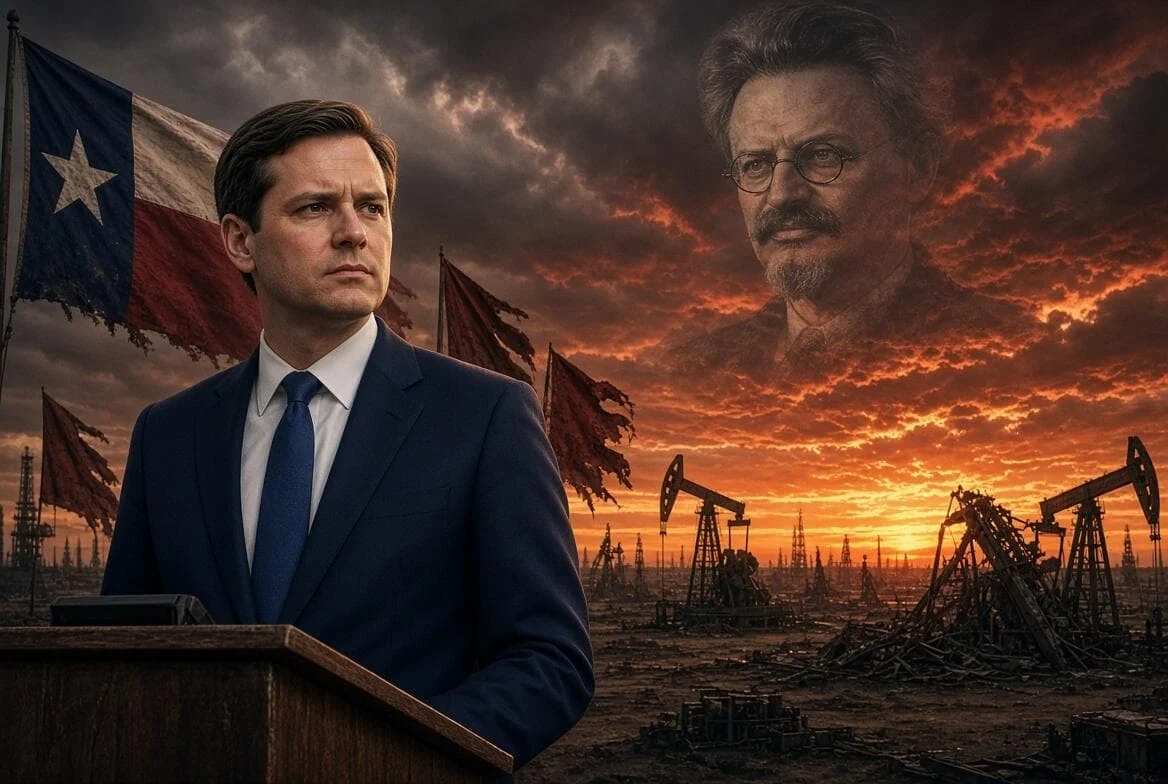
Texas Senate Democrat nominee James Talarico has ignited a significant political debate with recent comments declaring capitalism an "oppressive system" that is intrinsically linked with white supremacy and must be "dismantled" to achieve a more equitable world. The statements, captured in a video from a climate forum, have drawn comparisons to the rhetoric of historical Marxist figures like Leon Trotsky and reflect a growing ideological current within segments of the progressive movement. These remarks, initially highlighted by legal scholar Jonathan Turley, underscore a broader conversation about the foundational economic and political structures of the United States.
Talarico’s Provocative Stance on Capitalism and Systemic Oppression
The core of the controversy stems from Talarico’s address at a 2020 climate conference organized by the Austin chapter of the Sierra Club. While then a state representative, Talarico engaged the audience with an assertive critique of the prevailing economic system. "I’m so thankful that you asked this question and also thankful that young activists have really drawn the link between climate change and White supremacy and capitalism in our country," Talarico stated, adding, "And I think only ending the ways that all three of those oppressive systems work together are we gonna be able to begin the process of dismantling them." This articulation suggests a holistic view of systemic oppression, positing that capitalism, racial injustice, and environmental degradation are not merely interconnected but mutually reinforcing, requiring a radical systemic overhaul rather than incremental reforms.
The language employed by Talarico, particularly the call to "dismantle" capitalism, resonates deeply with socialist and communist historical discourse. Jonathan Turley, in his analysis, draws a direct parallel to Leon Trotsky, a key figure in the Russian Revolution, who vehemently denounced the "fundamental evil of the capitalist system" and advocated for its abolition to liberate citizens from its perceived oppression. This historical comparison frames Talarico’s comments within a lineage of revolutionary thought that seeks fundamental societal transformation.
Echoes of Radical Ideologies: Trotsky and Democratic Socialism
The historical parallel to Leon Trotsky is not merely rhetorical. Trotsky, a principal architect of the Bolshevik revolution alongside Vladimir Lenin, was a staunch critic of capitalism, viewing it as inherently exploitative and leading to imperialist wars and class conflict. His theories, particularly those on permanent revolution, advocated for the global overthrow of capitalist systems by the working class. While Talarico’s remarks do not explicitly endorse a global proletarian revolution, the shared terminology of "dismantling" an "oppressive system" evokes a similar revolutionary spirit aimed at fundamental societal restructuring.
Beyond historical figures, Talarico’s rhetoric aligns closely with the contemporary platforms of organizations like the Democratic Socialists of America (DSA). The DSA has explicitly challenged its members and the public to "Imagine the end of capitalism," outlining a vision for a post-capitalist society free from landlords, personal debt, and mandatory work hours. Their manifesto envisions essential goods and services such as food, education, energy, medicine, and transportation as "common goods and utilities," universally accessible rather than subject to market forces. The DSA’s ecosocialist wing further articulates this objective, declaring a need for "a revolutionary transformation to replace the capitalist social order based on exploitation and oppression." This ideological congruence suggests that Talarico’s statements are not isolated remarks but rather reflect a growing, organized current within the American left.
Specific Criticisms of Texas Industries and Economic Vision
Talarico’s critique extended beyond abstract economic theory to directly target Texas’s prominent oil and gas industry. He characterized the industry as a dying sector, likening its future prospects to "being the leader in cassette tapes in the 1980s." With evident satisfaction, he predicted, "That industry is not gonna last." Such statements are particularly contentious in Texas, where the energy sector is a cornerstone of the state’s economy, providing hundreds of thousands of jobs and substantial tax revenue. The implications of actively seeking to dismantle this industry, or indeed the broader capitalist system it operates within, represent a significant departure from mainstream Texas politics.
Further compounding the perceived economic radicalism, Talarico has also promised to run a "meatless, Vegan campaign," indicating a broader skepticism towards conventional agricultural practices and consumer markets. While seemingly a lifestyle choice, this stance, combined with his opposition to the energy sector, has led critics to suggest that his policies could inadvertently lead to a de facto "dismantling" of key components of the Texas economy. The state leads the nation in oil and natural gas production, and its cattle industry is also among the largest, making these specific criticisms particularly pointed and potentially impactful on his electoral viability in a state traditionally protective of its industrial and agricultural bases.
Broader Political and Academic Trends Challenging Established Systems
Talarico is not alone in voicing strong critiques of capitalism and core American institutions. California Governor Gavin Newsom, for example, recently garnered attention for declaring that "nostalgia is not working" and that "capitalism as we know it doesn’t work either." These remarks from a prominent Democratic governor signal a willingness within established political circles to openly question the efficacy and fairness of the current economic paradigm.

Similarly, other progressive candidates and elected officials have echoed calls for significant economic restructuring. In New York, Zohran Mamdani campaigned on a platform promising the "warmth of collectivism," advocating for policies such as free childcare, free public transportation, and state-run grocery stores. Allies of Mamdani across the country have pushed for the "de-commodification of private property" and, in some instances, the "seizing of the means of production," concepts historically associated with Marxist-Leninist ideologies.
Beyond economics, there’s a parallel ideological movement challenging fundamental constitutional structures. Legal scholars Ryan D. Doerfler of Harvard and Samuel Moyn of Yale published a New York Times column titled "The Constitution Is Broken and Should Not Be Reclaimed," advocating for citizens to "reclaim America from constitutionalism." Jonathan Turley, in his book "Rage and the Republic," extensively discusses this "crisis of faith" in core institutions, noting how figures from former Vice President Kamala Harris to Governor Newsom have dismissed adherence to these institutions as mere "nostalgia." Critics of these established systems are increasingly labeling those who defend them as "institutionalists" or constitutional "cultists," framing traditionalists as obstacles to necessary societal progress.
The 250th Anniversary: A Divergent Path from Founding Principles
The timing of these debates is particularly poignant as the United States approaches the 250th anniversary of its founding. This period marks not only the Declaration of Independence but also the publication of Adam Smith’s "Wealth of Nations," a seminal work that laid the intellectual groundwork for free-market capitalism. The American founders, embracing Enlightenment ideals of natural rights and individual liberty, quickly adopted Smith’s economic theories as a complementary framework to their political philosophy. They believed that economic freedom was essential for individuals to transcend class barriers, pursue prosperity, and fully exercise their natural rights.
This synthesis of political and economic theories, based on a belief in rights derived from a higher authority rather than government, created what has historically been considered the most prosperous and stable democratic system in the world. However, as Turley observes, this foundational system is now under attack from both sides. While some radicals call for a complete overhaul of the U.S. Constitution and its core values, others advocate for a fundamental reordering of the economic system, moving away from the principles that have underpinned American growth and individual opportunity for centuries.
Demographic Divides and Rhetorical Strategies
Interestingly, polling data suggests that the momentum for these radical candidates is not primarily driven by the traditional working class, but rather by younger, college-educated voters. These demographics, often described as emerging from "ideological echo chambers" within higher education, are perceived by critics as "armchair revolutionaries" who readily adopt socialist slogans. Talarico, in this context, is seen as embodying this trend, articulating highly ideological positions with a "robotic rote delivery" reminiscent of Soviet-era "Young Pioneer camps."
A common tactic observed among politicians with past radical statements, including Talarico, is to dismiss or deny them when confronted. Alexandria Ocasio-Cortez, for example, reportedly referred to some of her earlier extremist statements as "Woke 1," suggesting a past, less refined ideological phase. Critics argue that this "transparent insincerity" is tolerated by their base, who view these past statements as authentic declarations of commitment to a cause. From this perspective, any subsequent softening or denial is seen as mere "packaging for uneducated and malleable dupes," a strategic maneuver rather than a genuine shift in conviction.
Jonathan Turley concludes his analysis by referencing Trotsky’s infamous justification that "The end may justify the means as long as there is something that justifies the end." For these radical candidates, Turley posits, there is "no greater justification than their own election." This perspective suggests that the pursuit of political power can supersede fidelity to past statements or even objective truth, particularly when the ultimate goal is a perceived societal transformation.
Implications for Texas and National Politics
The emergence of a Senate Democrat nominee in Texas openly advocating for the dismantling of capitalism carries significant implications. In a state where the Republican Party has dominated for decades, and where the oil, gas, and agricultural industries are deeply embedded in the state’s identity and economy, such rhetoric could prove challenging in a general election. While Talarico’s statements may energize a progressive base, they risk alienating moderate voters and independent crucial for statewide success.
Nationally, Talarico’s comments contribute to an ongoing debate within the Democratic Party about its ideological direction. While some factions embrace increasingly progressive and even socialist ideals, others advocate for a more centrist approach, wary of alienating mainstream voters. The outcome of Talarico’s campaign, and how his anti-capitalist stance is perceived by the broader electorate, could serve as a bellwether for the future trajectory of the Democratic Party and the evolving landscape of American political discourse. The foundational principles of American democracy and its economic system are clearly under a level of scrutiny and challenge not seen in generations, setting the stage for profound ideological clashes in the years to come.

