

The U.S. stock market has witnessed an extraordinary surge in recent years, prompting both celebration among investors and considerable debate regarding the sustainability of current valuations. The benchmark S&P 500 index, a critical gauge for the retirement savings of millions, has climbed by approximately 57 percent over the past two years, doubling its value in just five years. This robust performance has profoundly impacted personal wealth, with many nearing or exceeding their retirement goals far sooner than anticipated, while others already retired find themselves with significantly enhanced portfolios, occasionally leading to consideration of more lavish expenditures.
This period of rapid appreciation naturally raises a fundamental question for investors: Is this growth a reflection of genuine economic strength and innovation, or does it represent an overinflated bubble poised for correction? A recent inquiry from an investor encapsulated this concern: "The market seems to be in a huge bubble right now due to all sorts of hype around Artificial Intelligence. Does this make it more vulnerable to a huge crash in the future, and will it affect my retirement?" Addressing this query requires a comprehensive examination of current market dynamics, historical valuation metrics, and the transformative potential of Artificial Intelligence.

Understanding Stock Valuation: The Price-to-Earnings Metric
To properly assess the market’s current state, it is crucial to revisit the foundational principle of stock valuation. A stock represents a fractional ownership in a business, entitling the owner to a share of its future profits. This concept is analogous to owning a rental property: an investor purchases a house to collect rent. After covering expenses, the remaining income constitutes profit. The attractiveness of this investment is primarily driven by the steady stream of income it generates.
If the market price of rental properties in an area rises dramatically, but the rental income remains stagnant, the property may appear more valuable on paper. However, this paper gain only materializes upon sale, and even then, reinvesting in another property would likely incur the same elevated price. True value enhancement comes from increasing the property’s profitability—perhaps through renovations, adding amenities, or streamlining operational costs. When such a property is sold, its price should logically be tied to its future income stream. For instance, a property generating $24,000 annually might reasonably sell for $240,000, yielding a price-to-earnings (P/E) ratio of 10 ($240,000 / $24,000). If, however, an investor pays $480,000 for the same income, the P/E ratio climbs to 20, indicating a less favorable return on investment for the buyer.
Applying this principle to the stock market reveals a similar trend. An investment of $100,000 in the S&P 500 in 2019, with dividends reinvested, would now be worth an estimated $256,960—a staggering 157% gain. Yet, over the same period, the underlying corporate earnings per share for that basket of stocks grew from approximately $5,290 to $7,540, a comparatively modest 42% increase. This divergence has led to a significant expansion of the S&P 500’s P/E ratio, rising from roughly 20 in 2019 to about 30 in early 2025, according to data from analysis sites like multpl.com. This suggests that investors are currently paying a higher multiple for each dollar of earnings, implying that future returns, as a percentage of portfolio value, are likely to be lower than in periods when stocks were acquired at more favorable P/E ratios.

The Concentrated Power of the "Magnificent Seven"
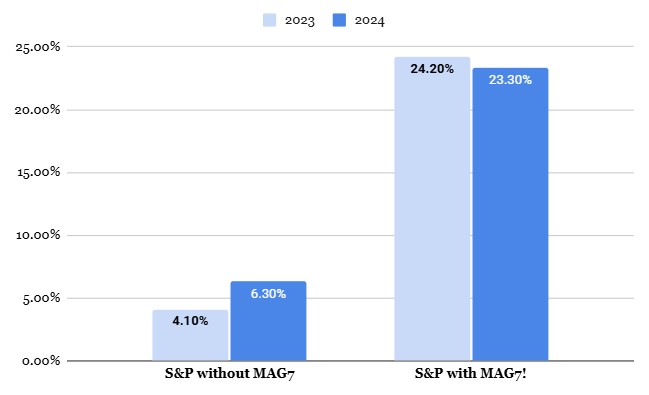
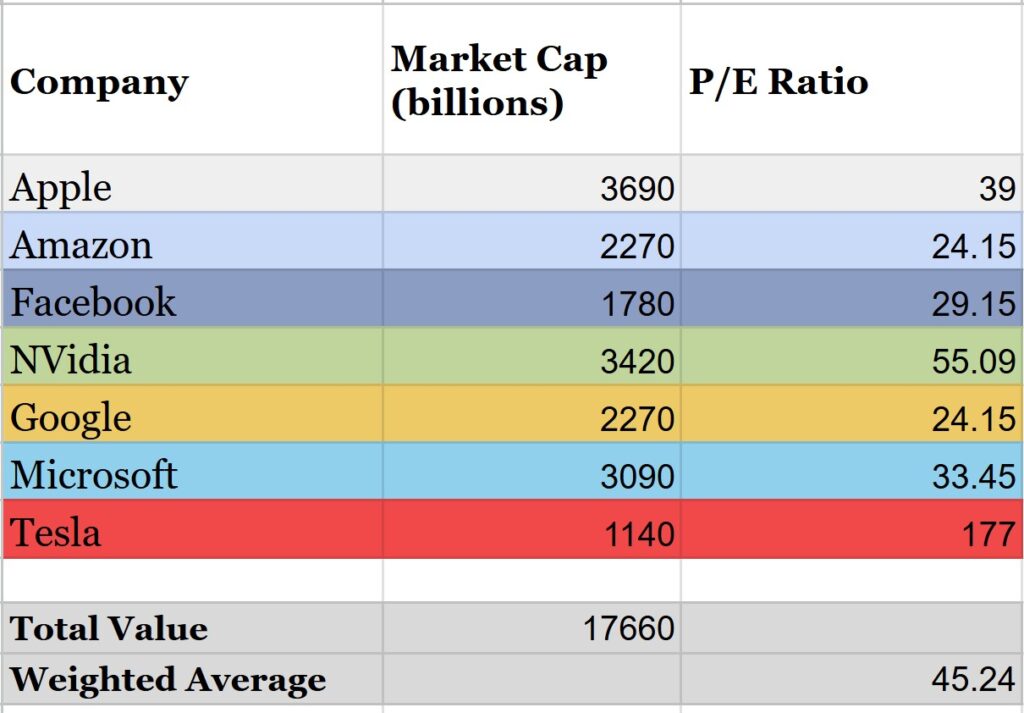
A deeper dive into the S&P 500’s performance reveals a highly concentrated source of its recent growth. Approximately three-quarters of the index’s ascent can be attributed to just seven colossal technology companies, colloquially known as the "Magnificent Seven": Apple, Nvidia, Microsoft, Amazon, Alphabet (Google), Meta Platforms (Facebook), and occasionally Tesla. These companies, characterized by their high-flying valuations and significant market influence, collectively command over 25% of the entire U.S. stock market’s value, amounting to an estimated $17.66 trillion.
The weighted average P/E ratio for these seven giants stands at approximately 45, significantly higher than the broader market average. In stark contrast, if one excludes the Magnificent Seven and considers the remaining 493 companies within the S&P 500, their collective P/E ratio drops to a more "reasonable" 20, albeit still above historical averages. This bifurcation suggests that while investors anticipate a generally healthy U.S. economy, they project exceptionally rapid and sustained growth specifically from these dominant tech players.
Artificial Intelligence: The Engine of Current Market Enthusiasm
The driving force behind the elevated valuations of the Magnificent Seven, and indeed much of the broader market’s optimism, is the palpable excitement surrounding recent breakthroughs in Artificial Intelligence. AI’s sudden capability to exhibit human-like reasoning across an expanding array of applications has ignited a frenzy within the business world, with profound implications for productivity and profitability.

Six of the Magnificent Seven companies are reportedly investing hundreds of billions of dollars in building vast data centers filled with cutting-edge supercomputers dedicated to AI development and deployment. The seventh, Nvidia, stands as a primary beneficiary of this infrastructure boom, as it manufactures the specialized graphics processing units (GPUs) essential for AI computations, allowing it to command premium prices amidst insatiable demand.
This "AI Infrastructure" phase is merely the first wave. Industries across the spectrum envision a new era of unprecedented productivity gains. AI is demonstrating capabilities ranging from analyzing complex legal documents and identifying contractual loopholes to debugging intricate software code. Beyond text and data processing, AI is integral to advancements in autonomous driving, medical diagnostics (e.g., melanoma detection from images), drug discovery (designing medications with vastly improved efficacy), and the development of humanoid robots capable of performing complex mechanical tasks. The prevailing narrative is that humanity is on the cusp of accessing an almost limitless, intelligent workforce that operates at minimal cost, effectively removing historical constraints on both intellectual and manual labor.
Navigating the Future: Opportunities and Uncertainties
While the potential of AI is undeniably transformative, the critical question for investors remains whether the projected profits of these companies will materialize at the levels currently priced into their stock valuations. The timeline for AI’s full impact is uncertain, and the path is fraught with potential challenges. These include massive cost overruns in infrastructure development, intense competition leading to margin compression, evolving regulatory landscapes, and unforeseen technological or ethical hurdles. Moreover, the long-term societal implications, such as widespread job displacement and the concentration of wealth, introduce additional layers of uncertainty that could impact economic stability and, consequently, corporate profitability. The specter of past technological bubbles, such as the dot-com era, serves as a cautionary reminder that even revolutionary technologies can experience periods of irrational exuberance followed by sharp corrections.
Macroeconomic Context and Historical Growth
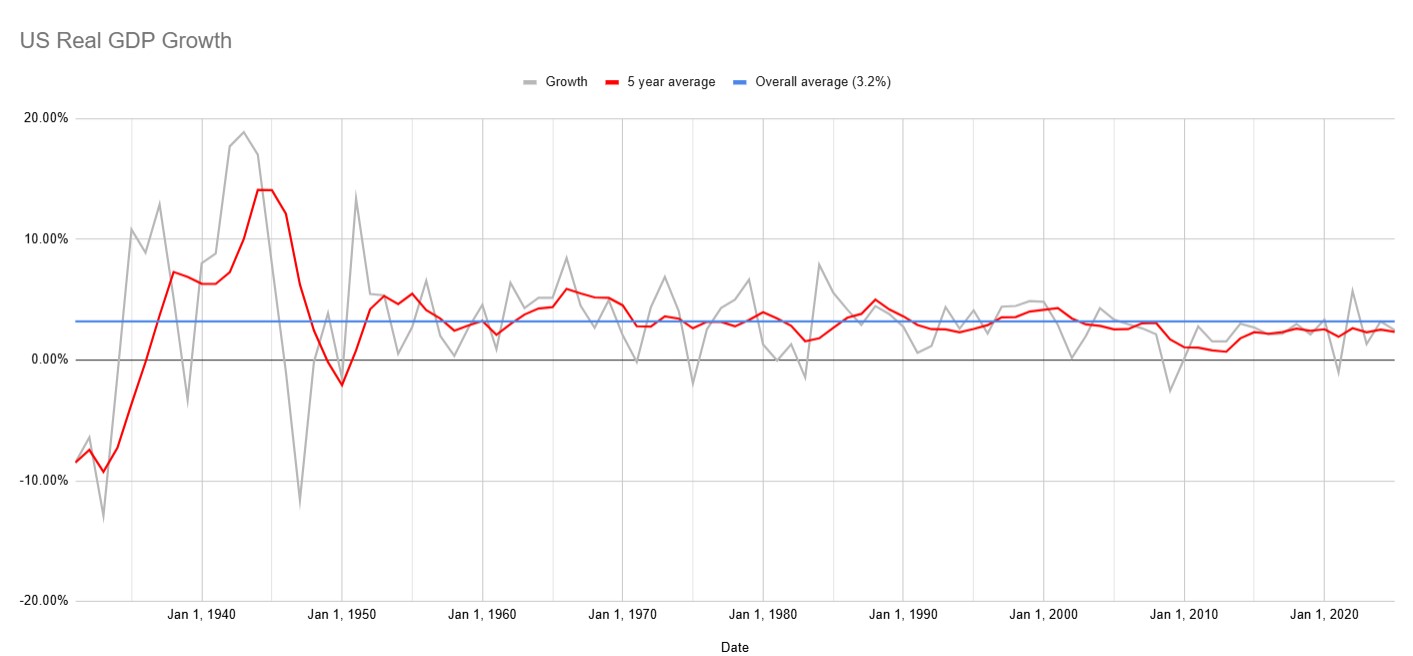
From a macroeconomic perspective, historical data offers a valuable counterpoint to current market enthusiasm. Over many decades, U.S. economic growth, as measured by real GDP, has averaged a remarkably consistent 3% after accounting for inflation. While technological advancements have continually reshaped industries, this underlying rate of economic expansion has shown surprising stability. Intriguingly, recent decades have actually seen slower than average GDP growth, which, when juxtaposed with the rapid escalation of stock market valuations, presents a disconnect that warrants careful consideration. If the broader economy is growing at a more subdued pace, the exceptional growth projected for a select few companies, and the high multiples paid for them, rely heavily on their ability to continually capture an ever-larger share of that economic pie, or to fundamentally redefine it.
Expert Perspectives on Market Outlook
Prominent financial institutions and legendary investors offer varying, yet often cautious, perspectives on the current market environment:
Vanguard’s 10-Year Projections
Vanguard, a titan in the index fund industry, annually publishes its 10-year annualized return forecasts. Their latest projections suggest that international stocks and even bonds are expected to outperform U.S. stocks over the coming decade. This outlook is largely predicated on the lower P/E ratios observed in international markets. For instance, the Vanguard Total International Stock Index Fund (VXUS) currently trades at a P/E ratio of approximately 15.9, nearly 50% lower than that of the S&P 500. While this valuation gap theoretically offers a more attractive entry point for international equities, it’s worth noting that Vanguard has made similar predictions in prior years which have yet to fully materialize, partly due to the concentrated AI boom primarily benefiting U.S.-based companies.
Warren Buffett’s Cautious Stance
Warren Buffett, the revered "Oracle of Omaha," consistently provides insights into the economic landscape. Berkshire Hathaway’s latest shareholder letter indicates a cautious approach, with the conglomerate holding a substantial $334 billion in uninvested cash. This significant cash reserve signals Buffett’s view that attractive investment opportunities offering compelling value are scarce in the current market. Even Berkshire Hathaway’s own shares, which have historically traded at a P/E ratio averaging around 21 in recent years, are not being aggressively repurchased, suggesting they are considered slightly overvalued by its management.
Diversification via Robo-Advisors
For investors seeking a more diversified approach, robo-advisors like Betterment offer portfolios that allocate funds across various asset classes beyond just U.S. stocks, including international equities and bonds. The weighted average P/E ratio for a typical diversified core portfolio offered by such platforms is approximately 22. The strategy behind such diversification is to potentially achieve slightly higher risk-adjusted returns with lower volatility over the long term, along with certain tax advantages through automated rebalancing. While a purely U.S.-centric portfolio has outperformed diversified options in recent years due to the exceptional performance of the Magnificent Seven, the long-term rationale for diversification, as suggested by Vanguard’s analysis, remains compelling.
Strategic Financial Decisions Beyond Stocks
Beyond direct stock market investments, other financial strategies warrant consideration in the current environment:

Mortgage Repayment
For homeowners carrying a mortgage, especially at higher interest rates, the decision to accelerate loan repayment gains relevance. While historically, investing surplus cash into index funds often yielded better returns than paying down a low-interest mortgage, the landscape shifts when expected stock returns are lower and mortgage interest rates are higher. A 7% mortgage, for instance, represents a guaranteed 7% return on investment when paid down. This is significantly more attractive than holding large sums in low-yield checking or savings accounts and offers a guaranteed return that rivals or exceeds projected future stock market returns. The psychological benefit of being mortgage-free also provides a substantial, albeit intangible, return on investment for many.
Conclusion: A Steady Course Amidst Volatility
The current stock market presents a complex picture: rapid growth driven by groundbreaking AI technology, concentrated gains in a few dominant companies, and elevated valuations that suggest lower future returns. While the allure of quick gains is strong, history repeatedly demonstrates the futility and risk of attempting to time market fluctuations. Selling off holdings in anticipation of a future crash, hoping to buy back in at a lower price, is a strategy that rarely succeeds for individual investors.
For the long-term investor, the fundamental principles remain steadfast. The global economy will continue to grow, and corporate earnings will expand in tandem. While future investors may indeed choose to pay a lower multiple for those earnings than they do today, resulting in a less steep growth trajectory than the recent past, the overall trend of wealth creation through equity ownership is expected to persist.
Therefore, the most prudent course of action continues to be a disciplined, long-term investment strategy. This involves consistent contributions to diversified portfolios, a steadfast commitment to one’s financial plan, and a conscious effort to filter out the daily noise of market headlines. While economic news, such as that provided by established publications like The Economist, can offer valuable context, excessive worry or reactive decision-making is detrimental. Ultimately, true, guaranteed "market-beating returns" often come from investing time and energy into personal well-being, engaging in physical activities, and enjoying the natural world—pursuits that offer immediate and tangible benefits regardless of market fluctuations.
In the Comments: What are your thoughts on the current stock market boom, future crashes and busts, and the role of Artificial Intelligence in our future?

