

The cryptocurrency industry is undergoing a significant paradigm shift, moving away from its long-held reputation as a purely speculative "get rich quick" scheme. According to Alex Svanevik, founder and CEO of Nansen, a leading blockchain analytics firm, this evolution is not merely a consequence of current market conditions but a fundamental maturation of the technology and its applications. This transition signifies a move from a "toy world" era of blockchains to one focused on integrating with and supporting real-world assets and financial instruments.
Svanevik, speaking on the Trade Secrets show, articulated this shift, stating, "Crypto assets have kind of been like the ‘toy world’ era of blockchains. And now we’re moving into the real-world era, where you see tokenized stocks, you see people trading indices like the S&P 500 and Hyperliquid." This sentiment highlights a growing trend where blockchain technology is being leveraged for more tangible and financially relevant use cases, expanding its utility beyond the confines of purely digital assets.
"I think the interesting spot that blockchains are in right now is that they are basically giving a lot of room for non-crypto assets," Svanevik elaborated. This indicates that the underlying infrastructure of blockchain technology is proving to be a fertile ground for innovation in tokenizing and trading traditional financial products, thereby bridging the gap between the nascent digital asset space and established financial markets.
Nansen’s Role in Analyzing the Ecosystem
Nansen, founded by Svanevik, Lars Bakke Krogvig, and Evgeny Medvedev in 2019, plays a crucial role in understanding these evolving dynamics. The firm’s extensive database, which tracks millions of labeled wallets and analyzes user activity across various blockchain networks, provides invaluable insights into market trends, investor behavior, and the adoption of new technologies. Svanevik’s position within such a prominent analytics firm lends significant weight to his observations on the industry’s trajectory. His expanded involvement in the crypto space, including joining the advisory board of the Pudgy Penguins NFT collection in August 2022, further demonstrates his deep engagement with various facets of the digital asset ecosystem.
Solana’s Untapped Potential: Challenging the Meme Coin Narrative
Among the various blockchain ecosystems, Svanevik expressed particular optimism for Solana, despite its prevailing perception as primarily a hub for meme coins. He firmly believes this association is a "ridiculous" misconception and that the Solana blockchain possesses far greater potential. "There’s been this view that Solana is just for meme coins, which I think is completely ridiculous," Svanevik stated, emphasizing the strength of the team behind the project.
He further lauded Solana’s development and business development (BD) teams, suggesting they are among the most effective in the industry. "Maybe the most effective BD team, if we think broadly, behind that chain; they really are here to win," Svanevik commented. This praise points to a strategic and aggressive approach to ecosystem growth and partnership development that Svanevik believes is often overlooked due to the focus on speculative token activity.
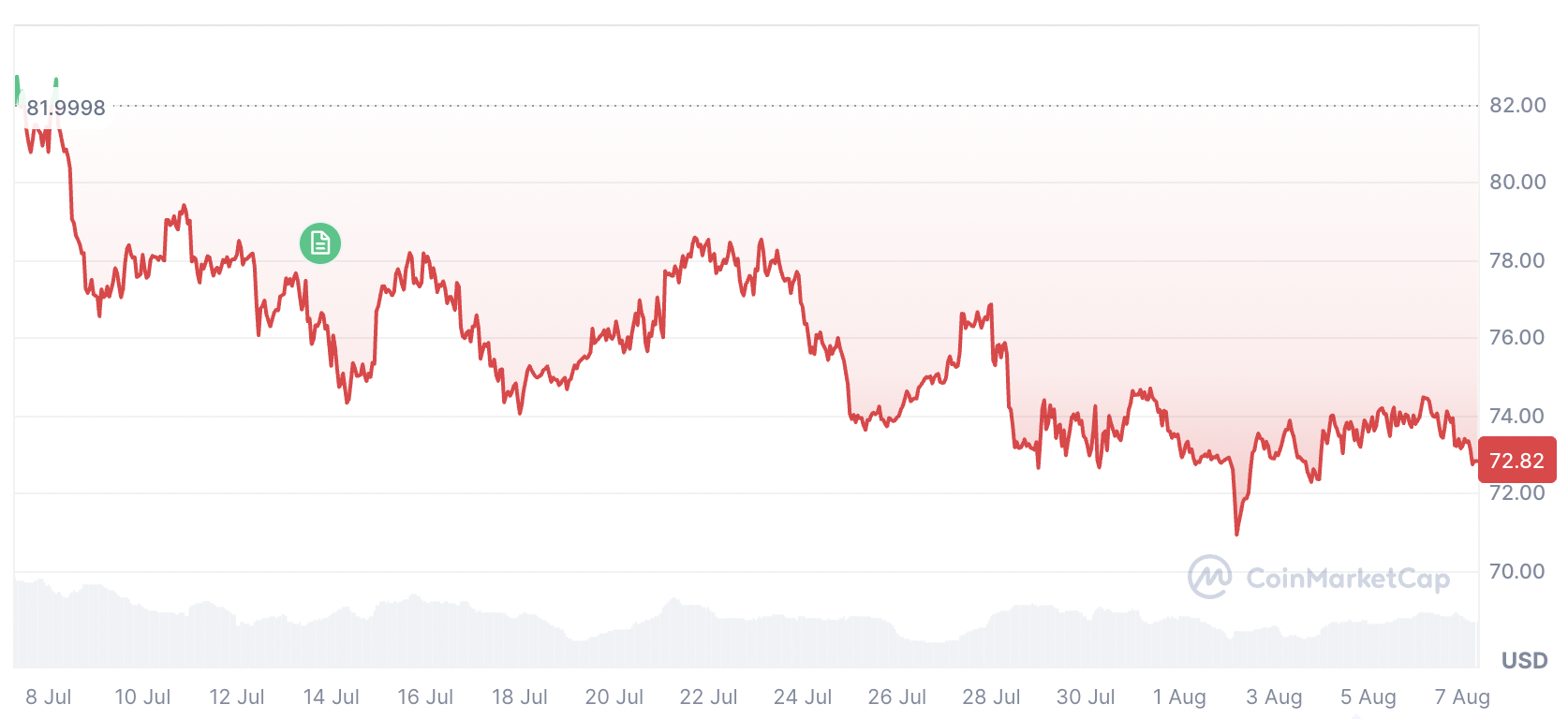
While acknowledging the recent surge in attention around platforms like Hyperliquid, Svanevik maintains that Solana remains a robust long-term contender. His confidence stems from what he perceives as a strong underlying technological foundation and a dedicated team focused on building a comprehensive ecosystem. The visual data from CoinMarketCap, showing Solana’s price down 9.60% over the past 30 days as of the article’s reporting, stands in contrast to Svanevik’s long-term bullish outlook on the ecosystem’s potential.

When pressed about the immediate implications for the SOL token’s price, Svanevik remained cautiously optimistic but refrained from providing specific price predictions. "I think Solana overall as an ecosystem and as a chain is going to do well. I don’t know what that means for the SOL price. I mean intuitively you’d imagine that it’s gonna go up based on what I’m saying," he remarked. This suggests that while he foresees ecosystem growth, the direct correlation to token price in the short term is subject to market volatility and broader macroeconomic factors.
The Rise of Real-World Assets and Tokenization
The broader trend Svanevik identifies—the integration of non-crypto assets onto blockchains—is a critical development for the industry’s legitimacy and mainstream adoption. The tokenization of stocks, for instance, allows for fractional ownership, increased liquidity, and 24/7 trading capabilities, potentially disrupting traditional financial markets. Similarly, the trading of indices like the S&P 500 on platforms such as Hyperliquid signifies a move towards replicating and enhancing existing financial products using blockchain technology.
This trend is not without its challenges. Regulatory clarity remains a significant hurdle for the widespread adoption of tokenized traditional assets. However, as more established financial institutions explore and invest in blockchain technology, the regulatory landscape is gradually evolving. The ability of blockchains to offer transparency, security, and efficiency in financial transactions is a compelling proposition that continues to drive innovation in this space.
Robinhood Chain: A New Contender in the Layer-2 Landscape
Svanevik also highlighted his bullish stance on the Ethereum layer-2 network, Robinhood Chain, which launched on July 1st. He views it as a significant competitor to other prominent layer-2 solutions like Base. "Robinhood seems to kind of rise up as like a big contender to Base. It’s really interesting because Robinhood has such excellent distribution," Svanevik explained.
The "excellent distribution" he refers to likely stems from Robinhood’s existing user base of millions of retail investors, a considerable advantage for any new platform seeking rapid adoption. This established network effect could significantly accelerate the growth and utility of the Robinhood Chain.
However, Svanevik expressed skepticism regarding the possibility of Robinhood launching its own token. He argued that such a move would be counterintuitive to the company’s existing business model, which is publicly traded on the Nasdaq under the ticker HOOD. "They clearly don’t need to, right? A lot of projects launched tokens as a way to bootstrap excitement in a user base," he stated, implying that Robinhood already possesses the necessary distribution channels.
Furthermore, he suggested that creating a token could potentially dilute the value proposition of its publicly traded stock. "You should just channel all of that value into the HOOD stock. That’s kind of the first thought," Svanevik advised. His observation that Robinhood Chain has gained significant traction without a native token underscores its inherent value proposition and the effectiveness of its distribution strategy. "They’ve been able to launch Robinhood chain and get tons of traction without a token," he concluded.
Bitcoin’s Potential Cycle Bottom and Macroeconomic Influences
Shifting focus to the flagship cryptocurrency, Bitcoin, Svanevik offered his perspective on its price outlook, suggesting that the market may be approaching a bottom. He posited that the current price range around $60,000 could represent the cycle low for Bitcoin. "My personal view is that I don’t think Bitcoin’s gonna go back below $60,000,” Svanevik asserted. “I think that’s the past… I think forever,” he added, indicating a strong conviction in this price level acting as a significant support.
His reasoning is rooted in Bitcoin’s role as a hedge against central bank monetary expansion. Svanevik believes that as long as global monetary policies continue to favor quantitative easing and money printing, Bitcoin, as a scarce digital asset, will retain its value proposition. He does not foresee an end to this global monetary expansion cycle in the near future, which underpins his confidence in Bitcoin’s long-term resilience.
This perspective contrasts with some other market participants. For instance, veteran crypto investor Michael Terpin recently shared a more bearish outlook, suggesting that Bitcoin might experience further downside before a sustained bull run. Terpin predicted a potential decline of up to 66% from Bitcoin’s all-time high, which he estimates could bring the price down into the $40,000 range. This divergence in opinions highlights the ongoing debate and uncertainty surrounding Bitcoin’s short-to-medium term price movements.
The differing analyses underscore the complex interplay of technological development, market sentiment, regulatory developments, and macroeconomic factors that influence the cryptocurrency market. While Svanevik’s insights are informed by Nansen’s deep data analysis, market participants often interpret these signals through various lenses, leading to a spectrum of predictions.
Broader Implications for the Crypto Industry
The shift away from the "get rich quick" narrative signifies a maturation of the cryptocurrency industry. As the focus moves towards real-world applications, institutional adoption, and robust technological development, the sector is likely to attract more serious investors and developers. This evolution could lead to increased stability, reduced volatility, and a more sustainable growth trajectory for digital assets.
The development of efficient and scalable layer-2 solutions like Robinhood Chain is crucial for addressing the transaction costs and speed limitations of foundational blockchains like Ethereum. This innovation is essential for supporting a wider range of decentralized applications and services that can compete with their centralized counterparts.
Furthermore, the increasing integration of tokenized traditional assets on blockchains could lead to a more inclusive and efficient global financial system. This convergence of traditional finance and decentralized technology has the potential to unlock new investment opportunities and streamline financial processes.
As Alex Svanevik’s observations suggest, the cryptocurrency industry is at a critical juncture. The focus on tangible use cases, the strengthening of underlying blockchain ecosystems, and the increasing sophistication of market participants are all indicative of a sector moving beyond its speculative origins towards a more integrated and impactful role in the global economy. The coming years will likely witness further developments that solidify crypto’s transition from a niche curiosity to a fundamental component of the future financial landscape.

