
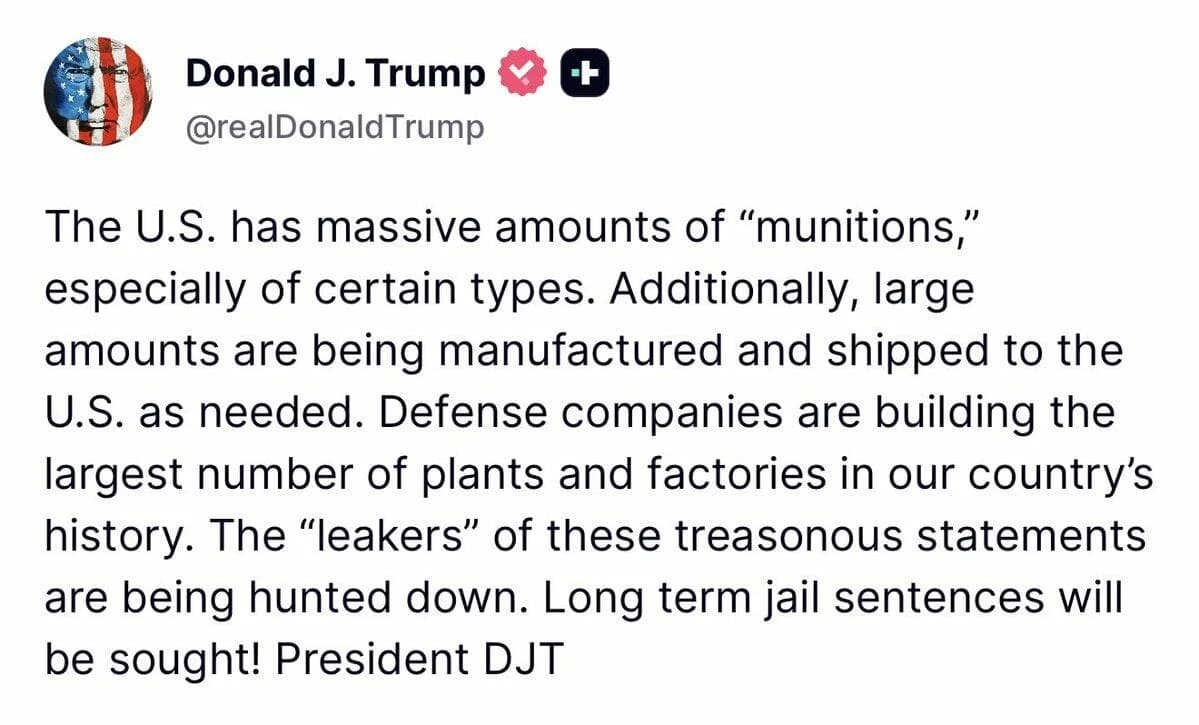
President Donald Trump on Thursday, August 6, 2026, issued a vehement threat of jail time against individuals he branded as "leakers" responsible for reports detailing significant depletion in U.S. military stockpiles, particularly advanced munitions, attributed to the ongoing conflict with Iran. The President, utilizing his Truth Social platform, unequivocally dismissed these reports, asserting that the United States possesses "massive amounts" of munitions, with production ramping up significantly to meet any perceived shortfall. This strong rebuke comes amidst a series of analyses and media reports that have painted a concerning picture of the nation’s defense readiness, particularly regarding high-value interceptor and strike missiles crucial to modern warfare.
The President’s Stance: Denial and Threat
In a series of posts on Truth Social, President Trump launched a forceful counter-narrative against the reports of munitions shortages. He stated, "The US has massive amounts of ‘munitions,’ especially of certain types. Additionally, large amounts are being manufactured and shipped to the US as needed." He further elaborated on the nation’s industrial capacity, claiming, "Defense companies are building the largest number of plants and factories in our country’s history." The President’s rhetoric then escalated as he directly addressed the sources of these reports, declaring, "The ‘leakers’ of these treasonous statements are being hunted down." This assertion underscores a deep-seated frustration within the administration regarding what it perceives as unauthorized disclosures of sensitive national security information, particularly during an active military engagement. The use of the term "treasonous" signals a grave view of such disclosures, implying severe legal consequences for those identified.
This official stance from the White House aims to project an image of robust military capability and unwavering readiness, vital for maintaining both domestic confidence and international deterrence, especially in the context of the ongoing hostilities with Iran. The administration’s narrative emphasizes an accelerated industrial response, suggesting that any current usage rates are being swiftly matched by enhanced production, thus mitigating long-term strategic vulnerabilities.
The Genesis of Shortage Concerns: Think Tanks and Media Reports
Contrary to the President’s characterization of "leakers," some of the most impactful analyses concerning munitions shortages originated not from clandestine leaks but from publicly accessible data compiled by reputable defense think tanks. A prominent example is the Center for International Studies (CSIS), a bipartisan, non-profit policy research organization, which published an extensive report titled "Renewed Iran War Would Test Diminished Interceptor Inventories." This analysis, grounded in publicly available procurement data, budget documents, and defense industry reports, offered a sobering assessment of U.S. capabilities.
CSIS’s findings were particularly alarming regarding advanced air defense systems. Their report indicated that the U.S. had utilized approximately 60% of its advanced Patriot air defense missiles. The Patriot system, a cornerstone of integrated air and missile defense for both the U.S. and its allies, is designed to intercept tactical ballistic missiles, cruise missiles, and advanced aircraft. Its extensive deployment and expenditure in the Iran conflict highlight the intensity and nature of the aerial threats encountered.
Even more critically, the CSIS analysis suggested that about half of the interceptors for the Terminal High Altitude Area Defense (THAAD) missile defense system had been expended. THAAD is specifically engineered to intercept short, medium, and intermediate-range ballistic missiles in their terminal phase, providing a crucial upper-tier defense layer. The original CSIS estimate was later reportedly revised by sources speaking to CNN, who indicated that the actual usage rate for THAAD interceptors could be as high as 80% during the conflict. Such a high expenditure rate for these sophisticated and costly systems raises significant questions about the long-term sustainability of the U.S. air defense posture, not only in the Middle East but globally.
Beyond air defense, other reports have highlighted shortages in offensive precision-strike capabilities. Media outlets, including AntiWar.com, have reported that the U.S. has depleted "virtually all" of its Army Tactical Missile System (ATACMS) missiles and Precision-Strike Missiles (PrSMs). Both ATACMS and its successor, PrSM, are long-range, all-weather, precision-strike guided missiles used to engage high-value targets deep within enemy territory. Their extensive use in strikes against Iranian targets underscores the critical role of precision-guided munitions in modern conflict and the rapid rate at which such assets can be consumed in sustained operations.
The Iran Conflict: A Backdrop of High Expenditure
The ongoing conflict with Iran, while not detailed in its specific contours in the provided text, serves as the critical context for these munitions expenditures. It is inferred to be a high-intensity engagement, characterized by significant aerial and missile exchanges, necessitating the extensive deployment of advanced air defense systems like Patriot and THAAD, and offensive platforms like ATACMS and PrSM. Such conflicts are notorious for their rapid consumption of sophisticated weaponry, often far exceeding peacetime production rates.
The strategic implications of a protracted conflict requiring such high-end munitions are profound. Each interceptor and strike missile represents years of research, development, and manufacturing, involving complex supply chains and specialized industrial capabilities. Their depletion signals not just a numerical reduction in inventory but a potential erosion of critical deterrence capabilities and a challenge to the U.S. military’s ability to respond to multiple, simultaneous contingencies across various theaters.
Industrial Capacity vs. Wartime Consumption: A Widening Gap
A central theme emerging from these reports is the stark disparity between the rate at which advanced munitions are consumed in active warfare and the rate at which the U.S. defense industrial base can produce them. While President Trump’s statements emphasize increased manufacturing efforts and the construction of new defense plants, defense analysts and industry experts consistently point out that significantly scaling up production for complex weapons systems is a multi-year endeavor.
Manufacturing advanced missiles like Patriot interceptors or THAAD missiles involves intricate processes, highly specialized components, skilled labor, and often relies on a limited number of suppliers for critical sub-systems. Lead times for these components can stretch into months or even years. Establishing new production lines or significantly expanding existing ones requires substantial capital investment, workforce training, and regulatory approvals. Therefore, even with accelerated efforts, the current rate of weapons usage in the Iran conflict is widely believed to far outpace the immediate replenishment capabilities of the U.S. defense industry. This creates a critical lag, where inventories could remain depressed for an extended period, potentially affecting future operational flexibility and strategic planning.
The Camp David Controversy: Internal Divisions and Denials
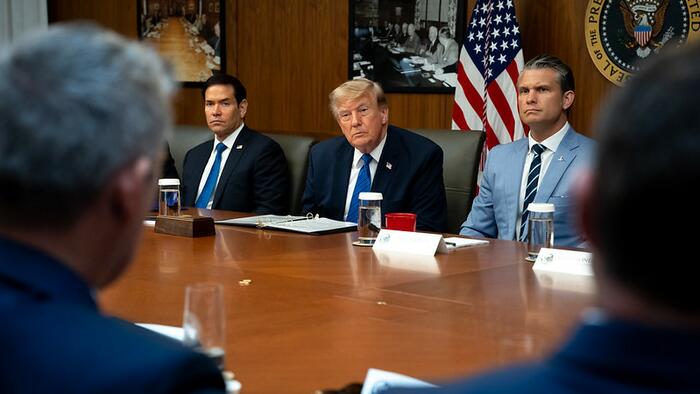
Further complicating the narrative of munitions shortages was a report from The Washington Post, which alleged internal discord within the Trump administration over the issue. According to the Post, President Trump reportedly clashed with U.S. Secretary of War Pete Hegseth during a cabinet meeting at Camp David. Sources cited by the newspaper claimed that Trump vented his frustration at Hegseth regarding the munitions shortages, with one source suggesting that these concerns about dwindling arsenals played a role in the President’s decision to hold off on dramatically escalating the war with Iran. The report further detailed that Hegseth, in turn, reportedly blamed his deputy, Stephen Feinberg, for both the shortages and for failing to adequately inform the President about the gravity of the situation.

President Trump swiftly and emphatically refuted The Washington Post‘s account, again taking to Truth Social to denounce it as "Fake News" and "completely unfounded rumors." He expressed strong support for Secretary Hegseth, stating, "I am extremely happy with the job that Pete Hegseth is doing." The President accused the Post of publishing the story "despite our telling them their story is completely FALSE" and reiterated his belief that such "fake ‘reporting’ is treasonous." This public denial and counter-accusation highlight the intense political sensitivity surrounding military readiness and the administration’s determination to control the narrative, particularly when it touches upon perceived weaknesses or internal disagreements.
The alleged Camp David incident, despite the official denial, points to a potential internal struggle within the administration regarding military strategy, resource allocation, and the transparency of information concerning defense capabilities. If accurate, it suggests that the munitions shortage is not merely an external concern raised by think tanks and media, but a recognized, albeit officially denied, challenge influencing high-level strategic decisions.
Broader Implications and Strategic Analysis
The controversy surrounding munitions shortages carries significant broader implications, extending beyond the immediate context of the Iran conflict.
- Deterrence and Global Posture: A public perception of diminished U.S. military stockpiles, especially of critical precision-guided munitions and air defense interceptors, could embolden adversaries and undermine the credibility of U.S. deterrence. Allies might also question the reliability of U.S. security guarantees if the industrial capacity to sustain prolonged conflicts is perceived as insufficient.
- Future Conflicts and Readiness: The current situation could serve as a stark warning about the need to reassess U.S. defense industrial capacity and strategic reserves for potential future conflicts. Modern warfare, characterized by high-intensity, precision engagements, consumes resources at an unprecedented rate, necessitating a robust and agile industrial base.
- Budgetary Pressures: Replenishing depleted stockpiles will require substantial new defense appropriations, adding to an already strained federal budget. This could lead to difficult choices regarding other defense priorities or domestic spending.
- Transparency vs. National Security: The administration’s aggressive stance against "leakers" and its labeling of critical reports as "treasonous" raises important questions about the balance between government transparency and national security interests. While legitimate classified information must be protected, analyses based on publicly available data, even if critical, play a vital role in informing public debate and congressional oversight.
- Political Ramifications: The issue of military readiness and the handling of the Iran conflict will undoubtedly become a significant political talking point. For the Trump administration, maintaining an image of strength and competence is paramount, making any perceived vulnerabilities politically damaging.
Defense analysts, while often refraining from commenting on specific inventory levels due to classified nature, have consistently highlighted the long-term challenge of maintaining adequate stockpiles of sophisticated weapons. Many have pointed out that the "peace dividend" reductions following the Cold War led to a leaner defense industrial base, which now struggles to surge production in response to large-scale conflicts. This structural challenge is independent of any particular administration but becomes acutely relevant during periods of active military engagement.
Conclusion: An Ongoing Tussle for Narrative and Readiness
The current situation represents a complex interplay of strategic realities, political narratives, and industrial limitations. President Trump’s forceful denial and threats against those reporting on munitions shortages underscore the high stakes involved in controlling the public perception of U.S. military strength during an active conflict. However, the persistent reports from reputable think tanks and media outlets, grounded in publicly available data and anonymous sources, suggest a deeper, more challenging reality regarding the sustainability of U.S. advanced munitions stockpiles.
As the conflict with Iran continues, the tension between wartime consumption and industrial production rates will remain a critical concern. The debate over the true state of U.S. military readiness, the integrity of information flows, and the appropriate response to perceived threats to national security will undoubtedly continue to unfold, shaping both domestic policy and the nation’s posture on the global stage. The long-term implications of these dynamics for U.S. defense policy and its geopolitical standing are profound and will require sustained attention from policymakers, defense planners, and the public alike.

