
A comprehensive analysis reveals a dramatic transformation in the distribution of risk across the global financial system over the past five years, fundamentally altering market structure and, critically, the dynamics of liquidity. This shift, driven by seven unprecedented trends, points to an increasingly fragile environment, prompting a re-evaluation of traditional investment strategies and risk management protocols.
The financial landscape of early 2026 bears little resemblance to that of even five or ten years prior. While the preceding year, 2025, saw broad market gains, leading many to approach the new year with confidence, seasoned market observers harbor significant reservations. The primary concern is the profound impact of these structural shifts on liquidity – not merely spot liquidity, but the inherent "Liquidity Dynamics," which describe how liquidity behaves and reacts under stress. This report will dissect these observable, existing dynamics rather than speculate on specific catalysts, as the consequences for asset prices are likely to be similar regardless of the trigger. However, potential catalysts such as the AI bubble, private credit defaults, energy shocks, central bank credibility erosion, major cyberattacks, and the ever-present "unknown unknowns" remain potent threats.
The central thesis identifies seven unprecedented trends over the past half-decade that have collectively reshaped global markets. These trends, individually and in concert, have negatively impacted Liquidity Dynamics, pushing the financial system into uncharted territory and warranting extreme caution.

For the purpose of this analysis, market participants are categorized into "Stabilizers" and "Fragilizers." Stabilizers, including fundamental managers, traditional banks, and sovereign entities, maintain a robust market structure by acting contracyclically, possessing long-term investment horizons, and bearing responsibilities beyond immediate profitability. They provide crucial liquidity in times of need. Conversely, Fragilizers contribute to concentration risk and speculative behavior. While they may offer local liquidity or participate in market-making, their procyclical nature, short investment horizons, or singular focus on immediate profitability mean they withdraw liquidity during crises, potentially even demanding it. This category includes private assets, passive investment vehicles, multi-strategy funds, non-committed liquidity providers, and retail investors. It is crucial to emphasize that these classifications are not condemnations; a healthy market requires a balance. However, the alarming trend of the past decade, accelerating in the last five years, is the significant expansion of Fragilizers coupled with a steady recession of Stabilizer capacity. This growing imbalance forms the core danger explored in this paper.
Private Assets: A Growing Fault Line in Market Liquidity
Any contemporary examination of market liquidity must confront the colossal growth of private assets. Investors have increasingly allocated substantial portions of their portfolios to private markets, often underestimating the inherent illiquidity premium. While appearing as a "free lunch" in periods of abundant capital, the true cost of illiquidity becomes starkly apparent during market tightening. Private assets, by their nature, cannot be easily sold, rebalanced, or reallocated, leading to trapped capital and reduced flexibility precisely when it is most needed. This phenomenon exerts immense pressure on the remaining liquid portions of portfolios, forcing them to bear a disproportionate burden of liquidity provision and exacerbating stress in public markets.

Evidence of Private Asset Proliferation
The growth of private assets has been spectacular and broad-based, as illustrated by figures up to 2025. While traditional private equity allocations remain robust, private credit has emerged as a significant new driver of expansion, often venturing into riskier asset classes. The Financial Times reported in late 2025 that private credit firms purchased nearly 14 times more consumer debt in 2025 than in 2024, including typically unsecured credit-card and "buy now, pay later" loans. On the demand side, retail investors now constitute up to 15% of private credit funds’ investor base, a significant and relatively new development.
Consequences for Market Stability
Increased Beta and Tech Exposure: Far from offering diversification, the surge in private assets often translates into a de facto doubling of beta exposure, frequently without the transparency or scrutiny of public markets. Allocators often gain similar underlying exposure to economic growth and sector concentrations, particularly in information technology, but with diminished oversight. The ECB’s 2025 Financial Stability Review highlighted the escalating share of IT-related transactions in private markets, meaning investors can be doubly exposed to the same sector, amplifying concentration risk rather than achieving genuine diversification.

Rising Opacity and Eroding Due Diligence: Private markets inherently operate with less scrutiny than public markets, but the accelerated deal activity appears to be compromising due diligence standards. John Graham, CEO of the Canada Pension Plan Investment Board, noted to the Financial Times that private credit transactions are executed so rapidly that investors frequently lack sufficient time for proper assessment. Elizabeth McCaul, an ECB Supervisory Board member, echoed this, stating, "we are trading transparency for speed […] that may be fine in good times, but in a downturn, it leaves policymakers flying blind." This trend leads to a weaker understanding of underlying exposures and a heightened risk of mispriced credit within portfolios. The IMF also observed a near-tripling of privately rated securities since 2019, with most of this growth coming from newer agencies focused on private assets, raising concerns about the consistency and rigor of risk assessment.
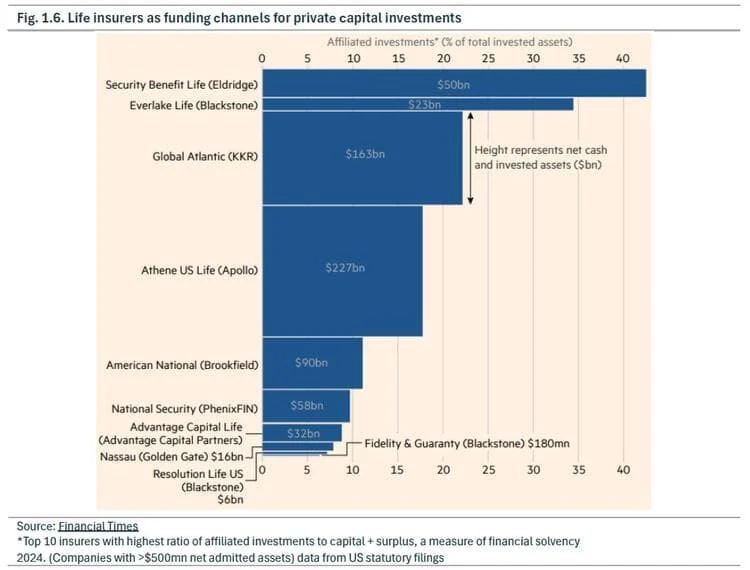
Contagion Risks to the Broader Financial System: Private credit is not an isolated segment; its interconnections pose significant contagion risks. Bloomberg reported that U.S. banks extended approximately $300 billion in loans to private credit funds and other investment vehicles by early 2026. While most private credit funds maintain moderate leverage, a segment with leverage ratios above 3.5% could, in the event of widespread defaults, create substantial stress for the industry and, in turn, for banks. Moreover, life insurers are increasingly becoming a transmission channel as private capital groups utilize them for funding and even acquire them outright (e.g., Apollo’s control of Athene, KKR’s ownership of Global Atlantic). The Financial Times documented a corresponding rise in Level 3 assets (those valued by models rather than observable market prices) within these insurers, reaching 36% at Athene and 30% at Global Atlantic by Q3 2025, up from 12% and 10% in 2021. These growing linkages underscore that private credit is an interconnected component of the financial system, capable of transmitting stress to other financial actors.

Passive Investment’s Ascendancy: Herd Behavior and Concentration
The public markets have witnessed a parallel shift: the dominance of passive investing over active management, marking a significant victory for Fragilizers over Stabilizers. This trend has profound implications for price discovery, market concentration, and overall stability.
Evidence of Passive Growth
Over the last decade, passive investing has seen relentless growth, while active management has steadily declined. Bloomberg Intelligence estimated cumulative redemptions of $1 trillion from active equity mutual funds between 2010 and 2025. A broader Goldman Sachs analysis in its 2026 Global Macro Outlook indicated that since 2007, approximately $4 trillion has been withdrawn from active funds, with $6 trillion flowing into passive vehicles. By 2024, passive equity funds accounted for nearly 60% of total Assets Under Management (AUM), according to the ECB.

Consequences for Market Dynamics
Technically Driven Valuations and Extreme Concentration: The shift to passive investment fundamentally alters the rationale for asset ownership. Instead of micro-level, bottom-up analysis, passive strategies prioritize tracking indices. This "obsessive benchmarking," particularly to the S&P 500, disconnects investors from the underlying merits of individual stocks. While praised for low cost and ease of diversification, the latter benefit has eroded due to extreme index concentration. Passive funds mechanically overweight the largest stocks to minimize tracking error, creating a self-reinforcing loop where larger firms receive more capital inflow, further increasing their market capitalization relative to smaller ones. This process, highlighted by the ECB, amplifies existing market concentration. The decline of active management concurrently weakens corrective forces, as active managers typically reallocate capital counter-cyclically, moving away from overvalued large caps towards undervalued companies. This stabilization mechanism is severely diminished as passive share rises.
Increased Volatility Shocks from Correlation: The ECB also found that increased passive allocation may "increase co-movement among stock returns," leading to potentially higher volatility. Specifically, a 1% rise in passive ownership in the EURO STOXX Index is estimated to increase return correlation by 0.45%. ADAPT IM’s "The End of History Illusion" report in January 2025 already highlighted the ultra-high concentration in equity indices and the disconnect between the fundamental interdependence of the AI complex and the low realized correlation among its stocks. This complex has since grown by $7 trillion, further exacerbating this vulnerability. Mathematical models demonstrate that index volatility can sharply rise if correlations spike, even if individual stock volatilities remain stable. A model by Michael Green, Hari P. Krishnan, and Stephan Sturm suggests that as passive ownership increases, the mean-reverting corrective force of active managers weakens, leading to stronger and longer-lasting market instability, particularly increasing volatility in response to market shocks.

Multi-Strategy Funds: A Homogenizing Force
On the buy-side, away from traditional long-only investing, the meteoric rise of multi-strategy funds also represents a significant win for Fragilizers. Their growth, while seemingly a sign of sophistication, introduces new vulnerabilities to Liquidity Dynamics.
Evidence of Multi-Strategy Expansion
Goldman Sachs’ 2025 landscape report on Multi-Manager Hedge Funds confirmed new highs in assets under management, risk deployed, trading volumes, and headcount for these platforms. Over the past 15 years, their expansion has doubled the growth rate of the broader hedge fund industry, accelerating further in 2025 to four times the rate of other hedge funds. By early 2026, multi-manager funds accounted for roughly one-third of hedge fund gross market value in US equities and 37% of average daily trading volumes, employing approximately 24,000 individuals, or one-third of all hedge fund employees.

Consequences for Market Resilience
Multi-manager funds have become crucial intermediaries, simplifying due diligence for allocators and institutional infrastructure for portfolio managers. This has propelled them into a systemic force. While their strict and effective risk management, designed to rapidly scale down exposure to underperforming managers, has enabled resilience in past decades, their current scale presents a new risk. The very model that underpinned their success could, in a severe or prolonged downturn, transform them into amplifiers of volatility.
Their standardized risk frameworks, applied across diverse strategies, naturally foster concentration and crowding. With a growing share of industry assets managed under similar models and constraints, the risk of asymmetric liquidity conditions rises significantly. During periods of stress, a coordinated attempt by many managers to exit similar positions simultaneously could amplify market moves and exacerbate shocks.

Compounding this concern is the increasing correlation between multi-strategy fund performance and broader equity markets. BNP’s 2026 Hedge Fund Outlook revealed that by the end of 2025, the one-year correlation between MSCI World and hedge fund performance reached 92%. Multi-strategy funds, specifically, saw their correlation to equities surge to 88% in 2025, up from 28% over the 2021-2025 period. This high correlation suggests that multi-strategy funds may not offer true diversification during an equity market reversal, creating a "perfect storm" for portfolios with significant implicit equity beta. The "butterfly effect," where the liquidation of a smaller, similarly positioned multi-strategy pod can trigger a chain reaction forcing larger pods to unwind, presents a clear and present danger of large-scale market dislocations.
Non-Committed Liquidity Providers Ascendant, Committed Receding
The market-making ecosystem has also undergone a dramatic transformation. New titans, classified as non-committed liquidity providers, have steadily captured significant portions of the business once dominated by traditional banks, the committed providers of liquidity. This shift further compromises Liquidity Dynamics.

Evidence of Shifting Liquidity Provision
Non-Committed Liquidity Providers at All-Time High: Market makers and quant funds, while distinct, share a critical characteristic: their liquidity provision is opportunistic, not committed. This liquidity, abundant in calm conditions, can evaporate instantly under stress. These entities operate with limited transparency compared to banks and can withdraw from markets with minimal reputational consequence. Quant funds, through high-frequency and systematic strategies, contribute significantly to trading volumes but withdraw liquidity when volatility rises and signals break down.
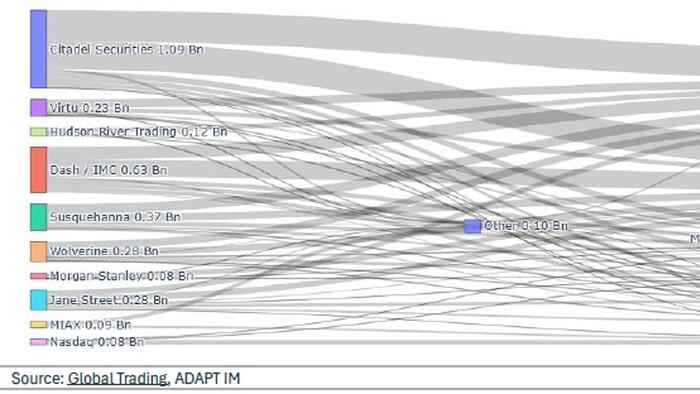
Historically, major investment banks dominated trading. Post-2008 regulation and market electronification created a vacuum that specialized electronic market makers filled aggressively. By 2025, the combined revenue of firms like Jane Street and Citadel rivaled nearly one-third of the total trading revenue of the five largest US investment banks. The Boston Consulting Group’s 2024-2025 Capital Markets & Investment Banking Update reported that Non-Bank Liquidity Providers (NBLPs), including market makers and proprietary trading firms, accounted for roughly a quarter of the global market revenue pool, up from 12% in 2018. Their dominance in retail trading is total, exemplified by Payment for Order Flow (PFOF), where market makers pay brokers for order flow, raising conflict-of-interest concerns and leading to its prohibition in the EU from 2026. Quant funds, according to Bloomberg Intelligence, now account for half of equity volume among buy-side funds, up from 25% a decade ago, creating an impression of abundant liquidity that is, in fact, highly conditional and pro-cyclical.

Committed Liquidity Providers at All-Time Low: Following the 2008 crisis, banks faced stringent regulatory requirements, making them better capitalized but limiting certain activities. Regulations like UMR (Uncleared Margin Rules), designed to enhance OTC derivatives trading resilience, have shifted business away from banks to new entrants. This has led to Non-Bank Financial Institutions (NBFIs) accounting for the largest share of financial system assets on record. A BIS report highlighted that in advanced economies over the past 15 years, NBFI financial assets grew significantly faster than those of banks relative to GDP, driven largely by investment funds.
Consequences for Systemic Stability
The Illusion of Liquidity: The rise of non-committed liquidity providers creates an illusion of deep liquidity. Spreads may appear tight, but underlying market depth is fragile. When volatility spikes, these providers, whose utility function is primarily profit-driven with a short horizon, will quickly withdraw, contrasting sharply with banks, which have broader mandates (client service, reputation) and longer horizons. This abrupt withdrawal can lead to severe market dislocations.

Increased Complexity and Systemic Risks: Market makers have moved beyond high-volume, low-margin business to more complex areas like proprietary trading and structured products. IFR reported that nearly 70% of Jane Street’s revenues now come from proprietary trading, indicating a shift where market making serves as an information extraction mechanism rather than solely spread capture. This expansion means liquidity risks are no longer confined to listed instruments but extend to complex products across asset classes and regions.
Prime Brokerage: A Contagion Channel: The IMF’s 2025 Global Financial Stability Report, "Shifting Ground beneath the Calm," highlighted NBFIs’ increasing reliance on banks for funding. US and European banks have a combined exposure of $4.5 trillion to these institutions. For some banks, NBFI exposures approach six times their Tier 1 capital. Banks with the highest NBFI exposures also rely more heavily on wholesale funding, increasing vulnerability. The failure of a large multi-strategy fund or market maker could rapidly transmit stress to banks via prime brokerage and financing channels. The IMF estimates that over 20% of European banks could see their CET1 ratios fall by 50-100 basis points under severe NBFI stress, with about 50% experiencing declines exceeding 100 basis points. This interconnectedness creates a false sense of resilience, as the potential for contagion is often underestimated.

Retail Investors: Emerging Fragilizers
While non-committed liquidity providers impress with their scale, retail investors stand out in sheer numbers and collective influence. This new group now possesses enough firepower to significantly influence market direction, making payment for order flow even more consequential. Although retail has historically acted as a local stabilizing force, its current characteristics position it as a growing Fragilizer.
Evidence of Retail’s Heightened Influence
Surging Volumes: By late 2025, retail investors accounted for 29% of all options activity, up from 23% in early 2020, according to Bloomberg Intelligence. A record 60% of US households owned stocks in 2025, and retail inflows into single stocks and ETFs reached a ten-year high. Retail traders have more than doubled their options activity over the past five years, showing a strong preference for call options. CBOE data indicates record-high overall options volumes coupled with record-low average execution sizes, reflecting the growing retail presence.

Impact on Derivatives Pricing: Retail’s influence is also evident in derivatives pricing. Their consistent bullish speculation, often driven by fear of missing out, has shifted implied volatility surfaces for several US technology names from a traditional skew to a "smile," where upside calls trade almost as richly as downside puts. This is particularly notable given that index-option skews remain steep and upside calls on single stocks were historically dominated by call-overwriting programs.
Consequences for Market Stability and the Real Economy
"Buy-the-Dip" Mentality: A Double-Edged Sword: Retail traders, empowered by technology, frictionless market access, and social platforms, can now move markets in unprecedented ways. This dynamic intensified during the COVID-19 lockdowns and persisted in a regime of low volatility and steadily rising asset prices. The "buy-the-dip" (BTD) strategy has been consistently rewarded, deeply ingraining this trading psyche. However, BTD resembles a martingale; it works until capital constraints are met, at which point it inevitably fails. The "Captain Condor" episode in December 2025, where a retail trading community incurred a $50 million loss from a short S&P 500 volatility martingale, illustrates the fragility. When market conditions reverse, the same cohort that provided bid-side support can abruptly withdraw or become forced sellers, causing liquidity to "flip" and creating highly unbalanced, fragile market conditions.

Contagion Risks from Wall Street to Main Street: Retail participation extends beyond high-income households to include a significant share of lower-income individuals, a trend at its highest level since the Global Financial Crisis, excluding temporary pandemic-era fiscal stimulus. While individual investments by these households are small, their rising exposure raises concerns about financial resilience. Lower-income investors typically lack the buffers to withstand significant market losses, increasing the risk that a downturn could erode lifetime savings and force substantial reductions in consumption. In aggregate, this could create a dangerous transmission mechanism from Wall Street to Main Street, where a sharp equity decline translates into lower consumption and broader economic stress.
Sovereign Authorities: Dry Powder at All-Time Low
The previous five trends highlight the ascendance of Fragilizers and the recession of traditional Stabilizers. We now turn to the Stabilizers of last resort: sovereign authorities, comprising central banks and governments. Here, too, the picture is deteriorating, with their maneuvering room narrowed and, in some cases, their credibility weakened.

Evidence of Diminished Capacity
Rising Debt Levels: Public debt has become a seemingly intractable problem. Both emerging and advanced economies are exhibiting cycle-high levels of public debt relative to GDP by 2025, with advanced economies at levels not seen since the 1950s and emerging markets facing unprecedented burdens. Governments find it increasingly difficult to use debt for stimulus or as a crisis backstop, as markets may be unwilling to absorb new issuance, or the "cure" proves worse than the "disease." The only realistic paths out are inflation or financial repression.
The US fiscal deficit, at approximately 6% of GDP, matches levels last seen during the Global Financial Crisis. An aging population, expanding social and ecological policies, and higher defense spending contribute to significant public financing needs. Despite attempts like the H.R. 1 ("One Big Beautiful Bill") under the Trump administration, material reductions in deficits are not projected. A structural break around 2015 saw deficits rise despite a solid economy, deviating from historical correlations with economic conditions. Since the Global Financial Crisis, public debt has expanded alongside a contraction in private sector leverage, a configuration last observed in the 1930s and 1940s.

Erosion of Central Bank Credibility: Central bank credibility has steadily declined over the past decade, accelerating in the last five years. Years of unconventional monetary policy (negative interest rates, quantitative easing) have fostered moral hazard, incentivizing governments to expand deficits without fiscal discipline. An ECB working paper in 2024 noted further erosion post-pandemic due to: 1) inflation far exceeding targets, exposing a mandate failure; 2) persistent underestimation of inflation in forecasts; and 3) inconsistencies in forward guidance. While disinflation proved easier than in the 1970s due to still-anchored expectations, trust remains fragile, difficult to measure, and challenged by polarization and misinformation. Trust, rather than popularity, is fundamental for effective monetary policy.
Consequences for Crisis Response
Higher Rates and Debt Issuance Risks: Elevated public debt and current interest rates severely constrain governments’ ability to issue new debt for economic support during a recession or financial crisis. This significantly weakens their role as Stabilizers of last resort, reducing their capacity to inject liquidity and stabilize Liquidity Dynamics during stress. The Swiss case of Credit Suisse in 2023, where strong public finances enabled credible guarantees to UBS, illustrates the importance of fiscal health in containing systemic shocks. Without such capacity, interventions risk becoming counterproductive.

Credibility Destruction Curbing Central Bank Power: While central banks have expanded their toolboxes, diminished credibility renders these tools largely ineffective. A 2025 International Journal of Central Banking paper concluded that reduced credibility amplifies market instability, erodes confidence, and increases the risk of disorderly adjustments. Three critical channels are highlighted: 1) weakened anchoring of expectations, increasing uncertainty and volatility; 2) reduced effectiveness of monetary policy tools like forward guidance; and 3) undermined ability to stabilize markets, as actions are questioned or ignored. High public debt also influences the yield curve, steepening it and pushing long-term rates higher, contributing to fears of inflation, financial repression, and US Dollar debasement, as evidenced by rising gold demand despite higher interest rates. This also worsens the "bank-sovereign nexus," the interconnectedness between a country’s banking system and its government’s financial health, as highlighted by the IMF.
Leverage at Cycle-High: Fuel for the Fire
The preceding six trends collectively point to a significant shift towards Fragilizers and reduced Stabilizer capacity. Compounding this, leverage across the financial system is building towards local highs. While leverage alone rarely triggers a crisis, it invariably provides "fuel for the fire," making Liquidity Dynamics increasingly vulnerable and raising the risk that the next significant fundamental shock could trigger an unorderly breakdown rather than a healthy correction.

Evidence of Broad-Based Leverage
Heightened Derivatization of the World: Derivatives trading is reaching unprecedented levels across all market segments – from 0DTE options to OTC structures, and from retail investors to institutions. The last three years saw the highest derivatives trading volumes ever, driven significantly by the rapid adoption of same-day expiry options among a broad range of participants. OTC derivatives have expanded aggressively, sometimes even outpacing exchange-traded products. In credit markets, risk.net reported a 20% increase in CDS trading volumes for US systemic banks in Q3 2025, reaching a decade high. Interest rate derivatives remain the largest OTC component, with notional volumes reaching $123.5 billion in Q2 2025. This surge in derivatives is not matched by proportional growth in underlying securities, often making it easier to trade an option than the underlying asset.
Increasingly Complex ETFs: Financial engineering, once confined to large banks, is now accessible to a broader range of investors through complex ETFs. With over 5,000 ETFs listed in the US (25% more than listed single stocks), the growth of derivative-income ETFs has outpaced traditional dividend ETFs over the past five years. Autocallable ETFs, launched in June 2025, quickly gathered $500 million in assets, combining a bond component with the sale of downside options. These, along with leveraged ETFs, democratize sophisticated, high-risk strategies previously reserved for institutional investors.

AI Financing Overengineering: The AI sector’s boom, driven by massive capital expenditure for data centers, relies on increasingly complex vendor financing arrangements, often involving circularity and greater debt reliance. Declining forward EBITDA-Capex ratios for tech giants (Alphabet, Amazon, Meta, Microsoft) and decreasing Free Cash Flow (FCF) yields for the Magnificent 7 (Alphabet, Amazon, Meta, Microsoft, Nvidia, Apple, Tesla) indicate rising investment needs outpacing operating income and self-financing capacity. Yet, traditional on-balance sheet debt has not risen proportionally, suggesting significant off-balance-sheet financing through complex structures. The Financial Times reported that tech companies are using Special Purpose Vehicles (SPVs) to fund over $120 billion in data center construction, isolating project risks from parent balance sheets. This allows for additional traditional debt issuance, as demonstrated by Meta raising $30 billion through an SPV and then another $30 billion in corporate bonds within weeks in late 2025.
Payment-in-Kind (PIK) Provisions: Another form of financial engineering common in private markets is Payment-in-Kind (PIK) debt, which allows borrowers to defer cash interest payments by capitalizing interest and adding it to the loan principal. Lincoln International reported that the share of private market investments incorporating PIK features nearly doubled over the past four years, reaching 11%. This includes "Bad PIK," where PIK features are adopted after origination, indicating borrower deterioration.

Consequences for Liquidity Dynamics and Market Fragility
Derivatization and Speculative Mood: The growing reliance on derivatives represents a profound shift from fundamental-driven investing to speculative trading. Many investors hold positions out of fear of missing out, lacking deep conviction in the underlying assets. This absence of conviction means positions are unlikely to be held when market sentiment turns, potentially creating severe supply-demand imbalances and deteriorating Liquidity Dynamics.
ETF Complexity and Tail Risk: Complex ETFs enable individuals to speculate on intricate products without full understanding. This increases tail risk, especially during regime shifts, and, for autocallable ETFs, around barrier levels, potentially raising correlations due to hedging activities of ETF providers.

Opaque AI Financing and Debt Market Risks: Debt issued through SPVs is often repackaged into asset-backed securities (ABS), redistributing credit risk. While offering investment opportunities, the underlying risks can be opaque, particularly for non-specialists. This model creates a binary risk profile for investors, as the AI sector operates under a winner-takes-all dynamic, prioritizing scale over traditional profitability. The immense capital requirements push even tech giants to off-balance-sheet financing, where true long-term profitability remains highly uncertain.
PIKs Worsening Private Credit Risk: PIK provisions increase overall debt by capitalizing interest, potentially altering debt quality and raising effective leverage without refinancing. This practice can obscure borrower deterioration, delaying the recognition of problems and increasing the impact of sudden repricing. While a short-term liquidity buffer for companies, widespread PIK use can create future liquidity pressure for lenders, forcing them to sell other assets suboptimally. This confluence of factors points to a potential "Minsky Moment," where prolonged stability breeds complacency and excessive risk-taking, ultimately leading to an abrupt, severe disruption.

Conclusion: An Unprecedented and Untested Market Structure
The seven trends analyzed in this paper – the rise of private assets, passive investing, multi-strategy funds, non-committed liquidity providers, and retail investors, coupled with the diminishing dry powder and credibility of sovereign authorities and the cycle-high levels of leverage – represent a very recent evolution. None of these "blocks" were as large during the last significant market drawdown in 2020 as they are now; they have grown exponentially over the past five years. Consequently, this novel market structure has, at best, produced only two years of financial data during which no significant crisis occurred, meaning it remains largely untested under true stress.
The most critical takeaway is the unreliability of relying on historical precedents. Past mechanisms and chains of events are unlikely to repeat identically. This renders traditional reliance on history, past data, and back-tests a flawed approach for assessing future risk. In this context, a rigorous investment process, continuous live market structure analysis, and disciplined risk management are not merely advisable but imperative.

While markets have demonstrated relative resilience to recent, modest volatility shocks, predicting the behavior of this new market structure in a severe and prolonged crisis is impossible. What is unequivocally clear is that many of the participants who have rapidly expanded in recent years are Fragilizers, far more likely to withdraw liquidity during stress than to act as shock absorbers, thereby further exacerbating Liquidity Dynamics. Recent illustrations of this fickle liquidity include a sharp dislocation and near-meltdown in the Japanese Government Bonds market in January 2026, triggered by relatively modest trading volumes, and silver prices experiencing their worst daily performance ever, free-falling more than 30%.
This paper presents no groundbreaking new evidence; the individual facts are generally known. However, bringing them together and examining them holistically reveals a striking pattern: each of these shifts consistently moves in the same direction, making the market structure more fragile and worsening Liquidity Dynamics. While the specific conclusion drawn may be contested, the fundamental analysis that this market structure is completely new and untested cannot be disputed. It will, by necessity, react differently during the next crisis than in any previous one, demanding a fresh perspective on risk.

