
Global equity markets demonstrated renewed vigor on Thursday, with European indices staging a notable rebound, while US equity futures maintained a strong upward trajectory in anticipation of a holiday-shortened trading session ahead of Thanksgiving. The market’s attention was sharply focused on the previous day’s significant rally in Artificial Intelligence (AI) related stocks, which followed an abrupt weakening of the US dollar. This confluence of events has ignited a crucial debate among traders and analysts: does this represent the genesis of a sustained upward reversal in broader market sentiment, or is it merely another ephemeral rally within a prevailing bear market?
The Catalyst: Dollar Weakness and AI Sector Momentum
Wednesday’s trading session provided a dramatic illustration of market sensitivity to currency fluctuations and sector-specific momentum. Around midday New York time, the US dollar experienced a sudden and pronounced decline against a basket of major currencies. This weakening of the dollar often serves as a bullish signal for equities, particularly for multinational corporations whose international earnings become more valuable when converted back into a softer domestic currency. Simultaneously, the Artificial Intelligence sector, a bellwether for technological innovation and growth, witnessed a significant surge in stock prices. Companies at the forefront of AI development, ranging from semiconductor manufacturers like Nvidia to software and cloud service providers, saw substantial gains. This immediate correlation between a weakening dollar and a rally in high-growth tech stocks, particularly those in the AI domain, underscored the market’s current proclivity for risk-on assets when macro conditions appear to ease.
The question of whether this surge is sustainable is paramount. Historically, bear markets are characterized by periods of sharp, albeit temporary, rallies that often trap overly optimistic investors. These "bear market rallies" can be fueled by short-covering, technical factors, or temporary shifts in sentiment, only to fizzle out as underlying economic concerns persist. Conversely, a sustained reversal would imply a fundamental shift in investor confidence, potentially driven by improving economic data, a clearer path for monetary policy, or a re-evaluation of corporate earnings prospects. The current market environment, still grappling with inflationary pressures, higher interest rates, and geopolitical uncertainties, makes discerning between these two scenarios particularly challenging for market participants.
The "Safety Trade" and Its Potential Unwind
Amidst the volatility and the allure of high-growth AI stocks, a significant part of the market has been anchored in what is known as the "safety trade." This strategy involves investors flocking to defensive sectors, such as consumer staples, utilities, and healthcare, during periods of heightened economic uncertainty or market downturns. These sectors are typically less sensitive to economic cycles because demand for their products and services remains relatively stable regardless of the broader economic climate. Consumer staples, in particular, include essential goods like food, beverages, household products, and personal care items, making companies in this sector attractive during times of economic stress.
UBS equity trader Mark Paski has been closely monitoring this defensive posture, offering insightful analysis to clients. Paski indicated that he is specifically watching for signs of fading momentum within the "crowded consumer-staples safety trade." A noticeable decline in investor appetite for these traditionally safe havens could serve as a crucial indicator that a "floor is forming in AI stocks." In other words, if investors begin to exit defensive positions, it suggests a renewed willingness to embrace risk, which would naturally flow back into growth-oriented sectors like AI and semiconductors.
Paski elaborated further, pinpointing specific bellwether stocks whose performance would signal a meaningful shift. He highlighted that "stronger signal would be meaningful selling in Coca-Cola, Keurig Dr Pepper, Procter & Gamble, Colgate-Palmolive and Walmart." These companies represent some of the largest and most stable entities within the consumer staples sector, often characterized by consistent dividends and resilient earnings. Significant outflows from these stalwarts would unequivocally suggest a broad-based shift in investor sentiment away from defensives and towards more cyclical or growth-oriented assets.
However, Paski also tempered expectations by noting that a "broad unwind in defensive stocks has yet to materialize." While there might be nascent signs, the wholesale capitulation from safety plays, which would signify a decisive shift, has not yet occurred. This nuance is critical, as partial rotations or minor pullbacks in defensive stocks do not necessarily herald a full-fledged return to risk appetite across the entire market.
Intra-Sector Rotation within Defensives: A Deeper Dive
Paski’s analysis extends beyond a simple binary choice between growth and safety. He observed a more subtle "intra-sector rotation" within the staples sector itself. Specifically, he noted that "Beverage supply is emerging after a prolonged bid, the first sign of an intra-sector rotation in staples as demand shifts towards packaged foods." This implies that even within the relatively safe confines of consumer staples, investors are making tactical adjustments. If capital is moving from beverage companies (which have been particularly strong performers within staples) to packaged food companies, it signals a granular adjustment in perceived safety or value, even if the broader defensive allocation remains intact.
Paski’s desk views this "defensive-within-defensive move as worth watching for evidence that the AI and semis momentum trade is approaching a floor." This suggests a layered approach to market analysis. Before a full-scale rotation out of defensive sectors into growth sectors, there might be preliminary signals within the defensive category itself. A shift from one type of staple to another could indicate a subtle increase in risk tolerance or a hunt for better value within a still-cautious framework. It’s a nuanced indicator that sophisticated traders use to gauge the incremental shifts in market psychology.
Coca-Cola as a Bellwether for the Safety Trade

Coca-Cola, a perennial favorite among defensive investors, has been a standout performer in the recent "safety trade." Its consistent cash flows, global brand recognition, and dividend history make it an attractive option during periods of market uncertainty. The company’s stock often acts as a proxy for the broader defensive sector’s appeal. However, as Paski noted, its momentum has begun to wane in recent sessions, which aligns with the observed intra-sector rotation and the broader market’s attempt to find a floor in growth stocks.
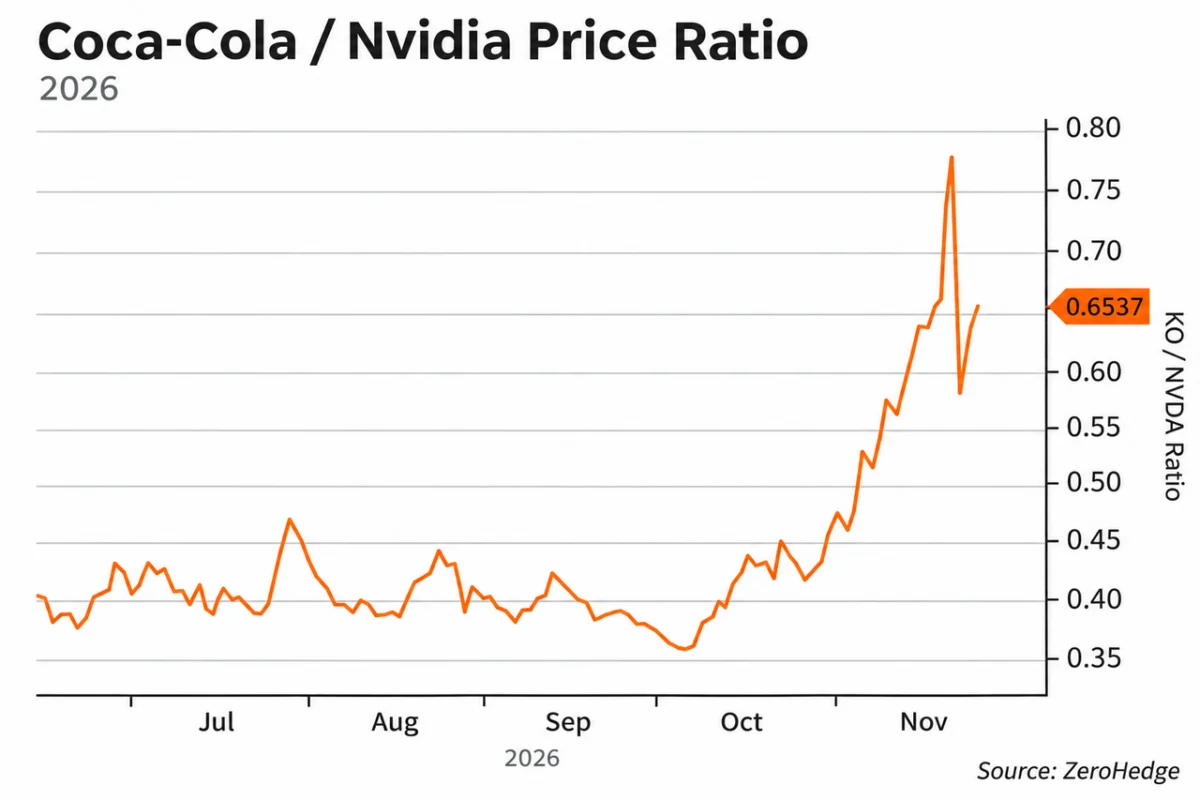
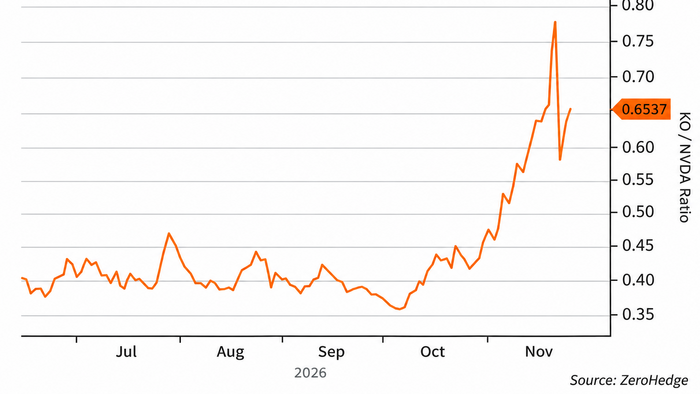
The "Coke-to-Nvidia ratio" chart provides a powerful visual representation of this dynamic. This ratio illustrates how sharply the safety trade, exemplified by Coca-Cola, gained ground from the start of October, relative to a high-growth AI stock like Nvidia. For much of the autumn, as macroeconomic concerns intensified and interest rate hikes continued, investors favored the stability of Coca-Cola over the volatility of Nvidia. However, this trend began to reverse earlier this week, coinciding with reports of Nvidia CEO Jensen Huang’s renewed engagement and positive sentiment surrounding the AI sector. The ratio shows a clear pullback in the dominance of the safety trade, indicating that the scales might be starting to tip back towards growth.
While this pullback in the ratio is significant, it has "yet to establish a sustained reversal." This underscores the ongoing uncertainty. A single week or a few days of shifting momentum does not necessarily confirm a long-term trend change. Traders will continue to monitor this ratio closely, as its sustained movement in either direction will offer critical insights into the market’s broader risk appetite and the durability of the current rally.
Broader Macroeconomic Context and Holiday Trading Dynamics
The current market movements unfold against a complex macroeconomic backdrop. Persistent inflation, while showing some signs of moderation, remains a concern for central banks globally. The Federal Reserve, along with other major central banks, has aggressively raised interest rates over the past year and a half to combat inflation. Higher interest rates typically weigh on equity valuations, especially for growth stocks that rely on future earnings, by increasing the cost of capital and making bonds more attractive relative to stocks. The market is constantly trying to price in the trajectory of future rate hikes and the eventual timing of rate cuts, which remains highly uncertain.
Investor sentiment has also been heavily influenced by concerns about a potential recession. While economic data has shown resilience in some areas, fears of an impending slowdown persist, fueled by tighter monetary policy and geopolitical tensions. This environment has naturally led to a preference for defensive assets and a cautious approach to risk.
The Thanksgiving holiday adds another layer of complexity to market dynamics. Holiday-shortened trading weeks often lead to lower trading volumes and increased volatility, as many institutional investors and traders step away from their desks. This reduced liquidity can sometimes amplify price movements, making it harder to interpret the true underlying sentiment. The early close on Thursday, followed by a full market closure on Friday for the Thanksgiving holiday, means that any significant market shifts observed during this period might be subject to re-evaluation once full trading volumes resume. Traders are often wary of making definitive directional bets during such periods, preferring to wait for more robust market participation.

Implications for Investor Strategies and Forward Outlook
The current juncture presents both opportunities and risks for investors. If the recent surge in AI stocks and the subtle unwinding of the safety trade prove to be the beginning of a sustained reversal, it could signal a broader rotation back into growth and cyclical stocks. This would favor investors with a higher risk tolerance and those positioned in technology, consumer discretionary, and other growth-oriented sectors. Conversely, if this proves to be another bear market rally, defensive sectors could quickly regain their appeal, punishing those who prematurely abandon their safe havens.
For long-term investors, the focus remains on fundamental analysis, identifying companies with strong balance sheets, sustainable competitive advantages, and robust growth prospects, irrespective of short-term market fluctuations. However, for active traders and portfolio managers, the signals from indicators like the Coke-to-Nvidia ratio and the intra-sector rotations within consumer staples provide crucial real-time insights into market psychology.
The coming weeks will be critical in determining the market’s true direction. Factors to watch include further inflation data, central bank communications, corporate earnings reports, and the continued performance of both growth and defensive sectors. A decisive unwind from consumer staples, coupled with sustained strength in AI and semiconductor stocks, would lend significant credence to the argument for a genuine market reversal. Until then, the market remains in a delicate balance, with traders and investors carefully weighing the evidence for either a sustained uptrend or the continuation of a challenging bear market environment. The current rebound, while welcome, serves as a potent reminder of the market’s ongoing search for direction amidst prevailing economic uncertainties.

