
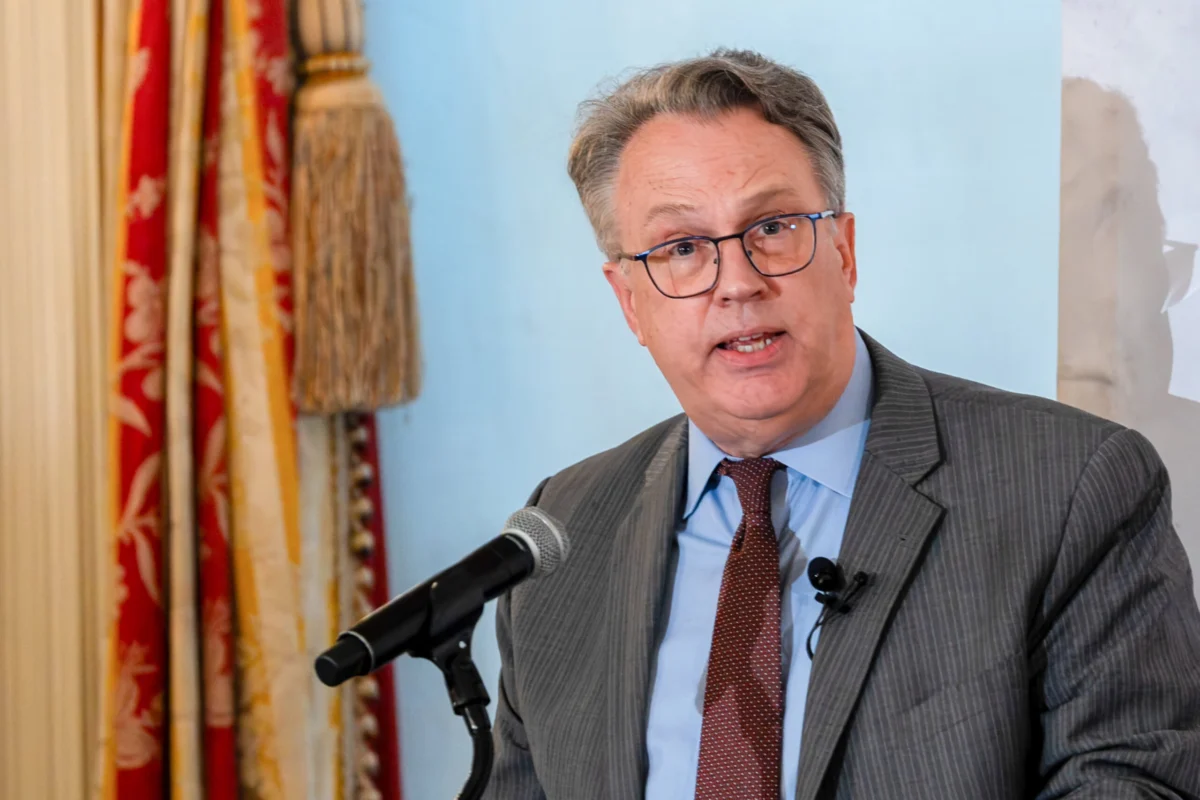
New York Federal Reserve President John C. Williams articulated a resolute stance on the ongoing battle against inflation on Monday, emphasizing that the central bank still has critical work ahead to restore price stability, even as the U.S. economy demonstrates remarkable resilience. Speaking at the University of Mount Saint Vincent in New York, Williams underscored the imperative of achieving the Fed’s 2% inflation target, a goal he projects will be met by 2028, with substantial progress anticipated in 2027. His remarks, delivered just weeks before the Federal Open Market Committee’s (FOMC) crucial December meeting, offered a measured yet firm outlook, balancing the need for continued monetary vigilance with an acknowledgment of robust economic growth.
Williams, a key voice on the FOMC given the New York Fed’s central role in market operations and policy implementation, reiterated that while the economy continues its expansionary path, inflation remains stubbornly above desired levels. "Getting inflation back to 2% is 100% essential," Williams stated, underscoring the unwavering commitment of the central bank. "We must take actions over time that will ensure that we get inflation back to our 2% goal in a timely manner and on a sustained basis. There is still work to do to get that done." This declaration serves as a guiding principle for monetary policy in a period characterized by complex economic crosscurrents.
A Delicate Economic Juncture
The timing of Williams’ address is particularly salient, occurring at what many analysts describe as a "delicate moment" for monetary policy. The U.S. economy, contrary to some earlier forecasts of an imminent slowdown, has consistently defied expectations, maintaining a strong labor market and steady consumption. Recent data, which Williams alluded to, indicates continued robust economic activity. For instance, the latest employment report showed unemployment edging lower to 3.8%, well below its long-run average, while Gross Domestic Product (GDP) growth for the third quarter of 2026 clocked in at an annualized rate of 2.7%, signaling sustained demand.
However, this strength has also contributed to the persistence of elevated inflation. The Consumer Price Index (CPI) has hovered around 4.3% year-over-year, with the Fed’s preferred measure, the Personal Consumption Expenditures (PCE) price index, at 3.9%—both significantly higher than the 2% target. This persistent divergence has fueled internal debate within the FOMC, creating a dichotomy between policymakers who advocate for more aggressive rate hikes to quickly quell inflationary pressures and those, like Williams, who favor a more measured, data-dependent approach to avoid unnecessarily stifling economic growth.
Williams’ perspective aligns with the latter group, emphasizing patience and careful observation of incoming economic data. He did not explicitly pre-commit to a specific action at the upcoming December meeting, instead pointing to the FOMC’s previous statement from late October, which highlighted the importance of "the accumulation of more information" in guiding future policy. However, his subsequent comment that "The data that we have received since then show that the economy has remained strong and that inflation has continued to run too high" strongly suggests that the conditions for further tightening are likely being met.
Understanding the Inflationary Landscape: Geopolitics, AI, and Tariffs
In his analysis of current inflationary pressures, Williams provided a multifaceted perspective, attributing the persistent upward pressure on prices to a confluence of factors. He specifically cited the ongoing geopolitical conflict in Iran, heightened demand for goods associated with the burgeoning artificial intelligence (AI) build-out, and the lingering, albeit diminishing, effects of tariffs.
The conflict in Iran, for instance, has had tangible ripple effects across global energy markets, contributing to volatility in crude oil prices and subsequently impacting transportation and production costs for a wide array of goods and services. While energy prices have seen fluctuations, the underlying tension keeps a floor under them, preventing a more significant disinflationary impulse from this sector.
More novel in Williams’ assessment was the explicit mention of the AI boom as an inflationary driver. The rapid advancement and adoption of artificial intelligence technologies are spurring unprecedented demand for specialized hardware, advanced semiconductors, data centers, and skilled labor. This surge in demand is straining supply chains for critical components and driving up capital expenditure across industries. Companies are investing heavily in AI infrastructure, leading to increased competition for resources and, consequently, higher prices for these foundational technologies. While this initial investment phase may exert upward pressure on prices, Williams expressed confidence that AI’s long-term impact is unlikely to be a source of "more persistent inflation." This nuanced view suggests that while the initial build-out costs are inflationary, the eventual productivity gains and efficiency improvements brought about by AI could, over time, become a disinflationary force, lowering production costs and enhancing supply. This perspective offers a forward-looking dimension to the inflation debate, acknowledging technological shifts as significant economic variables.
Regarding tariffs, Williams noted that their effects as a primary source of inflationary pressure "have largely abated." This suggests that while tariffs imposed in previous years initially raised import costs for businesses and consumers, their incremental impact on current inflation is diminishing as supply chains adjust and companies absorb or re-route production. However, their legacy continues to influence global trade dynamics and domestic production costs.
The Fed’s Dual Mandate and Policy Limitations
Williams’ remarks underscored the Federal Reserve’s dual mandate of achieving maximum employment and price stability. The current economic environment presents a challenging balancing act: a strong labor market suggests the employment objective is largely being met, but elevated inflation means the price stability goal remains elusive. The central bank must navigate these objectives carefully, avoiding actions that could jeopardize the robust labor market while simultaneously bringing inflation back to target.
He also eloquently articulated the limitations of monetary policy, stating, "Monetary policy cannot move ships or reopen pipelines and refineries, but it can — and must — ensure that these shocks do not lead to broader or persistent inflationary dynamics or erode well-anchored inflation expectations." This statement is a critical reminder that while the Fed can influence aggregate demand through interest rates, it cannot directly address supply-side disruptions or geopolitical events that contribute to inflation. Its primary role is to prevent these external shocks from becoming embedded in the broader economy through sustained price increases and a shift in public inflation expectations. Maintaining "well-anchored inflation expectations" is paramount, as a belief that inflation will remain high can become a self-fulfilling prophecy, making the Fed’s job significantly harder.
Market Expectations and the Road Ahead
Financial markets have largely anticipated the Fed’s trajectory, with futures markets fully pricing in a quarter-percentage-point interest rate increase at the upcoming FOMC meeting on December 8-9. This would elevate the federal funds rate target range from its current 3.75%-4% to 4%-4.25%. Williams’ statements, being the last major policy remarks from a Fed official before the blackout period preceding the December decision, served to reinforce these expectations, providing clarity and reducing uncertainty for investors and businesses.
The consistent message from influential Fed officials like Williams helps to guide market behavior and manage public expectations, a crucial aspect of effective monetary policy. By signaling a continued commitment to tightening, albeit at a potentially slower pace than earlier in the cycle, the Fed aims to engineer a "soft landing" – bringing inflation down without triggering a severe recession.
Looking further ahead, Williams expressed confidence that inflation will subside substantially in 2027, even as economic growth remains robust and unemployment edges lower. This optimistic forecast, however, is predicated on the continued effectiveness of monetary policy and the gradual unwinding of various inflationary pressures. He expects the 2% inflation target to be fully achieved in 2028, suggesting that while the path to normalcy is clearer, it will require sustained effort over the next two years.
Chronology of Recent Monetary Policy and Future Outlook:
- September 4, 2025: John Williams speaks at an Economic Club of New York event (as per image caption context, serving as a historical reference point for his public engagements).
- Late October 2026: The Federal Open Market Committee (FOMC) convenes, concluding with a statement emphasizing a data-dependent approach for future policy decisions and noting the "accumulation of more information" would guide the path forward. At this meeting, the federal funds rate was likely maintained at 3.75%-4% or raised by a smaller increment following earlier aggressive hikes.
- Monday, Late November 2026: John Williams delivers his significant remarks at the University of Mount Saint Vincent, reinforcing the need for continued action against inflation and providing detailed insights into the economic landscape. This speech is strategically timed as the final major public commentary from a Fed official before the December FOMC meeting.
- December 8-9, 2026: The next FOMC meeting is scheduled. Markets are fully pricing in a 25-basis-point rate hike, which would lift the federal funds rate to a target range of 4%-4.25%. The committee will assess recent economic data, including employment figures, inflation reports, and GDP growth, in making its decision.
- 2027 Projections: Williams anticipates a substantial deceleration in inflation throughout 2027, moving closer to the Fed’s 2% target. Economic growth is expected to remain robust, and unemployment is projected to stay low, indicating a potentially successful disinflationary process without significant economic contraction.
- 2028 Goal: Williams forecasts that the Federal Reserve’s long-sought 2% inflation target will be fully achieved by 2028, signaling the culmination of the current tightening cycle and a return to price stability.
Broader Impact and Implications
Williams’ consistent message provides clarity for businesses and households alike. For businesses, the expectation of continued, albeit potentially slower, rate hikes means borrowing costs will remain elevated. This could temper investment in certain sectors, particularly those sensitive to interest rates, while encouraging efficiency gains and careful capital allocation. For consumers, higher interest rates translate to increased costs for mortgages, auto loans, and credit card debt, prompting a more cautious approach to spending and borrowing.
The emphasis on AI’s dual role—initially inflationary through investment demand, but potentially disinflationary through productivity gains—offers a long-term perspective on economic evolution. This suggests that policymakers are not only reacting to current economic data but also attempting to understand and integrate the structural changes brought about by technological advancements into their forward guidance.
Ultimately, Williams’ remarks underscore the Federal Reserve’s unwavering commitment to its price stability mandate. Despite the strong economy, the job is not yet done. The path forward remains data-dependent, measured, and focused on ensuring that inflation does not become entrenched, thereby preserving the purchasing power of the dollar and fostering sustainable economic growth for years to come. The December FOMC meeting, informed by these latest insights, will be a critical step in this ongoing endeavor.

