
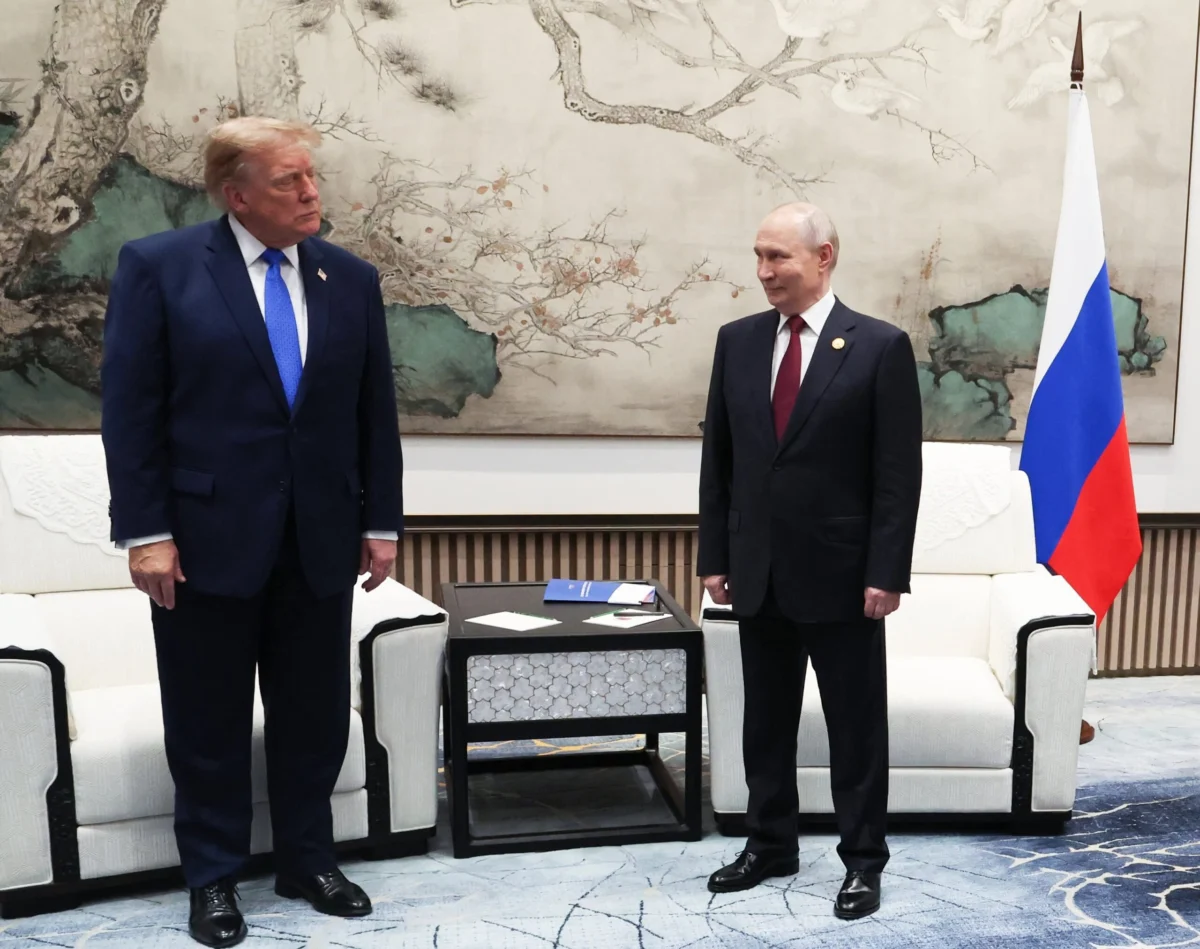
SHENZHEN, China – The Asia-Pacific Economic Cooperation (APEC) Summit in Shenzhen emerged as a pivotal stage for high-stakes international diplomacy on Thursday, November 19, 2026, as U.S. President Donald Trump engaged in separate bilateral meetings with Russian President Vladimir Putin and Chinese President Xi Jinping. These crucial discussions preceded an eagerly anticipated trilateral summit involving all three leaders, signaling a complex and evolving geopolitical landscape at the heart of the Asia-Pacific region. The convergence of these global powers underscored the delicate balance between economic cooperation and strategic competition that defines the current international order.
Bilateral Engagement: Trump and Putin Seek Common Ground Amidst Conflict
President Trump’s meeting with President Putin, held on the sidelines of the APEC forum, lasted approximately 40 minutes and was closely scrutinized by international observers. It marked their first face-to-face encounter since a summit in Alaska in August of the previous year, highlighting a significant gap in direct high-level communication. Upon greeting the Russian president, Trump reportedly expressed that he held a "great relationship" with Putin, noting their long acquaintance and articulating hope that "a lot of wonderful things can come out of this, or at least start." This sentiment, conveyed through pool notes, suggested a desire for renewed diplomatic momentum despite persistent geopolitical frictions.
The core agenda for the Trump-Putin discussions, as confirmed by Russian presidential aide Yuri Ushakov, centered prominently on Russia’s full-scale invasion of Ukraine. This conflict, which has profoundly reshaped European security architecture and triggered widespread international condemnation, remains a critical flashpoint in global affairs. Ushakov indicated that preparations for the forthcoming trilateral summit with China’s President Xi were also a key topic. Following the talks, Ushakov conveyed to Russian state news outlet Ria Novosti that Putin left the meeting in "an excellent mood," a detail that sparked varied interpretations regarding the tenor and potential outcomes of the dialogue.
The conflict in Ukraine, now in its third year, has imposed severe humanitarian costs and spurred significant shifts in global energy markets and supply chains. Previous diplomatic efforts to de-escalate the conflict or broker a lasting peace have largely faltered, making any direct engagement between Washington and Moscow particularly significant. Observers noted that Trump’s stated hope for "wonderful things" could range from discussions on a ceasefire or peace framework to broader strategic stability talks, arms control, or even cybersecurity cooperation, areas where both nations have previously sought common ground despite deep disagreements. The bilateral meeting provided a rare opportunity for direct communication at the highest level, potentially paving the way for future diplomatic initiatives that could impact the trajectory of the protracted conflict. The backdrop of a multilateral economic summit, rather than a dedicated security conference, added an unusual dimension to these politically charged discussions, emphasizing the interconnectedness of economic stability and geopolitical security in the Asia-Pacific.
Navigating US-China Dynamics: Trump and Xi’s Dialogue on Trade and Tech
Earlier on Thursday, President Trump also held a bilateral meeting with Chinese President Xi Jinping. The optics of their engagement were carefully orchestrated, with the two leaders entering the APEC summit room side-by-side and posing for a photograph during their bilateral meeting at Kylin Villa. This visual presentation aimed to project an image of constructive engagement, even as underlying economic and technological tensions between the world’s two largest economies continued to simmer.
During the APEC plenary session, President Xi underscored China’s commitment to regional cooperation by announcing a pledge of $20 million to support APEC initiatives. He further unveiled plans to establish a "Center for Asia-Pacific Community Studies in Shenzhen to conduct policy research and exchanges and provide intellectual support." These moves were widely interpreted as China’s effort to reinforce its leadership role within the Asia-Pacific region and to foster greater integration under its vision for regional development, utilizing its economic might and intellectual resources to shape the future direction of the forum.
President Trump, in his remarks during the morning session, addressed a critical emerging technology issue, stating his opposition to regulating artificial intelligence (AI), arguing that such measures would "stifle" the burgeoning industry. His stance highlighted a prevailing view within certain U.S. policy circles that excessive regulation could impede innovation and disadvantage American companies in the global race for AI dominance. This position contrasts with growing calls internationally for robust regulatory frameworks to address ethical concerns, national security risks, and the societal impact of rapidly advancing AI technologies. The debate over AI governance is a crucial front in the broader technological competition between the U.S. and China, both vying for supremacy in this transformative field.
Trump also reiterated the United States’ enduring role in the region, affirming that "The United States has been a Pacific power for hundreds of years, and we continue to work to promote growth and stability, sovereignty, prosperity, and peace throughout this region." This statement served to reaffirm America’s strategic commitment to the Indo-Pacific, a region vital for global trade, security, and economic growth, and to counter narratives suggesting a potential U.S. disengagement. The emphasis on sovereignty and peace implicitly addressed various regional flashpoints and maritime disputes, where U.S. alliances and presence are seen as crucial for maintaining regional stability.
Notably, U.S. officials had previously indicated that Trump did not intend to raise specific allegations concerning Nvidia’s CEO Jensen Huang and an alleged affair with a Chinese spy during his meetings. This decision underscored a strategic choice to focus on broader economic and geopolitical issues rather than potentially inflammatory individual controversies, despite the heightened sensitivities around technology transfer, industrial espionage, and intellectual property theft that characterize the U.S.-China relationship. The omission of such a high-profile, sensitive topic suggested a calculated effort to maintain a focus on macro-level policy discussions.
The APEC Forum: A Platform for Economic Showcase and Dialogue
The APEC Summit itself served as a significant platform beyond the high-level bilateral and trilateral discussions. Established in 1989, APEC comprises 21 member economies across the Asia-Pacific region, representing approximately 60% of global GDP and nearly half of world trade. Its primary objective is to promote free trade and economic cooperation throughout the Asia-Pacific, fostering sustainable growth and prosperity. The summit provides a unique forum for leaders to address common economic challenges and advance regional integration.
China’s decision to host the APEC summit in Shenzhen was a deliberate strategic choice. Michael Hart, President of AmCham China, articulated this point, stating, "By hosting APEC in Shenzhen, China took the opportunity to showcase another of its economic powerhouse cities, this time one that is home to some of the country’s leading technology companies and innovators." Shenzhen, a sprawling metropolis in southern Guangdong Province, has transformed from a fishing village into a global technology hub over the past four decades, earning it the moniker "China’s Silicon Valley." It is home to tech giants like Huawei, Tencent, and DJI, and serves as a crucial center for hardware manufacturing, innovation, and R&D. The city’s rapid development and technological prowess presented a powerful narrative of China’s economic strength and ambition to the assembled world leaders and business delegates.
Hart further elaborated on the perspective of American businesses, remarking, "The scale of China’s economic strength and technological ambition is clear to U.S. businesses. They recognize the importance of the Chinese market, but also understand that they need to remain competitive, innovative, and prepared to compete in an increasingly sophisticated business environment." This statement encapsulated the complex reality faced by international corporations navigating the Chinese market – a vast consumer base and manufacturing ecosystem coupled with intense domestic competition, evolving regulatory landscapes, and geopolitical headwinds. The APEC summit in Shenzhen thus became a microcosm of these broader economic dynamics, emphasizing both the opportunities and the challenges inherent in global economic interdependence. Discussions during the broader APEC sessions also likely encompassed topics such as enhancing supply chain resilience, fostering digital economy growth, promoting green and sustainable development, and advancing regional trade facilitation initiatives, all critical for the post-pandemic global economic recovery.
The Anticipated Trilateral Summit: A New Geopolitical Configuration?
The most significant event anticipated from the Shenzhen summit was the scheduled trilateral meeting between Presidents Trump, Putin, and Xi. Such a high-level convergence of the leaders of the United States, Russia, and China—three of the world’s most influential powers—is a rare occurrence and carries immense geopolitical weight. While the exact agenda for this unprecedented gathering was not publicly detailed, it was widely expected to cover a spectrum of pressing global issues.
Analysts suggested that the trilateral discussions could potentially address global stability, strategic arms control, climate change cooperation, and regional security challenges, including the ongoing conflict in Ukraine and tensions in the Indo-Pacific. The meeting could serve as a platform for de-escalation, exploring common ground where shared interests might override existing rivalries. For instance, all three nations have an interest in global economic stability, preventing nuclear proliferation, and combating terrorism, offering potential avenues for cooperative dialogue.
However, the inherent complexities and deep-seated divergences among the three nations present substantial hurdles. The U.S. and Russia are at loggerheads over Ukraine and broader European security, while the U.S. and China are engaged in intense strategic competition across economic, technological, and military domains. Russia and China, on the other hand, have forged an increasingly close strategic partnership, often presenting a united front against perceived Western hegemony. The trilateral format, therefore, carries the potential for either groundbreaking diplomatic breakthroughs or a stark reaffirmation of existing fault lines. The optics of the meeting itself, regardless of substantive outcomes, would send a powerful message about the state of global power dynamics and the willingness of these major players to engage in direct, high-level dialogue to manage complex international challenges.
Implications and Outlook
The APEC Summit in Shenzhen, particularly the series of high-level bilateral and the anticipated trilateral meetings, underscored the critical juncture at which global diplomacy finds itself. For the United States, President Trump’s engagements with Putin and Xi were crucial for recalibrating diplomatic relations amidst ongoing conflicts and intensifying competition. The desire for "wonderful things" with Putin, alongside the reaffirmation of U.S. commitment to the Pacific, suggested a multi-pronged approach to foreign policy, balancing assertive leadership with a willingness to engage.
For Russia, the meeting with Trump provided an opportunity to break diplomatic isolation and signal a potential pathway for dialogue on Ukraine, a conflict that has significantly impacted its international standing and economy. President Putin’s reported "excellent mood" suggested that the discussions, at minimum, met Russia’s expectations for engagement.
China, as the host, successfully utilized APEC to project its image as a responsible global power and a leader in regional economic integration, while simultaneously navigating complex bilateral relationships with both the U.S. and Russia. Xi Jinping’s initiatives to bolster APEC and showcase Shenzhen highlighted China’s aspiration for greater influence in shaping the future of global governance and the regional order.
The broader implications for global stability are profound. The ability of these three nuclear powers to engage in direct dialogue, even amidst deep divisions, is seen by many as essential for preventing miscalculation and managing escalating tensions. The APEC forum, traditionally focused on economic cooperation, has thus transformed into a critical arena for high-stakes political maneuvering, reflecting the inseparable link between economic prosperity and geopolitical security in the 21st century. The outcomes of these discussions in Shenzhen are expected to shape the trajectory of international relations, regional dynamics in the Indo-Pacific, and the future of global multilateralism for years to come.

