

The United States housing market in 2026 presents a complex and dynamic environment for real estate investors, particularly those focused on rental properties. Understanding the nuances of state-level regulations is paramount, as the distinction between "landlord-friendly" and "tenant-friendly" markets can significantly influence cash flow and return on investment. This analysis delves into the characteristics that define a landlord-friendly state, explores the top five states currently exhibiting these traits, and examines why investors might still consider markets with more tenant-centric laws, offering a comprehensive perspective for strategic investment decisions.
What Constitutes a Landlord-Friendly State?
A landlord-friendly state is characterized by a legal and regulatory framework that generally favors property owners and simplifies the management of rental properties. These environments often feature laws and policies designed to reduce the barriers to entry and the operational costs associated with being a landlord. It is crucial to note that this designation does not imply that tenant rights are disregarded. Every state enforces tenant protection laws, and landlords are legally obligated to understand and comply with them. A strong landlord-tenant relationship is universally recognized as a cornerstone of successful rental property management.
Instead, landlord-friendly markets typically exhibit a combination of the following attributes:
Favorable Property Tax Regimes
Property taxes are a significant ongoing expense for landlords. In 2026, effective property tax rates across the U.S. can range from approximately 0.25% to 2% of a property’s assessed value. While property taxes are generally tax-deductible, higher rates in certain states directly reduce a landlord’s net operating income and can negatively impact capitalization rates (cap rates). Given that real estate taxes are often subject to annual increases, investing in states with lower property tax rates can help preserve a larger portion of rental income, thereby enhancing cash flow. For instance, states with consistently low property tax burdens allow landlords to retain more of their gross rental income, translating into a more robust financial return on their investment.
Absence of Rent Control Policies
Rent control, a set of regulations that limit the amount landlords can charge for rent and dictate the frequency and magnitude of rent increases, is primarily intended to ensure housing affordability and market stability for tenants. However, these measures can pose substantial challenges for landlords, particularly in periods of rising operational costs. When expenses such as insurance premiums, property taxes, management fees, and repair costs escalate, landlords operating under rent control may be unable to adjust rental rates accordingly. This can lead to a squeeze on profit margins, potentially forcing landlords to defer essential maintenance or major repairs, which can, in turn, diminish the long-term value and revenue potential of their investment properties. Consequently, many new real estate investors are drawn to states that do not impose rent control, seeking greater flexibility in pricing their rentals to align with market conditions and cover increasing costs.
Streamlined Entry and Licensing Procedures
The process of becoming a landlord can involve obtaining various licenses and permits, the requirements for which can vary significantly based on property type, rental strategy (e.g., short-term vs. long-term rentals), and geographic location. Some states impose stringent licensing requirements that can substantially increase initial setup costs. Landlord-friendly states generally offer more accessible pathways for investors to establish their rental property businesses, minimizing bureaucratic hurdles and reducing upfront financial outlays. This ease of entry can be a critical factor for investors looking to deploy capital efficiently and begin generating returns with fewer initial impediments.
Uncapped Security Deposit Limits
Security deposits serve as a vital financial safeguard for landlords, protecting against potential losses from unpaid rent or utilities, property damage beyond normal wear and tear, lease violations, and the costs associated with professional cleaning during tenant turnover. In states that cap security deposits, landlords may find that the maximum deposit allowed is insufficient to cover significant damages or accumulated arrears. Furthermore, lower security deposit limits can offer less insight into a prospective tenant’s financial stability. Markets without security deposit caps provide landlords with greater flexibility and more comprehensive protection. However, it is important to note that even in these states, landlords are typically expected to set "reasonable" deposit amounts that are commensurate with the rental property and potential risks.
Minimal Notice-of-Entry Requirements
The ability for landlords to access their rental properties with minimal legally mandated notice periods is essential for various reasons. These include conducting necessary inspections, performing routine maintenance and repairs, showing the property to prospective tenants or buyers, and responding to emergencies. While specific requirements vary, landlord-friendly states often permit entry with reasonable notice, typically ranging from 24 to 48 hours, facilitating efficient property management. This allows landlords to address issues promptly, maintain property condition, and minimize vacancies without protracted delays imposed by lengthy notification procedures.
Efficient Eviction Processes
While no landlord anticipates the need for eviction, it remains a potential reality in the rental property business. The eviction process can vary dramatically in duration and cost across the United States, ranging from as little as three weeks to as long as six months from the initial notice to the final lockout. In situations where tenants fail to pay rent, extended eviction timelines mean landlords must continue to cover operational costs out of pocket. Furthermore, during protracted eviction proceedings, disgruntled tenants may cause additional damage to the property. States with streamlined and cost-effective eviction processes offer landlords greater protection against financial losses and property damage, making them more attractive for investment.
Additional Landlord Protections and Rights
Beyond the aforementioned characteristics, some states offer further incentives for landlords, such as the absence of limits on late rent fees or provisions for the immediate disposal of abandoned property left by former tenants. State preemption laws, which prevent local governments from enacting regulations that contradict state-level landlord-tenant laws, can also contribute to a more consistent and predictable operating environment.

It is important to acknowledge that not every state listed as landlord-friendly will possess all these attributes. The designation often arises from a favorable balance of these characteristics relative to typical state laws. For example, in Texas, while landlords benefit from no rent control and a relatively straightforward eviction process, they may contend with higher property taxes. Furthermore, the regulatory landscape can be complex, with individual cities and municipalities sometimes implementing their own ordinances that may differ from state laws. Therefore, thorough due diligence at both the state and local levels is always necessary.
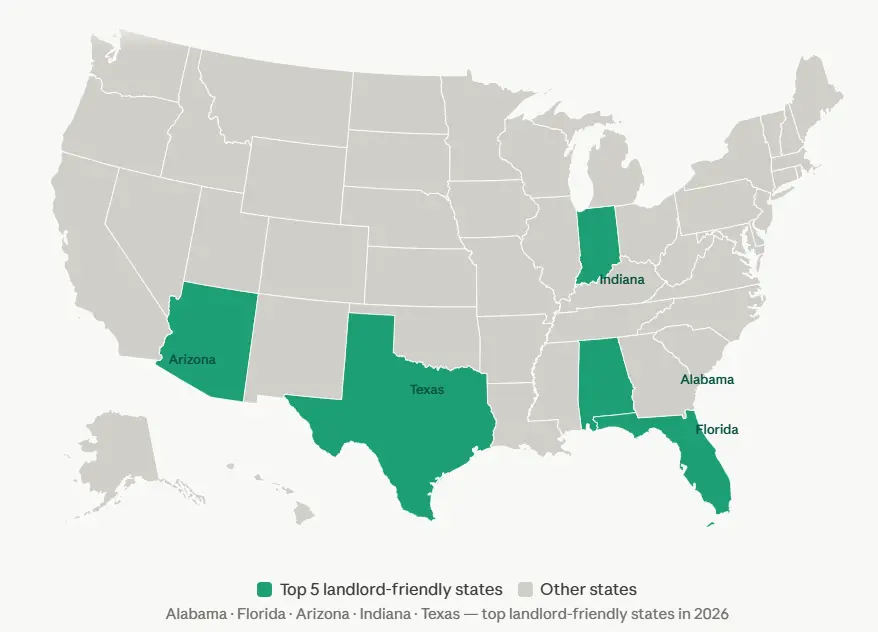
The Top 5 Most Landlord-Friendly States in 2026
Based on the combination of favorable regulations and market conditions, several states consistently emerge as top destinations for real estate investors prioritizing a landlord-centric environment.
Alabama
Alabama is frequently cited for its minimal regulations impacting individual landlords. The state generally offers a low barrier to entry for property ownership and management. Key characteristics include:
- Low Property Taxes: Alabama typically boasts some of the lowest property tax rates in the nation, significantly reducing the ongoing cost of property ownership.
- No Rent Control: The state does not have statewide rent control laws, allowing landlords to adjust rents based on market conditions.
- Streamlined Eviction Process: Evictions in Alabama are generally considered more efficient than in many other states, with timelines that can be as short as a few weeks for uncontested cases.
- Uncapped Security Deposits: Landlords have flexibility in setting security deposit amounts.
- Limited Licensing Requirements: The state has fewer stringent licensing requirements for landlords.
Top Landlord-Friendly City with High Average Cap Rate: Birmingham often presents attractive investment opportunities due to its affordability and potential for solid rental income, contributing to competitive cap rates.
Florida
Florida has long been a popular destination for real estate investors, offering a business-friendly climate that extends to its landlord-tenant laws.
- No Rent Control: Florida law prohibits local governments from enacting rent control ordinances, providing landlords with rent-setting autonomy.
- Efficient Eviction Process: The state generally offers a relatively swift eviction process, particularly for non-payment of rent.
- Uncapped Security Deposits: Landlords can set security deposits without state-imposed caps, providing enhanced financial protection.
- Strong Tenant Demand: Robust population growth and a thriving tourism sector contribute to consistent demand for rental properties.
- Favorable Tax Environment: While property taxes exist, they are often competitive, and the state has no state income tax.
Top Landlord-Friendly City with High Average Cap Rate: Orlando, benefiting from its status as a major tourist hub and growing population, often demonstrates strong rental yields and attractive cap rates for investors.
Arizona
Arizona’s legal framework and economic growth make it a compelling choice for landlords.
- No Rent Control: Similar to Florida, Arizona prohibits rent control measures at the local level.
- Relatively Quick Eviction Process: The eviction process in Arizona is designed to be relatively efficient, aiding landlords in regaining possession of their property when necessary.
- Uncapped Security Deposits: Landlords in Arizona can determine security deposit amounts without state limitations.
- Growing Economy and Population: The state’s expanding economy and influx of new residents drive demand for rental housing.
- Low Property Taxes (Compared to some states): While not the absolute lowest, Arizona’s property taxes are generally considered moderate, especially when balanced against other economic factors.
Top Landlord-Friendly City with High Average Cap Rate: Phoenix, as the state’s largest metropolitan area, offers diverse investment opportunities with consistent rental demand and potentially high cap rates, particularly in its growing submarkets.
Indiana
Indiana offers a stable and predictable environment for rental property owners, characterized by a balanced approach to landlord-tenant relations.
- No Rent Control: Indiana does not implement rent control policies.
- Efficient Eviction Process: The state generally allows for a straightforward eviction process, enabling landlords to resolve issues with non-paying tenants efficiently.
- Uncapped Security Deposits: Landlords have the discretion to set security deposit amounts.
- Affordable Cost of Living and Housing: Indiana generally provides more affordable housing options, which can translate into lower purchase prices for investment properties and a wider pool of potential renters.
- Strong Eviction Protections for Landlords: Indiana law provides clear guidelines and protections for landlords seeking to evict tenants for cause.
Top Landlord-Friendly City with High Average Cap Rate: Indianapolis, the state capital and largest city, provides a robust rental market with a mix of urban and suburban opportunities, often yielding competitive cap rates.
Texas
Texas presents a unique investment landscape with strong economic drivers and a business-friendly stance, though it requires investors to navigate specific considerations.
- No Rent Control: Texas law expressly prohibits rent control, offering landlords significant freedom in setting rental rates.
- Relatively Efficient Eviction Process: While requiring adherence to specific notice periods, the eviction process in Texas is generally considered more streamlined than in many other states.
- Uncapped Security Deposits: Landlords can set security deposit amounts without state-imposed limits.
- No State Income Tax: The absence of state income tax is a significant advantage for investors, boosting overall returns.
- Economic Growth and Population Boom: Texas continues to experience substantial population growth and economic expansion, fueling consistent demand for rental properties.
- Higher Property Taxes: A notable trade-off for some of the landlord-friendly aspects of Texas is its relatively higher property tax rates compared to other states on this list.
Top Landlord-Friendly City with High Average Cap Rate: Dallas-Fort Worth metroplex, with its dynamic economy and vast population, offers numerous opportunities for investors seeking strong rental income and appreciation potential, often resulting in attractive cap rates. Houston also remains a significant market with comparable potential.
Why Investors Might Choose Tenant-Friendly States
Despite the apparent advantages of landlord-friendly markets, a significant number of real estate investors strategically choose to invest in areas with more tenant-centric regulations. This decision is often driven by a deeper analysis of market fundamentals that can outweigh regulatory considerations.
For instance, a Q4 2025 Redfin report highlighted a notable increase in investor purchases in the Milwaukee housing market. Despite Milwaukee’s recent implementation of renter-friendly regulations, such as extended eviction timelines and stricter security deposit and inspection requirements, investor activity surged by 24%. This indicates that factors beyond regulatory friendliness can drive investment decisions.
Daryl Fairweather, Chief Economist at Redfin, emphasizes that "Landlord-friendly and tenant-friendly labels can be helpful, but they can be too broad to guide an investment decision on their own. What matters more is the underlying economics (fundamentals) of a market, like home prices, rent levels, job growth, and long-term demand." She further elaborates, "A landlord-friendly market with weak fundamentals can underperform a tenant-friendly market with strong population growth and tight supply, for example. I would suggest that investors should treat the regulatory environment as just one of many factors."
The Role of Market Fundamentals in Investment Decisions
The core principle is that regulatory environments are just one piece of the investment puzzle. Markets with strong underlying economic indicators, such as robust job growth, consistent population migration, and high demand for housing, can often yield superior returns even with more stringent tenant protections. Conversely, a landlord-friendly market with weak economic fundamentals might experience stagnant appreciation or declining rental demand, leading to underperformance.
Fairweather cautions that "Landlord-friendly doesn’t always mean low risk. Typically in some of these markets, rapid investor activity has already driven up prices, which can compress yields. There’s also the risk of overbuilding or economic volatility. Just because regulations are favorable doesn’t mean the investment will perform well. Always start by paying close attention to fundamentals like affordability, migration trends, and local employment."
Expert Strategies for Investing in Tenant-Friendly Markets
For investors who identify promising opportunities in tenant-friendly states, adapting investment strategies is crucial.
Navigating Rent Control
In markets with rent control, optimizing cash flow begins with the acquisition phase. Fairweather advises, "In rent-controlled markets, cash flow starts with the purchase price. You need to buy at a basis that makes sense given future rent constraints." She suggests focusing on minimizing tenant turnover and vacancy by maintaining properties well and fostering positive tenant relationships. Additionally, some investors seek properties where permissible rent increases, such as inflation-based adjustments or capital improvement pass-throughs, can help offset rising costs over time.
Professional Operations and Diligent Underwriting
When investing in tenant-friendly states, conservative underwriting and professional operations are paramount. This involves meticulous tenant screening, setting appropriate initial rents, and budgeting for potentially longer timelines when addressing issues. A thorough understanding of local regulations—including notice periods, eviction timelines, and rent increase rules—is essential to avoid unexpected challenges. Engaging local property managers or legal experts, particularly for first-time investors in such markets, is highly recommended.
The Bottom Line: Beyond Labels, Focus on Deal Fundamentals
In today’s real estate environment, the simplistic labels of "landlord-friendly" or "tenant-friendly" should not be the sole determinants of an investment decision. As Redfin’s Fairweather observes, "That’s increasingly true. What we’re seeing now is that investors are prioritizing fundamentals over labels. A market like Milwaukee, for example, may be considered tenant-friendly, but if it offers relatively affordable entry points and stable rental demand, it can still be attractive. Meanwhile, some traditionally landlord-friendly markets—like parts of Florida—have cooled due to rising prices and insurance costs. So today, the more important question is: ‘Does the deal make sense given the local market conditions?’ Regulation matters, but it’s not the whole story."
Ultimately, successful real estate investment hinges on a rigorous analysis of the deal’s numbers and the broader market context. By prioritizing fundamental economic indicators, understanding local regulations, and employing strategic investment approaches, investors can identify profitable opportunities in any market, regardless of its perceived friendliness to landlords or tenants. Tools and data platforms that facilitate comprehensive deal underwriting are indispensable for making informed decisions and achieving long-term success in the ever-evolving real estate landscape.

