
For decades, the bedrock of real estate valuation has been the concept of comparable properties, or "comps." These are properties similar in location, size, condition, and features to the one being assessed, serving as crucial benchmarks for estimating market value and income potential. However, the traditional method of gathering and analyzing this data has been a significant bottleneck, consuming vast amounts of an analyst’s time and introducing inconsistencies. This manual process, while historically essential, struggles to keep pace with the demands of modern, scalable real estate investment and development. The emergence of real estate comps APIs is fundamentally changing this landscape, offering a path toward faster, more reliable, and data-driven decision-making.
At its core, a real estate comps API (Application Programming Interface) automates the retrieval of structured comparable sales and rental data. Instead of analysts manually sifting through multiple listing services, public records, and fragmented databases, an API allows software applications to request and receive this vital information programmatically. This transformation is not merely about efficiency; it’s about enabling more robust valuation models, more accurate Debt Service Coverage Ratio (DSCR) analyses, and ultimately, more informed investment strategies. Investors, developers, and financial institutions are now integrating this market intelligence directly into their existing tools and workflows, marking a significant evolution in how real estate assets are evaluated.
The Enduring Importance of Comparable Property Data
The principle behind using comparable property data for valuation is straightforward: market participants, acting rationally, will price similar properties similarly. When an analyst seeks to determine the Fair Market Value (FMV) of a property, they look for recent sales of comparable properties in the same vicinity. Similarly, for income-generating properties, rental comps are essential for projecting potential revenue streams, a critical component of investment analysis. These benchmarks provide an objective, market-driven perspective, moving beyond subjective assessments.
Traditionally, two primary categories of comps have been utilized:
- Sales Comps: These refer to recently sold properties that share key characteristics with the subject property. They are the primary driver for estimating a property’s market value.
- Rental Comps: For investment properties, rental comps provide data on the typical rental rates achieved by similar properties in the area. This is crucial for forecasting rental income and assessing profitability.
The integration of both sales and rental comps forms the foundation for sound pricing, thorough underwriting, and strategic investment decisions. This is particularly true for investors aiming to build repeatable valuation frameworks across diverse markets and property types, where consistency and accuracy are paramount.
The Limitations of Traditional, Manual Comp Analysis
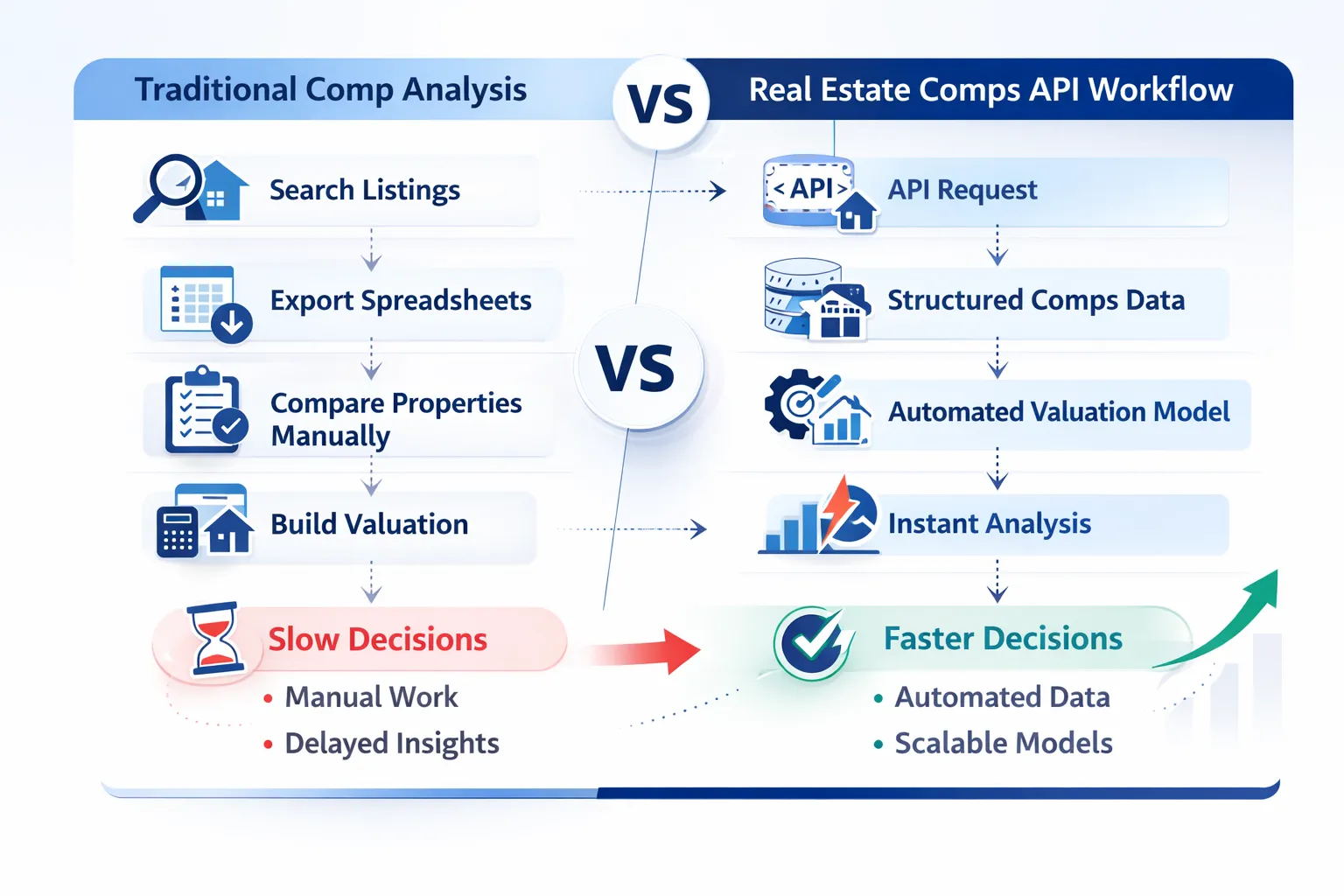
The effectiveness of comps is undeniable, but the traditional methods of acquiring and processing this data are fraught with challenges, especially as portfolios grow and the pace of transactions accelerates. The process typically involves:
- Manual Data Aggregation: Analysts spend considerable time searching disparate sources – MLS listings, public records, real estate portals, and even physical inspections – to identify suitable comparables.
- Data Reconciliation: Once data is gathered, it’s often inconsistent in format, completeness, and accuracy. Significant effort is required to clean, standardize, and reconcile these fragmented datasets.
- Time-Intensive Workflows: The entire process, from initial search to final analysis, can be exceptionally time-consuming, often taking hours for a single property.
- Inconsistent Application: Subjectivity can creep into the selection and weighting of comps, leading to variations in valuations even among experienced analysts.
- Scalability Issues: As the volume of deals increases, manual workflows become an insurmountable bottleneck, slowing down decision-making and limiting the number of opportunities that can be realistically evaluated.
- Delayed Insights: The lag time in data collection and processing means that market conditions may have shifted by the time a valuation is finalized, potentially leading to missed opportunities or flawed strategies.
These limitations become exponentially more pronounced for institutional investors, large development firms, and PropTech companies managing extensive portfolios or processing a high volume of transactions. The need for automated, structured data delivery through APIs has become a critical differentiator in achieving efficiency and maintaining a competitive edge.
Understanding the Real Estate Comps API: A Paradigm Shift
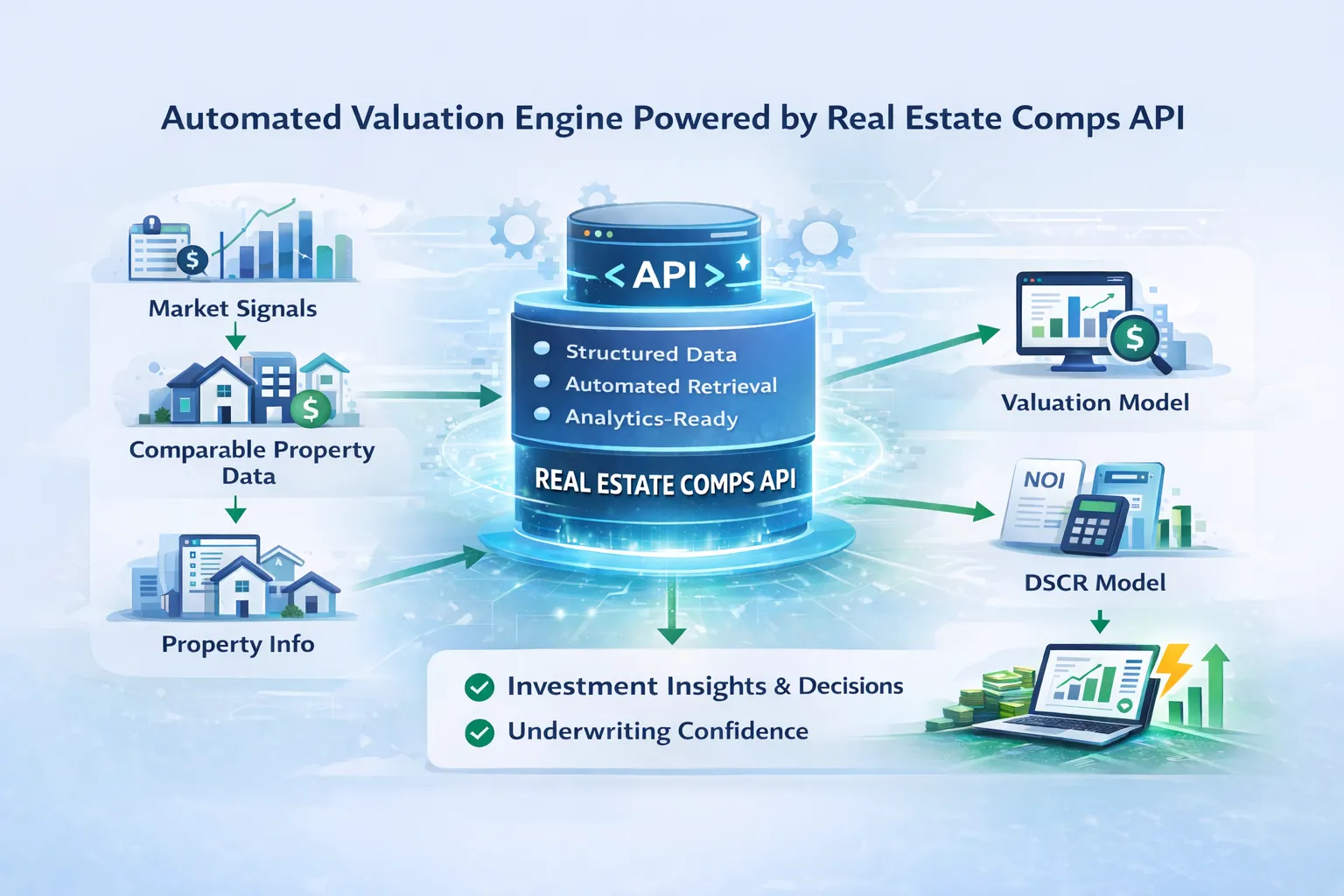
A real estate comps API serves as an automated data pipeline, delivering structured comparable property data directly into analytical systems. Instead of manual research, users query the API with specific property criteria, such as location, property type, or size. The API then returns standardized, ready-to-use comps data, including recent sales prices, rental rates, property characteristics, and market benchmarks.
This shift from static reports to automated valuation can be visualized as a streamlined workflow:
- Automated Data Request: A software application or platform initiates a request to the comps API, specifying the parameters for the desired comparable properties.
- API Data Retrieval: The API accesses its comprehensive database, identifies relevant comparables based on the query, and extracts key data points.
- Structured Data Delivery: The API returns the information in a standardized format, typically JSON, which is easily parsable by computer systems.
- Direct Integration: This structured data is fed directly into valuation models, underwriting software, dashboards, or other analytical tools, eliminating manual data entry.
- Automated Analysis: Valuation and underwriting models can then process this data instantly, generating insights and outputs without human intervention.
This automated process allows for the on-demand retrieval of up-to-date datasets. Because the data is delivered in a standardized format, it can be immediately integrated into valuation logic, making it repeatable and scalable across different property types and geographic markets.
The API’s Place in Modern Real Estate Technology Stacks
Comparable property data is no longer a standalone report but an integral component embedded directly into the operational workflows of real estate businesses. A real estate valuation API acts as a foundational data layer, powering a range of applications and tools used by:
- Investment Firms: For rapid deal screening, portfolio analysis, and market trend identification.
- Real Estate Developers: To assess project feasibility, land acquisition valuations, and market demand.
- Lending Institutions: To underwrite loans, determine collateral values, and manage risk.
- Property Management Companies: To set optimal rental pricing and assess property performance.
- PropTech Platforms: To build automated valuation tools, investment analytics dashboards, and client-facing reporting features.
For technical teams, a real estate API for developers eliminates the significant burden of aggregating raw listing data, building and maintaining complex data pipelines, and ensuring data quality. Instead, an automated property valuation API provides readily consumable comps data that can be seamlessly integrated into existing underwriting systems, investor dashboards, or comprehensive investment analysis platforms. This allows development teams to focus on building innovative features and user experiences rather than wrestling with data infrastructure.
Mashvisor Real Estate Comps API: Comprehensive Data and Endpoints
The utility of a comparable sales data API is directly proportional to the quality, structure, and comprehensiveness of the data it provides. The Mashvisor API aims to address this by offering a unified real estate analytics API that delivers comparable property datasets enriched with market benchmarks, investment analytics, and performance indicators. This integration allows users to transition directly from raw comps to actionable valuation and underwriting insights without the need for extensive additional data processing.
The Mashvisor API provides structured comparable property data designed to support a wide array of real estate valuation models, pricing analyses, and investment decision-making processes.
Key Data Points Available Through Mashvisor API
The Mashvisor API offers two main categories of data:
Property-Level Comparable Data:
- Address: The street address of the comparable property.
- Property Type: Categorization (e.g., Single Family, Condo, Townhouse).
- Sale Price: The price at which the comparable property was recently sold.
- Rental Price: The typical monthly rental income for comparable properties.
- Square Footage: The living area of the property.
- Number of Bedrooms and Bathrooms: Key functional attributes.
- Year Built: Age of the property.
- Property Condition: A qualitative assessment or score if available.
- Lot Size: For single-family homes, the acreage or dimensions of the land.
- Key Amenities: Features like a garage, pool, or basement.
Market and Investment Context:
- Property Valuation Estimates: Mashvisor’s proprietary valuation models based on available data.
- Rental Income Projections: Estimated monthly rental income based on market comparables.
- Cash-on-Cash Return: An indicator of the annual return on investment relative to the cash invested.
- Cap Rate (Capitalization Rate): A measure of a property’s profitability relative to its purchase price.
- Occupancy Rates: Historical or projected occupancy levels for similar rental properties.
- Neighborhood Demographics: Key demographic data relevant to investment potential.
- Market Trends: Insights into local market appreciation and rental demand.
These endpoints enable users to integrate a real estate investment analysis API directly into their acquisition pipelines or real estate underwriting processes, streamlining the entire workflow from data acquisition to decision-making.
Example Mashvisor API Endpoints and Their Functionality
Mashvisor provides access to comparable property data through a suite of dedicated API endpoints, each designed to serve specific analytical needs:
- GET /v1.1/client/property: Retrieves detailed information for a specific property, which can serve as a reference point for finding comps.
- GET /v1.1/client/property/nearby: This is a core endpoint for comps analysis. It allows users to request comparable properties located within a specified radius of a given address, property type, or geographic coordinates.
- GET /v1.1/client/property/transactions: Fetches historical sales transaction data for properties within a defined area, providing a direct source for sales comps.
- GET /v1.1/client/property/price-estimates: Provides Mashvisor’s estimated market value for a property, useful for cross-referencing with comps or as an initial valuation.
These endpoints collectively empower a fully automated comps workflow, replacing time-consuming manual research with structured, on-demand data retrieval.
Example Request: Retrieving Comparable Properties
Consider a real estate developer looking to value a potential acquisition in Phoenix, Arizona. They can use the Mashvisor API to quickly pull nearby comparable properties.
GET https://api.mashvisor.com/v1.1/client/property/nearby?state=AZ&city=Phoenix&address=123+Main+St
Headers:
x-api-key: YOUR_API_KEY
This request would instruct the API to find properties in Phoenix, Arizona, that are geographically close to "123 Main St" and suitable for use as real estate comps for valuation modeling.
Simplified Example Response
The API would then return structured comparable property data, ready for direct integration into valuation or underwriting models:
  "subject_property":
    "address": "123 Main St",
    "property_type": "Single Family",
    "price_estimate": 420000
  ,
  "nearby_properties": [

      "address": "118 Main St",
      "sale_price": 415000,
      "beds": 3,
      "baths": 2,
      "distance_miles": 0.3
    ,

      "address": "140 Oak Ave",
      "sale_price": 432000,
      "beds": 3,
      "baths": 2,
      "distance_miles": 0.6

  ]
The data is returned in a standardized JSON structure, enabling immediate use in valuation dashboards and automated underwriting tools without any manual formatting.
Building Smarter Valuation & DSCR Models with Mashvisor Data
The integration of comparable property data directly into analysis workflows dramatically enhances the accuracy and scalability of real estate valuation and DSCR models. By automating comps retrieval through an API, investors and developers can standardize assumptions, significantly reduce manual research efforts, and consistently evaluate properties against reliable market benchmarks.
How to Build a Property Valuation Model Using Comparable Data
Accurate property valuation models are built on the principle of using comparable sales to estimate Fair Market Value. This method reflects observable market behavior rather than subjective pricing assumptions. Leveraging API-delivered comps allows this process to be replicated automatically across numerous properties and markets.
A simplified workflow for building a real estate valuation model using API data includes:
- Input Property Data: Provide the subject property’s characteristics (address, size, type) to the valuation system.
- API Request for Comps: The system automatically queries the comps API for nearby properties that match the subject’s criteria.
- Data Ingestion and Standardization: The API returns structured comps data, which is directly ingested by the valuation model.
- Valuation Calculation: The model applies a predefined algorithm (e.g., averaging prices of the closest, most similar comps, adjusted for differences) to calculate the subject property’s FMV.
- Output and Reporting: The calculated valuation, along with supporting comps data, is presented in a report or dashboard.
As comps are delivered through an API for real estate valuation, the model can run automatically whenever new properties are analyzed, ensuring consistent valuation at scale.
Using Comps Data for DSCR Model Real Estate Analysis
The Debt-Service Coverage Ratio (DSCR) is a critical metric for lenders, measuring a property’s ability to cover its debt obligations from its net operating income (NOI). Accurate DSCR calculations depend heavily on realistic income and valuation assumptions. Comparable property data significantly improves DSCR accuracy by grounding these projections in verified market activity.
DSCR Calculation Formula:
DSCR = Net Operating Income / Total Debt Service
To calculate DSCR for a rental property, analysts typically:
- Estimate Potential Gross Income (PGI): Based on rental comps, determine the projected annual rental income.
- Account for Vacancy and Credit Losses: Deduct a realistic percentage for periods when the property is vacant or tenants default.
- Calculate Effective Gross Income (EGI): PGI minus vacancy and credit losses.
- Determine Operating Expenses: Estimate annual costs such as property taxes, insurance, maintenance, and property management fees.
- Calculate Net Operating Income (NOI): EGI minus operating expenses.
- Identify Total Debt Service: Sum of all annual mortgage payments (principal and interest).
- Compute DSCR: Divide NOI by Total Debt Service.
Accurate comps are vital for this process. Overestimated valuations or unrealistic income assumptions – common underwriting errors – can lead to inaccurate DSCR calculations, masking underlying risks. By providing verifiable market data, comps APIs help mitigate these errors.
Automating Rental Property Underwriting Workflows
When comparable property data is delivered programmatically via an API, underwriting can transition from a manual, review-intensive process to an automated evaluation system. This automation creates a robust pipeline:
API → Valuation Model → DSCR Calculation → Investment Decision
This form of rental property underwriting automation allows platforms to:
- Process Deals Rapidly: Evaluate a high volume of loan applications or investment opportunities in a fraction of the time.
- Standardize Underwriting Criteria: Ensure that every deal is assessed using the same objective, data-driven metrics, reducing bias and improving consistency.
- Enhance Risk Management: Identify potential red flags or deviations from market norms more quickly through automated data analysis.
- Free Up Analyst Time: Allow human capital to focus on complex exceptions, strategic analysis, or client relationships rather than repetitive data gathering.
Instead of building data infrastructure from scratch, businesses can leverage a real estate data API partnership to supply standardized comps data, ready for immediate integration into their analytical models.
Real-World Example: Automating DSCR-Based Loan Underwriting
Consider a commercial lender evaluating a loan application for a multi-family rental property. Traditionally, this would involve manual appraisal reports, extensive spreadsheet analysis, and significant back-and-forth with the borrower. With an API-driven approach, the process transforms:
- Loan Application Submission: The borrower submits loan details and property information.
- API Data Retrieval: The lender’s system automatically queries a comps API for comparable rental properties in the specific submarket.
- Automated Valuation and Income Projection: The system uses the retrieved comps to generate an estimated market value and project potential rental income.
- DSCR Calculation: Based on these projections and the loan terms, the system automatically calculates the DSCR.
- Risk Assessment and Decision Support: The DSCR, along with other API-derived metrics, feeds into the lender’s risk assessment engine, providing an initial go/no-go recommendation or flagging areas for further manual review.
In this scenario, a process that previously took hours or days becomes a repeatable, near-instantaneous evaluation. Crucially, every loan application is assessed using consistent, data-driven criteria, fostering greater objectivity and efficiency in the lending process.
Real-World Use Cases for Investors, Developers, and PropTech Teams
A real estate comps API is most impactful when integrated into critical decision-making workflows. Its versatility makes it valuable across various segments of the real estate industry.
Investors and Acquisition Teams
Real estate investors leverage comparable property data to accelerate deal evaluation and ensure consistency across diverse markets. Common applications include:
- Rapid Deal Screening: Quickly assess the market value and income potential of dozens or hundreds of properties identified by off-market sources or brokers.
- Valuation Standardization: Implement a uniform methodology for valuing properties across different asset classes and geographies.
- Identifying Undervalued Assets: By comparing asking prices to API-generated valuation estimates and comps, investors can pinpoint potential mispricings.
- Portfolio Performance Analysis: Continuously update valuations and income potential for existing portfolio assets to track performance against market benchmarks.
- Negotiation Leverage: Armed with objective data on comparable sales, investors can negotiate more effectively on purchase prices.
Access to a centralized real estate comps dataset allows investors to standardize decision criteria, reduce subjective bias in deal evaluation, and allocate capital more efficiently.
Lenders and DSCR Underwriting
Financial institutions are increasingly adopting automated data workflows to manage borrower risk and assess collateral value. With API-delivered comps, lenders can:
- Automate Collateral Valuation: Streamline the appraisal process by integrating automated valuation estimates derived from comps into loan origination systems.
- Enhance DSCR Accuracy: Ensure that loan-to-value (LTV) and DSCR calculations are based on current, verifiable market data.
- Accelerate Underwriting: Reduce the time required to process loan applications by automating the data-gathering phase.
- Improve Risk Modeling: Incorporate granular property-level and market data into risk models for more precise predictions of loan performance.
- Ensure Regulatory Compliance: Maintain consistent underwriting standards and readily accessible audit trails for compliance purposes.
This approach aligns with broader industry trends toward automated underwriting, powered by historical real estate data APIs and advanced analytics.
PropTech Platforms and Developers
For startups and established analytics platforms, comparable property data serves as a fundamental data layer that powers their valuation and analytics tools. Typical developer use cases include:
- Building Automated Valuation Models (AVMs): Developing proprietary AVMs that leverage API-fed comps for instant property valuations.
- Creating Investment Dashboards: Providing clients with interactive dashboards that display property valuations, rental income potential, and investment metrics derived from comps.
- Enhancing Listing Platforms: Integrating comps data directly into property listings to provide users with market context and value estimates.
- Developing Underwriting Software: Building end-to-end underwriting solutions that incorporate automated comps retrieval as a core component.
- Offering Market Analytics Services: Delivering data-driven market insights and property analysis to real estate professionals.
With access to a robust real estate data API, teams can launch sophisticated valuation features and analytics tools without the immense cost and complexity of building and maintaining their own property data pipelines internally.
Mashvisor API Pricing and Getting Started
The Mashvisor API employs a usage-based pricing model, designed to accommodate businesses of all sizes and growth stages. This flexible structure allows companies to scale their API access in alignment with their evolving data needs, making it suitable for early-stage projects and large enterprise platforms alike.
Mashvisor offers both monthly and annual subscription plans. Opting for an annual subscription provides a cost advantage, effectively granting two months of service free. The pricing structure is tiered, catering to different levels of data consumption and feature requirements:
- Starter Tier: Designed for individuals or small teams with moderate data needs, offering a defined number of API credits per month.
- Growth Tier: Suitable for growing businesses and active investors requiring more extensive data access and higher query volumes.
- Enterprise Tier: Tailored for large organizations, PropTech platforms, and institutions with significant data demands, often including custom solutions and dedicated support.
To initiate the process of leveraging Mashvisor’s data, prospective users can schedule a consultation call with the Mashvisor Data Team. This ensures that businesses can align their specific requirements with the most appropriate API plan and understand how to best integrate the data into their operations.
Benefits of Using Mashvisor for Automated Property Valuation
The Mashvisor API offers a compelling suite of advantages for investors and developers looking to transition from manual valuation workflows to scalable, data-driven decision-making. The key benefits include:
- Accelerated Valuation Cycles: Significantly reduce the time required to value properties, enabling faster deal closure.
- Enhanced Accuracy and Consistency: Eliminate human error and subjectivity by relying on standardized, high-quality data for all valuations.
- Scalability: Effortlessly analyze an increasing volume of properties without a proportional increase in manual labor.
- Deeper Market Insights: Access not only comps but also critical investment metrics and market performance indicators within a single API.
- Reduced Operational Costs: Lower expenses associated with manual data collection, research, and redundant data processing.
- Improved Decision-Making: Make more informed investment and lending decisions backed by robust, up-to-date market intelligence.
- Streamlined Workflows: Integrate valuation and underwriting processes seamlessly into existing software and operational systems.
By consolidating comparable property data with essential investment analytics into a unified platform, Mashvisor empowers users to achieve faster, more reliable property valuation at scale.
When a Real Estate Comps API May Not Be Necessary
While the advantages of comps APIs are substantial, they are not universally required for every real estate scenario. A real estate comps API is most valuable when the need for speed, scale, or integration into software workflows is paramount. However, for certain situations, the added complexity and cost of an API might not be justified:
- Infrequent, Small-Scale Analysis: If an individual investor only analyzes one or two properties per year, manual research might suffice.
- Highly Specialized Niches: For unique property types or niche markets with limited comparable data, custom, manual analysis might be more appropriate.
- Local Market Expertise: Experienced local agents or investors with deep, intuitive knowledge of a very specific neighborhood might rely more on their firsthand experience than automated data.
- Budget Constraints for Very Small Operations: For extremely small operations with minimal cash flow, the cost of an API subscription might be prohibitive.
In these specific scenarios, opting for an API might introduce unnecessary complexity. However, as soon as the need arises for faster analysis, consistent benchmarks across multiple properties, or simultaneous evaluation of numerous deals, automated comps data quickly becomes significantly more valuable.
Bottom Line
The real estate analysis landscape is undergoing a profound transformation, shifting from traditional manual research toward data-driven, automated intelligence for valuation and underwriting. In this evolving environment, property comps data is no longer a one-time analysis performed for individual deals but a continuous input that fuels pricing models, risk assessments, and investment decisions across entire portfolios.
A real estate comps API is the engine driving this transition, delivering consistent, structured market data directly into automated valuation and DSCR models. This capability empowers teams to analyze opportunities with unprecedented speed while maintaining standardized assumptions and rigorous analytical discipline.
By providing scalable access to comparable property data, essential investment metrics, and analytics-ready datasets, Mashvisor enables investors, lenders, and PropTech platforms to redirect their focus from the laborious task of data collection to the more strategic objective of building smarter, more profitable real estate strategies. The future of real estate valuation is here, and it is automated, data-driven, and accessible through APIs.

