
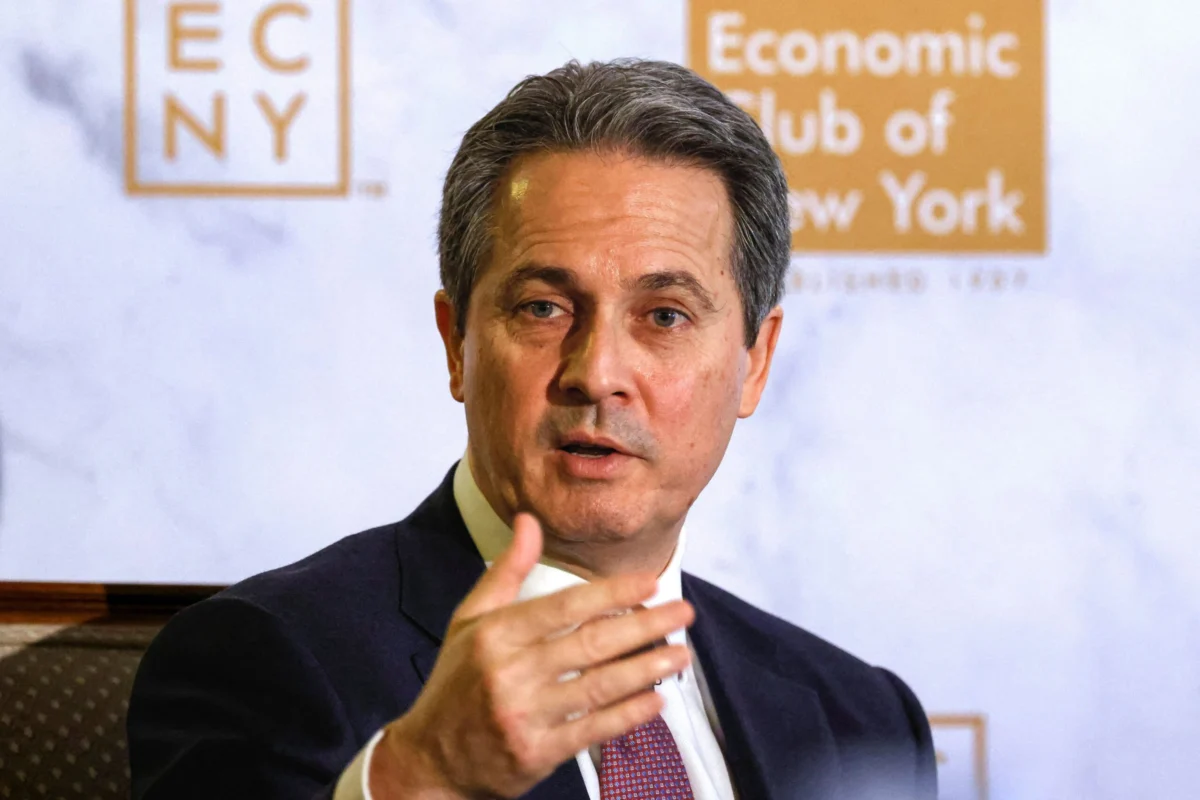
Despite the Federal Reserve’s decision on Wednesday, October 28, 2026, to hold its benchmark interest rate steady, two influential regional Fed presidents indicated Friday that the central bank’s tightening cycle is far from over, emphasizing the persistent need to quell elevated inflation. The remarks from Alberto Musalem, President and CEO of the Federal Reserve Bank of St. Louis, and Lorie Logan, President of the Federal Reserve Bank of Dallas, provided the first substantive insights into the central bank’s forward path post-pause, strongly suggesting a return to rate hikes as early as December.
A Unified Message for Further Tightening
Speaking to the Economic Club of New York, and later to the Shadow Open Market Committee, St. Louis Fed President Alberto Musalem underscored the urgency for further monetary policy tightening. "I judge that additional firming of monetary policy will be necessary, and soon," Musalem stated in his prepared remarks. His rationale centered on the principle that "incremental adjustments made earlier are usually less disruptive than larger and abrupt actions taken later." Musalem articulated a strategic approach, suggesting that "moving sooner in smaller steps while inflation expectations are anchored has a better chance of succeeding without adverse impact on the labor market or economic growth." This proactive stance signals a preference for preemptive, measured action over reactive, aggressive interventions, aiming to guide the economy toward price stability with minimal collateral damage.
Roughly an hour later, Dallas Fed President Lorie Logan echoed a similar sentiment, providing a more specific forecast for the path ahead. Addressing students at Davidson College in North Carolina, Logan asserted, "It remains clear to me, given the current outlook, that the FOMC needs to implement at least two more 25-basis-point rate increases." Logan, a voting member of the Federal Open Market Committee (FOMC) for the December decision, emphasized that while the destination is clear, the path doesn’t necessitate hikes at every meeting. "Skipping a meeting does not change the monetary policy destination," she explained. "Indeed, by making the destination clear, the FOMC can better help the economy adapt and obtain the promised benefits of a skip." She further suggested that after these two anticipated hikes, a pause would be prudent "to pause and examine economic and financial developments to determine what further action may be appropriate." This phased approach suggests a strategic calibration, using pauses not as a definitive end to tightening, but as opportunities for data assessment.
Market Expectations Solidify Ahead of December Meeting
The synchronized hawkish commentary from Musalem and Logan immediately resonated across financial markets, reinforcing investor expectations for a resumption of rate hikes. Fed funds futures traders, leveraging tools like CME’s FedWatch, rapidly adjusted their probabilities. Following their remarks, the likelihood of the Fed lifting rates by a quarter percentage point (25 basis points) at its December 2026 gathering surged to approximately 76%. This significant shift reflects the market’s interpretation that the central bank’s leadership remains committed to its inflation-fighting mandate, even in the face of recent robust economic data. The October pause, therefore, appears to be a tactical maneuver rather than a signal of a definitive end to the tightening cycle, offering the FOMC flexibility to assess incoming data without prematurely declaring victory over inflation.
The Economic Landscape: Resilience Amidst Persistent Inflation
Musalem’s positive assessment of the U.S. economy provided a crucial backdrop to his call for further tightening. He described the economy as "resilient," citing Thursday’s release of U.S. GDP data, which revealed a stronger-than-expected annualized growth rate of 3.4%. This robust growth, exceeding many economists’ forecasts, was attributed to several factors, including the ongoing artificial intelligence buildout, resilient consumer spending, and financial conditions that, despite a series of rate hikes, "remain accommodative." The concept of "accommodative financial conditions" implies that borrowing costs for consumers and businesses have not tightened sufficiently to significantly restrain economic activity, partly due to strong corporate earnings, robust equity markets, and relatively stable credit spreads.
The labor market also garnered praise from Musalem, who characterized it as "remarkably stable and balanced." He pointed to an unemployment rate of 4.2%, which sits precisely at the median of long-run projections made by FOMC participants. This suggests the labor market is operating near its full employment potential without showing overt signs of overheating or excessive slack. However, the strong labor market, while positive for economic stability, also contributes to wage pressures, which can feed into inflationary trends.
Despite these positive indicators, Musalem issued a stark warning: inflation remains "too high." He referenced the personal consumption expenditures (PCE) price index, the Fed’s preferred inflation gauge, released Thursday, which showed annual inflation persisting above 3%. While a notable decrease from its peak, this figure remains significantly above the central bank’s long-term target of 2%. In the subsequent question-and-answer session, Musalem emphasized his close monitoring of core inflation – which strips out volatile food and energy prices – and his vigilance for any signs that current inflationary pressures might be broadening out across the economy.

The Fed has consistently underscored the critical importance of anchoring inflation expectations. Officials closely track surveys of consumers and investors to ensure that expectations for future inflation do not drift too far above the 2% target. Musalem highlighted a plausible scenario where inflation could remain stubbornly above 2% indefinitely unless the Fed takes decisive action to adjust monetary policy. His core argument reinforced the central bank’s mandate: "The best that monetary policy can do now for employment and economic growth is to restore price stability in a timely manner." He added, "The short-run economic costs of reducing inflation are less when the central bank acts before inflation has become entrenched and is expected to persist." This philosophy underpins the Fed’s proactive approach, seeking to nip inflationary spirals in the bud to avoid more painful economic adjustments down the line.
The October Pause and Dissenting Voices
The FOMC’s decision on Wednesday, October 28, 2026, to leave the federal funds rate unchanged at a range of 5.50%-5.75% marked a temporary halt after a cumulative 525 basis points of tightening since March 2022. This pause followed a quarter-point hike in September 2026, which itself was the first increase to borrowing costs since mid-2023. While the majority of the 12 voting members agreed on the pause, it was not a unanimous decision. Two prominent voices dissented: Governor Lisa Cook and Cleveland Fed President Beth Hammack. Both officials advocated for an immediate quarter-point rate increase, signaling their belief that inflationary pressures still warranted further tightening without delay. Their dissent highlights the ongoing internal debate within the FOMC regarding the appropriate pace and extent of monetary policy adjustments in a dynamic economic environment.
Strategic Debates: Meeting Structures and Urgency
The discourse extended beyond the immediate rate path, touching upon the strategic architecture of FOMC meetings. Federal Reserve Chairman Kevin Warsh had announced a plan to dedicate certain Fed meetings in 2027 (one meeting) and 2028 (two meetings) to broader strategy discussions, rather than live interest rate decisions or Fed statements. This proposal, intended to allow for deeper policy deliberation, sparked varied reactions among current and former officials.
Former St. Louis Fed President James Bullard voiced strong reservations about Warsh’s initiative. Speaking to CNBC, Bullard stated, "I don’t think skipping a meeting is a good idea." He argued that in a "pretty volatile world," the inability to act at scheduled meetings could necessitate calling special, unscheduled meetings, thereby undermining the intended efficiency. This perspective underscores the importance of operational flexibility for a central bank operating in an unpredictable global economic landscape.
Conversely, former Richmond Fed President Jeffrey Lacker, also speaking on CNBC, expressed a broader concern about the Fed’s perceived "lack of urgency" in combating inflation. Lacker, who would have favored a rate hike in the preceding week, noted, "Inflation’s been high around three, three-and-a-half percent for so long." He mused, "Maybe they’ll come around in the next couple of meetings, but I’ve been surprised at the lack of urgency." Interestingly, Lacker offered a counter-intuitive recommendation to Chairman Warsh regarding meeting frequency: "If you want to take the pressure off individual meetings, have more of them." His argument implies that more frequent, smaller adjustments could be less disruptive and provide greater agility than fewer, higher-stakes meetings.
Broader Implications and the Path Ahead
The unified hawkish signal from Musalem and Logan suggests a resolute commitment from the Federal Reserve to achieve its 2% inflation target, even if it means maintaining a tighter monetary policy for longer than some market participants initially hoped. The implications of this sustained tightening are multifaceted. For consumers, it translates to higher borrowing costs for mortgages, auto loans, and credit card debt, potentially tempering demand. Businesses may face increased costs for capital, influencing investment decisions and hiring plans.
The Fed’s current challenge lies in engineering a "soft landing"—cooling inflation without triggering a severe economic downturn. The robust GDP growth and stable labor market provide some buffer, but the risk of over-tightening remains a persistent concern. The central bank’s communication strategy will be paramount in managing market expectations and guiding economic agents through this period of adjustment. By clearly articulating its intentions, even when skipping a meeting, the Fed aims to minimize volatility and allow the economy to adapt more smoothly to the desired policy trajectory.
As the calendar turns towards the December FOMC meeting, all eyes will be on incoming economic data—particularly on inflation, employment, and consumer spending—to validate or challenge the need for further rate hikes. The divergent views among officials, particularly on the pace and structure of future decisions, underscore the complexity of monetary policy in an evolving economic environment. What remains clear is that the battle against inflation is far from over, and the Federal Reserve stands ready to continue its fight until price stability is definitively restored.

