
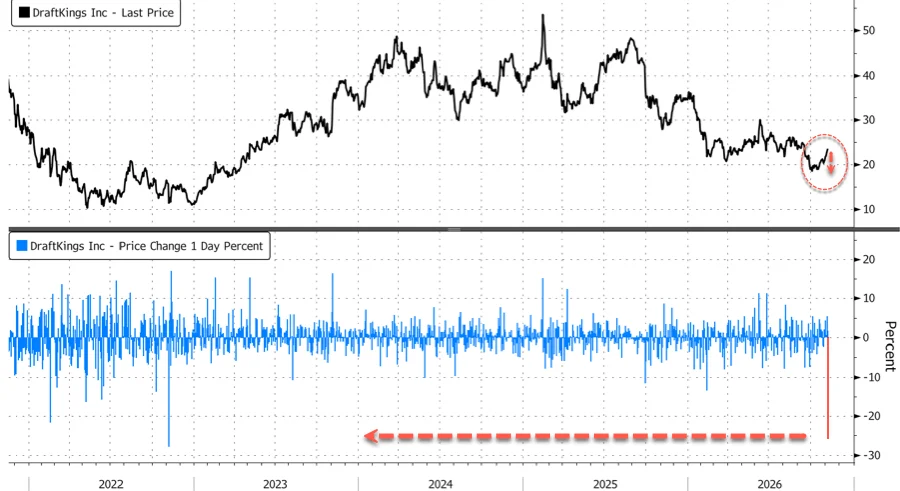
DraftKings (NASDAQ: DKNG) shares experienced a precipitous decline of 24.5% in Friday’s premarket trading, a stark market reaction following the sports betting and iGaming operator’s announcement that it had drastically revised the midpoint of its 2026 adjusted EBITDA forecast from an ambitious $800 million down to a mere $225 million. This dramatic downward adjustment, primarily attributed to an accelerated and substantial investment in the burgeoning prediction markets, overshadowed an otherwise robust 16% year-over-year increase in third-quarter revenue, which reached $1.33 billion. The market’s immediate focus clearly centered on the revised profitability outlook and the strategic pivot that entails significant near-term financial commitment and potential regulatory complexities.
A Deep Dive into DraftKings’ Q3 Performance and Revised Outlook
The third quarter of 202X saw DraftKings report revenue of $1.33 billion, a commendable 16% increase from the prior year, demonstrating continued top-line growth in its core online sports betting (OSB) and iGaming segments. However, this figure slightly missed analyst expectations, with BofA Securities anticipating $1.345 billion and the broader Street consensus at $1.393 billion. More critically, the company’s adjusted EBITDA for the quarter came in at a loss of $316 million, significantly wider than BofA’s forecast of a $100 million loss and the Street’s $66 million loss. This performance set the stage for the subsequent downward revision of future guidance.
The cornerstone of the market’s negative reaction was the revised 2026 adjusted EBITDA forecast. The reduction of $575 million from the previous midpoint of $800 million to the new $225 million signals a fundamental shift in the company’s near-to-medium term financial trajectory. BofA Securities gaming analyst Julie Hoover provided a critical breakdown of this cut, attributing a substantial $475 million directly to "incremental prediction market (PM) investment." The remaining $100 million of the guidance reduction was attributed to a lower adjusted EBITDA forecast for the company’s core business, suggesting a more challenging competitive or operational environment than previously anticipated even outside of the new strategic focus.
Looking further ahead, DraftKings provided initial guidance for 2027, projecting adjusted EBITDA in the range of $800 million to $1 billion. This forecast, however, explicitly includes a significant $300 million in anticipated EBITDA losses related to the prediction markets segment, highlighting the expected ramp-up period for this new venture. This aggressive investment strategy suggests that DraftKings is prioritizing market share and long-term growth in prediction markets over immediate profitability, a move that carries both substantial potential and considerable risk.
The "Mad Dash" into Prediction Markets: Strategy and Investment
DraftKings’ aggressive foray into prediction markets has been swift and impactful. CEO Jason Robins articulated the company’s rapid ascent in this emerging sector, stating in a letter to shareholders, "In just a few months, we have become the clear number three Predictions exchange by Total Volume." This rapid market penetration underscores the company’s agility and commitment to seizing new opportunities.

Prediction markets are platforms where participants can wager on the outcome of future events, ranging from sports results and political elections to economic indicators and entertainment awards. Unlike traditional sports betting, which typically involves fixed odds offered by a bookmaker, prediction markets often operate more like exchanges, allowing users to buy and sell "shares" in potential outcomes, with prices fluctuating based on collective sentiment. DraftKings’ entry into this space represents a strategic diversification, leveraging its existing user base, technological infrastructure, and expertise in managing complex betting ecosystems.
The financial commitment to this new segment is substantial. DraftKings’ 2027 guidance for prediction markets alone projects $700 million in net revenue and $500 million in gross profit. However, the operating expenses for this segment are expected to rise significantly, reaching approximately $800 million from about $675 million in the current year. Julie Hoover’s analysis sheds further light on this expenditure, estimating that higher fixed costs account for approximately $50 million of that increase, with an additional $75 million earmarked for marketing. The increased marketing spend, while perhaps surprising given its magnitude, signals DraftKings’ intent to aggressively capture market share and establish brand dominance in this nascent sector. Interestingly, a projected high-single-digit decline in core marketing suggests a potential reallocation of marketing dollars across the company’s various business lines, with resources shifting towards the high-growth prediction market initiative. Given DraftKings’ rapid capture of prediction-market share and the market’s inherent rapid expansion potential, Hoover also posited that the initial revenue forecast for this segment could prove conservative, implying a higher upside if growth continues apace.
The strategic rationale behind this "mad dash" appears multi-faceted. Firstly, it represents an effort to diversify revenue streams beyond traditional sports betting and iGaming, which are subject to intense competition and evolving regulatory landscapes. Secondly, prediction markets could potentially tap into a broader audience beyond conventional sports bettors, appealing to individuals interested in current events, finance, and data-driven forecasting. Thirdly, establishing an early leadership position in a nascent market could confer significant long-term competitive advantages, including brand recognition, network effects, and data accumulation. However, this aggressive expansion comes with considerable financial outlay and an uncertain return on investment, particularly given the inherent risks.
Navigating the Regulatory Minefield: A Key Concern
One of the most significant concerns highlighted by analysts, and a major factor in the market’s negative reaction, is the "looming regulatory risk around sports event contracts" within prediction markets. The regulatory environment for online gambling in the United States is notoriously complex, characterized by a patchwork of state-by-state laws governing sports betting, iGaming, and daily fantasy sports. Prediction markets, particularly those involving sports events, introduce a new layer of ambiguity.
Regulators, lawmakers, and even some consumer advocacy groups have expressed concerns about how prediction markets should be classified and governed. Are they a form of gambling, similar to sports betting, and thus subject to state gaming commissions? Or do they more closely resemble financial instruments, falling under the purview of federal agencies like the Commodity Futures Trading Commission (CFTC)? The distinction is crucial, as it determines which regulatory body has jurisdiction, what licenses are required, and what operational standards must be met.
The current lack of clear, uniform regulation for prediction markets creates both opportunity and risk. For companies like DraftKings, it allows for rapid innovation and market entry without immediate stringent oversight. However, it also exposes them to the possibility of future regulatory crackdowns, adverse rulings, or the imposition of costly compliance requirements that could significantly impact profitability and operational models. States could decide to ban certain types of prediction markets, impose high taxes, or require extensive consumer protection measures that are currently not in place. The experience of daily fantasy sports (DFS) a few years ago, which faced significant legal challenges and reclassification in many states, serves as a cautionary tale for operators in new, unregulated gaming segments.
The BofA analyst’s emphasis on "greater guardrails around spend, particularly in the current regulatory backdrop," underscores the market’s apprehension. Investors are wary of substantial capital commitments to a segment where the long-term legal and operational framework remains uncertain. DraftKings’ desire to be "best-in-class" has historically driven its top-line success, but in this context, it also implies a willingness to take on significant regulatory risk. The eventual clarity (or lack thereof) from federal and state authorities will be a critical determinant of the long-term viability and profitability of DraftKings’ prediction market investments.

Core Business Resilience and Strategic Adjustments
Despite the significant pivot towards prediction markets, DraftKings continues to invest in and refine its core online sports betting and iGaming businesses. The company is allocating approximately $40 million this year to bolster its iGaming offerings, a strategic move aimed at supporting longer-term growth in this competitive segment. This renewed investment comes after two years of observed market-share losses in iGaming, suggesting a proactive effort to regain competitive ground.
Third-quarter iGaming revenue growth of 2% fell below BofA’s 8% forecast, primarily due to increased promotional activity. This indicates a challenging and highly promotional environment where operators are heavily investing in customer acquisition and retention, often at the expense of immediate profitability. The company’s decision to increase investment in iGaming, even amidst this competitive landscape, appears sensible given its prior market share erosion.
For 2027, DraftKings’ core business outlook assumes a 6% revenue growth rate, with iGaming expected to expand faster than online sports betting. This projection highlights the company’s belief in the long-term potential of the iGaming segment, even as it continues to mature. However, the guidance also implies that 75% of incremental core revenue will translate into EBITDA, an assumption that BofA analysts deemed "ambitious" given the persistently competitive promotional environment. This ambitious conversion rate suggests DraftKings expects to achieve significant operating leverage or a moderation in promotional intensity, which may be challenging in a market still characterized by aggressive customer acquisition efforts. The interplay of marketing spending between the core business and prediction markets will be crucial to monitor, as resources are likely being dynamically reallocated to maximize overall company growth.
Wall Street’s Mixed Reactions and Forward Outlook
The significant reset in DraftKings’ financial outlook elicited varied, though largely cautious, responses from Wall Street analysts. While the immediate market reaction was a sharp sell-off, many analysts maintained their long-term optimism, albeit with adjusted price targets.
BofA Securities, while acknowledging the "bigger-than-expected 2027 numbers reset" and investor disappointment regarding prediction market investment and regulatory risk, reiterated its "Buy" rating. However, it lowered its price objective to $23, down from a previous higher target, basing it on 14x 2027E EBITDA (and 11x core 2027E EBITDA). This signals that while the firm still sees long-term value, the near-term path to profitability is more challenging, and the valuation multiple has been adjusted to reflect increased risk and lower near-term earnings. BofA still views prediction markets as a "potential source of upside," implying that successful navigation of regulatory hurdles and market adoption could eventually reward investors.
Other prominent firms also weighed in:

- Morgan Stanley maintained its "overweight" rating with a price target of $31, suggesting a belief in DraftKings’ long-term growth trajectory despite the immediate headwinds.
- CFRA also reiterated a "buy" rating, setting a price target of $40, indicating a more bullish outlook on the company’s ability to execute its strategy and grow profitability.
- Vital Knowledge offered its perspective, which, while not detailed in the provided excerpt, likely contributed to the broader analyst sentiment.
According to Bloomberg data, the overall consensus among analysts remains predominantly positive, with 31 analysts rating DraftKings a "Buy," eight rating it "Neutral," and only one issuing a "Sell" recommendation. The consensus 12-month price target stands at approximately $32.25. This divergence between the immediate market sell-off and the generally positive, albeit adjusted, analyst sentiment highlights the tension between short-term market volatility driven by guidance revisions and long-term investment theses focused on strategic growth and market potential. Investors are grappling with the trade-off between accelerated growth in a new, risky segment and deferred profitability, while analysts, after recalibrating their models, often take a longer view on the company’s strategic evolution.
Broader Implications and Future Trajectory
DraftKings’ aggressive move into prediction markets and the subsequent downward revision of its profitability forecast represents a critical juncture for the company and potentially for the broader online gaming industry. This strategic pivot reflects a bet on the future of interactive entertainment and the increasing convergence of gaming, finance, and information.
For DraftKings, the implications are profound. It is committing substantial capital and resources to establish a leadership position in a nascent market, a move that could either unlock immense long-term value or prove to be an expensive misstep if regulatory challenges intensify or market adoption lags. The coming years will be crucial in determining if the "mad dash" pays off, transforming DraftKings into a diversified entertainment and betting powerhouse, or if it stretches the company’s resources and delays its path to sustainable profitability.
The company’s ability to manage investor expectations while executing this ambitious strategy will be paramount. Clear communication regarding the progress of prediction markets, coupled with prudent financial management and a proactive approach to regulatory engagement, will be essential to rebuilding investor confidence. The challenge lies in demonstrating that the significant near-term investment will yield substantial, defensible long-term returns, particularly in a landscape where profitability has been a consistent investor demand.
Furthermore, DraftKings’ strategy could influence its competitors. If the prediction market venture proves successful, other online betting operators may follow suit, intensifying competition in this emerging sector. Conversely, if DraftKings encounters significant hurdles, it could deter others from making similar investments, shaping the competitive landscape for years to come. The success or failure of this bold strategic move will not only dictate DraftKings’ future but could also serve as a barometer for innovation and risk-taking within the dynamic and ever-evolving online gambling industry.

