
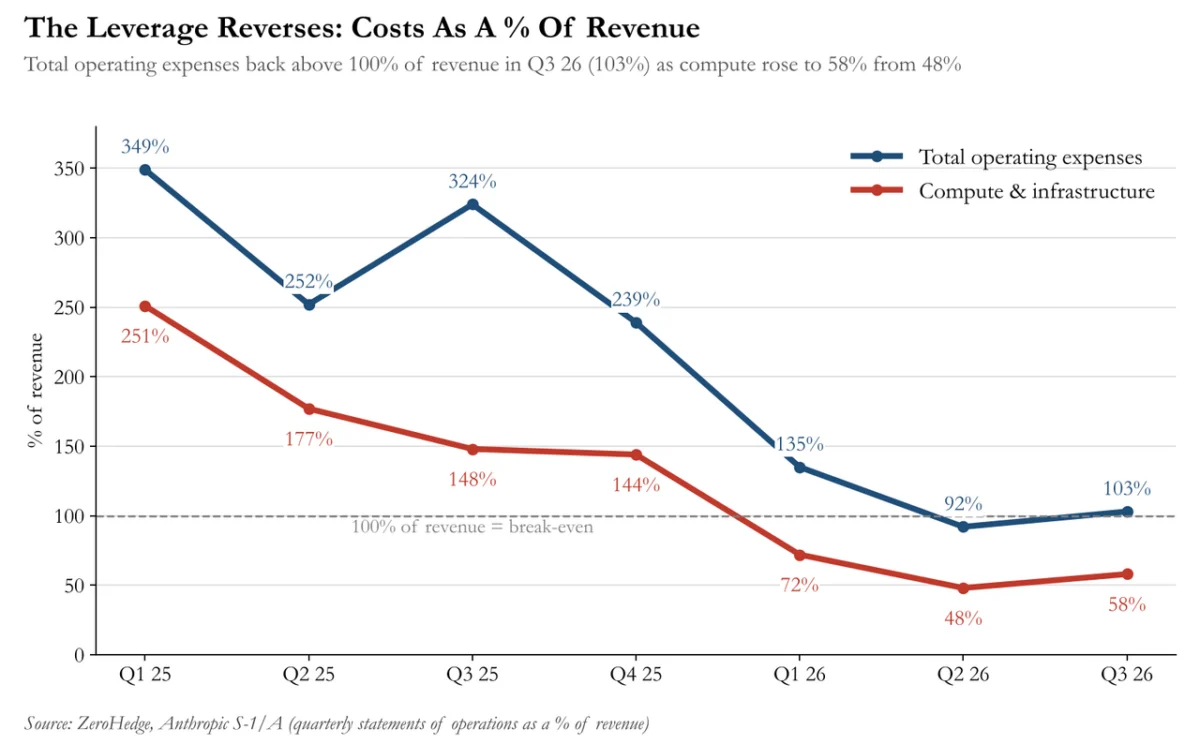
The highly anticipated Q3 financial update from Anthropic, revealed through Amendment No. 1 to its S-1 filing, paints a complex picture of a rapidly growing artificial intelligence powerhouse grappling with immense operational costs and an escalating compute infrastructure bill that now officially exceeds one trillion dollars. While revenue continues its steep ascent, the company has reported a swift return to an operating loss, just one quarter after achieving a fleeting period of profitability, raising significant questions about its financial sustainability and the urgency behind its impending initial public offering (IPO).
Anthropic’s Ascent and the High-Stakes AI Race
Anthropic, a prominent player in the generative AI landscape and creator of the Claude large language models, has been at the forefront of the intense competition to develop and deploy advanced AI. Founded by former OpenAI researchers, the company has attracted substantial investment, positioning itself as a key rival in a sector characterized by exponential growth, technological breakthroughs, and an insatiable demand for computational power. Its S-1 filing, a mandatory step for companies seeking to go public, offers an unprecedented look into the economics of operating at the frontier of AI development.
Last week, initial disclosures from the S-1 filing had already highlighted the sheer scale of Anthropic’s planned compute infrastructure investments, hinting at commitments stretching into the hundreds of billions of dollars. These initial figures underscored the capital-intensive nature of the AI arms race, where access to cutting-edge GPUs and specialized data centers is paramount. The Q2 financials, initially presented, showed a remarkable albeit narrow GAAP operating profit of $974 million, leading some observers to question its durability given the company’s aggressive investment strategy. The latest update, however, confirms that this profitability was indeed short-lived, with Q3 marking a significant reversal.
Q3 Financial Snapshot: A Reversal of Fortunes
For the three months ended September 30, 2026, Anthropic reported revenues of $16.96 billion. This figure, a slight increase from the $16.8 billion projected by management at its investor day, represents a staggering 1,127% year-over-year growth and a robust 47% quarter-over-quarter increase. While impressive, this growth rate marks a deceleration from the 144% quarter-over-quarter growth recorded in Q2, indicating a natural tapering as the company scales. A notable detail within the S-1/A filing further complicates the revenue narrative: approximately $600 million of the Q3 revenue growth was "partially offset by a decrease from price reductions introduced as part of new model versions and contractual discounts." This suggests that even as demand grows, competitive pressures or strategic market positioning are leading to downward adjustments in pricing, adding another layer of challenge to maintaining revenue momentum.
Despite the strong top-line growth, the bottom line suffered a significant setback. The $974 million GAAP operating profit achieved in Q2 evaporated, replaced by a GAAP operating loss of $567 million in Q3. Total operating expenses surged to $17.5 billion, a substantial increase from $4.47 billion year-over-year. This reversal underscores the immense operational costs associated with developing and deploying advanced AI, particularly the escalating expenditure on computational resources.
The Compute Conundrum: A $5 Billion Rush Order
The primary driver behind the return to an operating loss was a dramatic surge in compute and infrastructure expenses, which jumped 77% quarter-over-quarter to $9.9 billion. This figure now accounts for 58% of revenue, up from 48% in Q2, indicating that compute costs are growing significantly faster than revenue. A critical component of this surge was $5.0 billion of compute procured under short-term commitments. The S-1/A explicitly states that this short-term compute costs "significantly more than comparable compute procured under our multi-year commitments."
This revelation offers crucial insight into the current state of the AI infrastructure market. Anthropic typically procures compute 12 to 18 months in advance, suggesting that these costs are generally fixed in the near term. The need for a $5 billion "rush order" implies that actual demand for Anthropic’s services outstripped its pre-planned long-term capacity, forcing the company to acquire additional compute at premium spot-market rates. This is strong evidence of genuine scarcity in high-performance AI compute resources, highlighting the immense pressure on companies to secure capacity at any cost to meet burgeoning demand and maintain competitive edge. Essentially, half of Anthropic’s Q3 compute bill was incurred at elevated, non-contractual prices.
This dynamic directly impacted a key metric closely watched by analysts: the revenue generated per dollar of compute and infrastructure expense. In Q3, this ratio declined for the first time, dropping to $1.72 from $2.08 in Q2. This downward trend signals that the efficiency of converting compute investment into revenue is decreasing, a worrying sign unless revenue growth can accelerate sufficiently to offset rising costs. While the arrival of long-term contracted capacity from deals like SpaceXAI (estimated at $9.3 billion per quarter once fully delivered in December) and Microsoft ($44.9 billion starting this month) is expected to reduce the reliance on pricey short-term compute, there is a risk that if demand continues to outstrip even these massive long-term commitments, Q4 compute expenses could make Q3 look modest by comparison.
The Trillion-Dollar Tab: Unpacking Compute Commitments
Perhaps the most startling disclosure in the S-1/A is the official quantification of Anthropic’s aggregate compute and infrastructure commitments. Two weeks prior, analysts had estimated this figure based on named deals, arriving at a range of $637 billion to $810 billion. The amendment now fills in the blank, stating that as of (and subsequent to) September 30, Anthropic has entered into purchase commitments and leases "with an aggregate committed spend of approximately $895.4 billion," almost entirely related to compute and infrastructure.
This staggering sum alone positions Anthropic’s commitments as among the largest globally, with few companies outside of a handful of tech giants like Google holding comparable long-term obligations. The filing further clarifies that this $895.4 billion figure excludes deals "that do not specify a fixed dollar commitment," which Anthropic "currently estimate[s] such payments to be approximately $150 billion to $175 billion." These additional commitments align with previously reported deals such as an extra Google TPU tranche ($125-150 billion, spanning 2028-2031) and AMD’s Helios deal (over $20 billion). When these estimated variable commitments are added to the fixed $895.4 billion, Anthropic’s total compute tab comes to an astonishing approximately $1.05 trillion to $1.07 trillion – unequivocally more than one trillion dollars.
The S-1/A breaks down the fixed $895.4 billion, confirming several previously identified major agreements:
- Google: At least approximately $121.3 billion for hosting commitments from April 2026 to July 2033, an increase from the $114.5 billion in the original S-1. This commitment is "regardless of actual usage," with a true-up mechanism if Anthropic underspends.
- Broadcom: $161.2 billion for TPU lease rent.
- SpaceXAI: Up to $120.5 billion.
- Amazon: At least $110 billion.
- Microsoft: $44.9 billion.
- Nscale: $44.6 billion.
- Lambda: $41.3 billion.
These seven counterparties alone account for approximately $644 billion of the total, underscoring the deep and extensive relationships Anthropic has forged with leading hardware manufacturers and cloud providers.
Near-Term Pressures: $70 Billion Due in 12 Months
While the trillion-dollar figure represents a long-term commitment, the immediate financial implications are equally pressing. The S-1/A states that approximately $69.8 billion of these commitments are due within the 12 months following September 30. This near-term obligation is critical. It exceeds Anthropic’s entire Q3 annualized revenue run rate of $67.8 billion and represents more than half of the company’s $131.8 billion cash, equivalents, and short-term investments as of September 30. Furthermore, it is roughly 11 times the $6.6 billion in operating cash flow Anthropic generated in the first nine months of the year, with only about $2.7 billion of that coming in Q3.
This stark comparison highlights a profound liquidity challenge: Anthropic’s committed compute bill for the next year alone surpasses its entire current annual revenue, even before factoring in employee salaries, R&D, and other operational costs. While Anthropic’s revenue has grown at an extraordinary pace (45x over the last seven quarters), the recent deceleration to 47% quarter-over-quarter, coupled with the introduction of price cuts, suggests that the margin for error in outrunning these escalating costs is rapidly shrinking. A significant portion of the anticipated IPO proceeds is already earmarked for tax withholding on RSU settlements, further constraining available capital for operational expenditures.
Strategic Maneuvers and Financial Instruments
The S-1/A does offer some potential "escape hatches" for a portion of these commitments. Approximately $213.8 billion (24% of the total) "relates to arrangements that are subject to either exercisable termination rights or contingent conditions prior to commencement, such as the counterparty’s ability to secure financing, facilities, or regulatory approvals." However, only $4.3 billion of the critical $69.8 billion due in the next 12 months falls under these flexible terms.
Scrutiny of who holds these contingencies reveals a complex interdependence. For instance, Lambda’s August deal ($34.9 billion of its $41.3 billion commitment) can be terminated if Lambda fails to "timely secure the facility lease." Nscale’s commitment is contingent on its "best efforts to obtain qualifying financing for the NVIDIA GPUs and data center infrastructure." This means that Anthropic’s flexibility is often tied to its partners’ ability to secure their own financing and infrastructure. Should the broader AI credit market tighten, or if neo-cloud providers face difficulties in securing capital (as hinted by CoreWeave CDS spreads), Anthropic’s obligations might shrink, but so would its vital compute supply. This effectively acts as a counter-intuitive hedge that reduces compute access precisely when it might be most needed.
The filing also provides more granular detail on the vendor financing arrangements designed to support these commitments. Broadcom, for example, offers a $42 billion note facility specifically to finance quarterly rent payments on its leases. This facility carries a 9% interest rate paid in kind (PIK), convertible at 90% of the 30-day volume-weighted average price (VWAP). Critically, if "certain revenue performance conditions are not met," new notes issued under this facility jump to a 13% PIK rate, convertible at 85% of the VWAP. Furthermore, in the event of a change of control, Broadcom can demand 150% of the principal. This "circular financing" mechanism, where a supplier effectively lends its customer money to pay for its own products, now comes with escalating penalty rates tied to Anthropic’s revenue performance, illustrating the leverage held by key hardware providers.
Google, another major partner, secures an option to purchase up to $10 billion of Anthropic stock in a concurrent private placement at the IPO price, alongside its existing $20 billion note facility. Share issuance under this facility is capped at 14.99% Google ownership. These arrangements underscore the intricate web of financial dependencies and strategic alignments required to fuel the AI compute arms race. Anthropic explicitly states that its total commitments are a floor, expecting to "continue to enter into additional arrangements to secure compute and infrastructure capacity," suggesting the trillion-dollar figure will only continue to grow.
Other Financial Dynamics: Donations, Stock Comp, and Net Loss
Beyond compute, other operating expenses also saw significant movement. A substantial $2.0 billion non-cash charge for Anthropic’s employee donation-matching program was recorded in Q3, a sharp increase from just $126 million for the entire first half of the year. This charge, representing 12% of Q3 revenue, pushed "other operating and administrative" expense to $3.6 billion (21% of revenue) from $1.0 billion in Q2. While reflecting a generous corporate social responsibility initiative, this non-cash expense significantly impacts GAAP profitability. Removing this and other adjustments, Anthropic’s "adjusted" operating income for the first nine months stands at $4.1 billion (a 12% margin), implying roughly $2.5 billion in Q3 alone against the GAAP loss of $567 million. This highlights how non-cash accounting items can dramatically alter the reported bottom line.
On a positive note, personnel expense actually decreased slightly to $1.7 billion from $1.9 billion, primarily due to the full vesting of certain option awards, leading to a drop in quarterly stock compensation to $1.1 billion from $1.3 billion. Sales, marketing, and partnerships also became more efficient, falling to 14% of revenue from 22% in Q1. This improvement is attributed to a decrease in revenue generated from channel partners as a percentage of total revenue and renegotiated distribution arrangements, suggesting Anthropic is either selling more directly or securing better terms from hyperscaler partners. However, the reprieve on stock compensation is temporary, as unrecognized stock-based compensation on RSUs still stands at $24.1 billion (plus $2.1 billion on other awards), much of which will hit the books once the S-1 goes effective.
Below the operating line, the Q3 net loss was a staggering $23.3 billion, with $21.9 billion primarily attributed to marking up convertible notes, derivatives, and SAFEs to fair value. This brings the nine-month net loss to an astounding $104.0 billion on $33.2 billion of revenue. The only significant offset was $1.2 billion in interest income from Anthropic’s substantial cash pile, which was more than double the operating loss. The balance sheet remained robust in terms of liquid assets, with cash, equivalents, and short-term investments at $131.8 billion, essentially flat from June. However, the accumulated deficit swelled to $156.2 billion, and total stockholders’ deficit grew to $149.9 billion, all underpinned by $157.5 billion of redeemable preferred stock.
The Path Ahead: IPO Imperative and Investor Scrutiny
The S-1/A amendment, while filling in critical financial blanks, notably still omits the price range and share count for the IPO. Based on a reported $1.5 trillion valuation that investors have reportedly settled on, Anthropic’s Q3 annualized run rate of $67.8 billion implies a valuation multiple of approximately 22 times revenue. This multiple, unchanged from earlier analyses, will be a key point of discussion for potential investors evaluating the company’s growth trajectory against its cost structure.
The sheer scale of Anthropic’s unfunded commitments has not gone unnoticed by financial observers. Ratings agencies, for instance, have already indicated skepticism about Anthropic securing an investment-grade rating post-IPO, with reports citing concerns over the "hundreds of billions in unfunded commitments."
The updated scorecard presents a challenging narrative: rapid revenue growth now accompanied by price cuts, compute costs outpacing revenue, a brief period of profitability quickly reversed, and an officially confirmed compute bill exceeding $1 trillion, with $70 billion due in the next 12 months—a figure that surpasses a full year’s revenue at current rates. These factors collectively strengthen the argument that Anthropic’s rush to go public is driven less by a position of unassailable financial strength and more by a critical need for capital to fund its monumental operational requirements. The IPO, therefore, becomes an imperative not just for liquidity, but for the very continuation of its ambitious AI development roadmap. Prospective IPO buyers and the broader credit markets will undoubtedly scrutinize these disclosures, seeking clarity on Anthropic’s long-term path to sustainable profitability and its ability to manage the unprecedented financial demands of the AI era.
Broader Industry Implications
Anthropic’s S-1/A provides a revealing glimpse into the economic realities of developing frontier AI. The escalating compute costs, the scarcity of advanced hardware, and the strategic importance of long-term infrastructure commitments underscore the immense capital intensity of this sector. The complex vendor financing arrangements, with their escalating interest rates and equity dilution clauses, highlight the financial leverage held by the suppliers of critical AI infrastructure. This dynamic could pose significant barriers to entry for smaller players and may lead to further consolidation in the AI industry, as only those with deep pockets or access to substantial capital markets can sustain the pace of investment required. Anthropic’s journey to public markets will serve as a crucial test case for the financial viability of independent AI powerhouses in a rapidly evolving, capital-hungry technological landscape.

