

Navigating the complexities of modern life often hinges on effective personal organization and robust productivity strategies. For individuals seeking to master their schedules, streamline their workflows, and achieve their aspirations, the bullet journal system has emerged as a highly adaptable and powerful tool. Far from being a mere notebook, a well-structured bullet journal, when populated with the right pages, can serve as a comprehensive command center for personal and professional growth. This article delves into seven essential planner bullet journal pages that form the bedrock of an organized and productive life, offering insights into their function, implementation, and the tangible benefits they provide.
The core premise of the bullet journal method, developed by Ryder Carroll, is to create a customizable system that can be tailored to individual needs. This flexibility is its greatest strength, allowing users to adapt it for everything from daily task management to long-term goal setting. By strategically incorporating specific page layouts, individuals can transform their journals from a collection of random notes into a dynamic planning and reflection tool. The following pages are crucial for establishing this effective system.

The Bullet Journal Key Page: Establishing the Language of Your System
At the heart of any functional bullet journal lies the Key page, often referred to as the legend. This is where you define the symbolic language that will guide your entries. Without a consistent key, the rapid logging method, a cornerstone of bullet journaling, loses its efficiency. The key acts as a universal translator for your thoughts, tasks, and events, ensuring clarity and quick comprehension at a glance.
Typical entries on a key page include:
- • (Dot): Represents a task. This is a fundamental building block for action items.
- ○ (Circle): Denotes an event. This category is reserved for scheduled occurrences, appointments, or significant happenings.
- – (Dash): Signifies a note. This is for general information, observations, or ideas that don’t necessarily require action.
Beyond these core symbols, the key can be expanded to include modifiers that add layers of detail and context:

- * (Asterisk): Often used to highlight important items, signifying priority or urgency.
- ! (Exclamation Mark): Can be designated for inspiration or significant insights, capturing moments of creativity or realization.
- > (Greater Than Symbol): Indicates a task that has been migrated to another day or list. This is crucial for tracking unfinished business.
- < (Less Than Symbol): Marks a task that has been scheduled for a future date or time.
- x (Cross): Represents a completed task. This visual confirmation of accomplishment is a powerful motivator.
The strategic placement of the key page, typically immediately following the cover page, ensures it is readily accessible. This constant visibility reinforces the system’s logic and encourages consistent application of the chosen symbols. Developing a simple, intuitive, and memorable key is paramount; it should resonate with the user’s personal style and workflow, fostering effortless navigation and efficient logging. Research in cognitive psychology suggests that consistent use of visual cues and categorization can significantly improve memory recall and task prioritization.
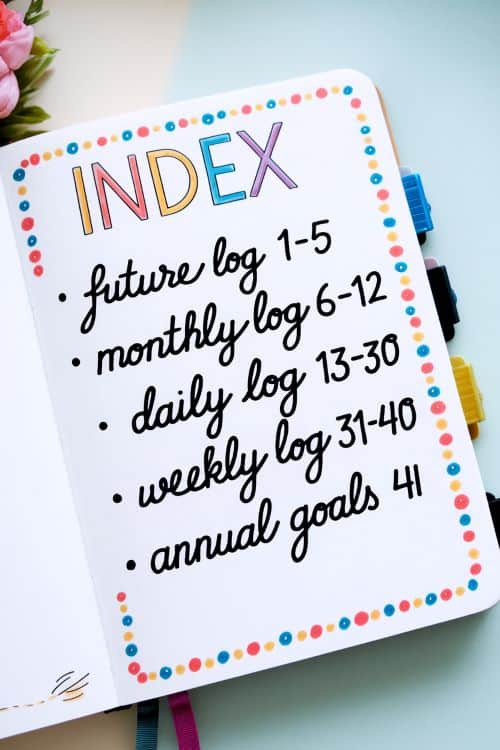
The Index: Your Journal’s Navigator
The Index serves as the vital table of contents for your bullet journal. In a system designed for flexibility, where new collections and logs can be created on any blank page, the index is indispensable for maintaining order and enabling quick retrieval of information. As you populate your journal, dedicating a few initial pages to the index allows you to log the title of each new section or spread along with its corresponding page number.
For instance, if you create a dedicated spread for "Project X Brainstorming" that spans pages 34 through 36, and a follow-up on page 38, your index entry would read: "Project X Brainstorming – pp. 34-36, 38." This simple yet powerful mechanism liberates you from the constraints of pre-formatted planners. You are free to use the next available blank page for a new entry, confident that the index will guide you back to it when needed. This approach aligns with principles of efficient information management, ensuring that data is not lost and can be accessed with minimal effort. The ability to quickly locate past entries also facilitates review and builds upon previous progress, a critical component of sustained productivity.

The Future Log: Charting the Horizon
The Future Log is the strategic foresight component of your bullet journal, providing a bird’s-eye view of upcoming events, deadlines, and significant milestones in the months ahead. This spread typically occupies several pages at the beginning of the journal, allowing for a review of at least three to six months into the future, though some users opt for a full year.
When setting up your Future Log, divide the allocated pages into sections representing future months. As significant dates arise – be it a birthday, a critical work deadline, an upcoming holiday, or a planned vacation – jot them down in the corresponding month’s section. This log acts as a proactive reminder system, preventing oversights and allowing for better long-term planning. It is the ideal place to capture commitments that fall outside the current monthly or weekly view, ensuring that no important future event slips through the cracks. The practice of forward-looking planning has been shown to reduce stress and increase a sense of control over one’s life, as individuals can anticipate and prepare for future demands.
The Monthly Log: Navigating the Present Month
The Monthly Log is a dedicated spread that encapsulates the current month, serving as both a calendar and a high-level task manager. It typically consists of two parts: a calendar view and a task list.
The calendar portion lists each day of the month, allowing you to quickly note appointments, events, and commitments as they occur or are confirmed. The key principle here is to record events retrospectively or as they are finalized, ensuring accuracy and preventing premature commitments. This method encourages a more realistic assessment of one’s availability and workload.
Adjacent to the calendar, a dedicated space is provided for monthly goals, key tasks, and overarching objectives for the month. This section acts as a roadmap, outlining what needs to be accomplished during the current period. By consolidating these elements onto a single spread, the Monthly Log provides a comprehensive overview of the month, enabling users to prioritize effectively and manage their time with greater intention. The effectiveness of monthly planning is often correlated with increased goal attainment rates. Studies by organizations like the Project Management Institute consistently highlight the importance of clear monthly objectives for project success.
The Daily Log: Capturing the Day’s Momentum
The Daily Log is the dynamic, granular engine of the bullet journal, designed for the day-to-day capture of tasks, events, and notes. This spread is characterized by its flexibility and adaptability, allowing users to record information as it arises throughout the day. Whether it’s a simple bulleted list of to-do items, a reminder of an important meeting, or a fleeting idea that needs to be captured, the Daily Log serves as a catch-all for the immediate present.

Users can approach the Daily Log with varying degrees of detail and artistic flair. Some prefer a minimalist approach, focusing solely on actionable items and key events, while others incorporate doodles, motivational quotes, or reflections on their day. The core function, however, remains the same: to provide a space for rapid logging of immediate information. This immediate capture is crucial for preventing forgotten tasks and ideas, thereby reducing mental clutter and enhancing cognitive load management. By documenting the day’s activities and commitments, individuals gain a clearer picture of their daily productivity and can identify patterns or potential bottlenecks. The practice of daily journaling, even in its most basic form, has been linked to improved self-awareness and emotional regulation.
The Weekly Log: Orchestrating the Week
The Weekly Log offers a mid-range perspective, providing a snapshot of the upcoming week. This spread is highly practical for individuals who prefer to plan and review their activities on a weekly basis, offering a balance between the broad overview of the Monthly Log and the granular detail of the Daily Log. A typical Weekly Log might span two pages, dedicating one page to daily planning and the other to reflections, habit tracking, or important notes for the week.
This layout allows for the allocation of specific tasks and appointments to each day, ensuring that the week’s objectives are broken down into manageable steps. It also provides a space to identify key priorities for each day, fostering focus and efficiency. For some, the second page might be reserved for reviewing completed tasks, noting achievements, or outlining intentions for the following week. Alternatively, a one-page Weekly Log can be employed, with reflections integrated into the Daily Logs. The weekly review, facilitated by this spread, is a critical practice for assessing progress, adjusting plans, and maintaining momentum toward larger goals. It allows for course correction and ensures that the week’s activities are aligned with monthly and long-term objectives. Organizations often conduct weekly team meetings for similar purposes of alignment and progress assessment.

The Annual Goals Tracker: Anchoring Long-Term Vision
The Annual Goals Tracker is a powerful tool for articulating and monitoring long-term aspirations. This dedicated spread within the bullet journal serves as a visual representation of your yearly objectives, broken down into actionable categories. Common categories include career development, health and fitness, personal growth, financial goals, and relationships.
The process of setting annual goals involves defining specific, measurable, achievable, relevant, and time-bound (SMART) objectives. The Annual Goals Tracker provides a space to write these down, alongside metrics for tracking progress. This could involve marking milestones achieved, noting completion percentages, or simply checking off completed steps. The act of physically writing down goals has been scientifically shown to increase the likelihood of their achievement by as much as 42 percent, according to research by Dr. Gail Matthews. Regularly referencing this page serves as a constant reminder of what matters most, fostering motivation and ensuring that daily and weekly efforts remain aligned with overarching aspirations. This page acts as the ultimate anchor, keeping your focus on the significant outcomes you aim to achieve over the course of the year, preventing short-term distractions from derailing long-term progress.
Optimizing Your Planning with the Best Bullet Journal Pages: A Holistic Approach
The power of the bullet journal system lies not just in its individual components but in their synergistic integration. By consistently utilizing these seven essential pages – the Key, Index, Future Log, Monthly Log, Daily Log, Weekly Log, and Annual Goals Tracker – individuals can construct a robust framework for organization and productivity. This framework transforms the journal into more than just a repository of information; it becomes a dynamic, adaptive partner in achieving personal and professional success.

The inherent flexibility of the bullet journal allows it to evolve alongside the user. As priorities shift and life circumstances change, the system can be readily modified to accommodate new needs. The key is to start with these foundational pages, experiment with layouts, and discover what works best for your unique workflow. Regular engagement with these spreads cultivates a habit of intentional planning, reflection, and action.
The cumulative effect of this practice is a significant reduction in mental clutter, leading to increased clarity, reduced stress, and enhanced productivity. By providing a centralized and customizable system for managing tasks, events, and goals, the bullet journal empowers individuals to take control of their time and energy, ultimately leading to a more organized, productive, and fulfilling life. The adoption of such planning methodologies is increasingly recognized in professional development circles as a critical skill for navigating the demands of the 21st-century landscape.

